All decks
Close
-

Copy of [Private] of A CSO's Strategy: Can we Resolve Eckerd's Funding Crisis in Two Quarters - Vincent Bish
This presentation outlines a feasible, data-driven strategy to navigate Eckerd's existential funding challenge. By reverse-engineering the crisis from public records, I've identified a novel approach that diverges from traditional consulting—one that leverages our unique position in ways MBB firms would likely miss. The core proposal: deploy former Job Corps participants as Medicaid navigators, powerfully aligning mission with revenue to generate $36 million in projected ARR. -Vincent H. Bish, Chief Strategy Officer Candidate www.vincentbish.com
-
[Private] of A CSO's Strategy: Can we Resolve Eckerd's Funding Crisis in Two Quarters - Vincent Bish
This presentation sets out a data-driven strategy to address Eckerd’s funding crisis with an innovative, mission-aligned solution. Drawing on public records analysis, the plan departs from conventional consulting approaches by positioning former Job Corps participants as Medicaid navigators: directly linking social impact with sustainable revenue. The proposed model projects $36M in annual recurring revenue while advancing Eckerd’s core mission. Vincent H. Bish www.vincentbish.com
-
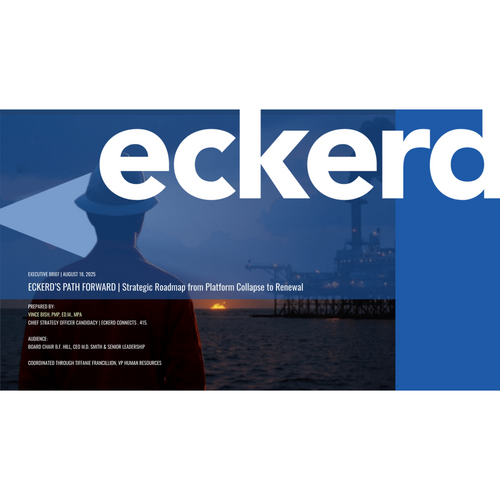
A CSO's Strategy: Resolving Eckerd's Funding Crisis in Two Quarters - Vincent Bish
This presentation, submitted by Vincent Bish for the Chief Strategy Officer role, outlines a both feasible and data-driven strategy to navigate Eckerd's existential funding challenge. Core Insight: By reverse-engineering the crisis from public records, I've developed a novel strategy that diverges from traditional consulting approaches that associate partners and social impact practice managers from MBB will miss, and if they don't are unlikely to deliver without a certain angle of vision. (see slides 7-9). Key Proposal: Train and deploy former Job Corps participants as Medicaid navigators: a solution that powerfully aligns mission with revenue. Financial Impact: This initiative is projected to generate $36 million in new Annual Recurring Revenue (ARR). - Vincent H. Bish www.vincentbish.com
-
Documenting the Path to Open Source: Community-Driven Development of an ASR System for Jamaican Patois (Patois.ai)
My project, Patois.ai, aims to address the linguistic exclusion of Jamaican Patois in the world of artificial intelligence and automatic speech recognition technology. This exclusion has profound implications for the justice, equity, and inclusion of Patois speakers in the digital world. By documenting the process of building an ASR system for Jamaican Patois and sharing it openly through the NVIDIA NeMo open-source community, Patois.ai contributes to the advancement of inclusive AI technology and paves the way for other marginalized languages to join the digital conversation. Additionally, the project raises important legal questions surrounding data collection, model training, and intellectual property rights, contributing to the vital dialogue on responsible AI development and governance. Dr. Shieber's expertise in computational linguistics, open access, and ethics aligns strongly with my project's aims. His research on ASR and ethical AI development can provide valuable guidance and collaboration opportunities.
-
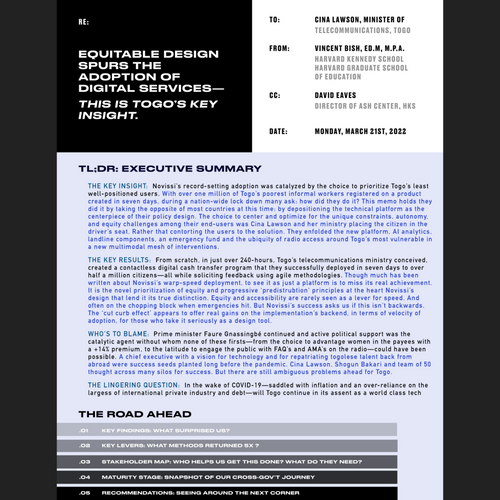
DPI 671M: Disrupting Bureaucracy: Grasping Digital Government
In just over 240-hours, Togo—a small country in Western Africa —conceived and created a contactless digital cash transfer program during the first month of the pandemic. This memo was created for the Telecommunications minister as a case study exploring how equitable design, agile methodologies, and the "cut curb effect" came together to aid Togo in deploying a world class digital response to the pandemic in just seven days.
-
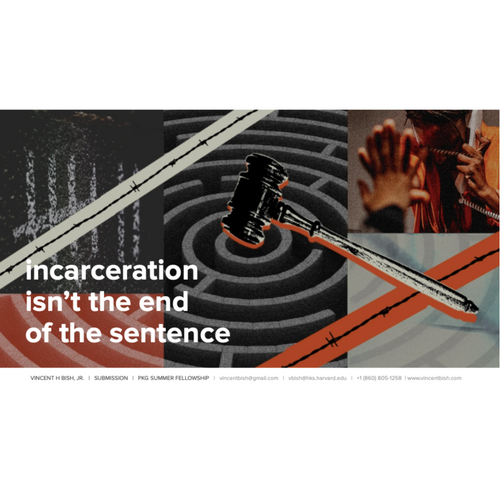
V.BISH | Re-Entry Housing Stories | PKG Summer Fellowship Proposal
I worked with six incarcerees in San Quentin prison as a program director of Slack’s first racial equity pilot. Four years ago, they told me about their treatment in re-entry housing. This is the blindspot in abolition we don't talk about. I'm seeking funding to tell the story of six men, using the skills of media advocacy I learned studying with the former head of the NAACP at Harvard. Objective: Long-form content in NYT or The New Yorker with possible audio additions.
-
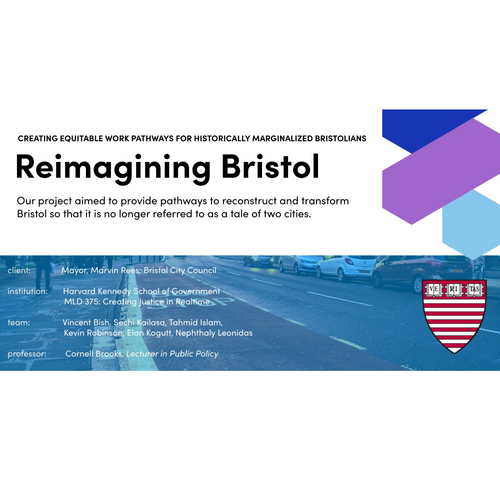
Reimagining Bristol, UK | HKS x Trotter Collaborative
-
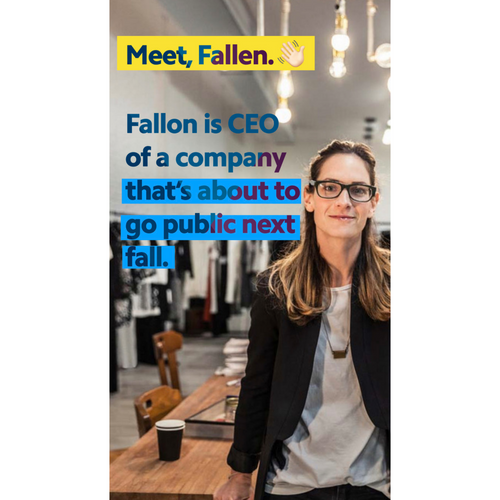
"I'm a CEO. And I Need a Social Impact Strategy—yesterday".
Audience: Tech C-Suite | Class: Harvard University - BGP -235M - Private Capital for Public Purpose? Impact Investing and its Siblings | PAPER 2 | V.BISH | Mobile-First Deck - Avivar Capital Retaining Tech as Social Impact Investing Clients
-
DES 3358 | Code of Ethics for Fictional Firm
-

Radcliffe | Augmented Civics | Youth Leadership & Learning
Vincent H. Bish, Candidate for Ed.M - Harvard Graduate School of Education's 100th Class
-

T545: How Games Effect Our Lives as Tools for Motivation - Final Project
This multimedia presentation combines video, text, and links to explore Assassin's Creed gameplay and Universal Design for Learning standards. Intro and preview videos situate Assassin's Creed as an immersive virtual environment, drawing on Murray's concept of the cybernetic meadow. Further videos and texts scaffold understanding of UDL’s framework for flexible pedagogical representation, expression and engagement, as discussed by Rose and Meyer. By compiling multimedia, the presentation leverages digital affordances to open experiential pathways for acquiring information in line with UDL standards.
-

Universal Design for Learning Applied to Federal Instructional Resources
-
BISH | T538 | FINAL PROJECT | 4/22/21
The goal is to apply your rubric to a learning design / experience of your choice and unpack its affordances, limitations and potential for powerful redesigns. Pretend that you will be sending the final report to the designers of the learning experience you are analyzing!Format: you can work off your slide deck from last week if that's more convenient for you, or start from scratch. In your final deliverable, make sure that you have a subsection for each of the following points: Motivation: briefly describe your motivation for the focus of the project. Feel free to add anecdotes or personal experiences to make it more interesting! Learning Design: describe the learning design you are analyzing. Make sure that this section is as self-explanatory as possible. Anyone reading your report should be able to fully understand the learning design just by reading your slides. Rubric: describe your rubric and how you structured it. Again, the rubric should be self-contained and self-explanatory. Don't expect the reader to have any knowledge about its previous iterations. Make sure that you add references when appropriate; and briefly describe why you think the rubric is a good fit for the learning experience. Analysis: apply your rubric to the learning design described above. Important: for each sub-dimension, you should justify your rating.
-
UDL Project Update
By this point, you will be expected to have a start to the actual product and initial rationale to accompany it. Therefore we ask you to submit two components: 1) A draft of your product or instructional/curricular resource. 2) A draft of your rationale Lay out (at least in an outline) as much of the rationale as possible to ensure you are on the right track for this element.
-
BISH | T538 | MID-SEMESTER PROJECT 4/04/21
The goal is to apply your rubric to a learning design / experience of your choice and unpack its affordances, limitations and potential for powerful redesigns. Pretend that you will be sending the final report to the designers of the learning experience you are analyzing!Format: you can work off your slide deck from last week if that's more convenient for you, or start from scratch. In your final deliverable, make sure that you have a subsection for each of the following points: Motivation: briefly describe your motivation for the focus of the project. Feel free to add anecdotes or personal experiences to make it more interesting! Learning Design: describe the learning design you are analyzing. Make sure that this section is as self-explanatory as possible. Anyone reading your report should be able to fully understand the learning design just by reading your slides. Rubric: describe your rubric and how you structured it. Again, the rubric should be self-contained and self-explanatory. Don't expect the reader to have any knowledge about its previous iterations. Make sure that you add references when appropriate; and briefly describe why you think the rubric is a good fit for the learning experience. Analysis: apply your rubric to the learning design described above. Important: for each sub-dimension, you should justify your rating.
-
BISH | T538 | MINI-PROPOSAL PRESENTATION 3/09/21
Your task is to put together a mini-proposal for your mid-semester project. The goal of this project is to apply your rubric to a learning design / experience of your choice. There will be three components of your project (due after spring break): 1) describe the learning design you want to analyze; 2) describe your rubric and how you structured it; apply it to the learning design of your choice; 3) based on the results, conduct a SWOT analysis (Links to an external site.) (Strengths, Weaknesses, Opportunities, Threats). We will be providing more detailed instructions for each of those points next week.
-
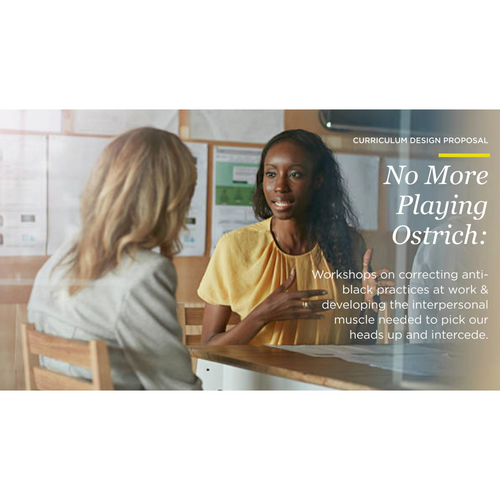
No More Playing Ostrich | L&D Anti-Oppression Workshop Curriculum Design Proposal
Created for EDU 101A | How People Learn - Harvard University | Summer 2020
-

Minority Veterans for America | Engagement Strategy Board Presentation
Pro-bono work
-

Oil Painting Portfolio of Vincent Bish (2012)
-
Kellogg Foundation | Slack + Next Chapter + Last Mile | Annual Report