Jesús Quintana

@marduke182

@marduke182

Barcelona
Digital Origin

Basic Redux

What this talk is not
- Complex application
- Side Effects
- React
What this talk is
- What redux solves?
- The principles of redux
- Middlewares
- A working example
State
State
- Web Services responses
- User interaction
- Modals
- Inputs
- Web Environment
- Routes, navigation, etc.

Problem: State is hard
- Sharing information
- Keeping the application updated
- Replicating issues
- Debugging
Current solutions




Stateful components (this.state)
Services / Factories / Providers / $scope
Ember Data or Services
Backbone Models
-
These solutions don't scale well
-
Bugs are hard to replicate (non deterministic)
-
Tied to frameworks (Hard to migrate)
-
Prone to errors
Caveats

Redux to the Rescue

It's a predictable state container that runs in any javascript environment
The Principles
- The state tree will be stored in a single Javascript Object
- The state tree is read-only and the only way to change it is through an action
- Changes are explicit and executed by a pure function called reducer.
The State tree
- Read only
- The whole state of your application as a single Javascript Object
The State tree
let initialState = {
    peanut: {
        skin: 'white',
        hair: 'black',
        eyes: 'normal',
        glasses: 'white',
        mouth: 'big',
        shirt: 'yelow_black_jacket',
        pants: 'black_jeans',
        shoes: 'black_white'
    },
    setting: {
        place: "outside",
        time: "9:00am",
        season:"SUMMER"
    }
};
Dispatch an action
- Plain Javascript Object
- Describes the change with his minimum representation
- Only requirement: has a type property
const winterIsComing = {
    type: 'CHANGE_SEASON',
    season: 'WINTER'
};

const goToSchool = {
    type: 'CHANGE_PLACE',
    place: 'school'
};

const incrementByAction = {
    type: 'CHANGE_HAIR',
    colour: 'green'
};
Dispatch an action


winterIsComing
goToSchool
Reducer
- It's a function with this signature (currentState, action) => newState
- Must be a pure function
- Arguments don't mutate
- Without Side Effects
- Deterministic
Reducer
function setting(state, action) {
    if (typeof state === 'undefined') {
      return settingInitialState;
    }
    switch (action.type) {
      case 'CHANGE_SEASON':
        return Object.assign({}, state, {season: action.season});
      default:
        return state
    }
}
Reducer



winterIsComing
The reducer function
{
...
    settings: {
        ...
        season: 'SUMMER'
    }
}
{
...
settings: {
...
season: 'winter'
}
}
{
    type: 'CHANGE_SEASON',
    season: 'WINTER'
}
Why is this a good idea?
Lets talk about DX
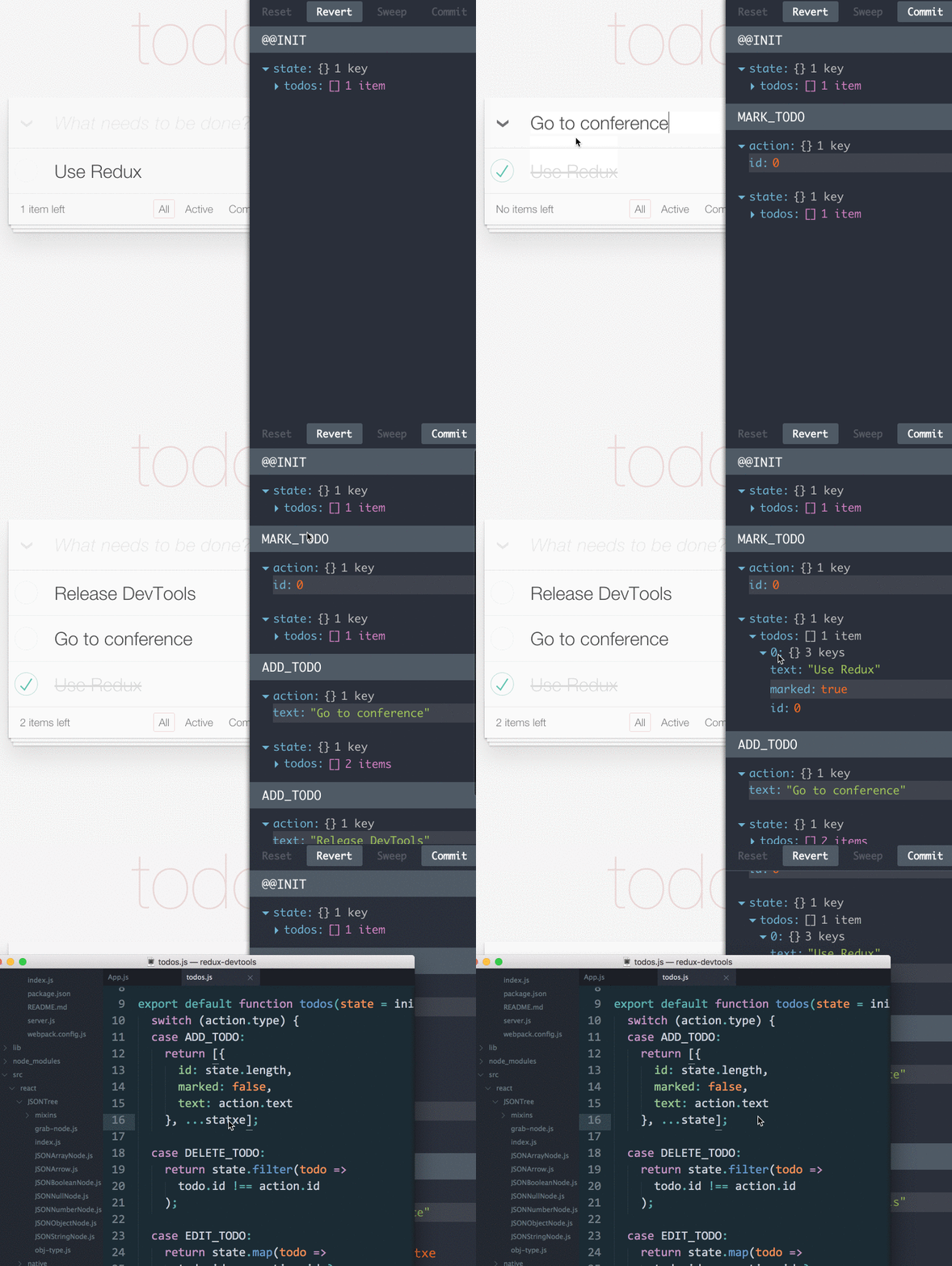
- Time Travel
- Replay
- Hot Module Replacement
- Easy to test
- Simplicity
What about side Effects
This talk is not about them :D.. But yes, we can handle that too.
And we use a middleware for that.
Middlewares
Middlewares in redux work in a similar fashion than in express. It is something that goes between dispatching an action, and the moment it's handled by the reducer
(\{ getState, dispatcher\})
=> (nextMiddleware)
=> (action)

Middlewares
winterIsComing
Middlewares
Dispatcher
All together
import { createStore, applyMiddleware } from 'redux';
import reducer from './myReducer';
import thunk from 'redux-thunk';

const initialState = { counter: 0 };

const store = createStore(reducer, initialState, applyMiddleware(thunk));

store.subscribe(() => {
    // Here i could update my javascript application.
    console.log(store.getState());
})

store.dispatch({ type: 'INCREMENT'});

// Must log { counter: 1 }
Basic Redux
By Jesus Quintana