Amy Spence - Ratchet
Evaluation question 2 - How effective is the combination of your main product and ancillary texts?
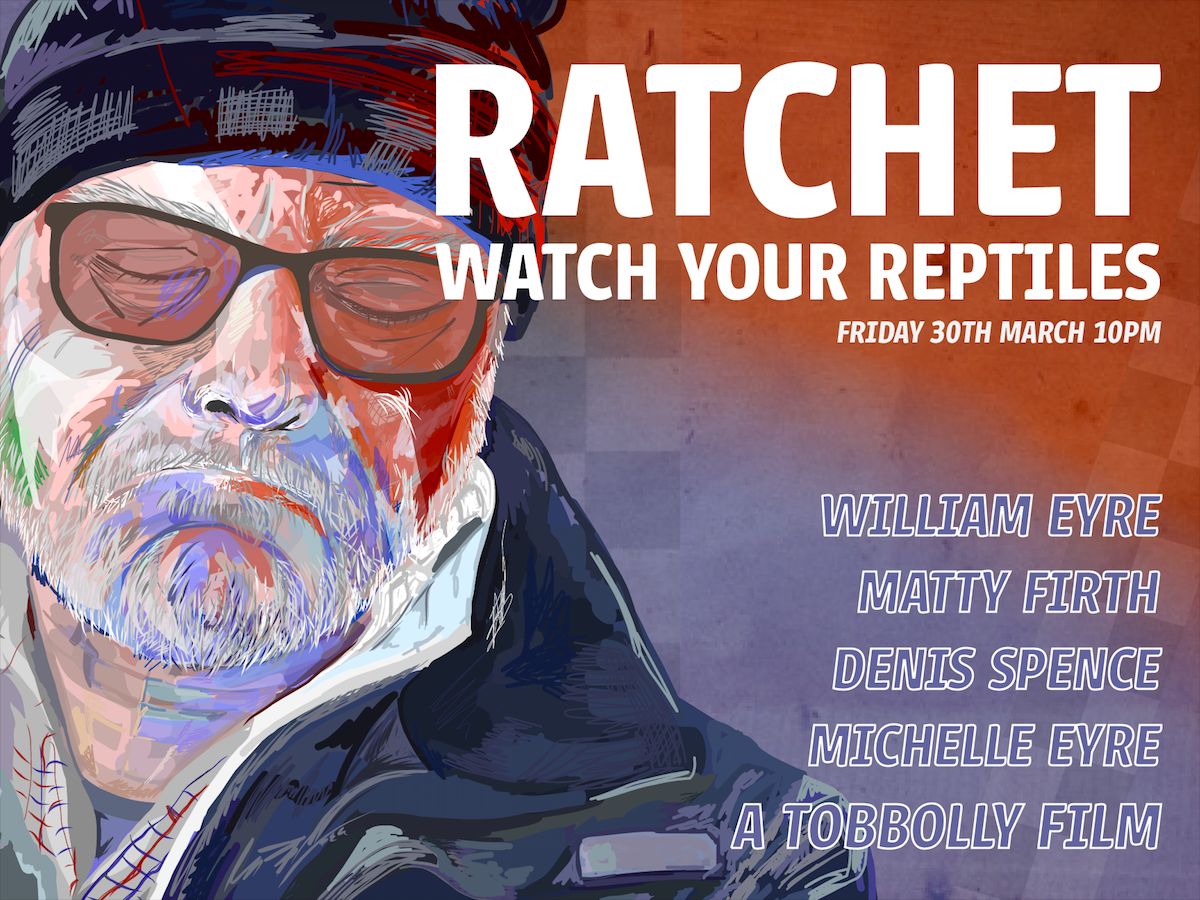
Poster
Article
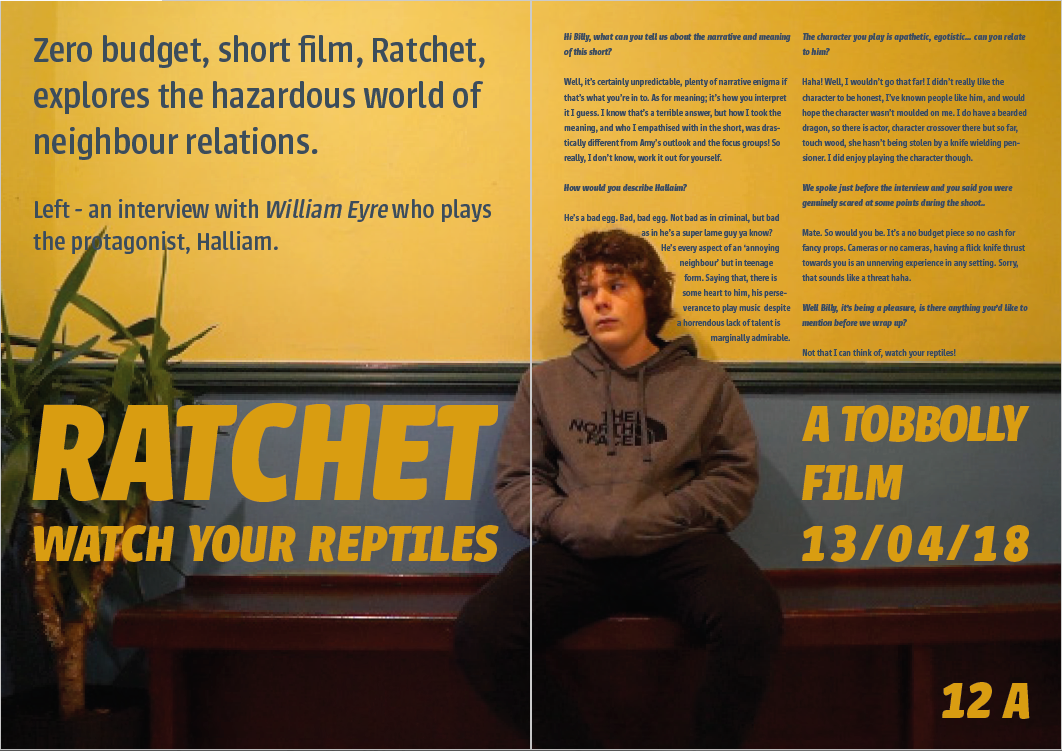
After this evaluation I decided to make changes to my article to make it more in line with presentation conventions. The updated version is above.
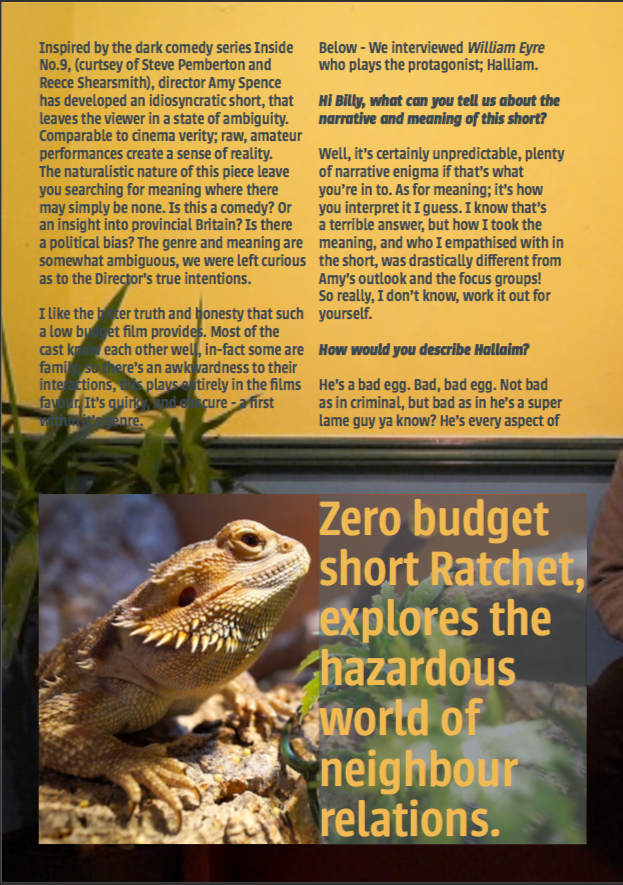
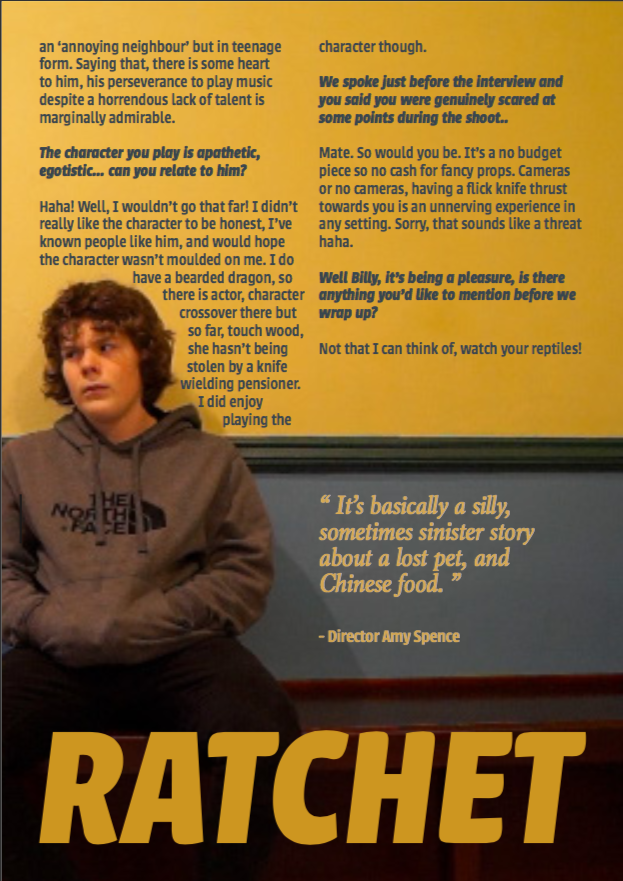
My products were effective visually, for the following reasons:
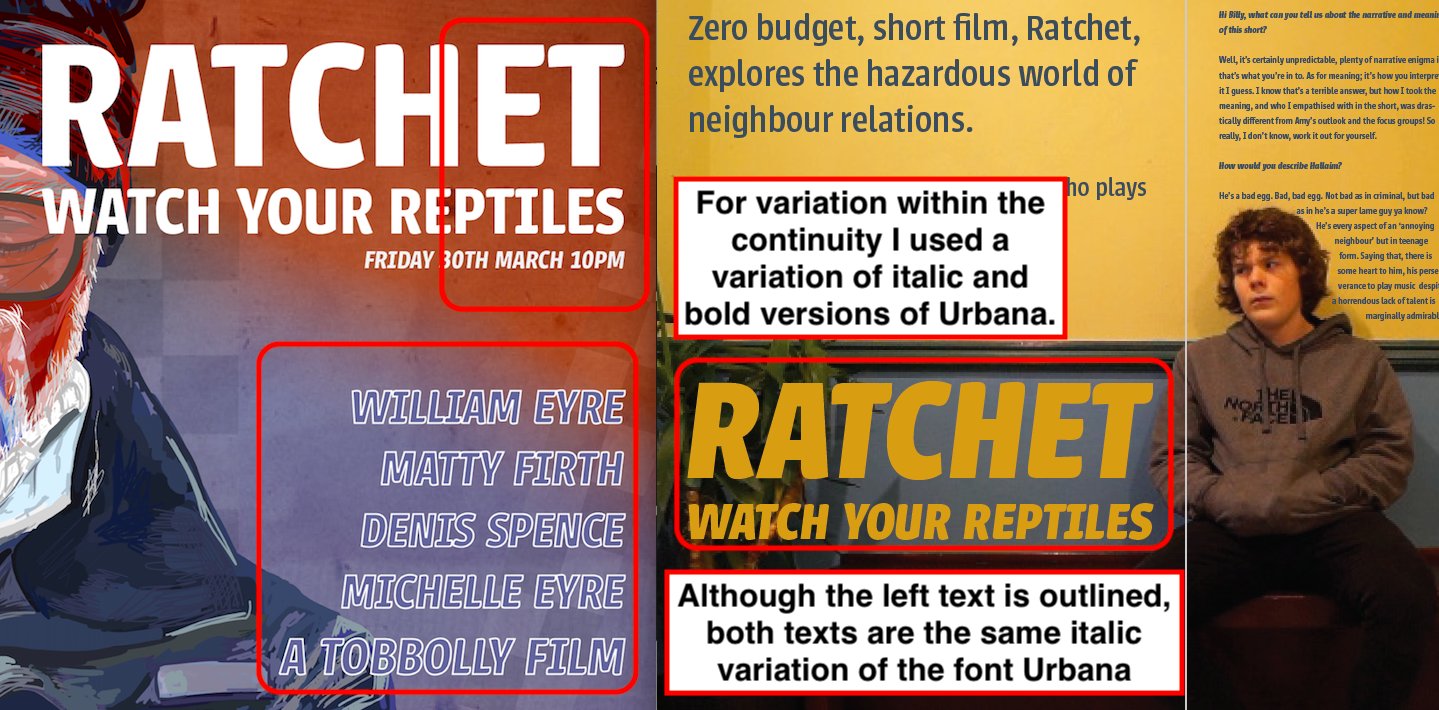
- Continuity in fonts.
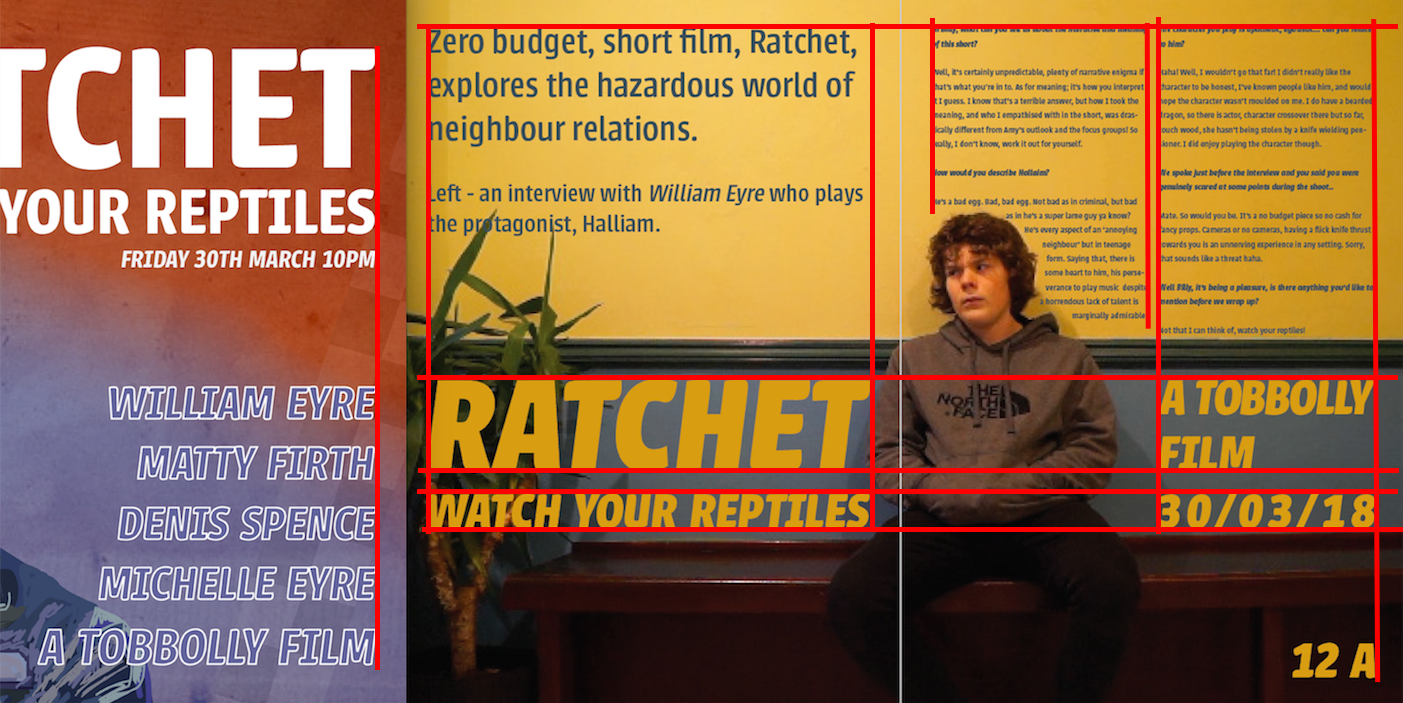
- Use of alignment.
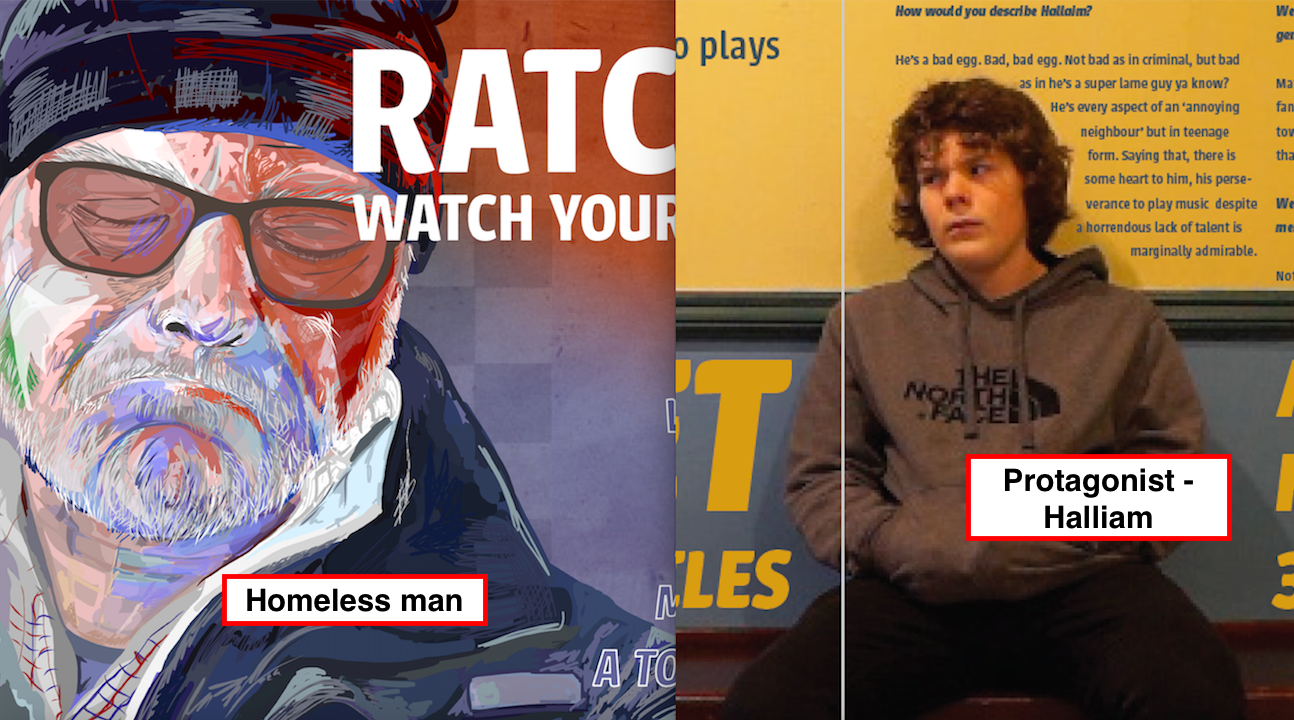
- Use of different characters to give pieces together a more rounded view of film.
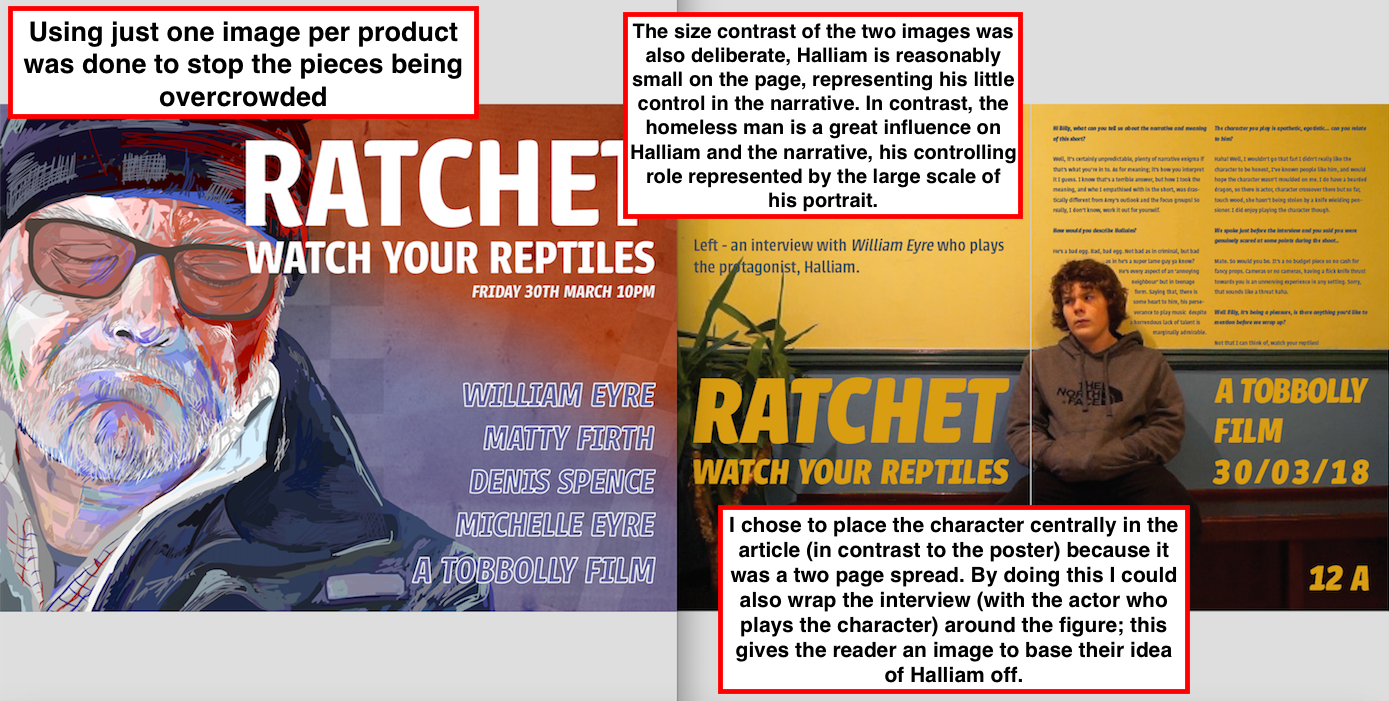
- Restriction of only one image/portrait.
- Minimal use of colour - the article and poster each operate solely around two dominant tones (Article blue & yellow, poster blue & red).
- Effective use of a slogan.
These features are demonstrated and explained in the following slides.
- Continuity in fonts.
2. Use of alignment.
3. Use of different characters to give pieces together a more rounded view of film.
4. Restriction of only one image/portrait.
5. Minimal use of colour - the article and poster each operate solely around two dominant tones (Article blue & yellow, poster blue & red).
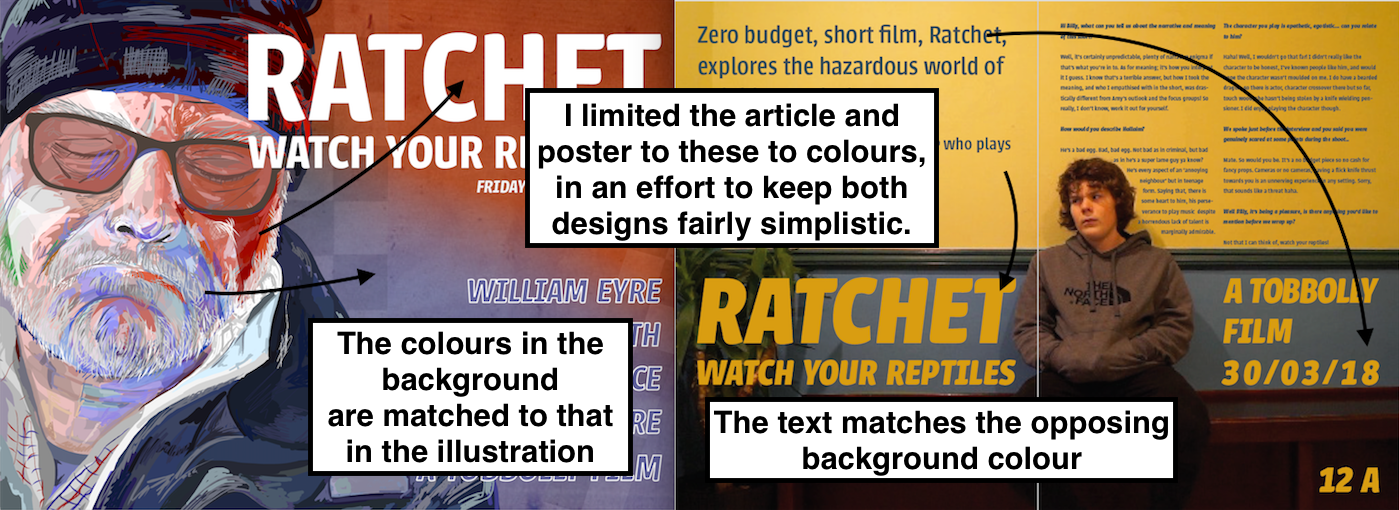
6. Effective use of a slogan.


Effective aspects of this slogan include:
- Length - 3 words, 6 syllables, this slogan will "stick in your head".
- "WATCH" - Suspense is created, there's potential danger. Use of suggestion, I am telling the audience to WATCH Ratchet.
- "YOUR" - I chose "YOUR" over "OUT", as it directly engages with the reader, speaking strait to the audience.
- "REPTILES" - Begins with R, so echoes the title, additionally creates narrative enigma.
Effectiveness in terms of audience appeal
The following sides explore the ways which the combination of my short film and ancillary products are viewed, used, appeal etc in realation to the audience.
Audience thoughts on the ancillary products. I asked: "Do the ancillary products (poster and article) link well with the film/each other? If not/yes, why?"
-
"Yeah they're great, good continuity in style and font, liked the colours also"
-
"They do, obviously they are different, but that's a credit to their usability as advertisement products for your film"
-
"Yes, the images link to the protagonist"
-
For sure. The title and character is the focus point in both despite featuring other components - effective link, plus they are arranged in a similar style"
-
"Yes! With that really nice photo from the film on the article and the cool illustration of the older character it really linked up."
-
"Yep same old man" (It's not...)
-
"One was an illustration which doesn't link but the fonts are the same I think."
Audience thoughts on the ancillary products. I asked: "What could be improved about the article/poster?"
-
"The teenage boy should be featured in both"
-
"Multiple pictures to give more of a feel for the narrative"
-
"Although I like how the text in the article matches the yellow of the wall, it does not stand out, maybe make the title darker?"
-
"Maybe if the protagonist was in the poster too?"
-
"The illustration is scruffy, spend longer on the drawing in the poster"
-
"You could certainly improve their combined effectiveness by having them both follow the same colour schemes."
How did the combination of main products and ancillary texts appeal to my audience in terms of audience theory
When designing my poster I looked a Barthes' five narrative codes; Hermeneutic/Enigma code, Proairetic/Action code, Semantic code, Symbolic code, Referential code. Out of these, I specifically looked at Barthes' Enigma Code Theory. This codes relates to mystery within a text, where whilst clues may be given, no clear answer (or in my case narrative), is presented.
Enigmas typically will make the audience want to know more - as stated earlier I wanted my poster and article to create ambiguity around my final product. An example of this could be the unexplained portrait in my poster.
This was an example of how my two texts worked in cohesion with my product, as I employed unanswered enigmas to frustrate the audience. For example, how the lizard in my film was stolen, or was it just lost then found?
How did the combination of main products and ancillary texts appeal to my audience in terms of audience theory
-
The Uses and Gratifications Theory was developed by Bulmer and Katz, it states an audience will seek out the media source that best fulfils there needs. These needs can be; information & education, integration & social interaction, entertainment, personal identity, and escapism.
-
My products can also be used for entertainment (where a viewer watches/ observes my products for enjoyment). For example, some of the scenes in my film involve suspense, which the audience might enjoy. They may also enjoy the ambiguity of the narrative, which is echoed in my ancillary products.
-
Personal identity could be applied to my film in terms of the five characters and the audience members the might relate. This could be in terms of race, gender, profession, class, personality. For example, an audience member working in the police force may recognise the similarities between themselves and the police officer in my film. This identification will be stronger if the audience also identifies with the characters gender (female) etc.
-
My combination of ancillary products can be used by an audience for escapism. An alternative reality is presented, the location and character in the article, being another world in which the audience can emerge themselves. An audience member might use my products (The article, combined with the obscure events of the film and character presented in the poster), to distance themselves from reality, this is escapism.
How did the combination of main product and ancillary texts appeal to my audience in terms of audience theory
Maslow's Hierarchy of Needs can be used to describe how my film covers some of the perceived steps towards self actualisation. The steps of this hierarchy my product and ancillary texts specifically explore include ...
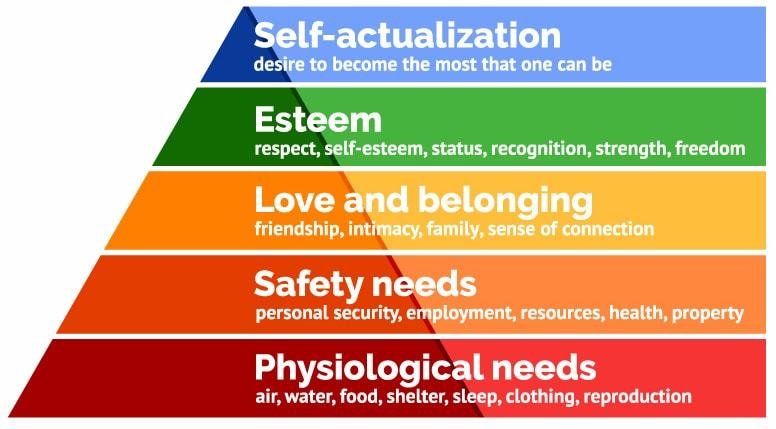
- The physiological need for food and shelter (our film involves a seemingly homeless individual).
- The safety need for personal security, property, health, (a theft is carried out as part of the narrative)
- Behaviour as a result of love and belonging needs such as family (A man threatens Halliam, acting on instruction from family).
- Esteem needs such as status, freedom (Not a literal comparison, but Halliam is in some ways a slave to the Homeless Man whilst he holds his property hostage).
Some of these aspects from the narrative are also present in my advertising products, for example, a Homeless Man is the key feature of my poster.
How did the combination of main product and ancillary texts appeal to my audience in terms of audience theory
Young and Rubicam's Cross - Cultural Consumer Categories model can be applied to my product and ancillary products in terms of Cultural Consumer Categories. This model acknowledges the global nature of media audiences, dividing audiences into 7 types of consumer. The 4 main categories are mainstreamers, aspirers, succeeders, and reformers.
How these 4 categories view my film and texts -
Mainstreamers - Would identify with the conformist, conventional mise-en-scene I have shown eg. Halliam wears a costume typical of a teenage boy.
Aspirers - Typically younger people; may empathise with the young protagonist.
Succeeders - With an urge for control, a succeeder would be interested in the power exchange between the Homeless Man, Halliam, and the Police Officer.
Reformers - Are generally socially aware, maintaining behaviours as result of independent judgement; hence would seek to empathise with the class contrast and social struggles represented in my short film. Intellectual and tolerant, I expect a reformer would be intrigued by the ambiguity of my seemingly shallow characters.
How the distribution of my main product and ancillary texts was effective.
I distributed my main product and ancillary texts on the same platform - Facebook, (In addition to publishing my film on YouTube). To enhance potential suspense, I released the poster, before the article, and then my film.
I also used media convergence to increase the effectiveness of said distribution. Media convergence can refer to either;
1 - the convergence of media technologies and forms due to digitization and computer networking, or
2 - an economic strategy where communications company's media properties use digitization and computer networking together.
In my case, I used the first definition. From my audiences phone they would be able to access my work on Twitter, Facebook, YouTube, and in some cases through promotion emails I sent to around 50 people, this convergence allowed me to advertise to single people, multiple times, because of their use of a solitary device.
Because they were distributed together the audience were able to observe the synergy between each product, making for a more effective combination.
How effective is the combination of your main product and ancillary texts? - Conclusion
In conclusion, my combination of main product and ancillary texts was very effective, in terms of aesthetic, audience appeal and consumer/audience theory.
Amy Spence - Ratchet
End of question 2
Media Studies - Evaluation Question 2
By Amy Spence