







Carina I. Hausladen, Manuel Knott, Colin F. Camerer, Pietro Perona

Social perception of faces in a vision-language model

"Make it More" Trend

Ok, make it more Swiss

MORE SWISS

Moooorrreeee Swisssss!!

Documenting social biases in VLMs

Measuring input-output bias by prompting the model

Analyzing the retrieved image outputs w.r.t. various grounds of discrimination

1. Bias categories are hard to generalise.

2. Image outputs could include unobserved correlates.

Are there generalizable ways in which people categorize each other?

1. Bias categories are hard to generalise.

1. Bias categories are hard to generalise.

2. Image outputs could include unobserved correlates.

Can we manipulate grounds of discrimination in images one at a time?


We measure social perception

of human faces

in a vision-language model.

A photo of a

person

A photo of a

person

 A photo of a
person

Measuring social perception via

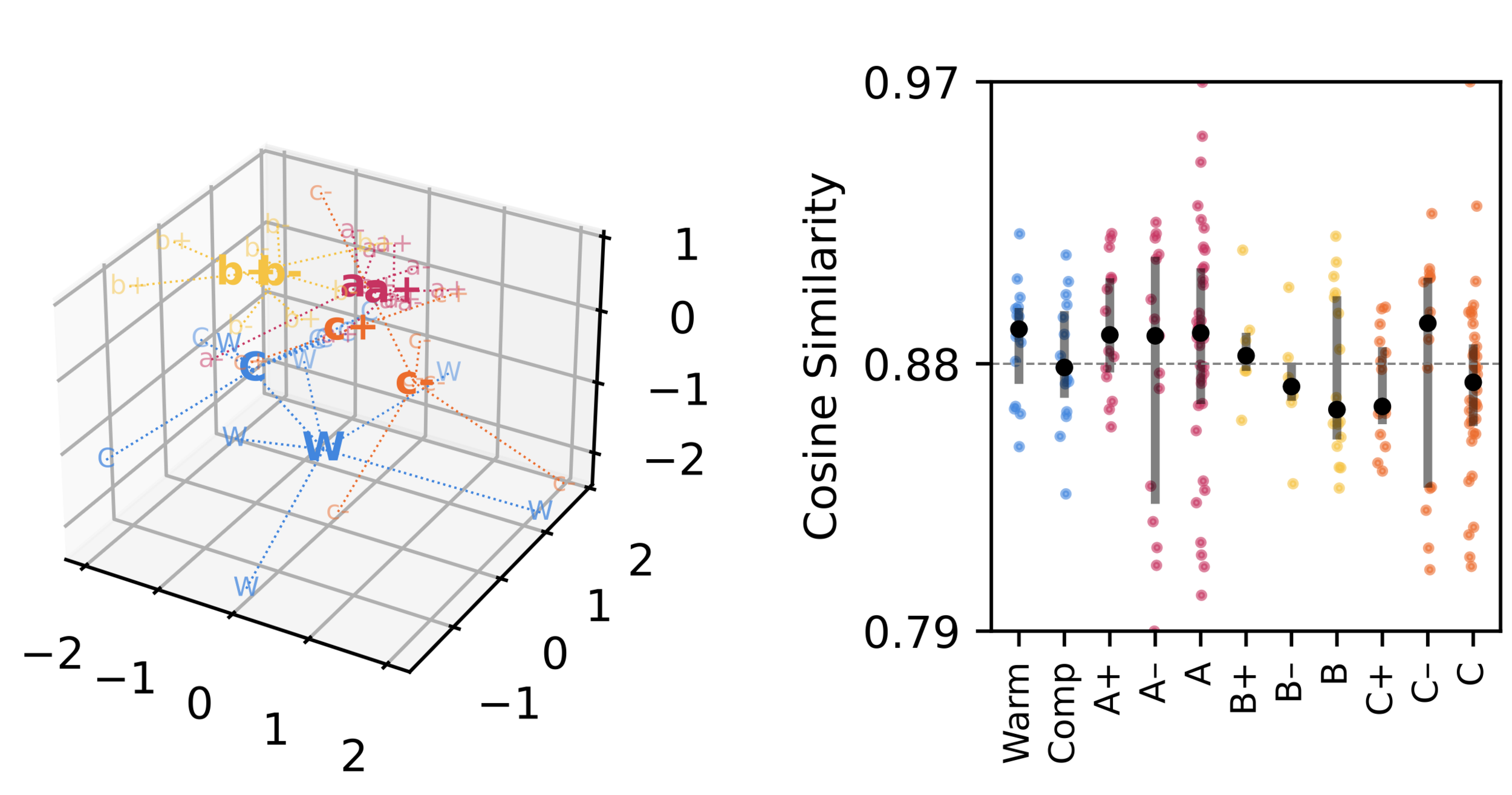
Cosine Similarity

age

CausalFace

CausalFace

female

male

age

CausalFace

female

male

age

Asian

Black

White

Legally protected

Legally protected

Non-protected

smiling

lighting

pose

 A photo of a
person

 A photo of a

person

Stereotype Content Model

Fiske et al. (2007)

Agency Belief Communion Model

Koch et al. (2016)

Warmth

Competence

unfriendly
friendly

Agency

Belief

Communion

+

C

P

+

surgeon

parent

 A photo of a


person

friendly

Prompt templates

  • A photo of a <attribute> person.
  • A <attribute> person.
  • This is a <attribute> person.
  • Cropped face photo of a <attribute> person.

We deploy an experimental dataset.

1.

We deploy theories of social perception.

2.

We investigate the embedding space directly.

3.

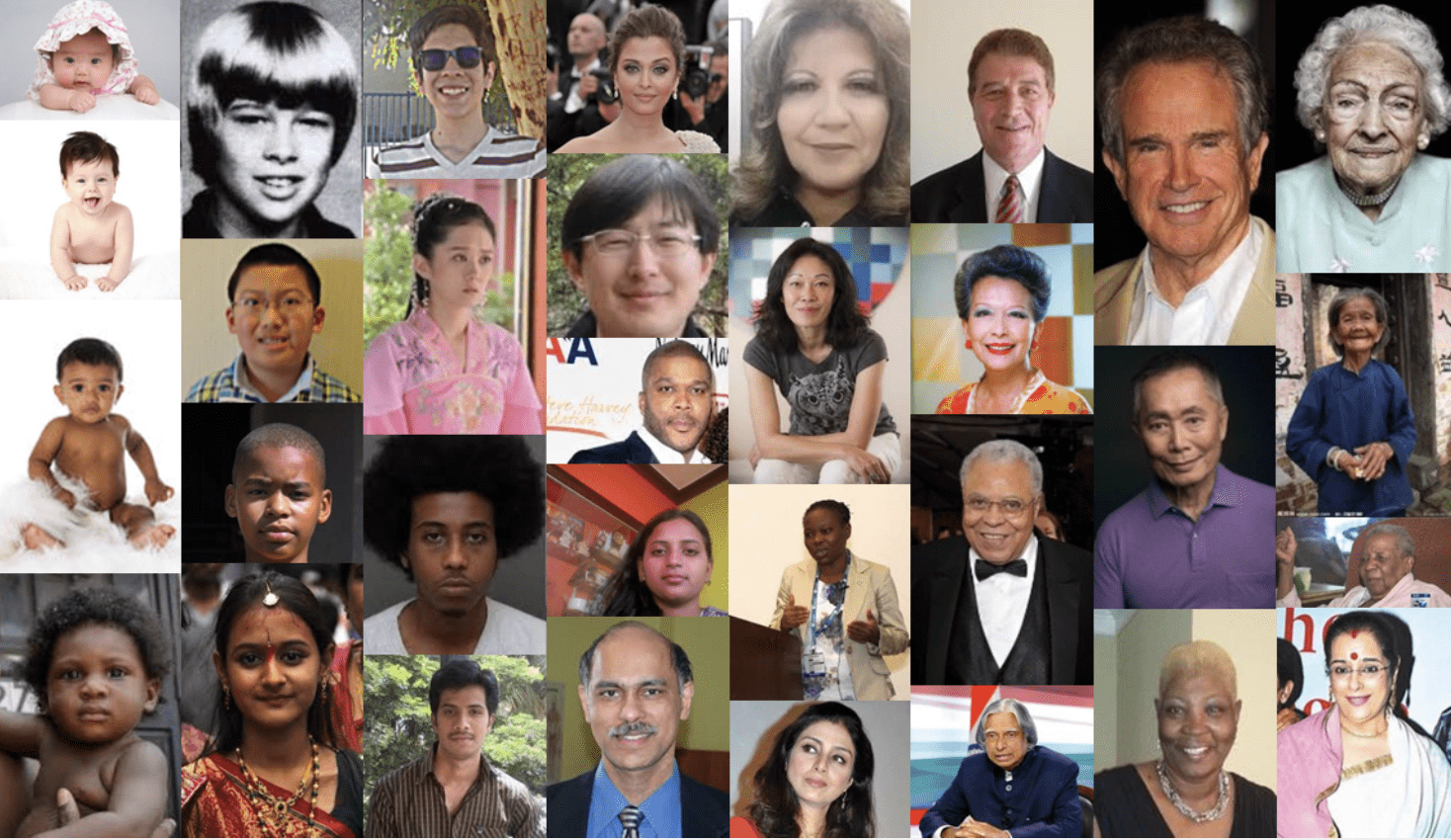
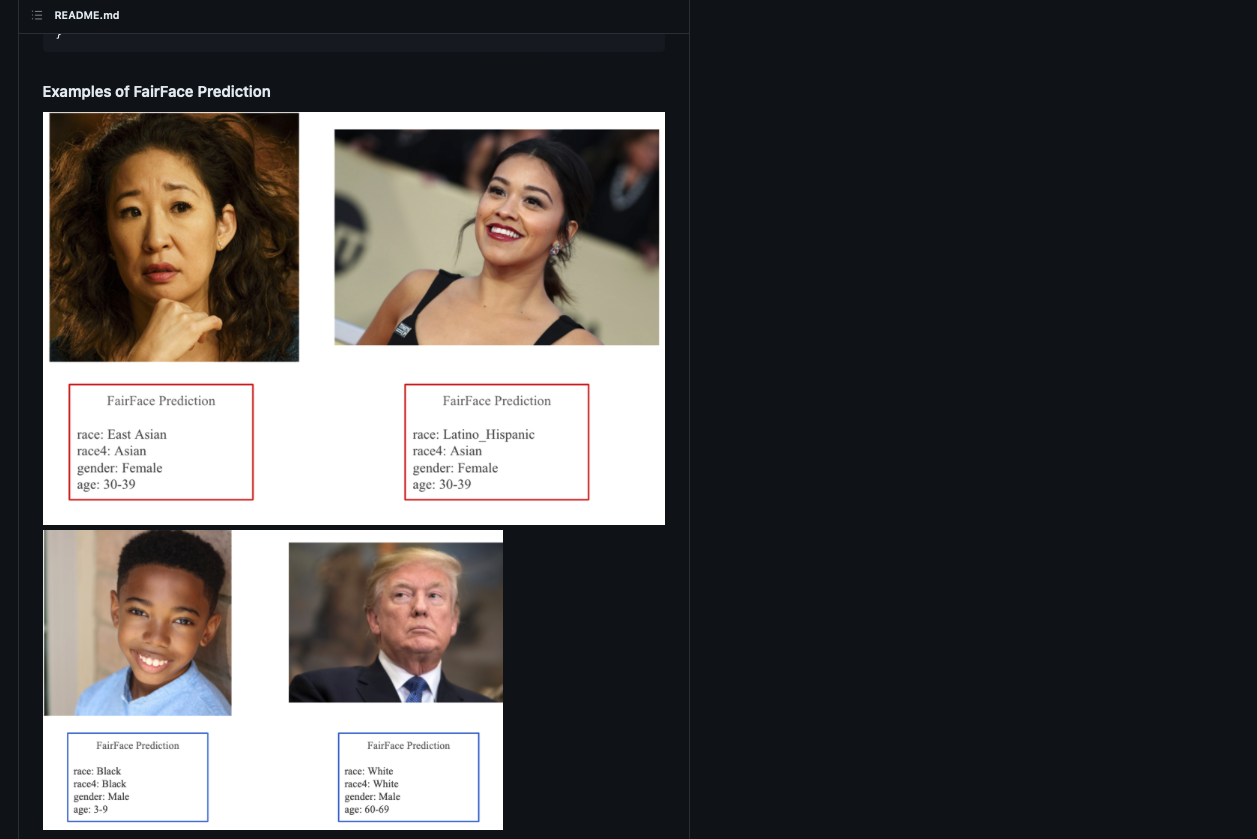
FairFace

UTKFace

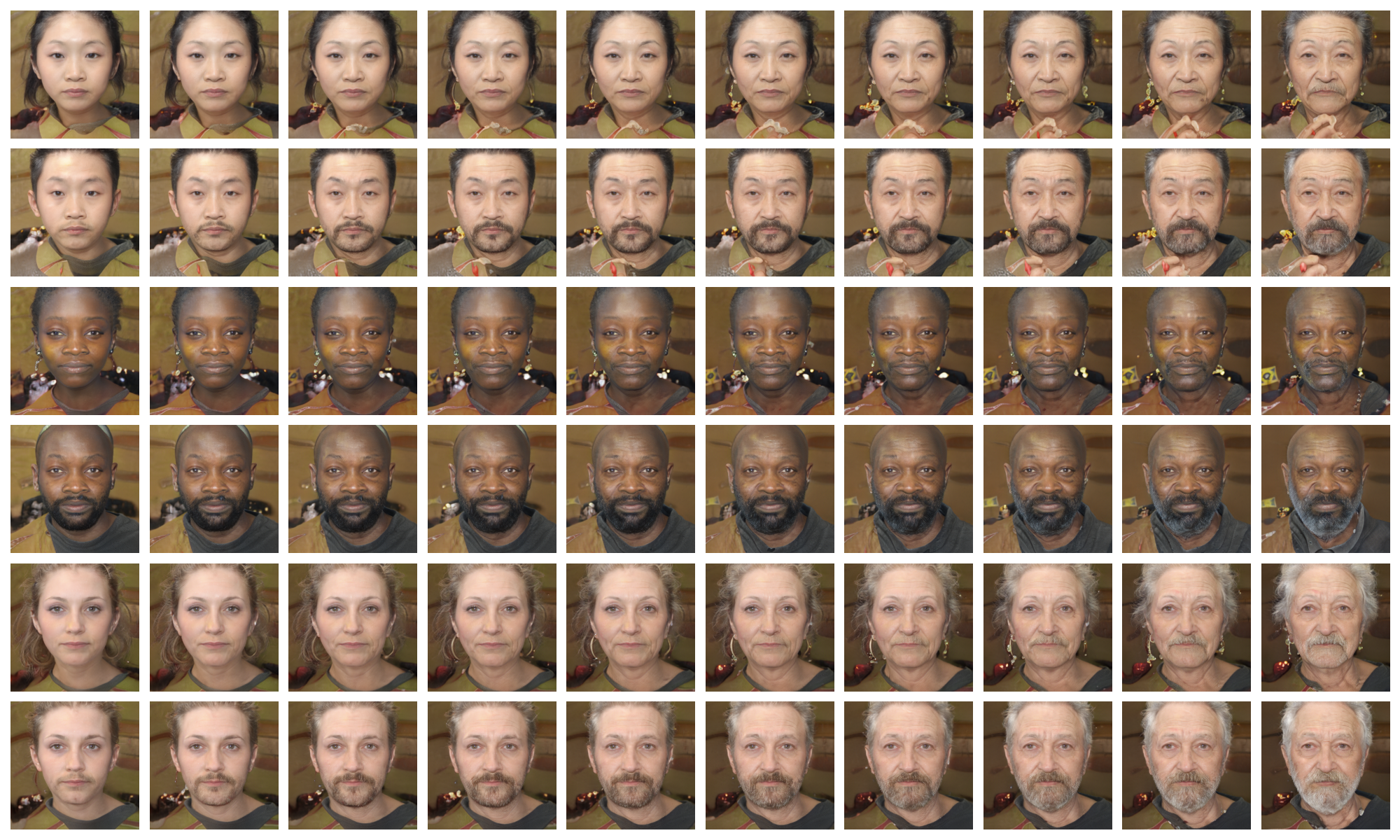
CausalFace

Do the statistical properties of CausalFace embeddings systematically differ from real-world photographs?

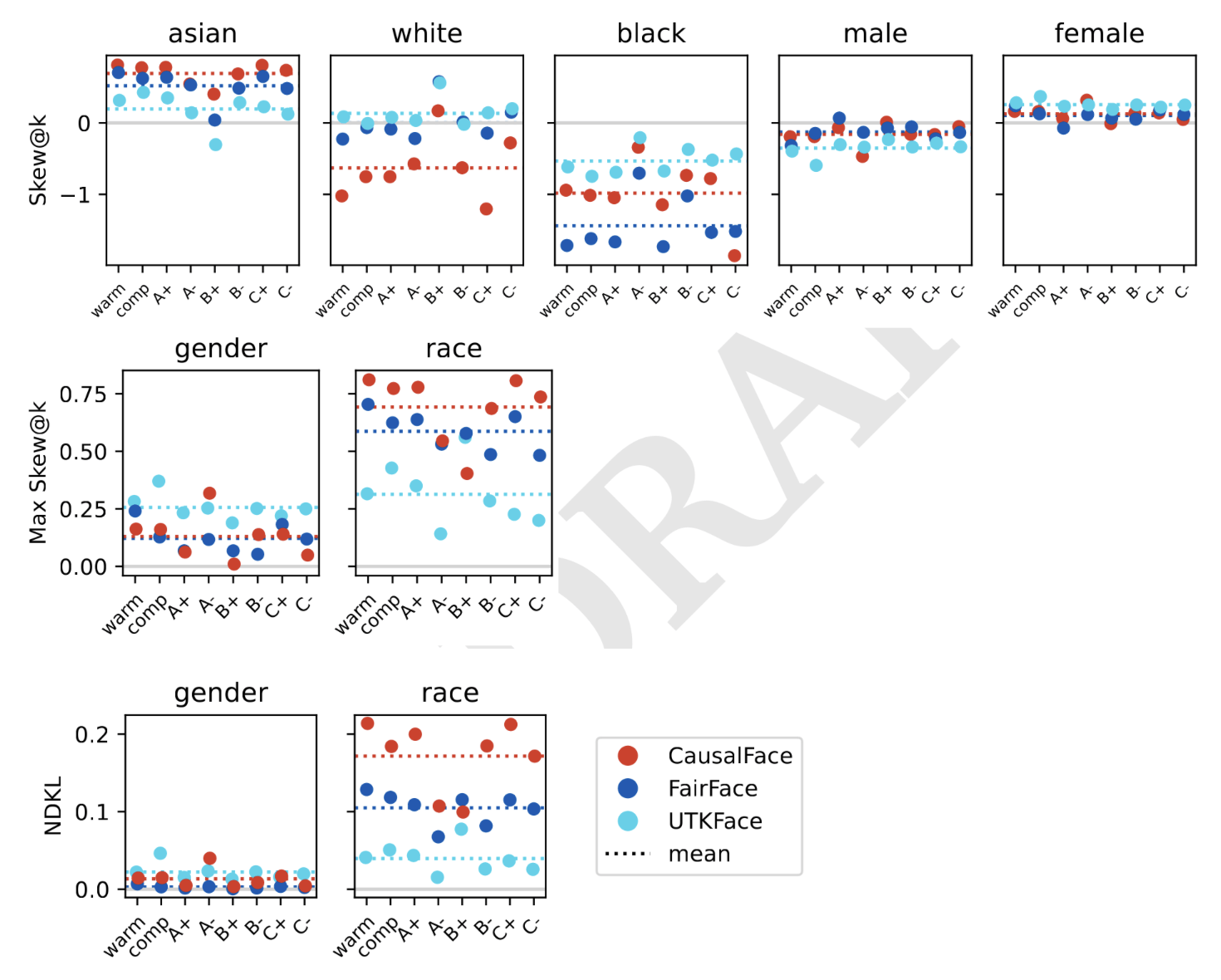
Commonly used bias-metrics

Markedness 

a photo of a 

person
a photo of a
 WHITE 
person

unmarked

marked

image category
 
CausalFace

 
white
 
45.5
black 0.7
asian 0.1
male 0.4
female 0.6
Fair
Face

 
UTK Face
47.09
 
32.6
1.8 2.9
1.9 4.1
0.00 20.1
0.00 11.6

>

%

Commonly used bias-metrics

CausalFace images are statistically similar to real photographs.

Protected attributes

female

male

age

Asian

Black

White

Non-protected attributes

smiling

lighting

pose

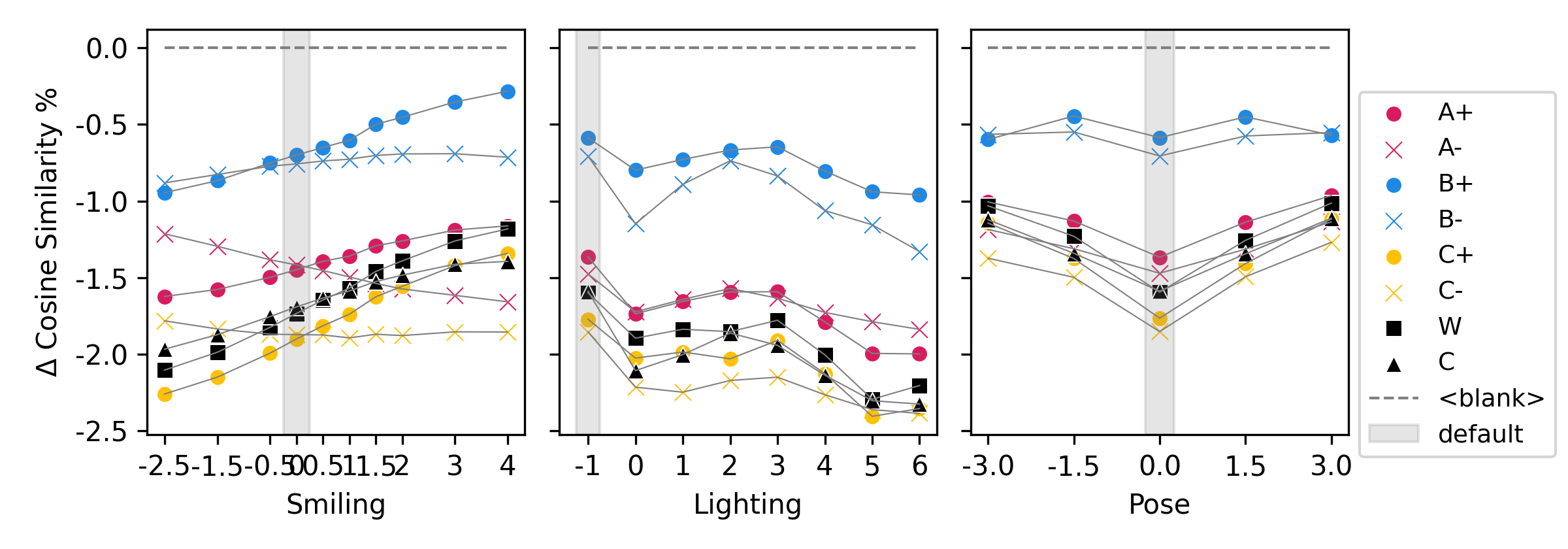
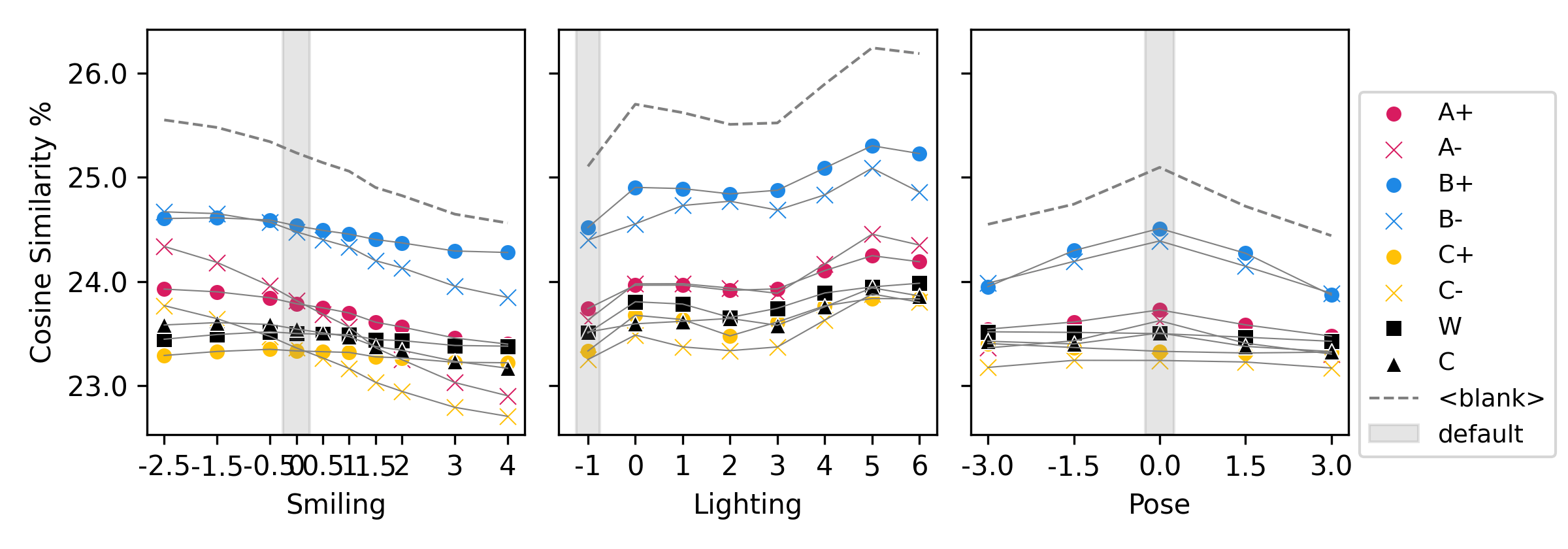
How do

protected and

non-protected

attributes affect social perception?

smiling

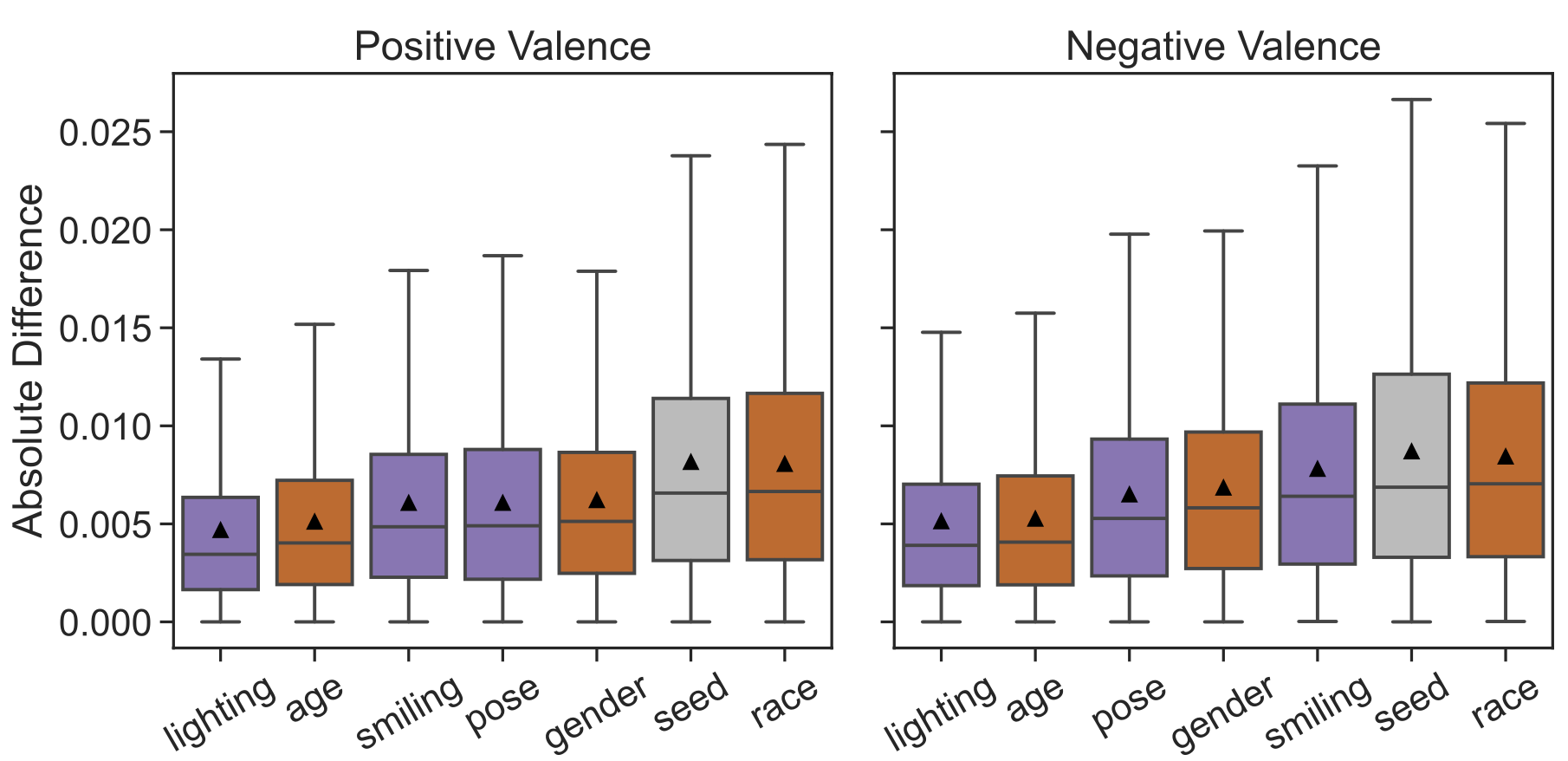
Bootstrapping differences

Bootstrapping differences

smiling

Bootstrapping differences

smiling

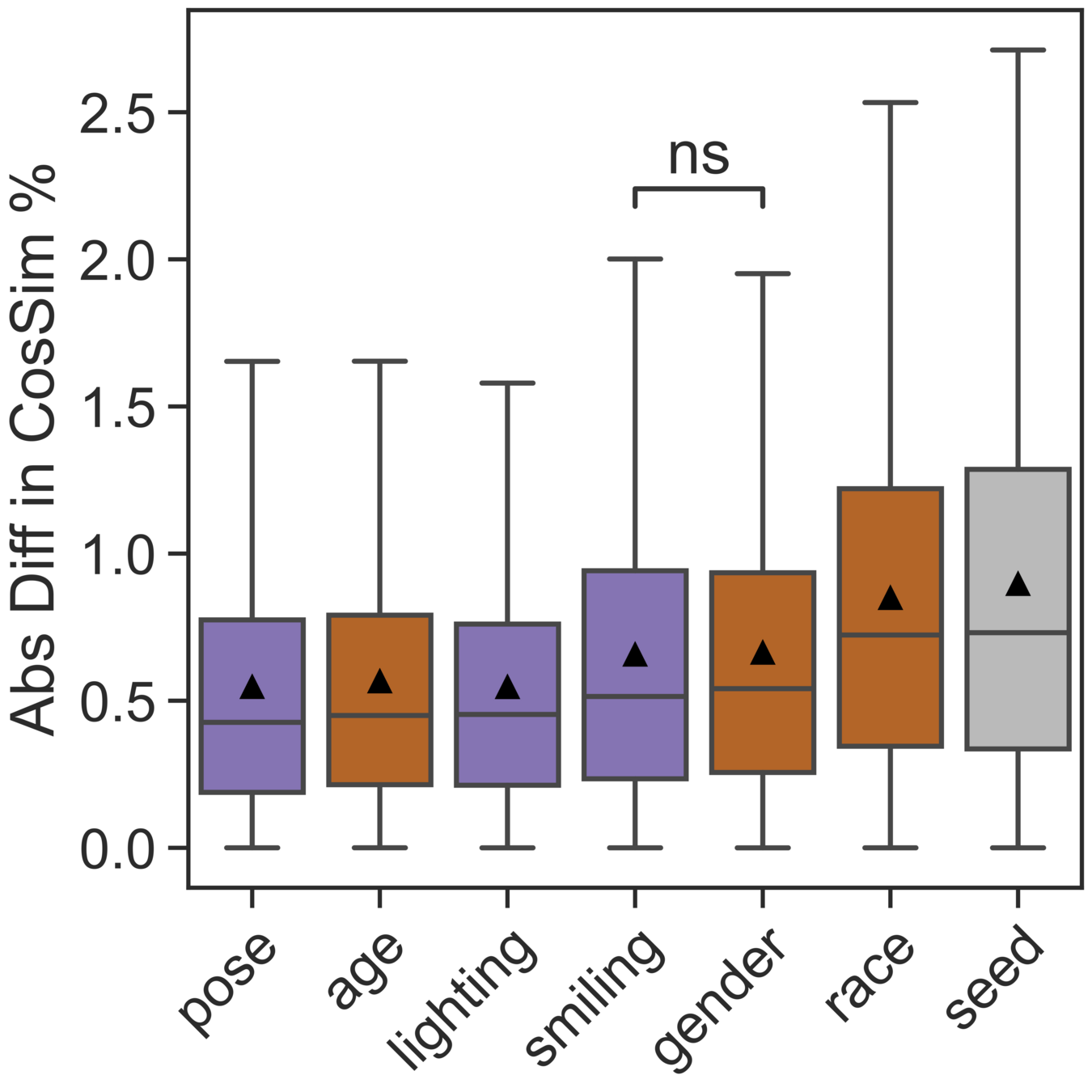
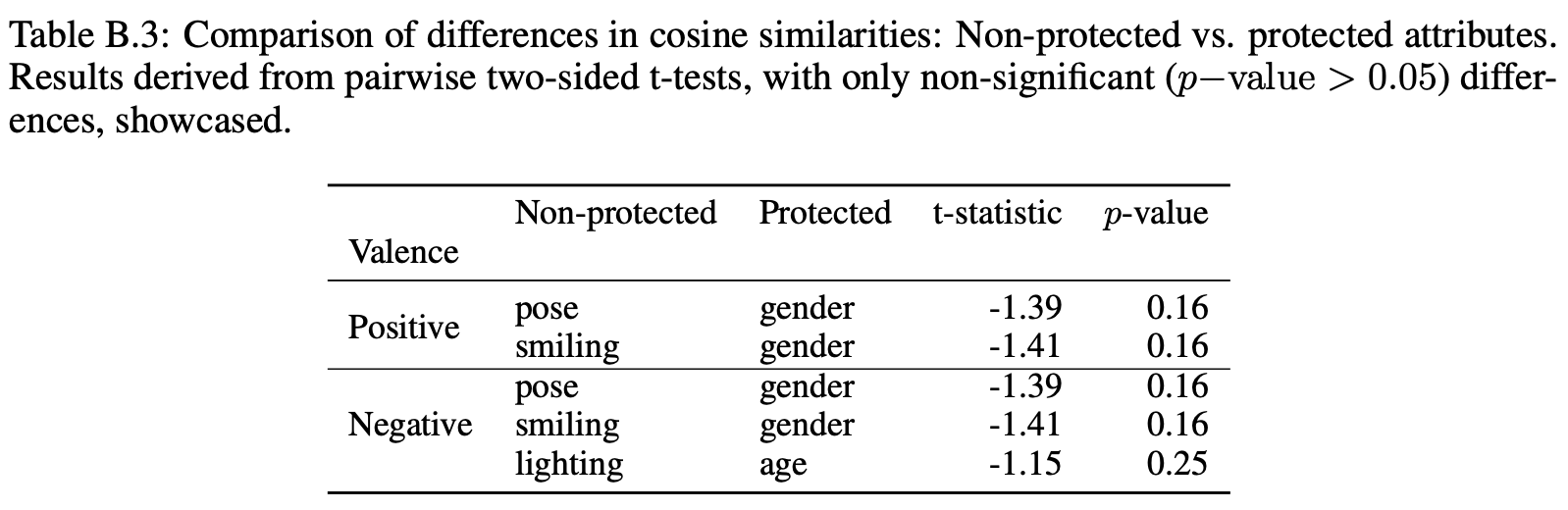
protected and non-protected attributes

Wilcoxon Rank-Sum test, independent samples,
\(p<0.001\)

ns

ns

  • Non-protected attributes cause as much variation as protected ones.
  • Considering a wide spectrum of protected and non-protected variables is necessary to understand and measure biases comprehensively.

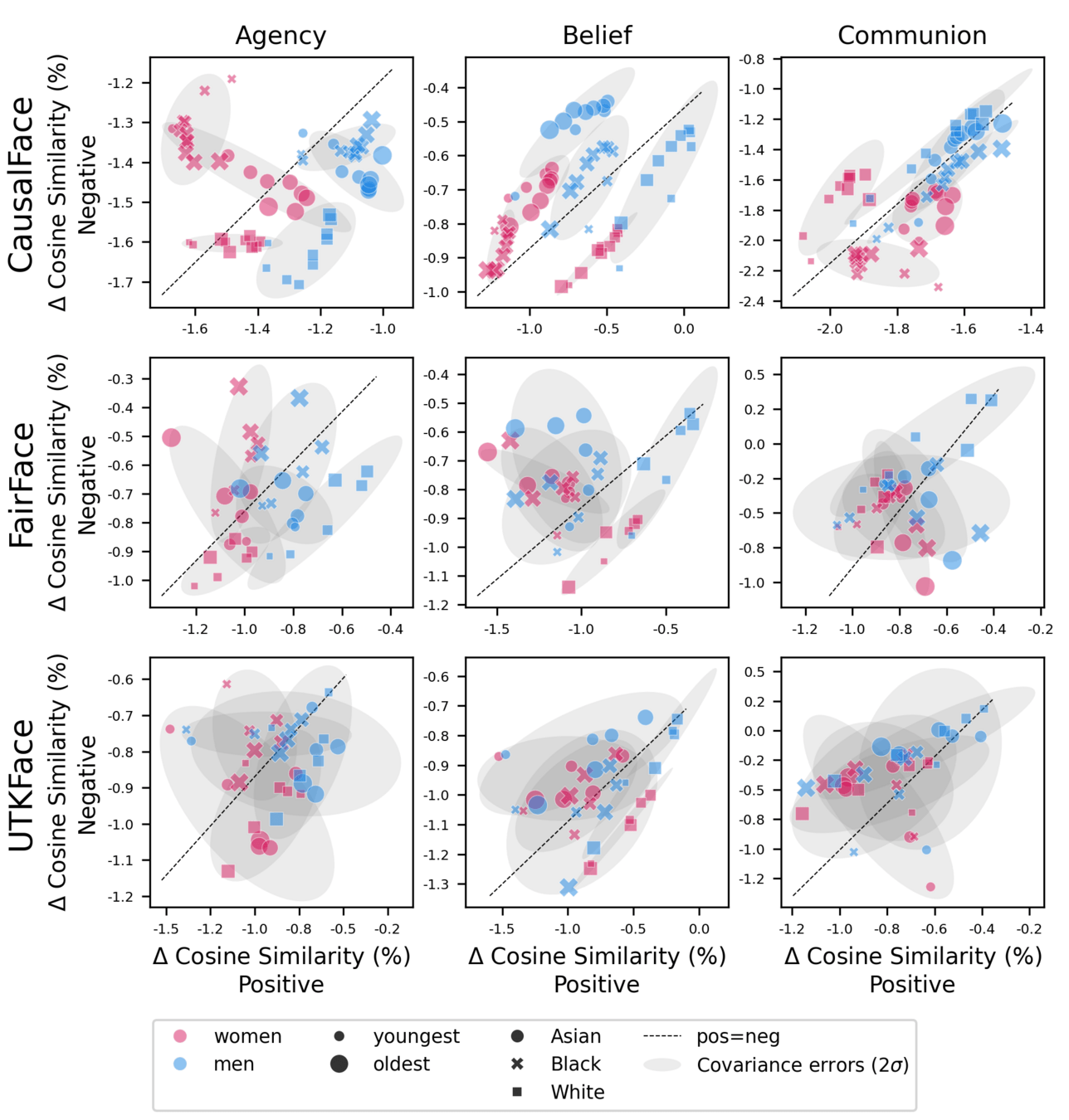
Do age-related social perceptions vary across different social groups?

age

CausalFace

CausalFace

female

male

age

CausalFace

female

male

age

Asian

Black

White

Legally protected

Warmth

Competence

Belief

Communion

+

Agency

+

Agency

UTKFace

💼 Powerful

👑 High status

🦁 Dominating

💰 Wealthy

💪 Confident

🏆 Competitive

🍂 Powerless

📉 Low-status

🌾 Dominated

🪙 Poor

🐭 Meek

🍂 Passive

UTKFace

Agency

FairFace

Agency

CausalFace

UTKFace

FairFace

Agency

Distinct Clusters

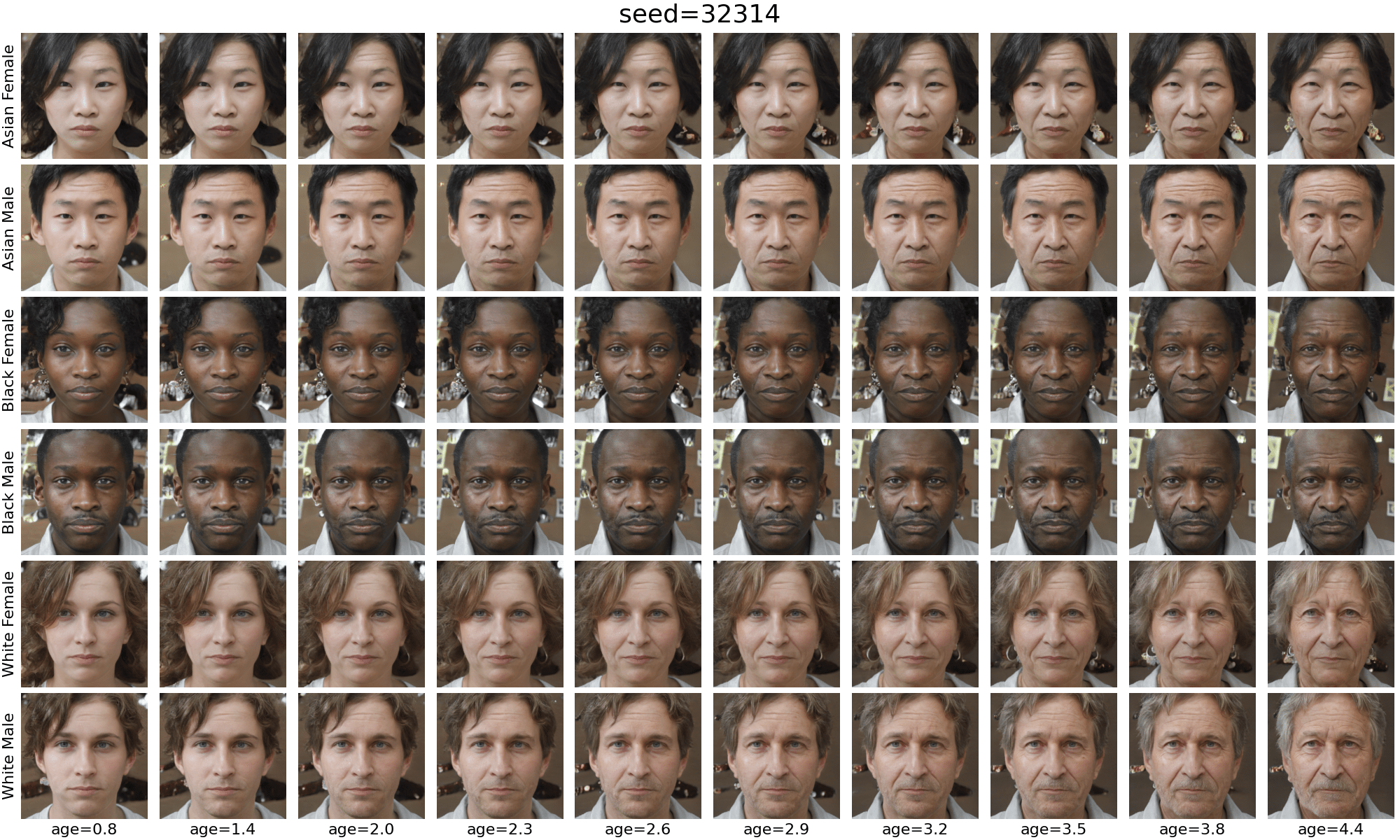
  • CausalFace representation keeps facial expression, lighting, and pose constant.
  • FairFace and UTKFace lack this level of control.

CausalFace

+

youngest

oldest

Agency

+

Positive Agency

Black Women

youngest

oldest

example

identity

  • In line with Chatman (2022), we also find that perceived Warmth drops for middle-aged White women.
  • We observe increased Warmth for older men across all three racial groups.
    • Chatman (2022) find that men's perceived warmth increases from young adulthood to middle age, but not beyond.

Comparison to human subject research

How does
age-related
social perception
differ across datasets?

Uncontrolled attributes in FairFace and UTKFace make for noisy measurements and hide interesting phenomena.

age

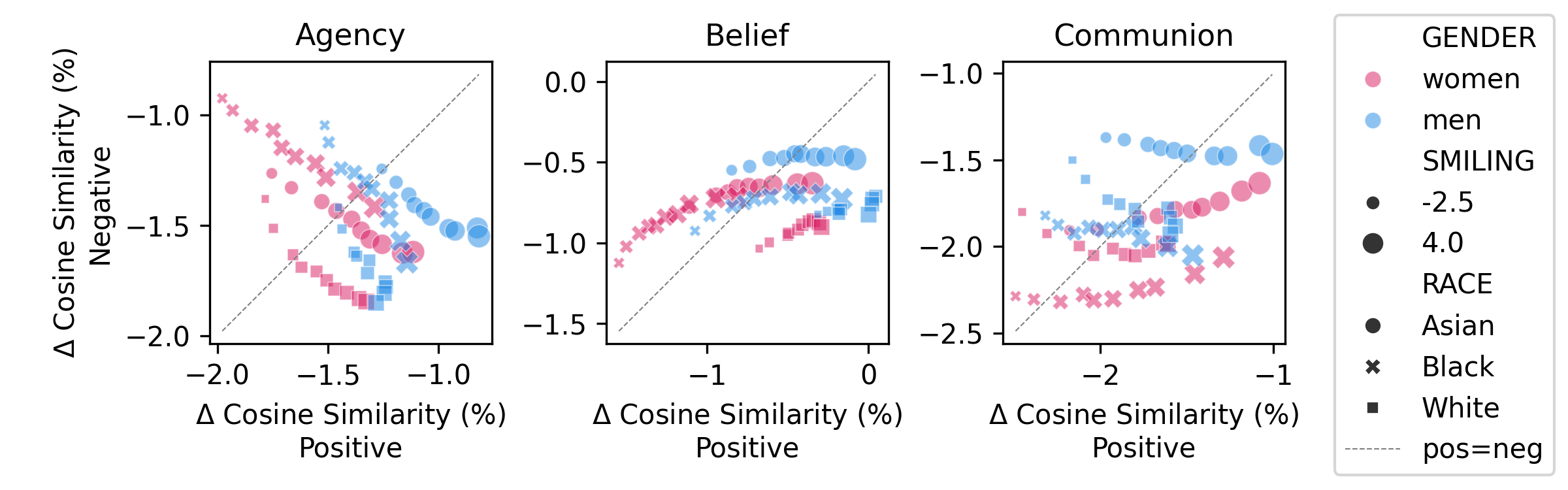
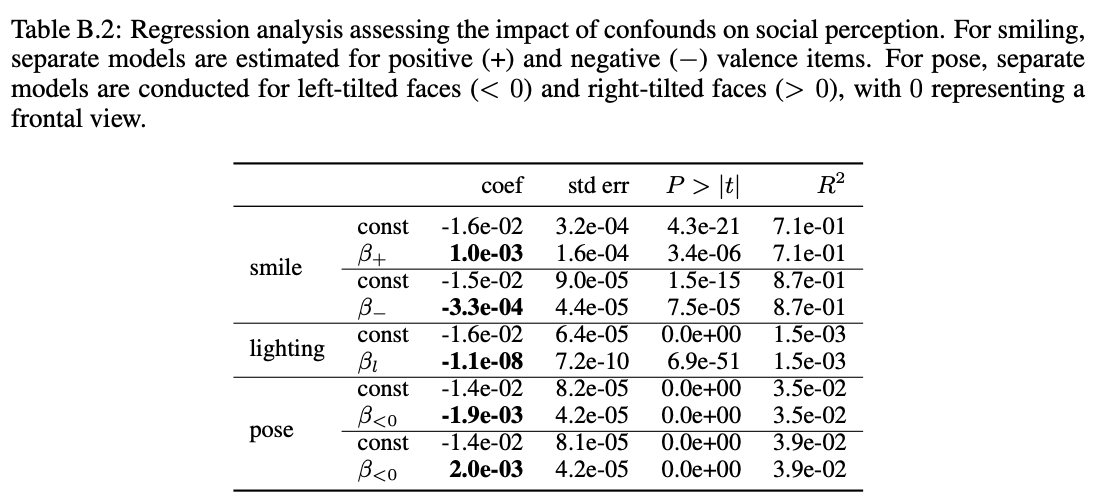
How do facial expressions influence social perception?

smiling

female

male

Asian

Black

White

smiling

Smiling

Smiling

a photo of a person
a photo of a person

Smiling

NegativeAgency

Conservative Belief

Negative Communion

a photo of a person

Smiling

NegativeAgency

Conservative Belief

Negative Communion

Smiling

Positive Agency

Progressive Belief

Positive Communion

Warmth

Competence

Smiling

Opposing valences are negatively correlated \( r_{smiling}=-0.21 \).

CLIP demonstrates human-like social perception

  • ability to make broad associations, distinguishing race and gender
  • exhibits fine-grained social judgments

How does the impact of facial expression on social perception vary across intersectional groups?

Warmth

most frowning

most smiling

sample

identity

Black Women

most frowning

most smiling

Conservative Belief

Conservative Belief

Facial expressions influence social perception differently across groups.

Limitations


  • Attribute manipulation effectiveness
    • Manipulations such as lighting or facial expressions might have differing levels of effectiveness across demographic groups.
    • Human annotators validated this, but such validation is, of course, never perfect.
  • Potential residual confounds
    • Some color confounds might still be present despite controls for background, clothing, and hair color.
  • Dataset vs. model bias
    • ​We only investigate one CLIP model.

Conclusion

1.

Ignoring unprotected attributes may lead to incorrect conclusions.

2.

Bias patterns in wild-collected datasets remain hidden due to noise.

3.

Causal image dataset + theory-based text prompts enable the discovery of new phenomena.

carina.hausladen@uni-konstanz.de

slides.com/carinah

Appendix

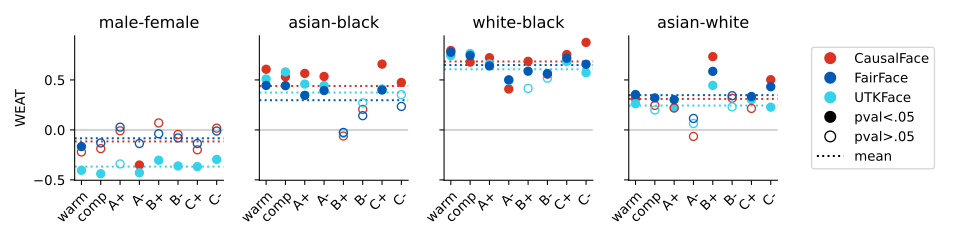
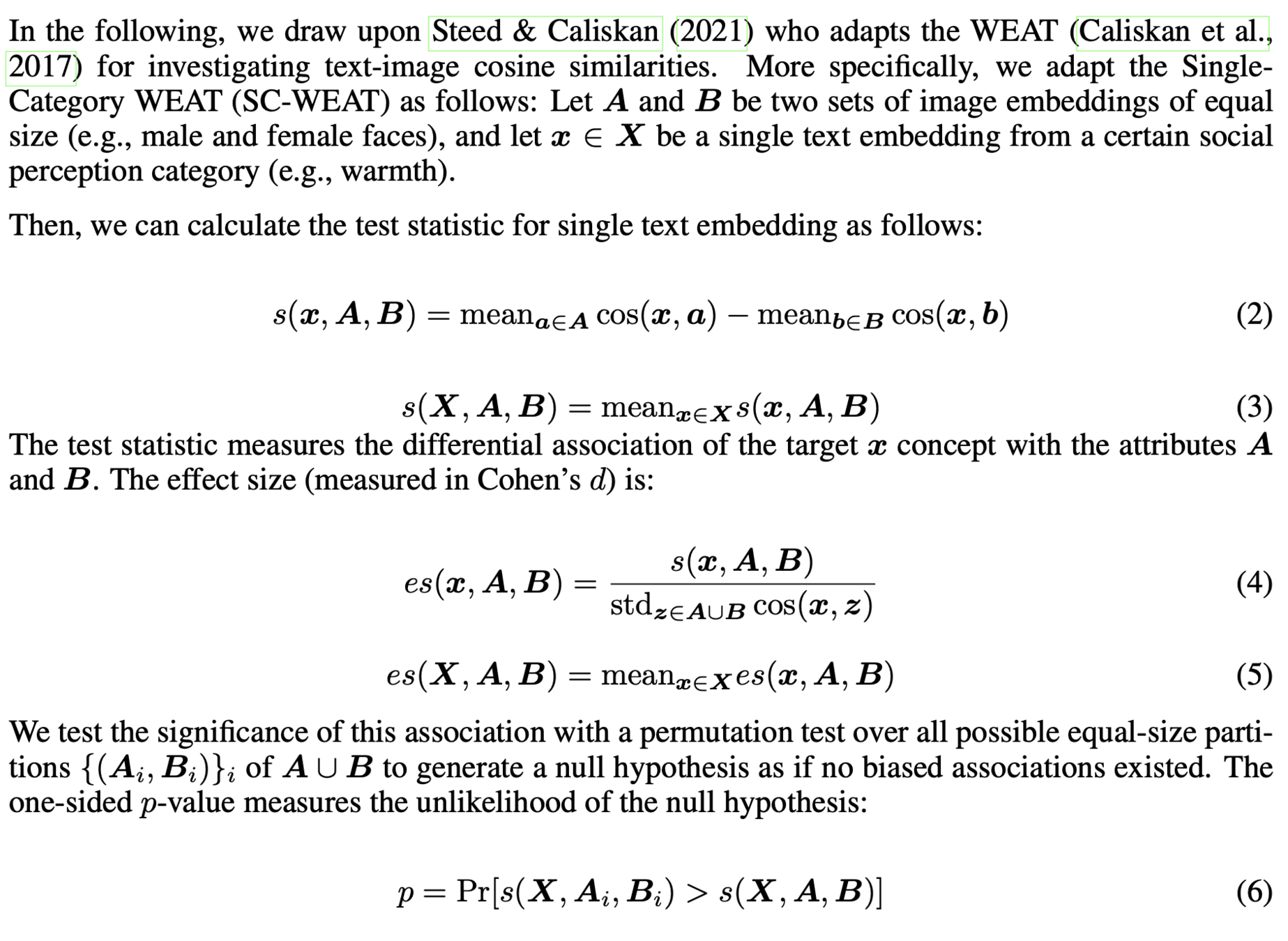
Word Embedding Association Test (WEAT)

pooled sd

asian                                     black

photo of a warm person

photo of a warm person

asian                                     black

WEAT

Kruskal-Wallis  \(\chi^2\) = 1.6,
p-value = 0.4

protected and non-protected attributes

+

Bootstrapping Variations 

  • We randomly choose two distinct values, \(x_1,x_2 \sim X\), for the chosen dimension (e.g., white and black).
  • For each pair of values, we select the respective image embeddings, \(i_1(x=x_1), i_2(x=x_2)\) that are equal in all other dimensions (in this example: gender, age, smiling, lighting, and pose).
  • We then compute the difference in cosine similarities between each image embedding and a text embedding \(t\), defined as \(\Delta(t, i_1, i_2) = \lvert \cos(i_1, t) - \cos(i_2, t) \rvert\).
  • This process is repeated 1,000 times, generating a bootstrap distribution of \( \Delta \) values.
  • This distribution describes the impact of the specific dimension on the cosine similarity of image embeddings and text embedding.
     

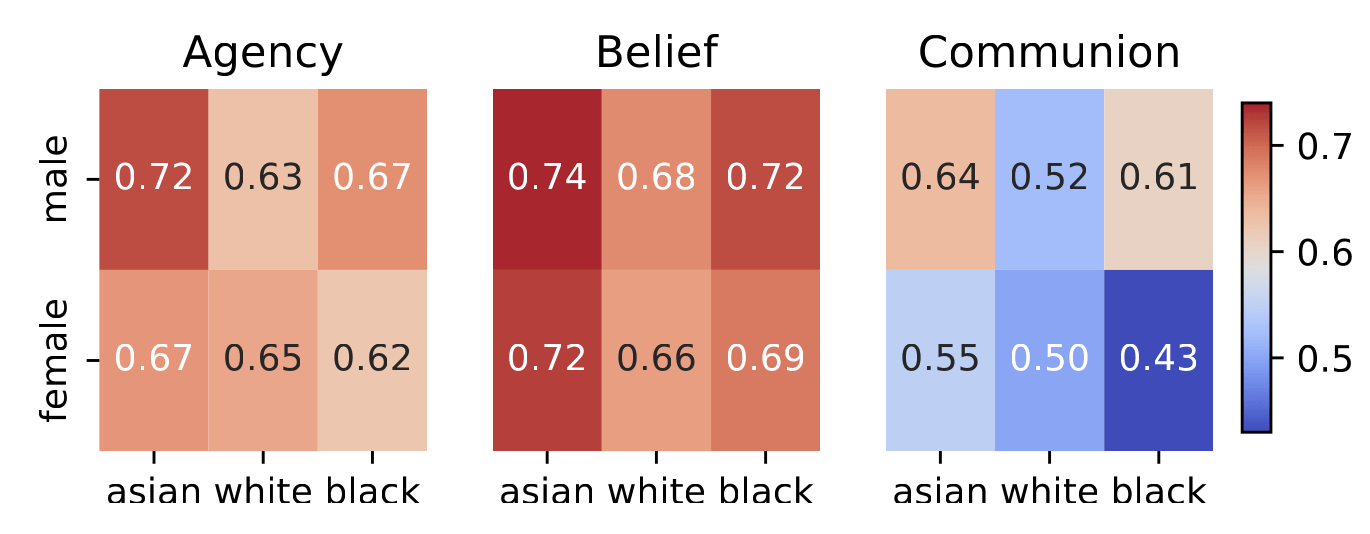
Heatmap of Pearson correlation coefficients of positive and negative valence dimensions of the ABC model.

Smiling

a photo of a person
a photo of a person

Social Perception in VLMs

By Carina Ines Hausladen

Social Perception in VLMs

Social Perception in VLMs

  • 213