Corentin Cadiou
cadiou@iap.fr
Researcher @ CNRS (France)
https://github.com/cphyc/
Tracing Cosmic Evolution:
From the CMB to the Web, the CGM, and Galactic Disks




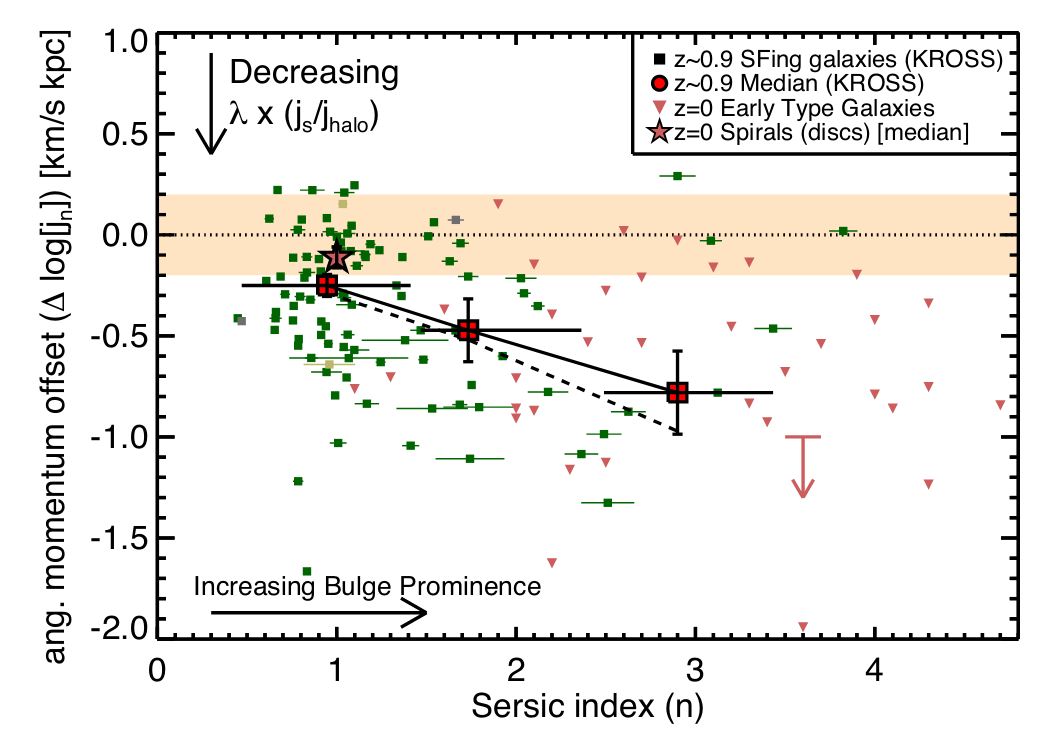
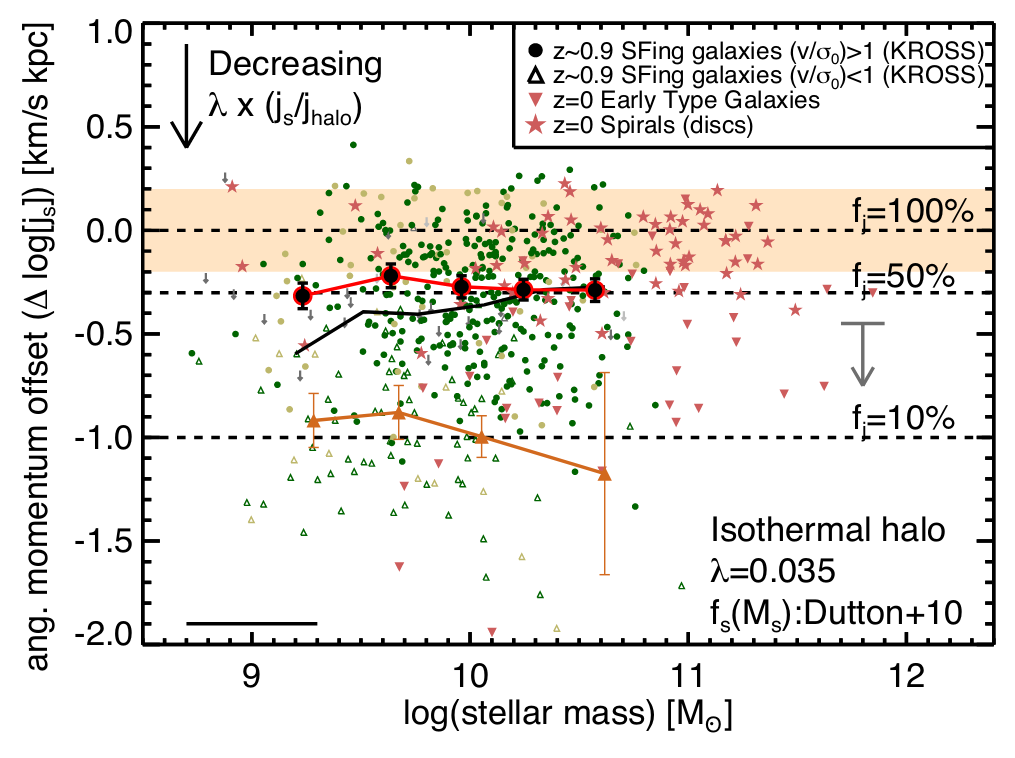
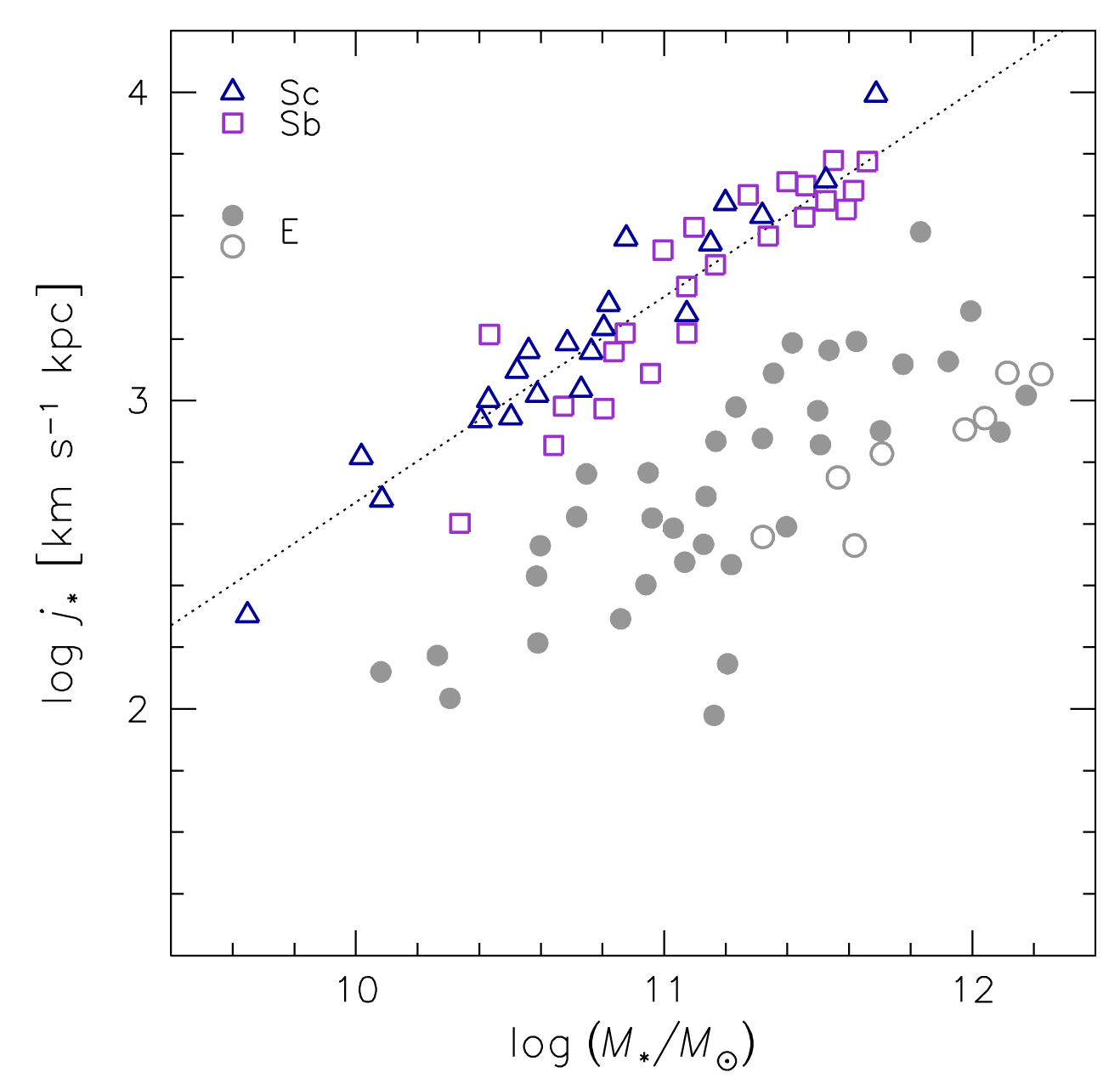
Harrison+17 (KMOS, \(z=1\))
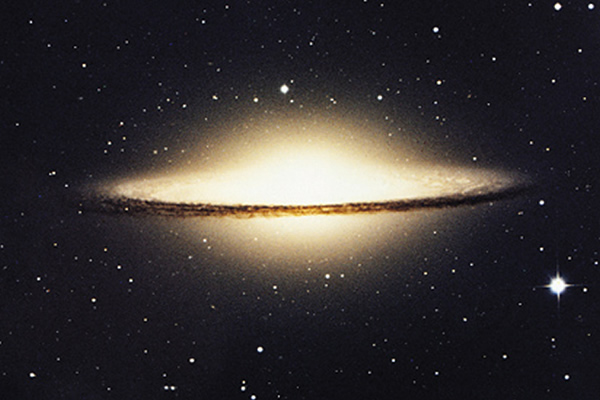
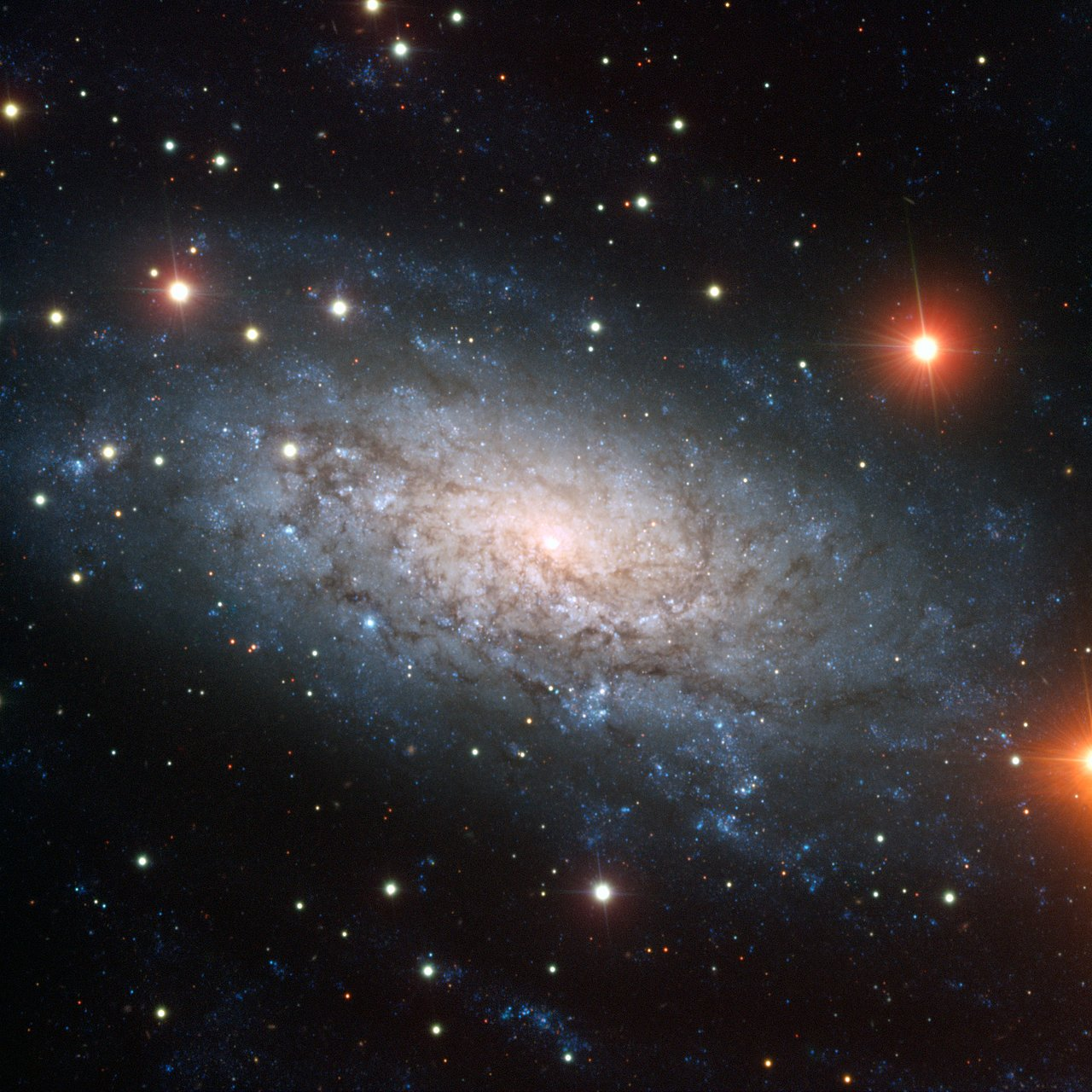
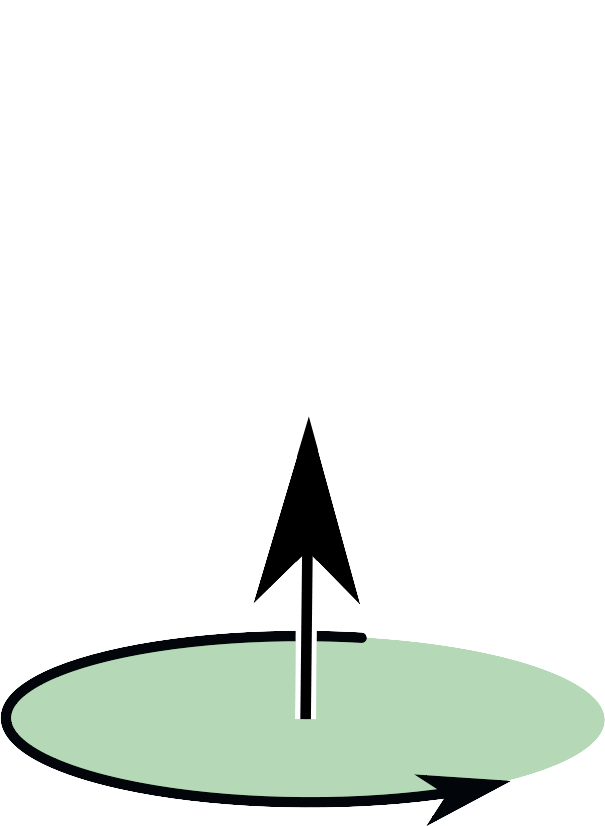
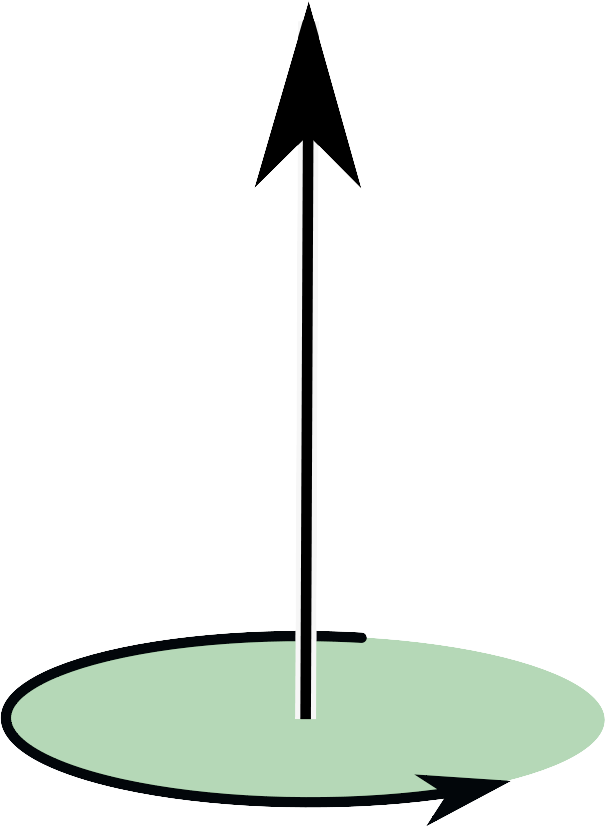
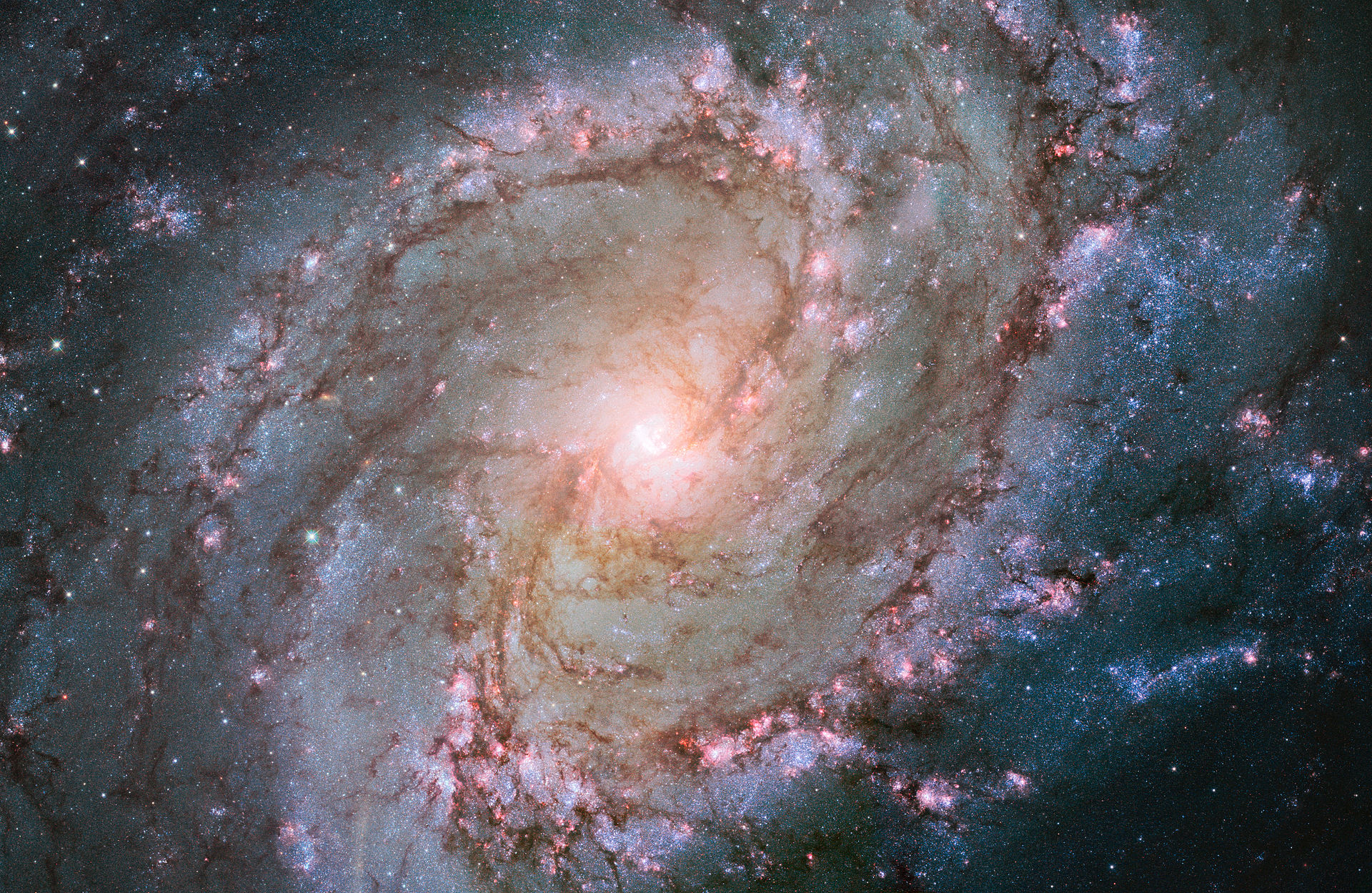
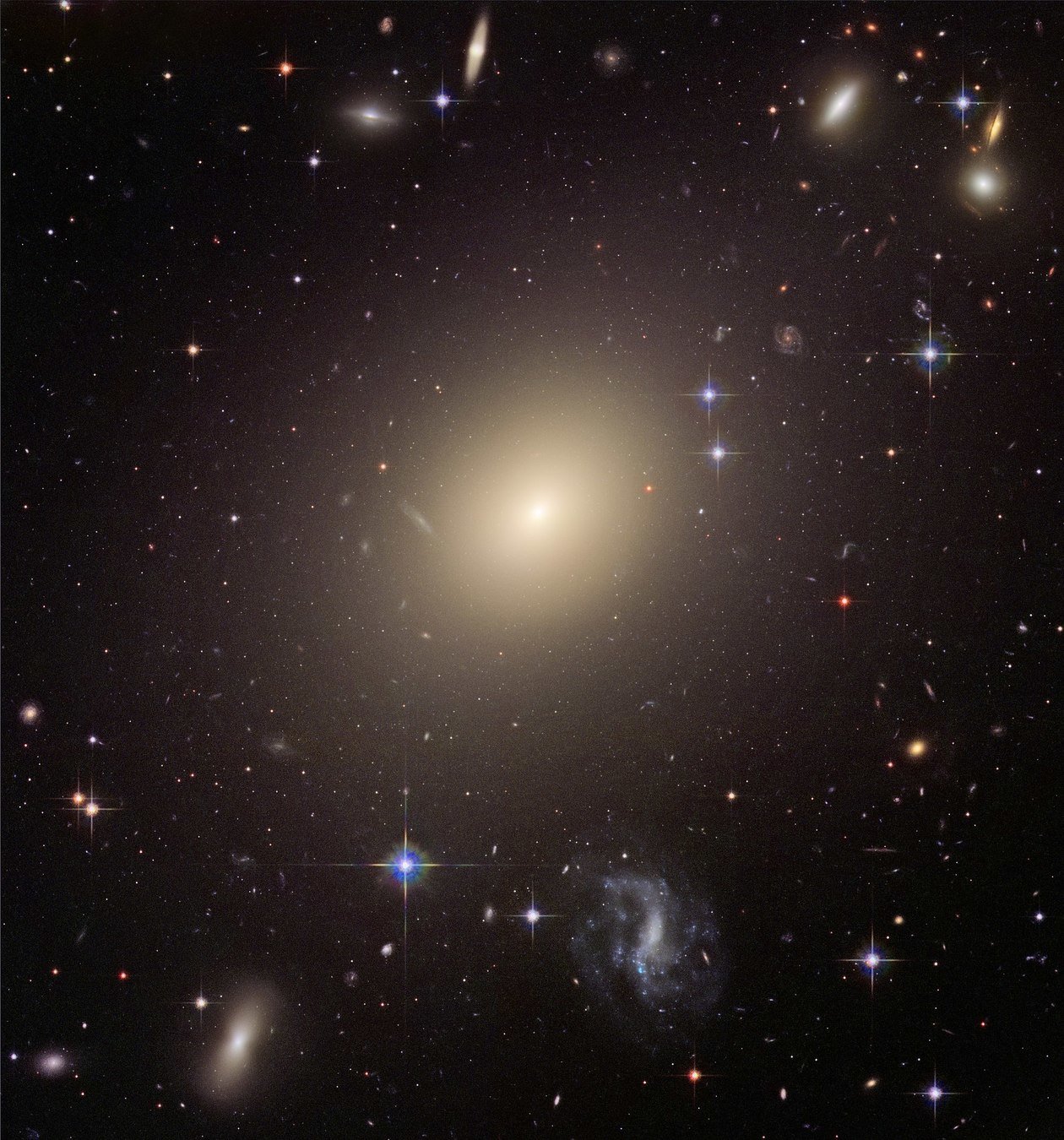
Spiral galaxies \(\leftrightarrow\) high \(J_\star\)
What's the arrow of causality?
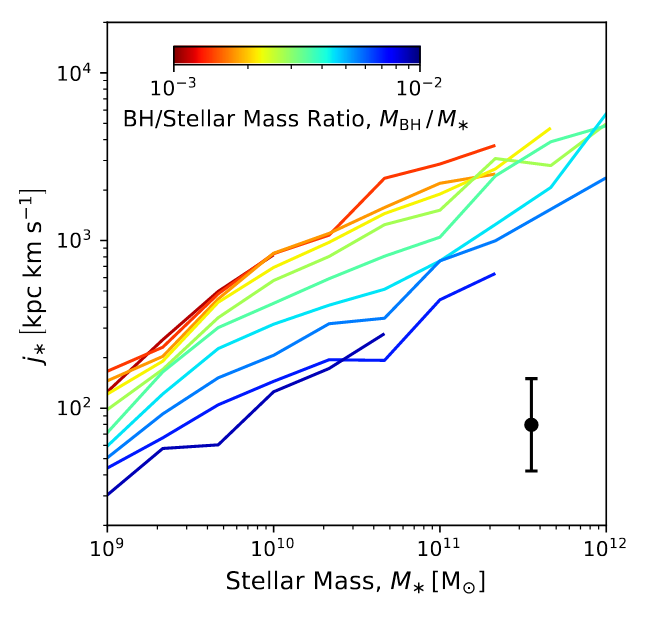
Rodriguez-Gomez+22 (TNG)
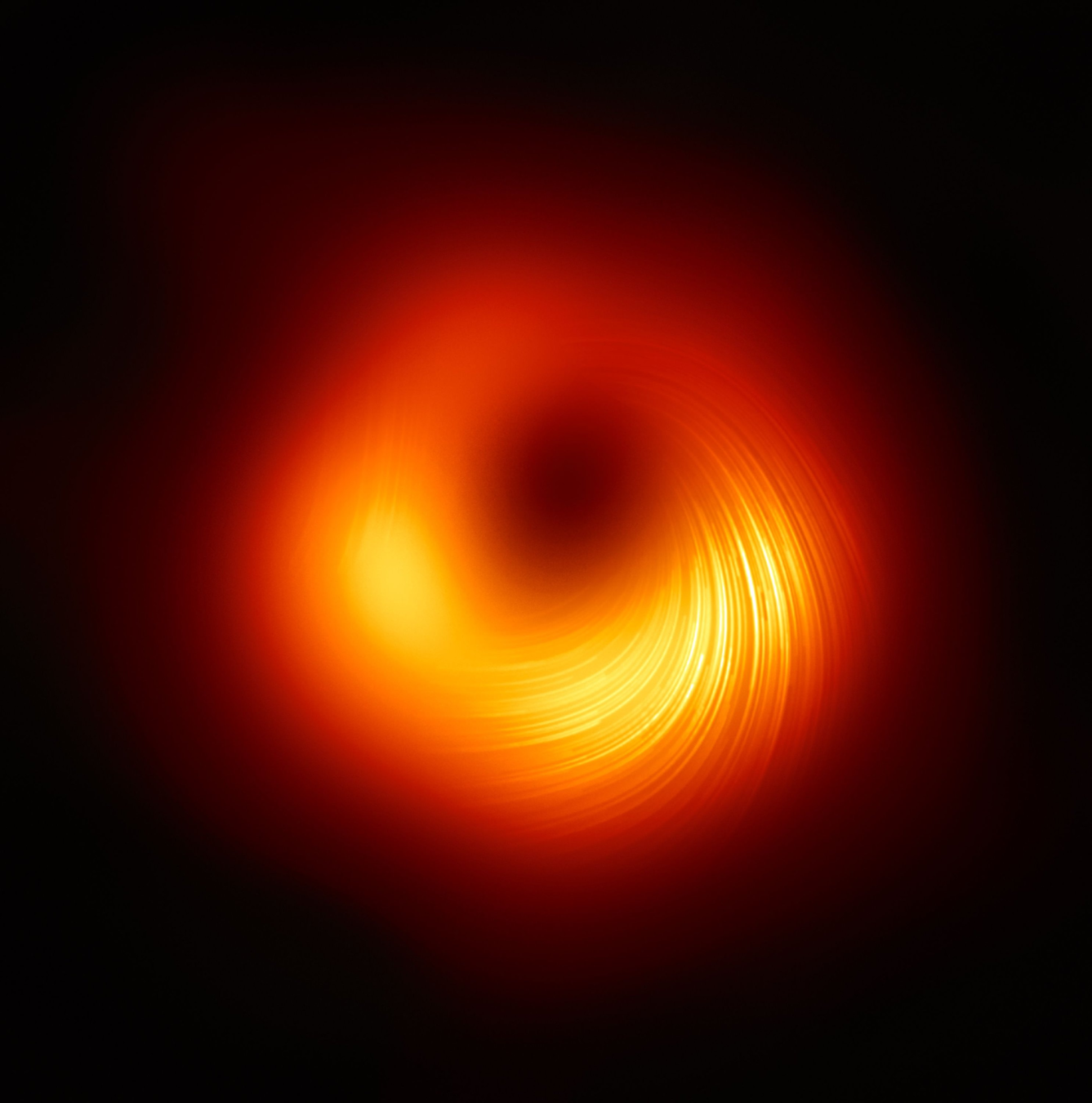
Angular momentum: controls disk formation?
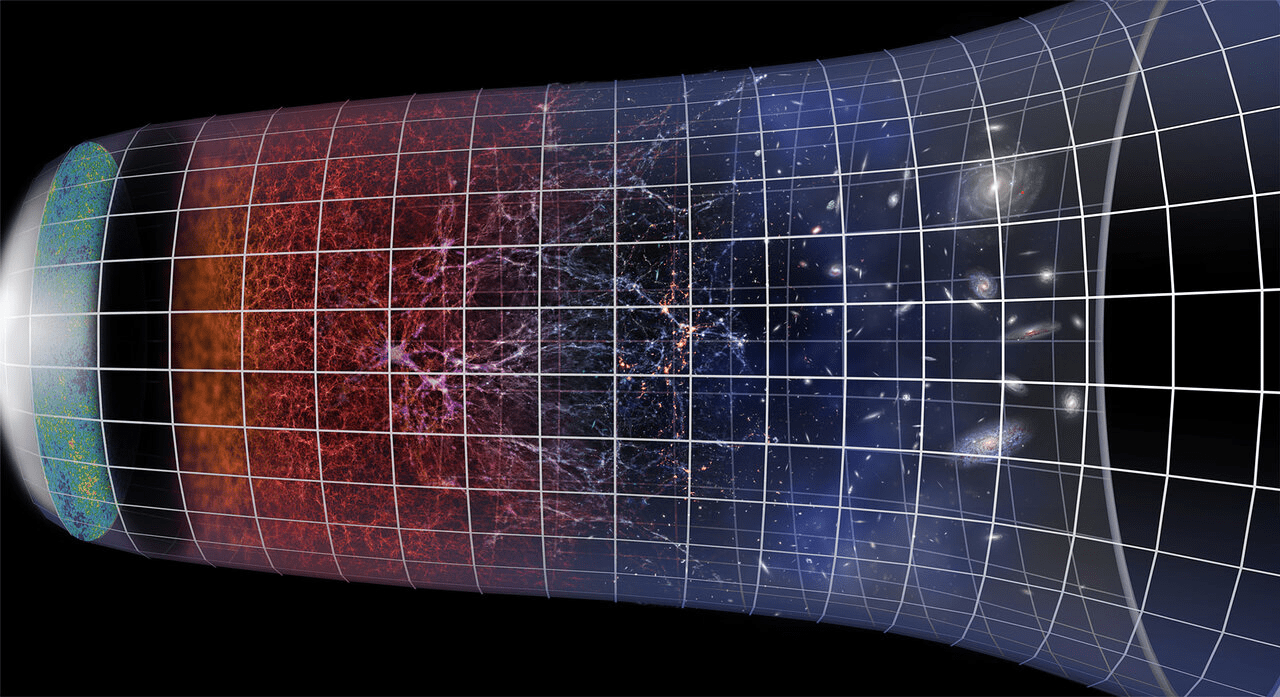
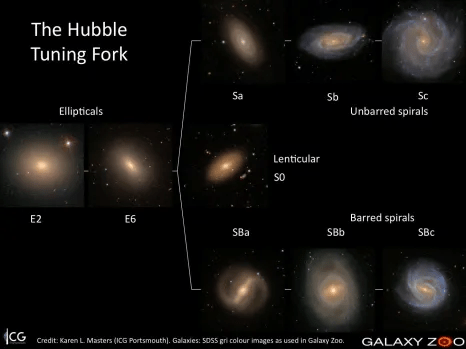
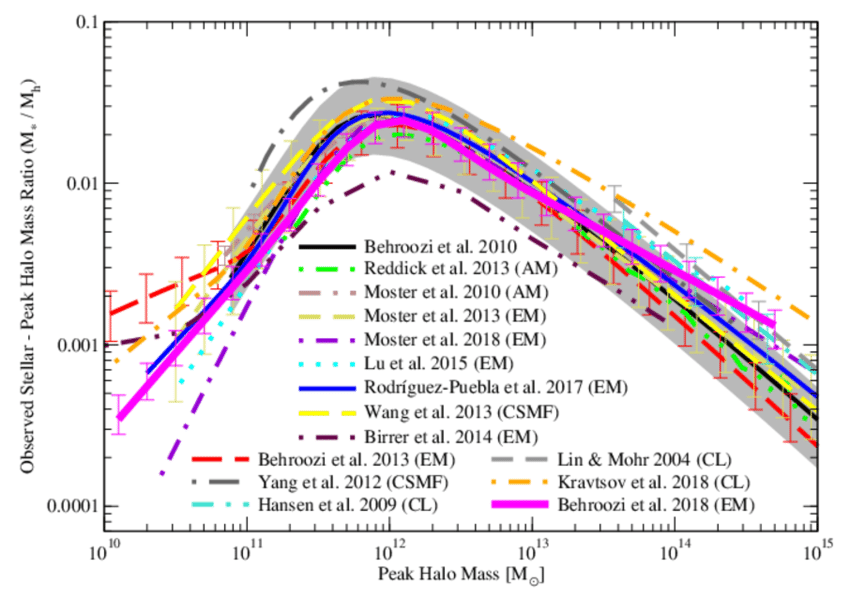
SMHM - Behroozi+19 | Romanowsky & Fall+13
Main driver of galaxy formation is mass
⇒ halo-mass main driver

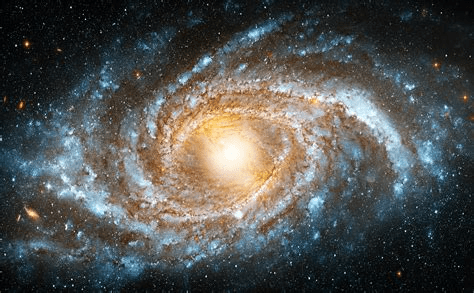
2nd parameter is angular momentum
⇒ origin much less clear
Stellar ang. mom.
Stellar mass
Disk dominated
Massive
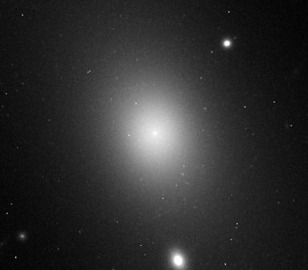
elliptical
Stellar mass / halo mass
Halo mass
Dark matter
\(80\%\) of mass
Gas
\(20\%\) of mass (initially)
Stars
\(<1\%\) of mass
Galaxy formation in a 🥜 shell
- Dark matter halo formation from cosmic fluctuations
- Gas condenses in DM halo
- Stars form out of gas
- Supernova + AGNs reinject energy


T [K]
Cooling rate
\(\dfrac{\mathrm{d}T}{\mathrm{d}t} = \Lambda(T) \rho^2\)
increasingly non-linear
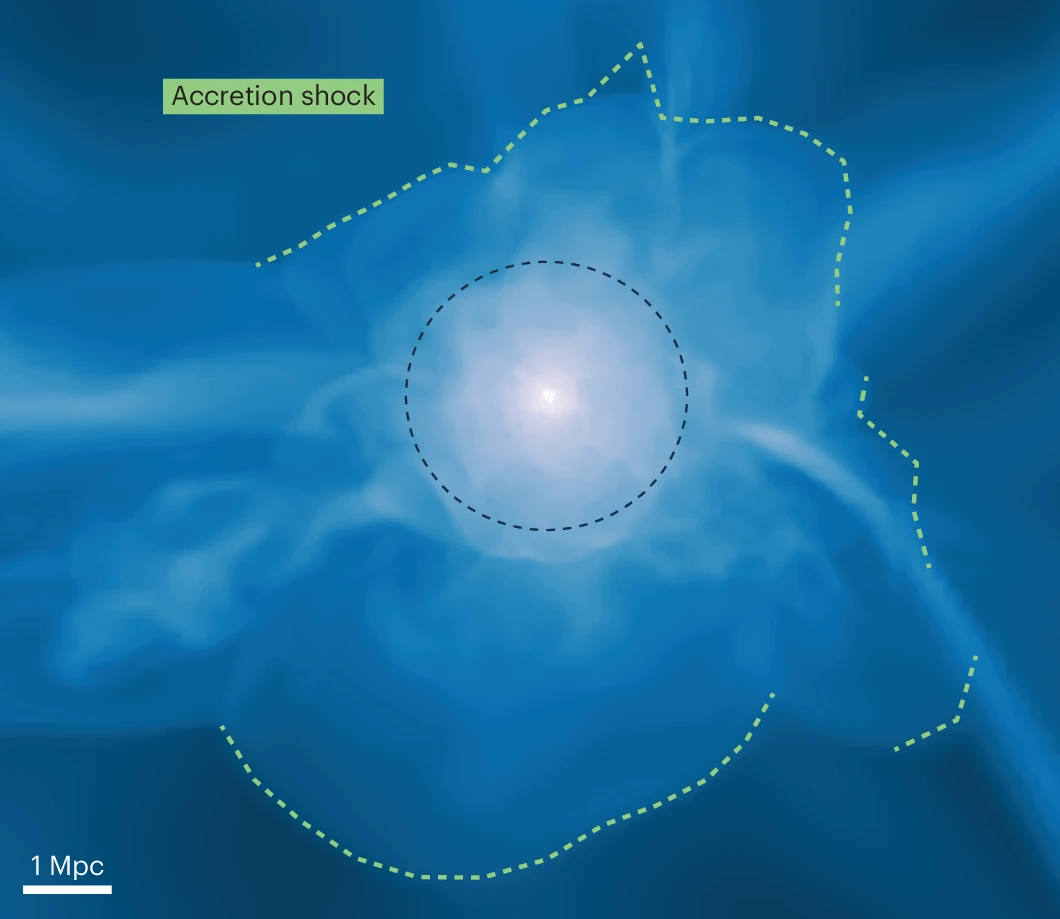
Accretion shocks, adiabatic heating, KH instabilities, ...
Vallés-Pérez+24
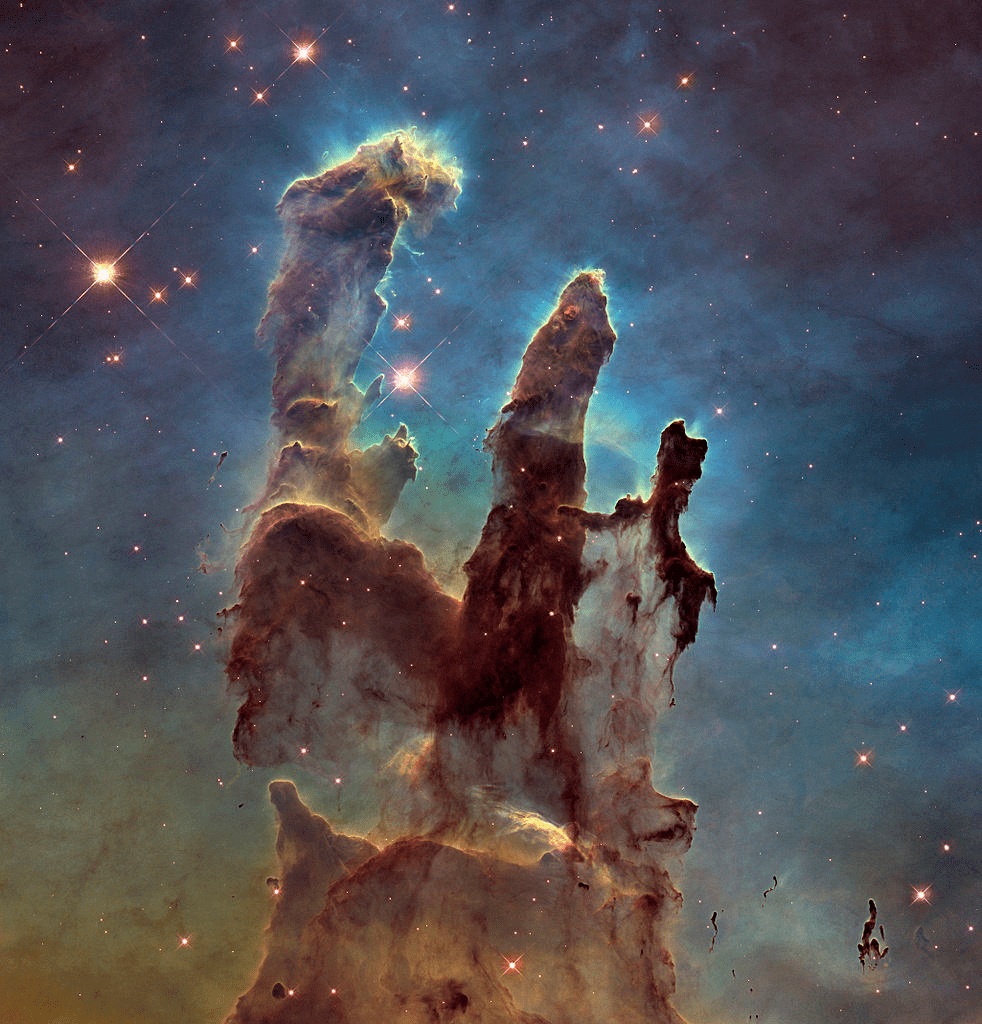
Stars form out of
cold gas

increasingly non-linear
increasingly chaotic?
⇒
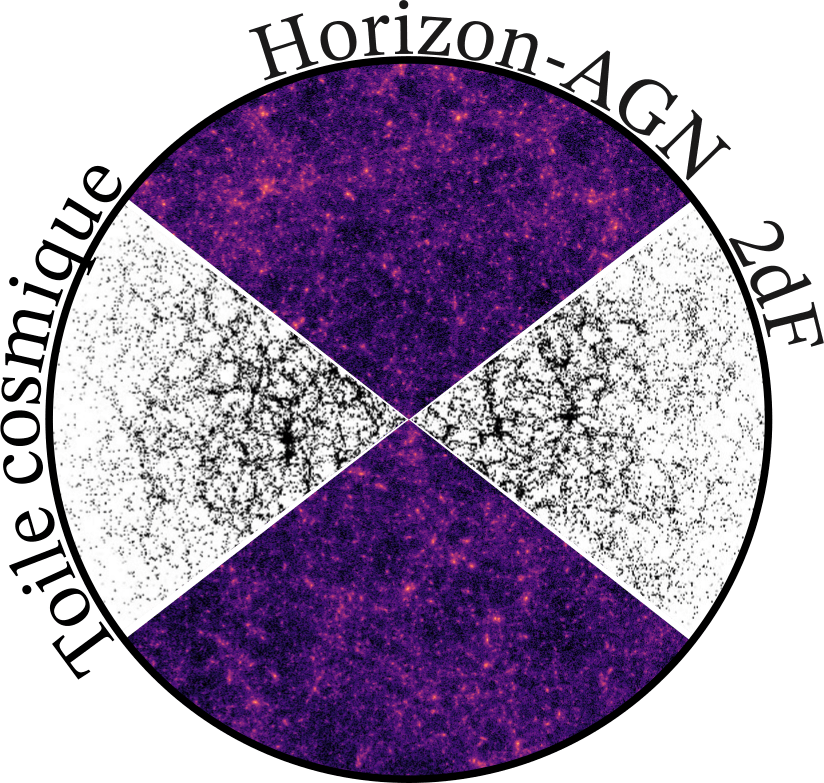
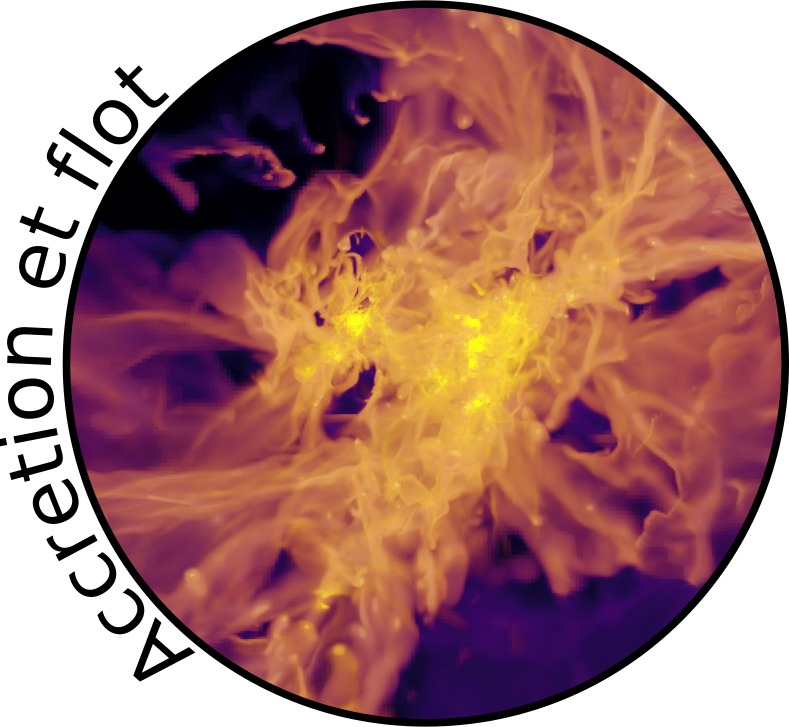
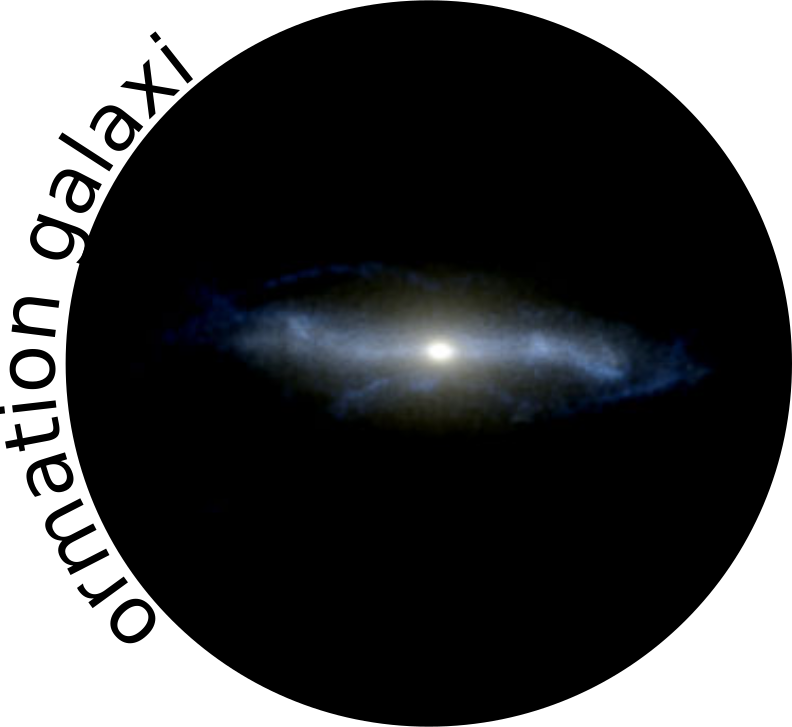
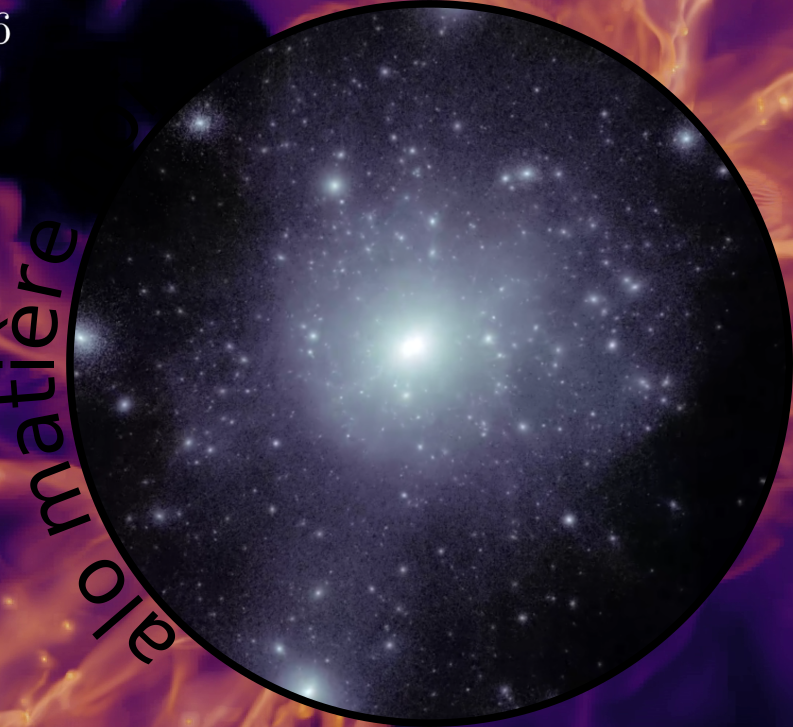
Galaxy formation in a 🥜 shell
- Dark matter halo formation from cosmic fluctuations
- Gas condenses in DM halo
- Stars form out of gas
- Supernova + AGNs reinject energy
kpc
100 kpc
Mpc
Gravitational
collapse
Baryonic physics, star form, AGNs
Feedback processes
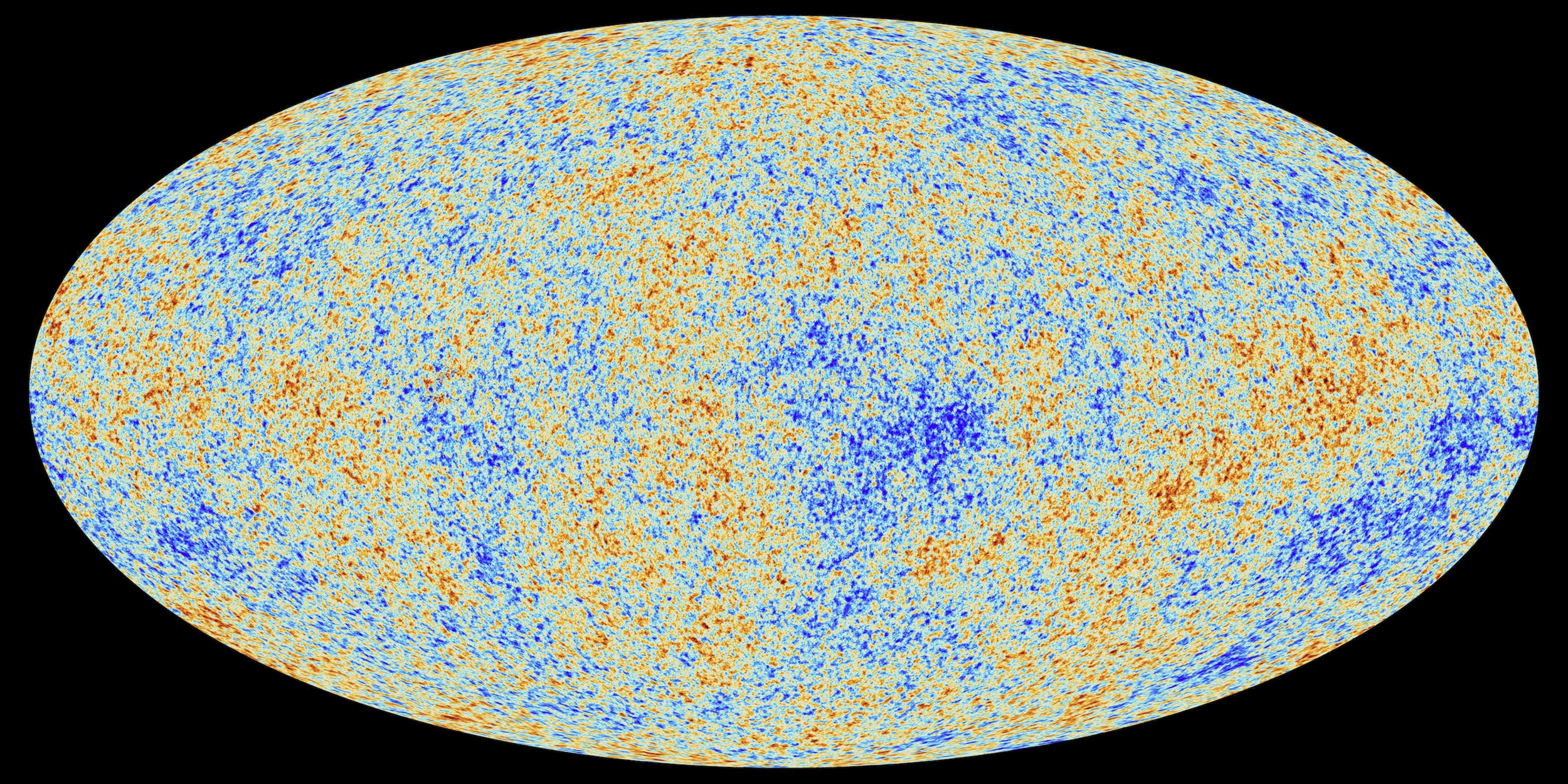
Perturbations
Simulations
Perturbation
theory
Intrinsic alignment measurement: Ganeshaiah Veena+ 19 · Alignment: M. Sachs
Neighbouring galaxies' shapes are aligned
(on the plane of the sky)
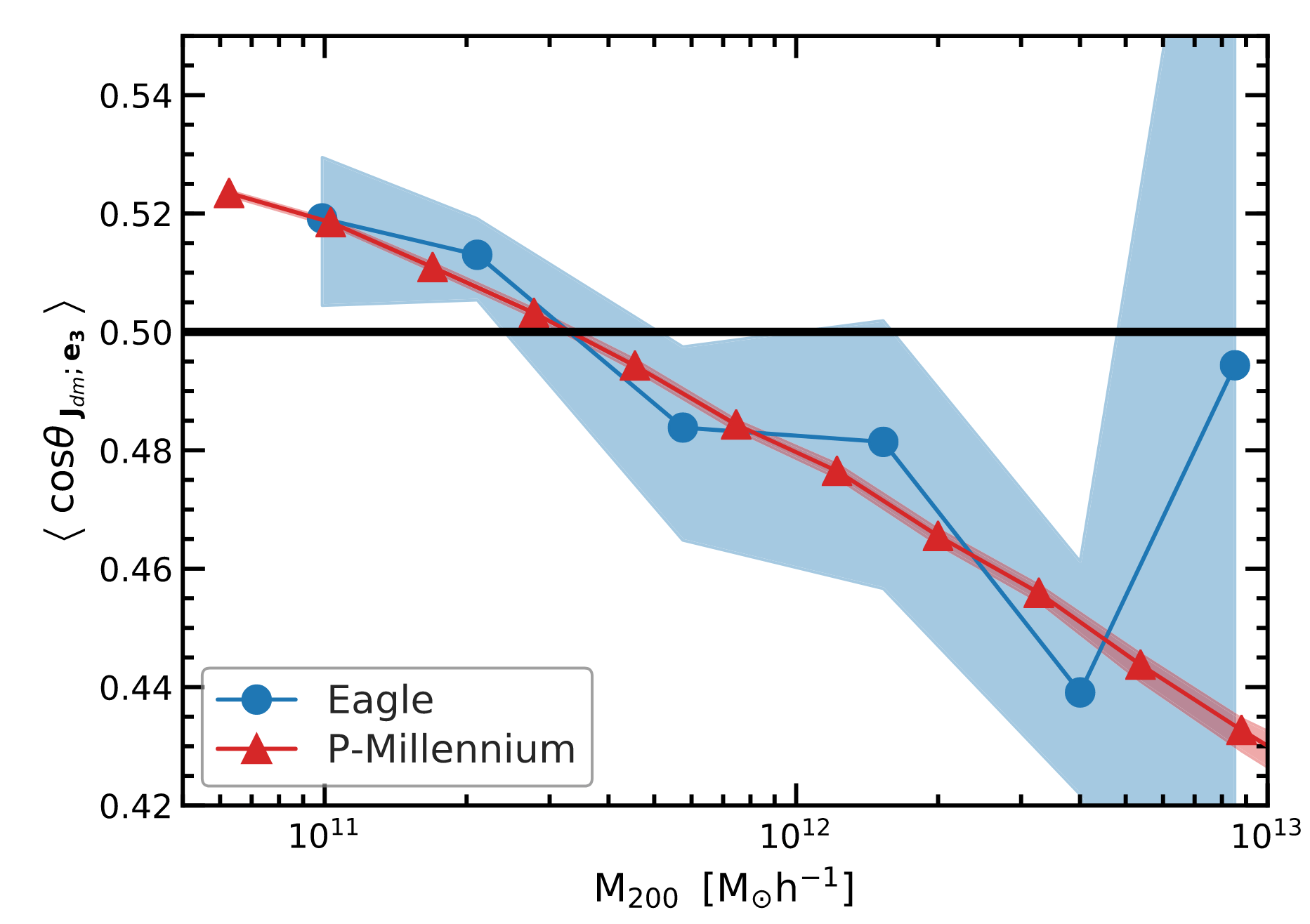
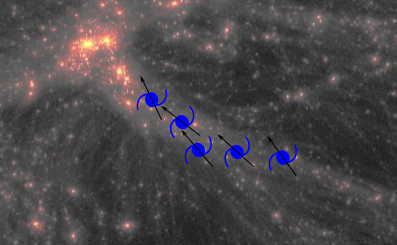
Intrinsic alignment
Baryon-dominated?
Astrophysical signal
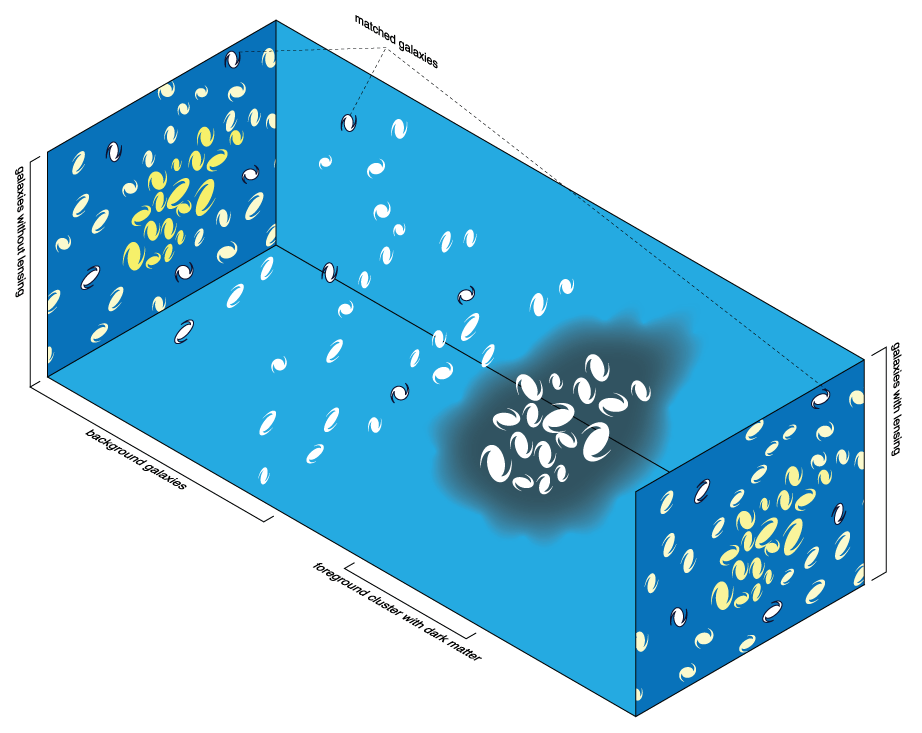
Weak lensing
L.o.s. probe of
dark matter density
Cosmological signal
+
⇒

Angular momentum and cosmology
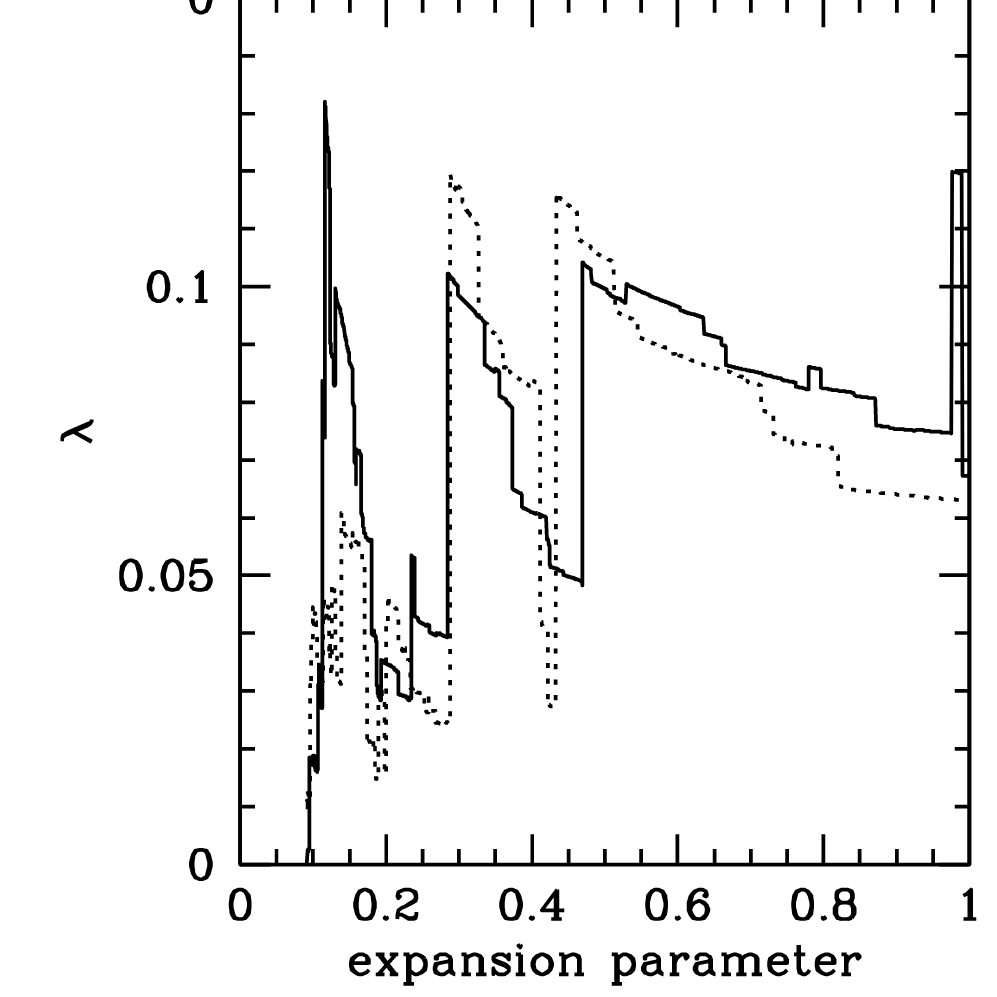
Tidal torque theory: White 84
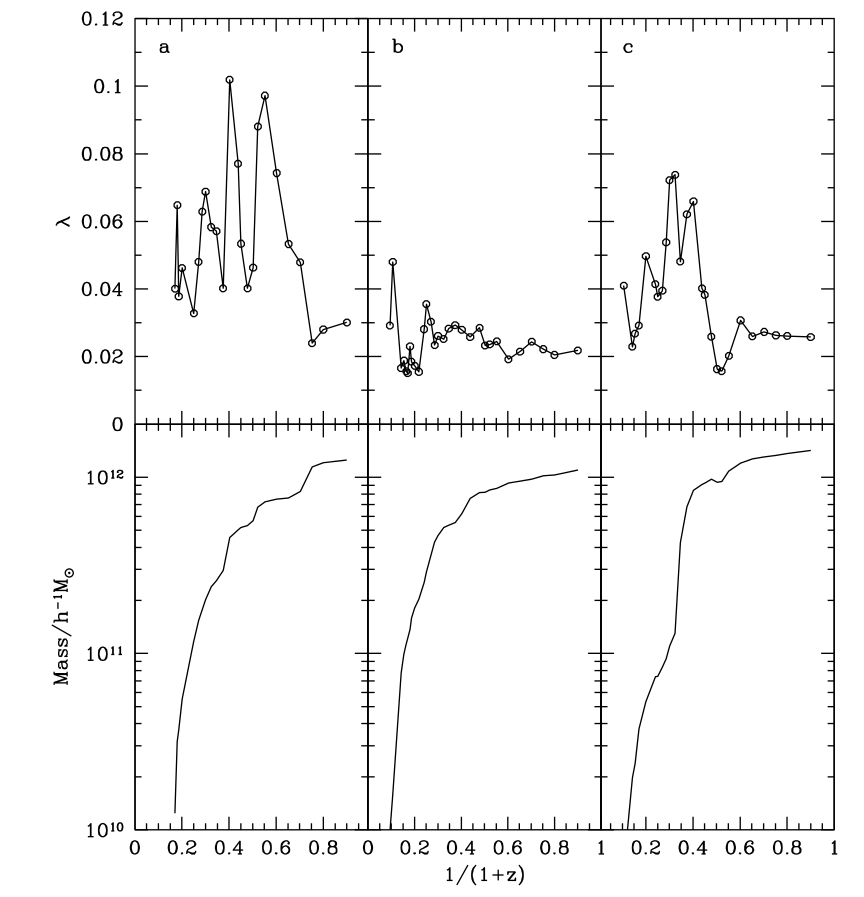
Stochastic spin: Vitviska+ 02, Beson+ 20
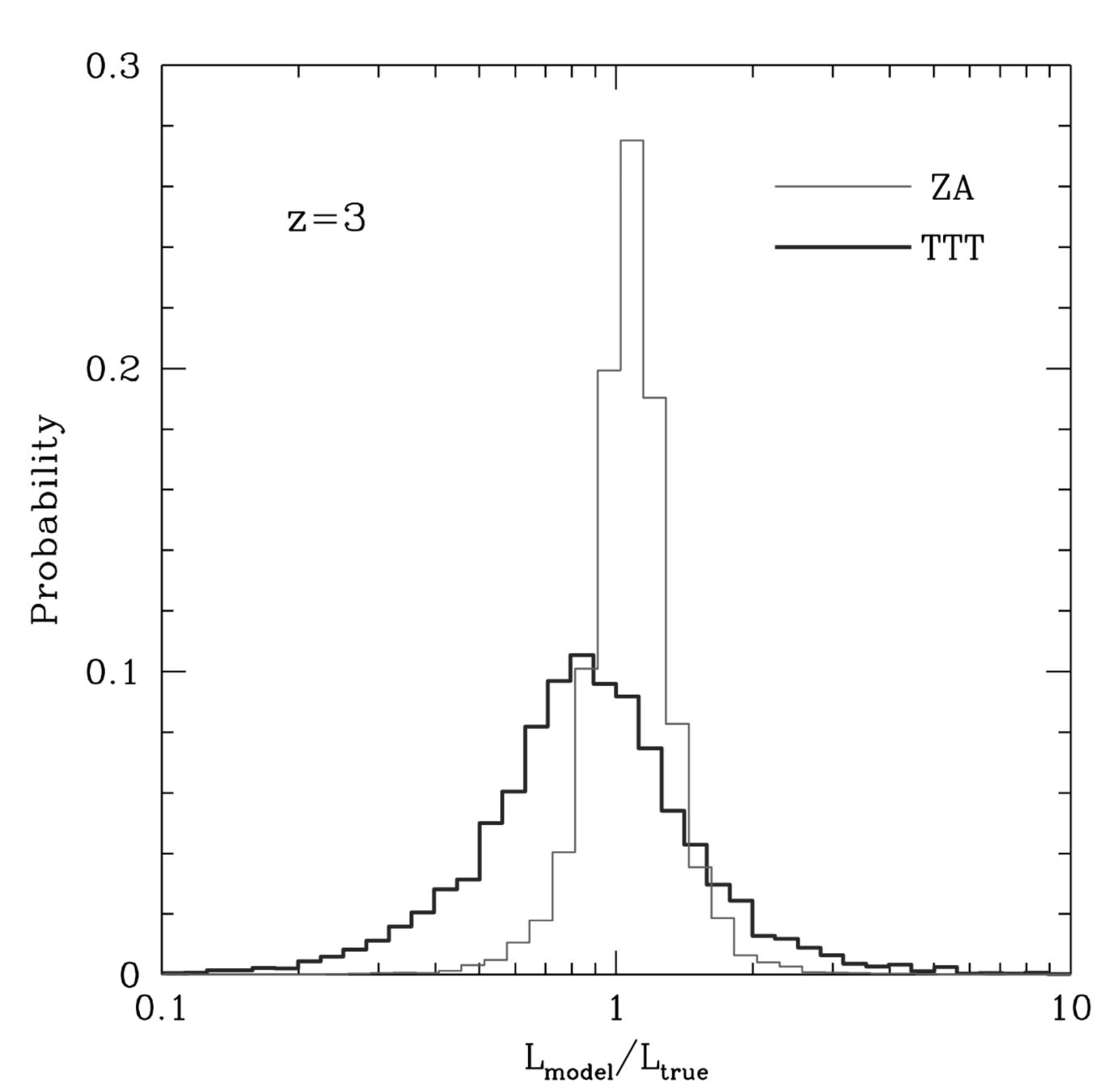
Spin prediction, Porciani+ 02
Theoretical predictions of angular momentum are, at best, inaccurate
First complication
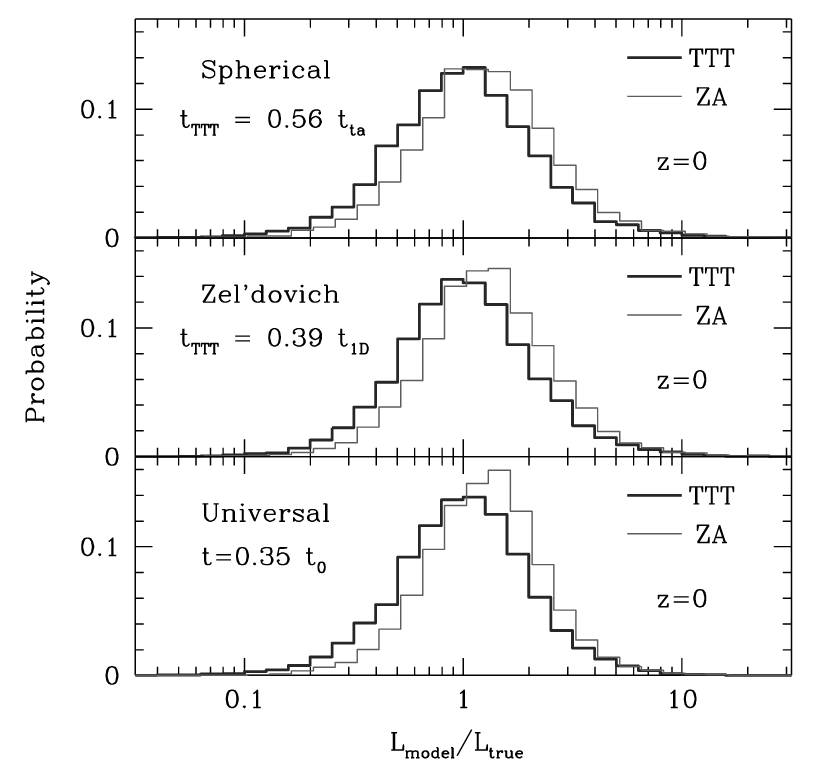
\(\pm 100\%\)!
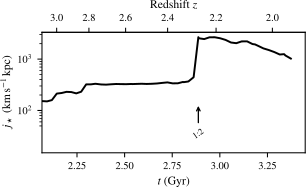
Angular momentum jumps hapazardly at each merger ⇒ “mergers are chaotic”
Spin prediction / measured
(in simulation)
Note: spin is \(\lambda \propto J/M_\mathrm{vir}R_\mathrm{vir}V_\mathrm{vir}\)
Second complication
Let's be optimistic and assume we can predict DM spin
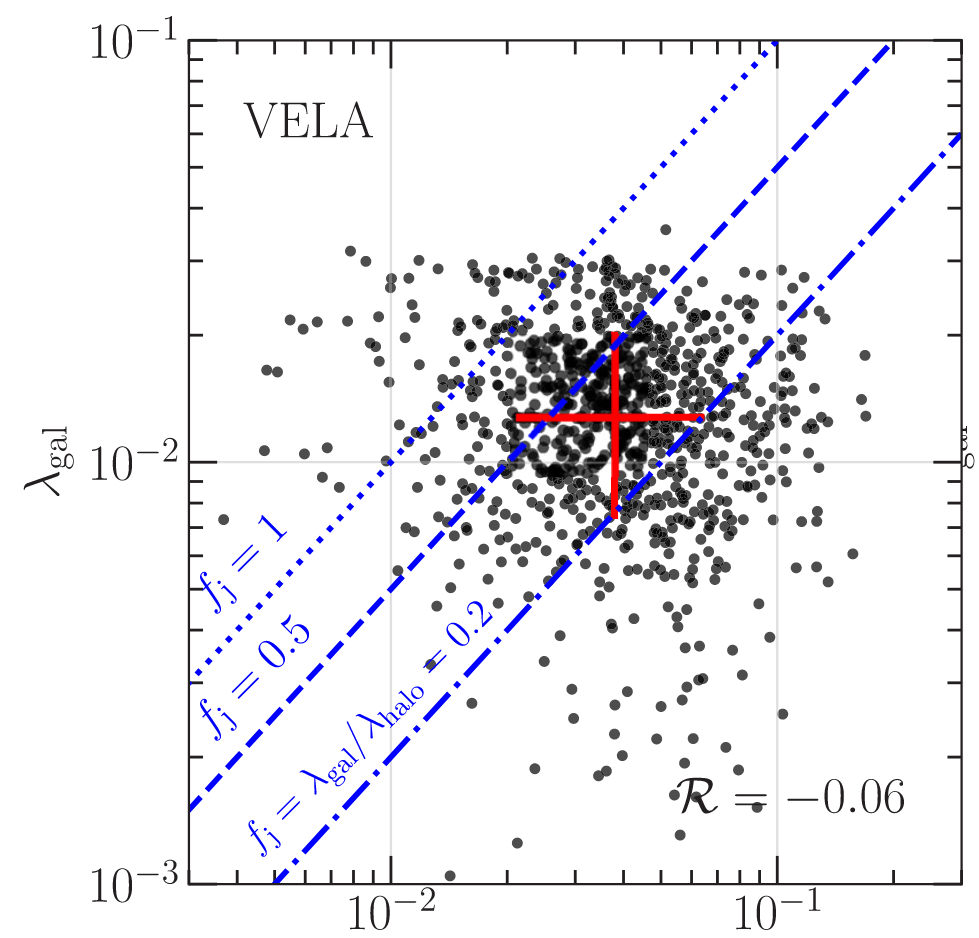
DM spin is not even a good predictor for the galaxy's!
Jiang+ 19
\(\lambda_\mathrm{DM}\)
Dark matter angular momentum
Galaxy angular momentum
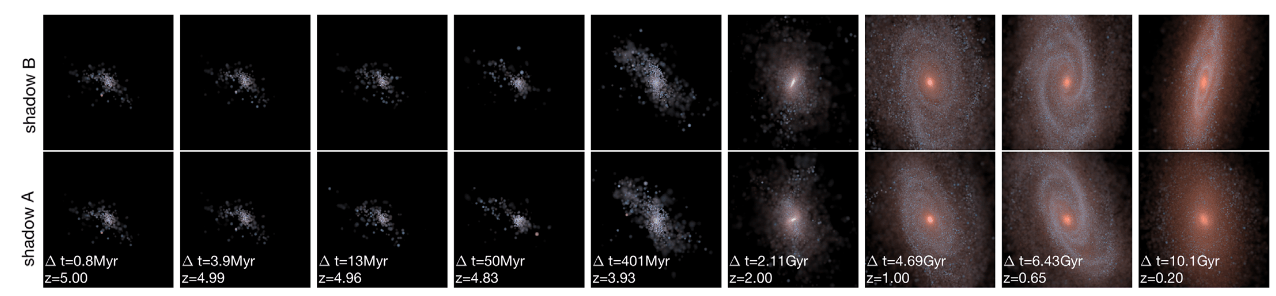
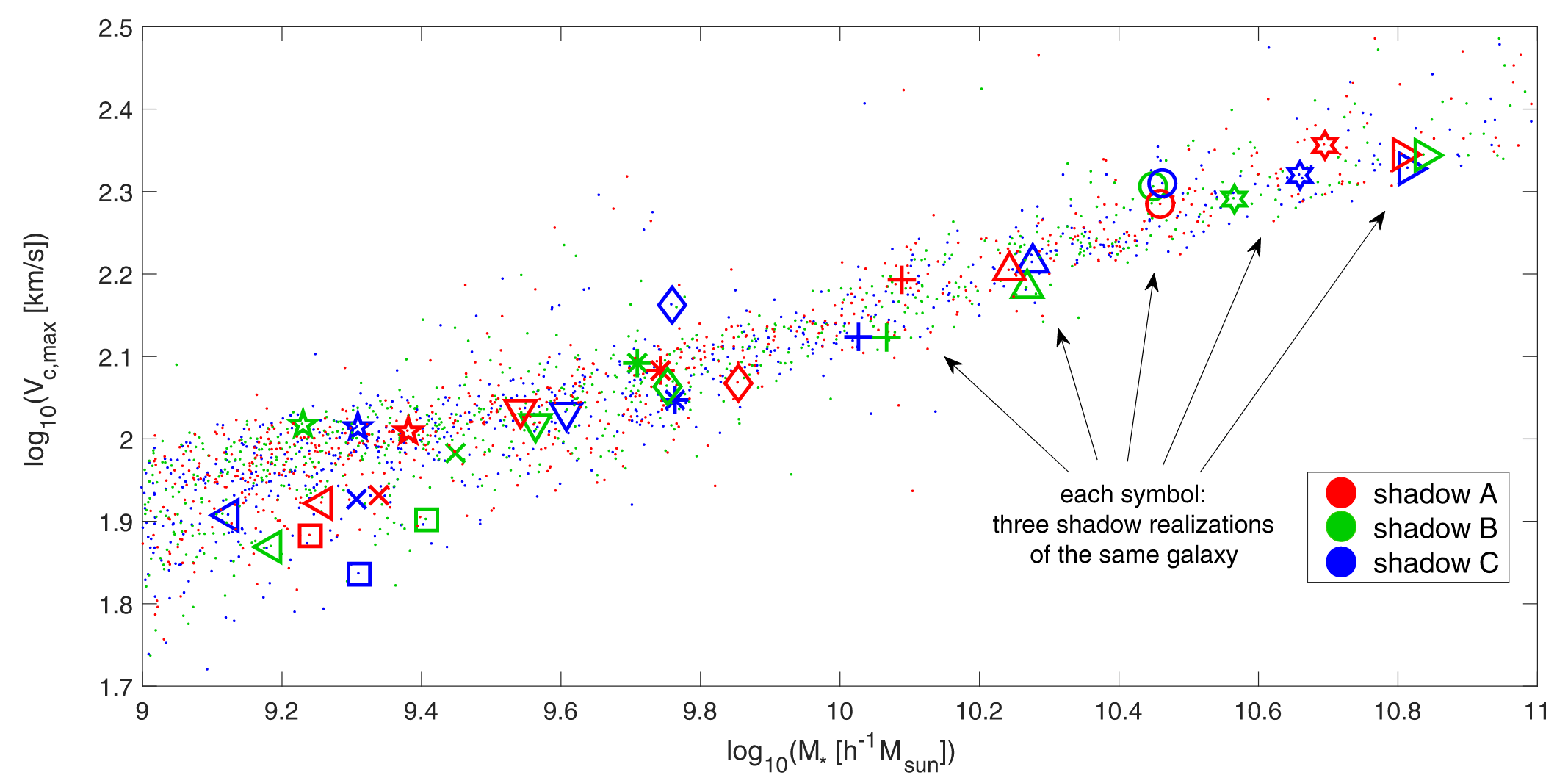
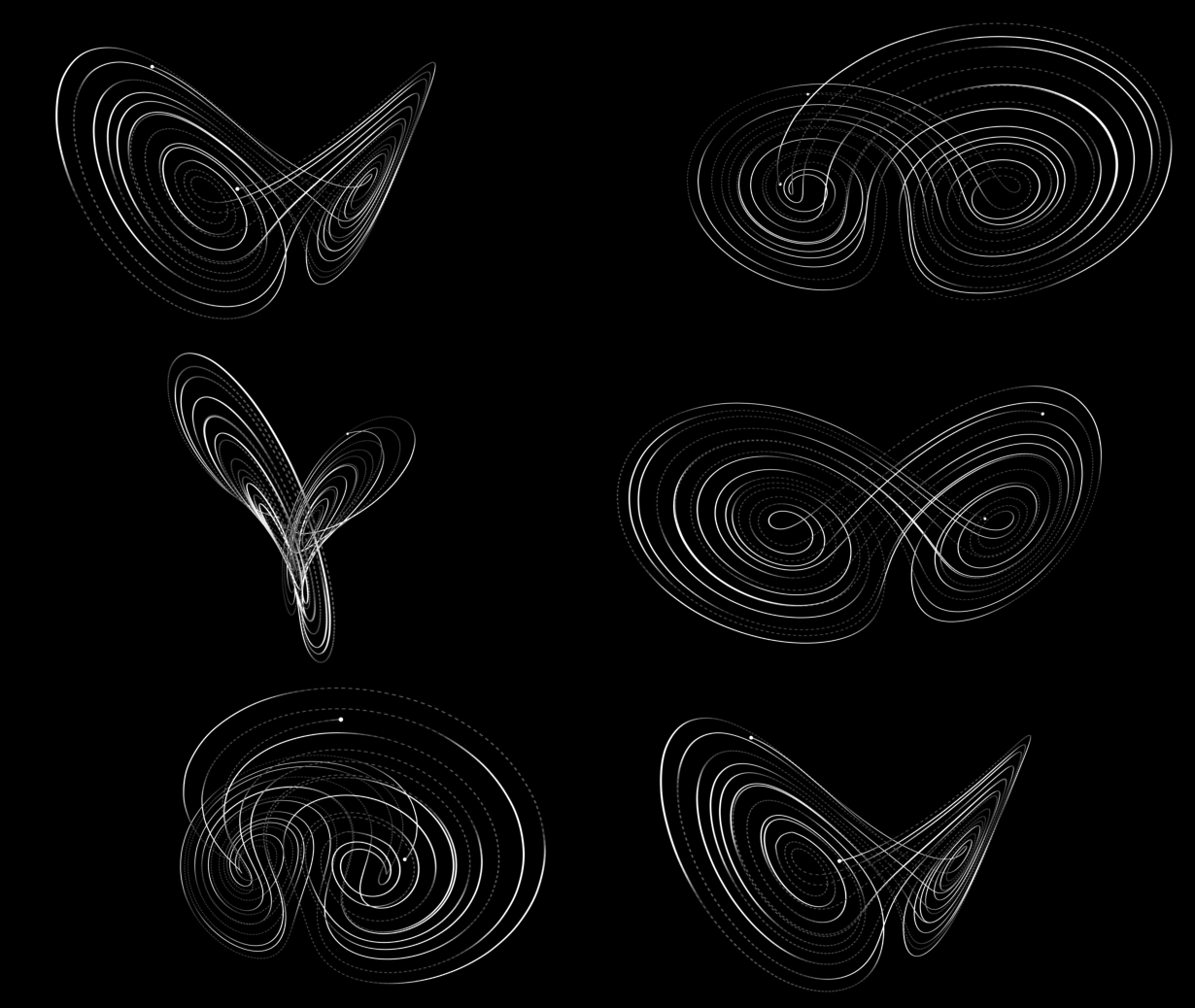
Butterfly effect: Genel+ 19, see also Thiébaut+ 08
Third complication
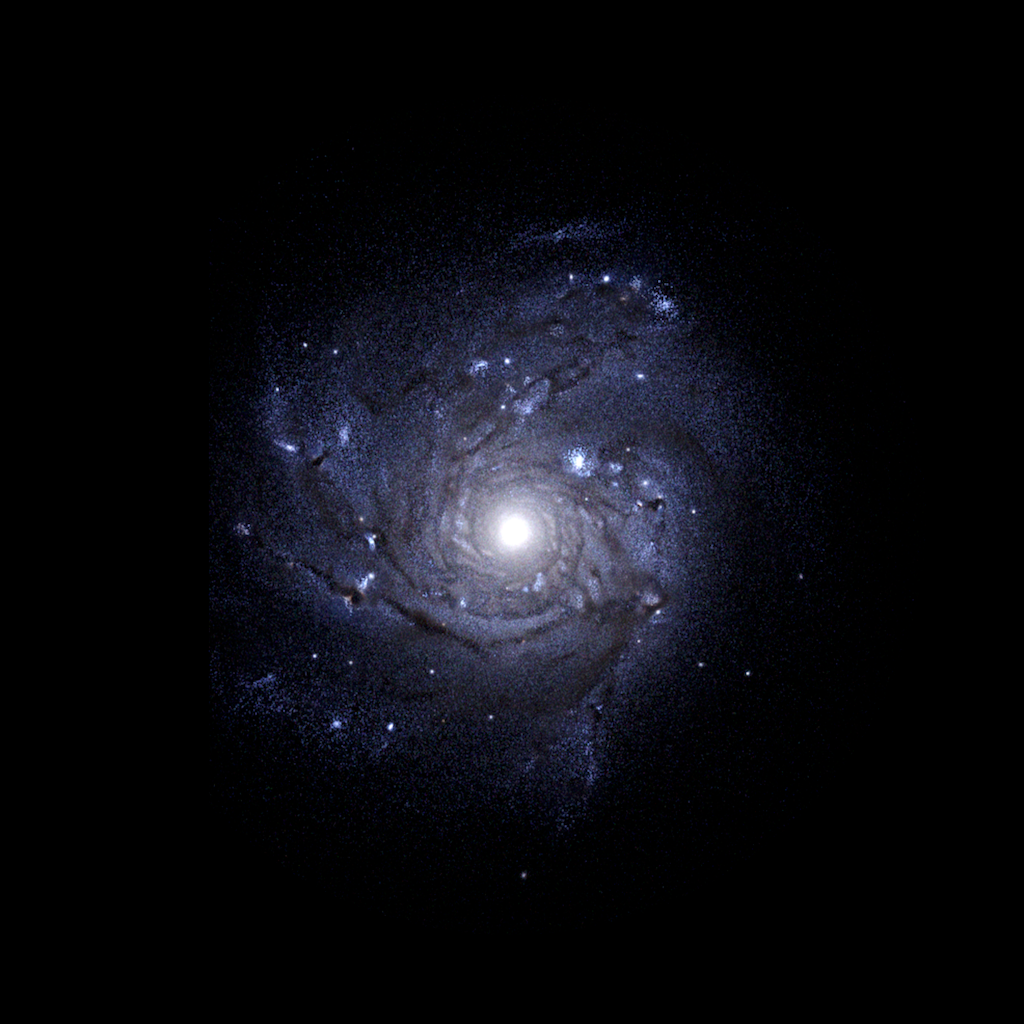
Resimulating the same galaxy twice yields different results ⇒ galaxies are chaotic
Same galaxy
multiple times
Why can't we predict angular momentum?
- No good model for dark matter angular momentum,
- Stellar AM poorly correlates with DM AM,
- Galaxies seem chaotic.
But are galaxies truly chaotic?
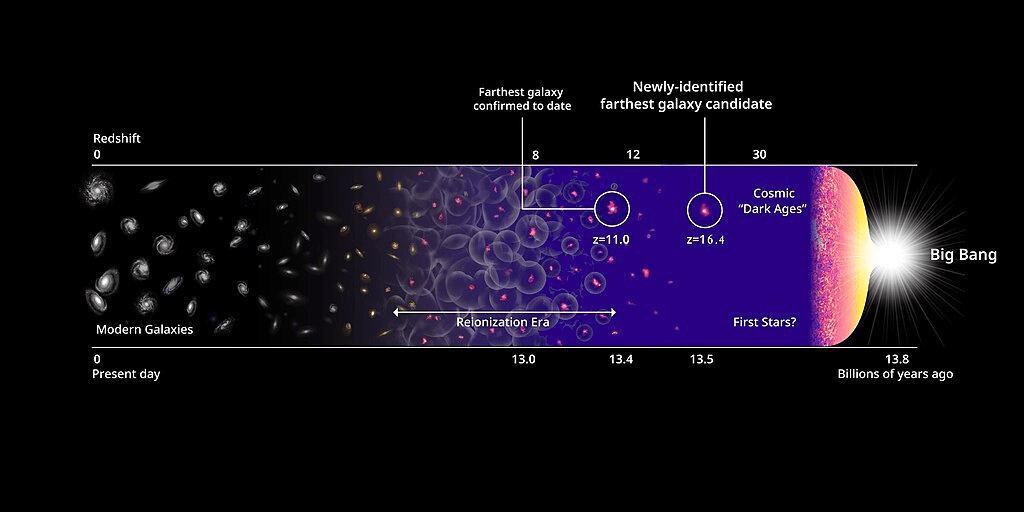
Credits: Dennis Bogdan
How complex are galaxies?
Results from Cadiou+ 24a
1
How complex are galaxies?
Results from Cadiou+ 24a
1

Example of the S-curve:
2D manifold embedded in 3D
Compute \(k\)-nearest neighbors
→ edges of a graph
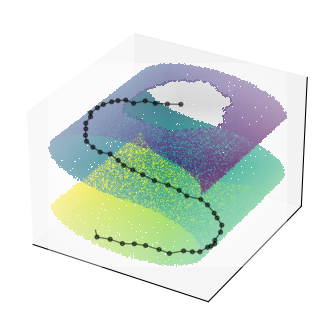
Draw a point
→ find shortest path to all others
Take a radius
count number of points, \(p\) within \([r, r+\mathrm{d} r]\)
\(\Rightarrow p(r) \propto r^{D-1}\)
\(r\)
\(\#(<r)\)
Actually \(p(r)\propto \sin^{D-1}(r)\), Granata & Carnevalle 16
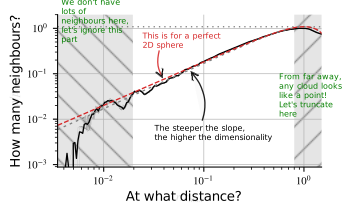
\(\#(<r)\)
COSMOS dataset
300,000 observed galaxies
Horizon-AGN
700,000 simulated galaxies
We have a method to measure
the intrinsic dimensionality of any dataset.
- Magnitude measurements (not images!)
- 14 photometric wide-bands (u*, g, r, i, z, y, Y, J, H, Ks, B, V, IRAC CH1 & CH2)
+ 14 narrow-bands - SNR > 2
- passive/active selection
Note: we are not working with images, but integrated magnitudes

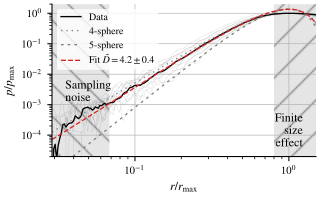
COSMOS dataset
300,000 observed galaxies
Horizon-AGN
700,000 simulated galaxies
No more than \(\sim 4\) independent parameters? (with comparable magnitudes)
See Disney 08 for even more controversial results, although with smaller statistics
Horizon-AGN
700,000 simulated galaxies
No more than \(\sim 3\) independent parameters!
Galaxy formation is tightly constrained
Galaxies populate a 3D attractor?
\(M\)
\(z\)
\(j\)?
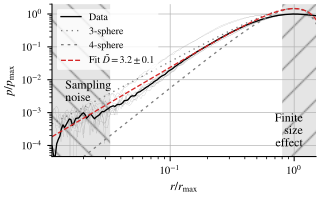
With simulated noise
Without simulated noise
Is DM angular momentum chaotic?
Results from Cadiou+21, 22
Question: is DM angular momentum fundamentally unpredictable?
1
Is DM angular momentum chaotic?
Results from Cadiou+21, 22
1
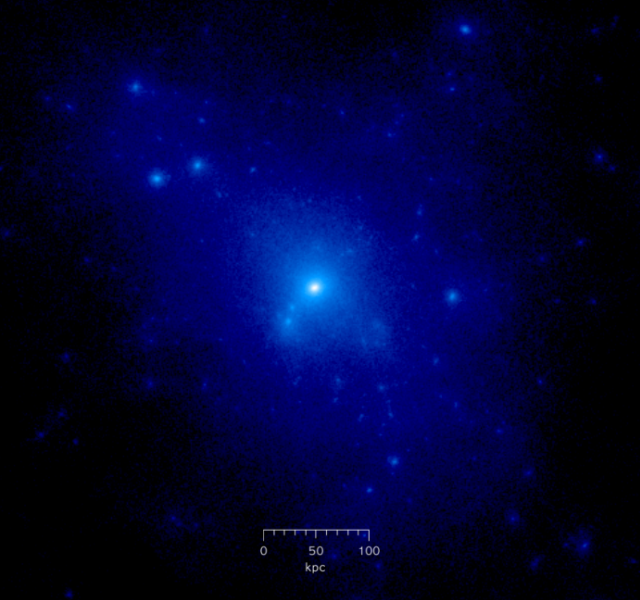
DM angular momentum


\(z=0\)
\( z = 100\)
\(z=0\)
\( z = 100\)
[White 84]
DM angular momentum
\(z=0\)
\( z = 100\)
[Genetic modifications: Roth+16, see also Rey&Pontzen 18, Stopyra+20]
DM angular momentum
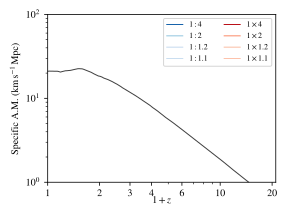
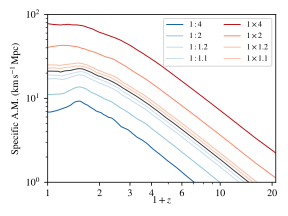
Time
Angular
momentum
DM angular momentum
Higher initial tides
Lower initial tides
\(z\rightarrow \infty\)
\(z=0\)
✅ AM of fixed DM regions responds ~linearly (so is not chaotic!)
However, particle membership hence DM halo does not
Angular
momentum
Time
DM angular momentum
Dark matter spin is hard to predict
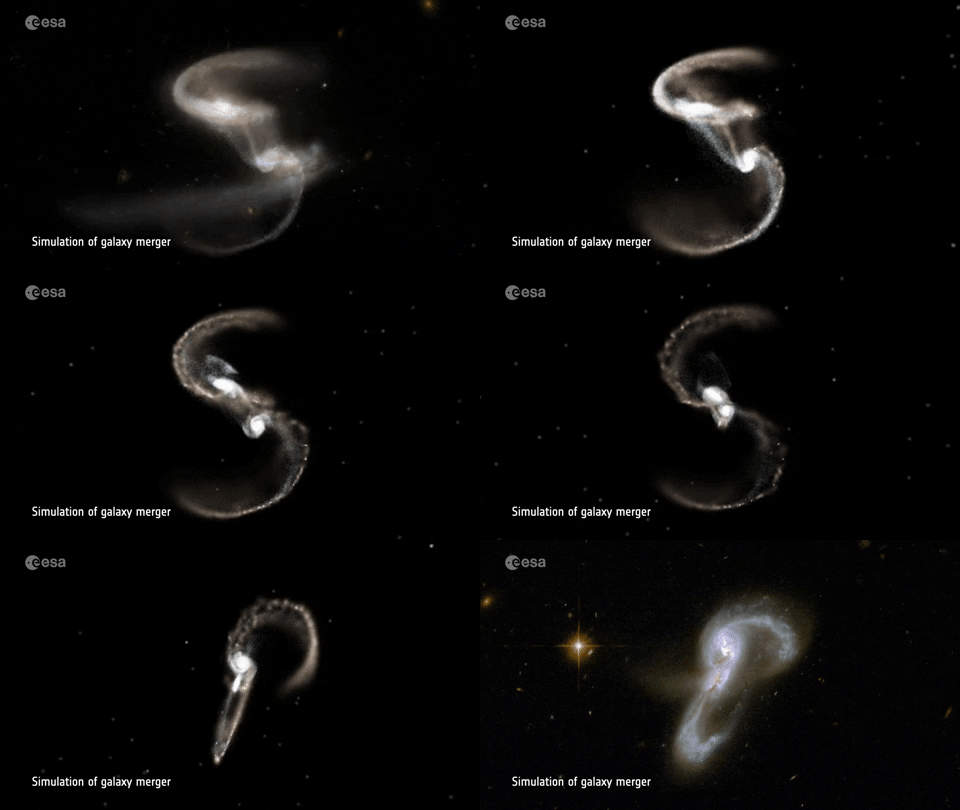
⇒ the usual culprit are mergers
Are mergers really
stochastic?
Results from Cadiou +24b
2
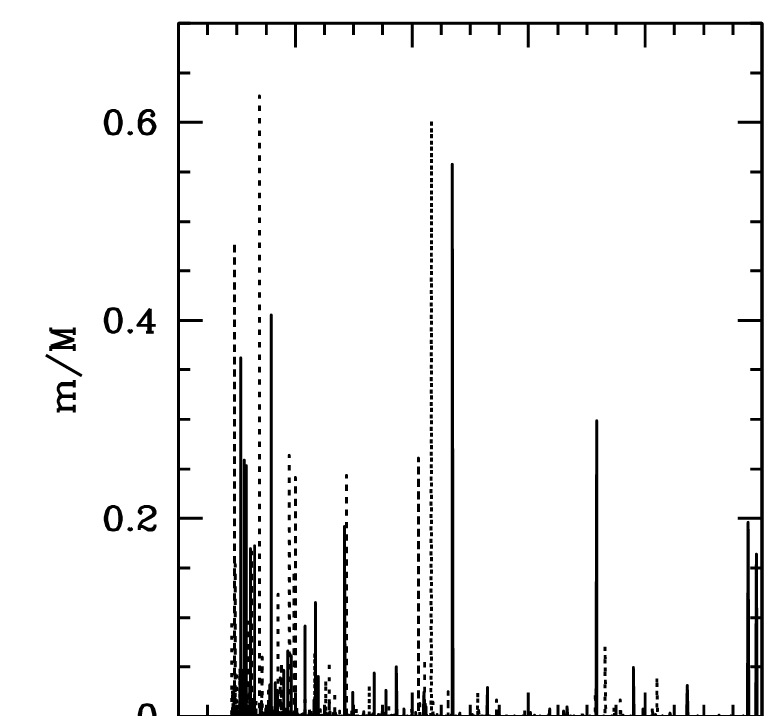
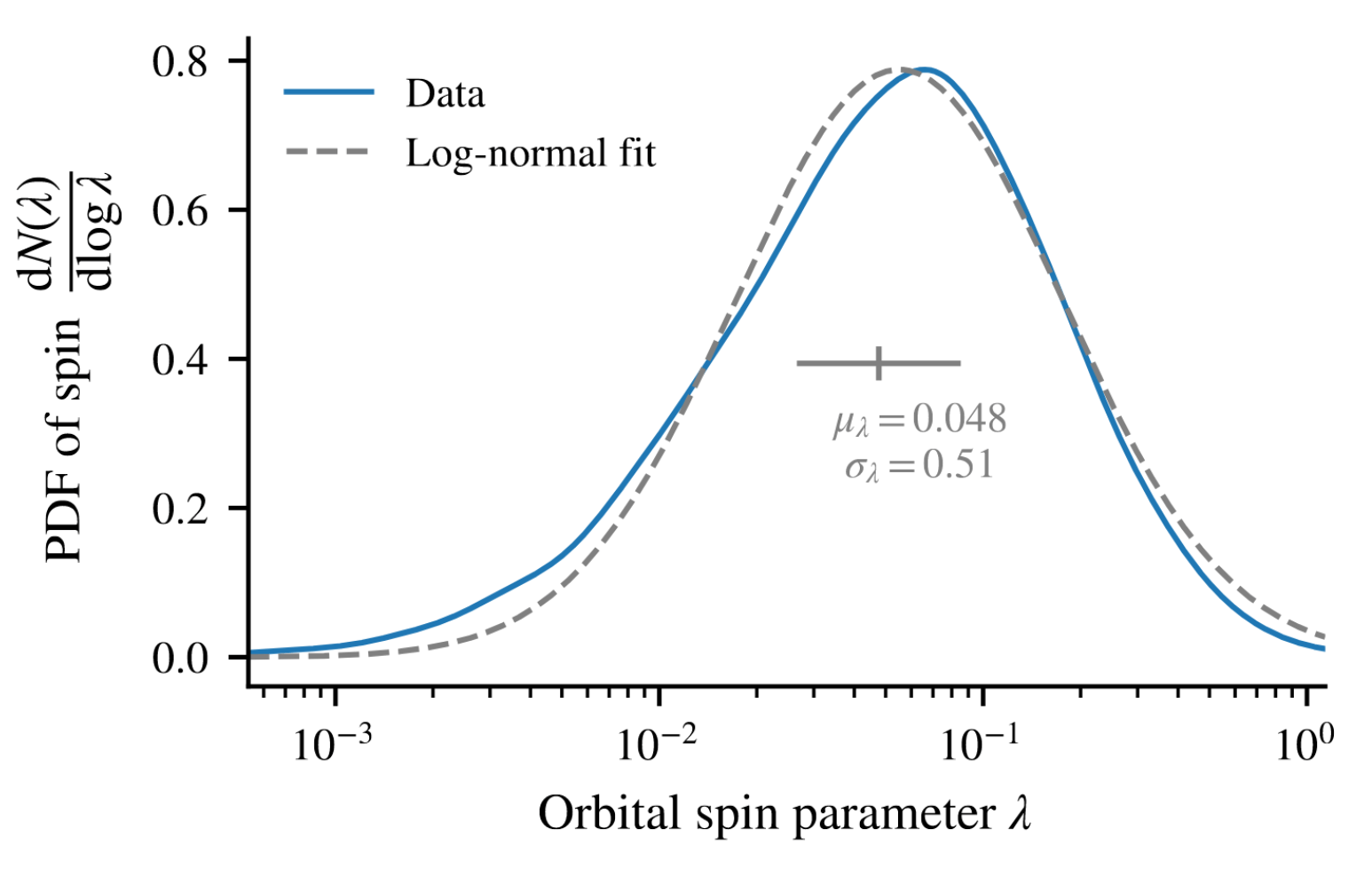
Cadiou+24
Based on the critical event theory (Cadiou +20)
itself based on Hanami 2001
We can make some reasonable predictions
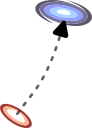
of orbital spin of mergers
Given: tides + density peaks

\(z\gg 100\)
\(z = 0\)
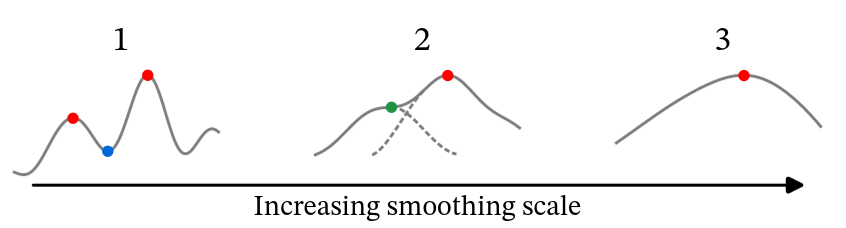
Critical event:
\(\nabla \delta = 0\quad\&\quad\lambda_1 \leq \lambda_2 \leq \lambda_3=0.\)
Critical point:
\(\nabla \delta = 0\)
Maximum: \(\lambda_1 \leq \lambda_2 \leq \lambda_3 \leq 0\)
Saddle: \(\lambda_1 \leq \lambda_2 \leq 0 \leq \lambda_3\)
1 peak = 1 halo
1 peak disappearing = 1 merger
Critical event:
\(\nabla \delta = 0\quad\&\quad\lambda_1 \leq \lambda_2 \leq \lambda_3=0.\)
Critical point:
\(\nabla \delta = 0\)
Maximum: \(\lambda_1 \leq \lambda_2 \leq \lambda_3 \leq 0\)
Saddle: \(\lambda_1 \leq \lambda_2 \leq 0 \leq \lambda_3\)
Counting haloes & galaxies
Counting filaments
Counting mergers
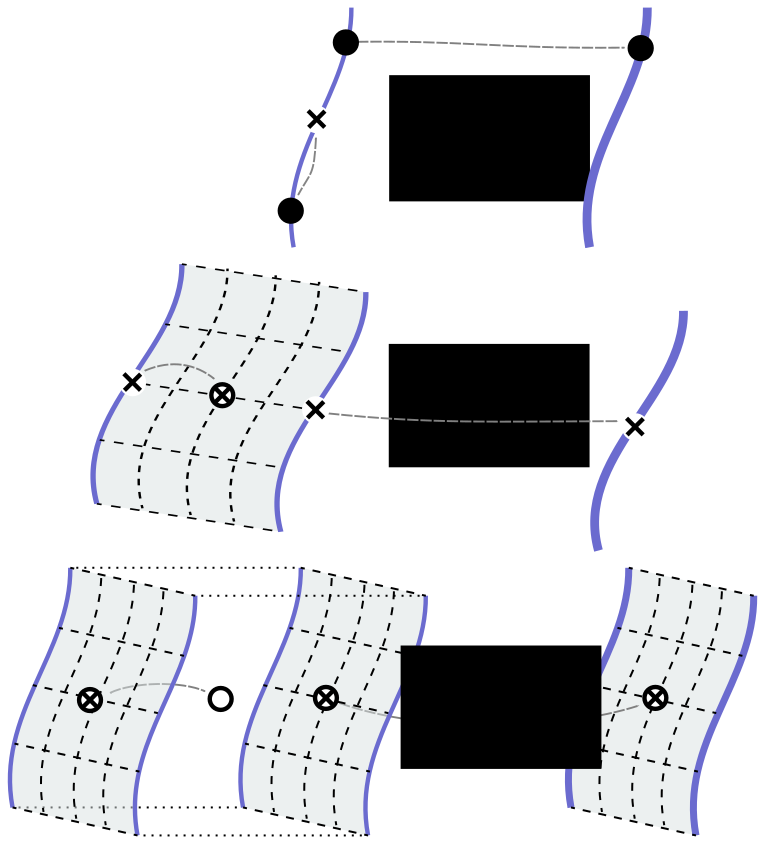
Critical event:
\(\nabla \delta = 0\quad\&\quad\lambda_1 \leq \lambda_2 \leq \lambda_3=0.\)
Counting halo mergers
halo-filament-halo
\(\nabla \delta = 0\quad\&\quad\lambda_1 \leq \lambda_2 = 0 \leq \lambda_3.\)
Counting filament mergers
filament-wall-filament
\(\nabla \delta = 0\quad\&\quad\lambda_1 =0 \leq \lambda_2 \leq \lambda_3.\)
Counting wall mergers
wall-void-wall
A small detour at critical event theory
Critical event:
\(\nabla \delta = 0\quad\&\quad\lambda_i = 0.\)
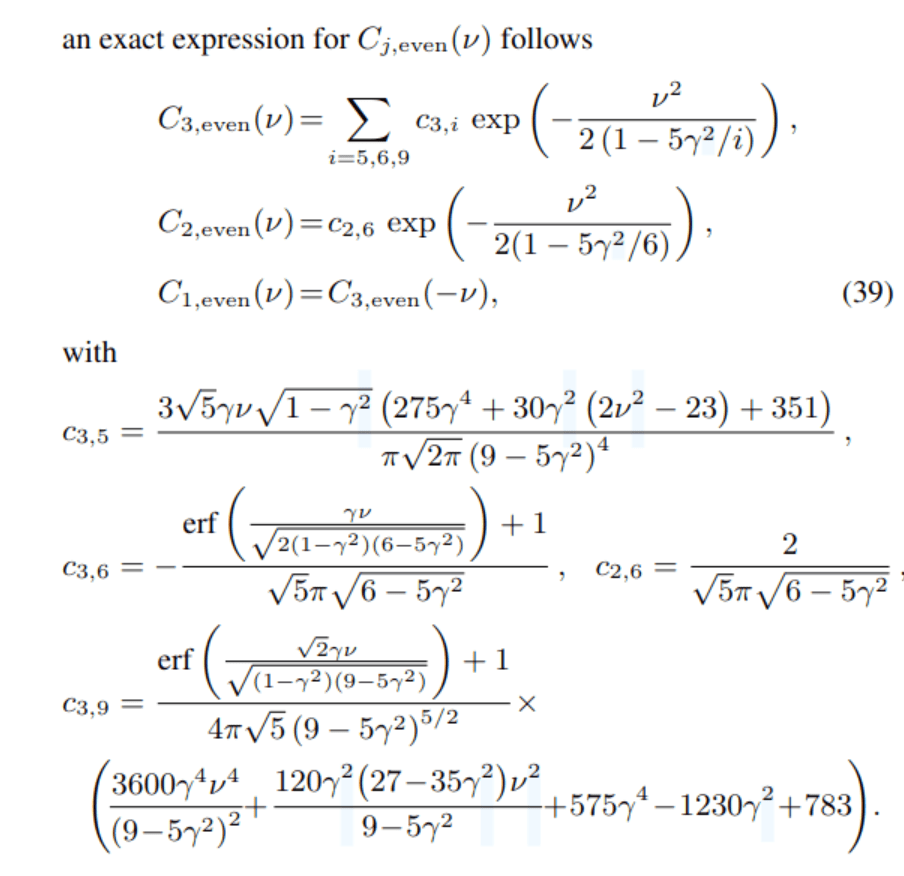
a few pages of math…

Based on the critical event theory (Cadiou +20)
We can compute
\(\mathcal{P}\left( m \textbf{r}\times\textbf{v}\ \middle|\ \text{peak of mass $M$}\right)\)
Changes to tides at \(z=100\), effect at \(z<1\)
How chaotic is baryonic
angular momentum?
Results from Cadiou +21a
Question: DM angular momentum is ill-defined, is the same true about galaxies?
3
How chaotic is baryonic
angular momentum?
Results from Cadiou +21a
3
\(\lambda_\mathrm{DM}\)
Full hydro simulations
(RAMSES, New-Horizon model):
- Resolved disk height
\(\Delta x_\mathrm{min} = 35\ \mathrm{pc}\) - \(M_\mathrm{200c} = 10^{12}\ \mathrm{M}_\odot\)
at \(z=2\) - SF, AGN, SN feedback
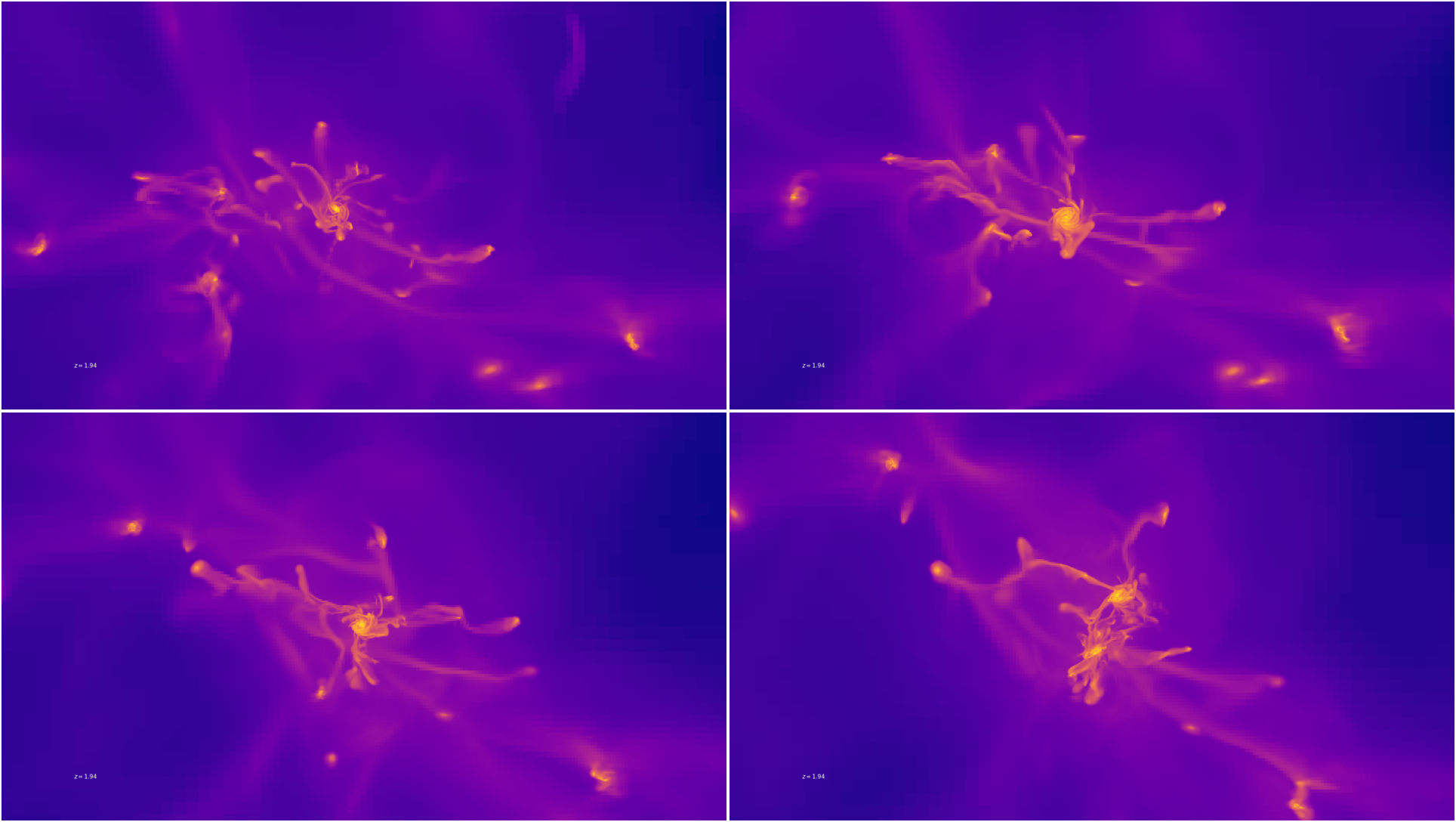
- 3 galaxies, 5× scenario each
Lowest tides
Low tides
Higher tides
Highest tides
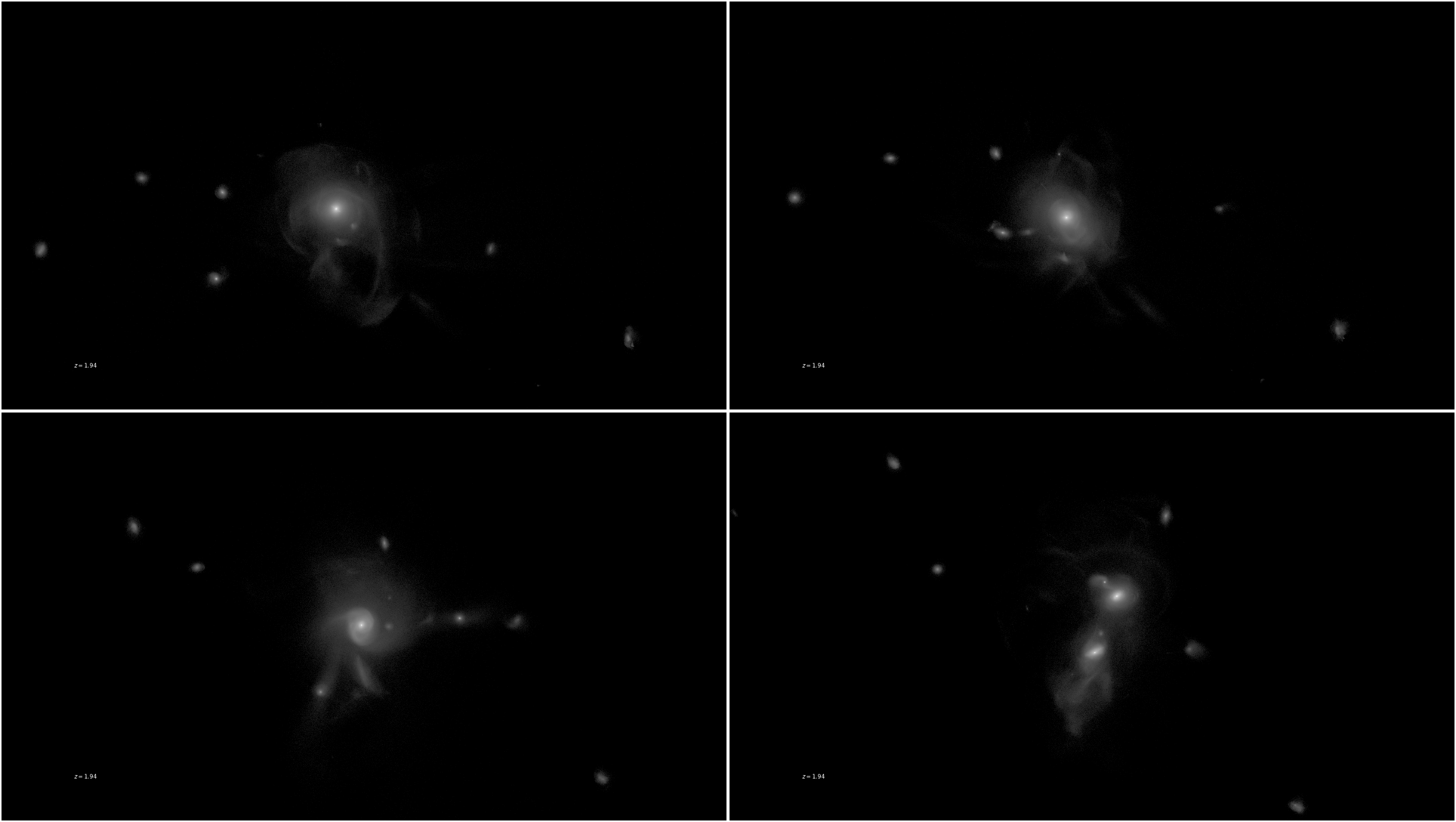
\( j_0 \times 0.66\)
\( j_0 \times 0.8\)
\( j_0 \times 1.2\)
\( j_0 \times 1.5\)
See Cadiou+21a
INPUT: Changes to tides \(z=\infty\)
OUTPUT: Ang. mom
\(z=2\)

\( j_0 \times 0.66\)
\( j_0 \times 0.8\)
\( j_0 \times 1.2\)
\( j_0 \times 1.5\)
\( j_0 \times 0.8\)
See Cadiou+21a
INPUT: Changes to tides \(z=\infty\)
OUTPUT: Ang. mom
\(z=2\)
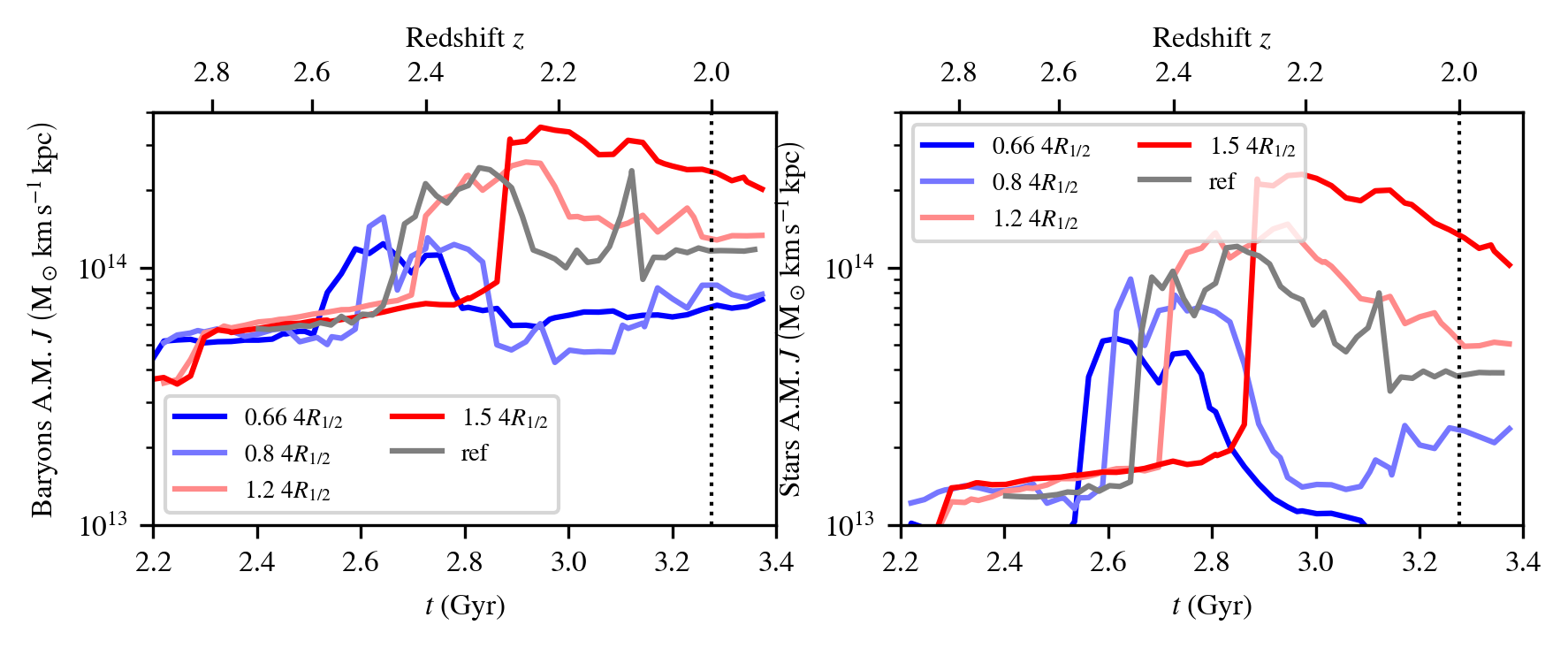
Stellar angular momentum responds ~linearly
to large-scale tides

Gas + stars spAM
Stars spAM
Halo spAM
Halo spAM
See Cadiou+21a
Halo and disk evolve separately,
this allows stellar AM to be ~linear despite halo AM not being
Gas + stars spAM
Stars spAM
Halo spAM
Halo spAM
See Cadiou+21a
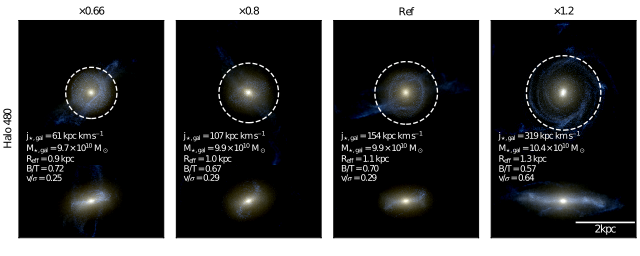
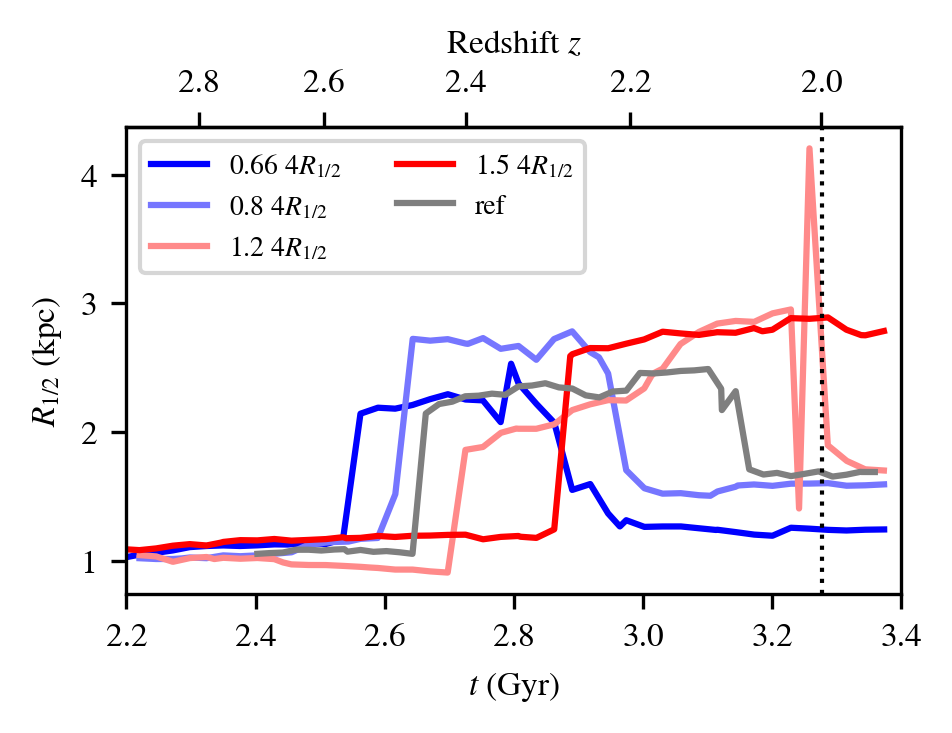
Special case: no massive satellite
Low tides
High tides
\(\mathcal{B}\searrow\)
\(R_\mathrm{eff} \nearrow \)
\(v/\sigma\nearrow\)
See Cadiou+21a
Two intermediate conclusions:
- Stellar angular momentum is driven by cosmological tides
⇒ failure of theory, not fundamental limitation
- Galaxies respond quasi-linearly to perturbations
⇒ morphology, bulge fraction, spin are not chaotic!
Impact of the cosmological-scale tides on halo properties
Results from Storck, Cadiou+25
4
Impact of the cosmological-scale tides on halo properties
Results from Storck, Cadiou+25
4
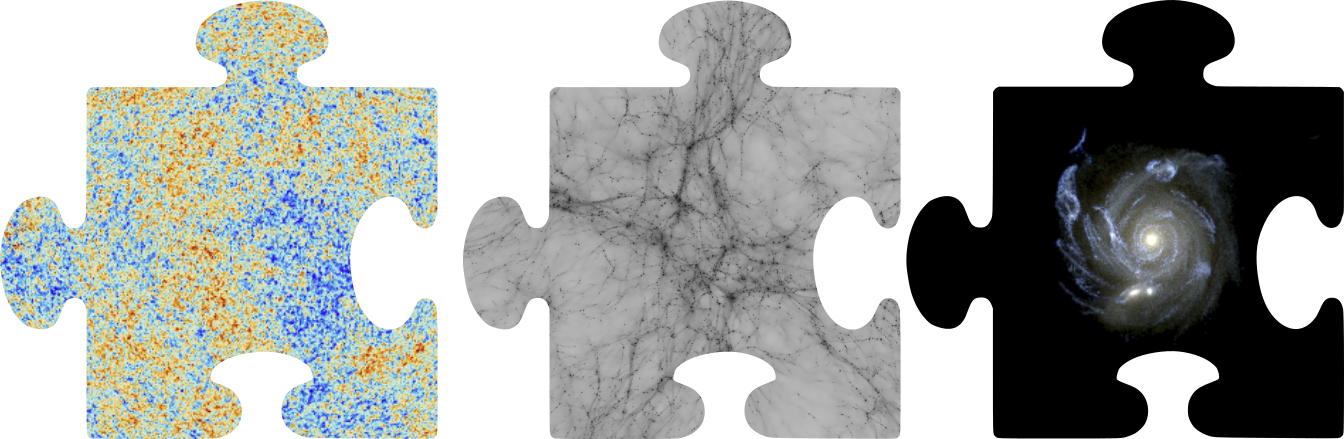
\(\rho_\mathrm{i}, v_\mathrm{i}\)
\(\Lambda\)CDM+baryon non-linear evolution
halo & galaxy properties
Impact of the cosmological-scale density on halo properties
Results from Cadiou +21b
5
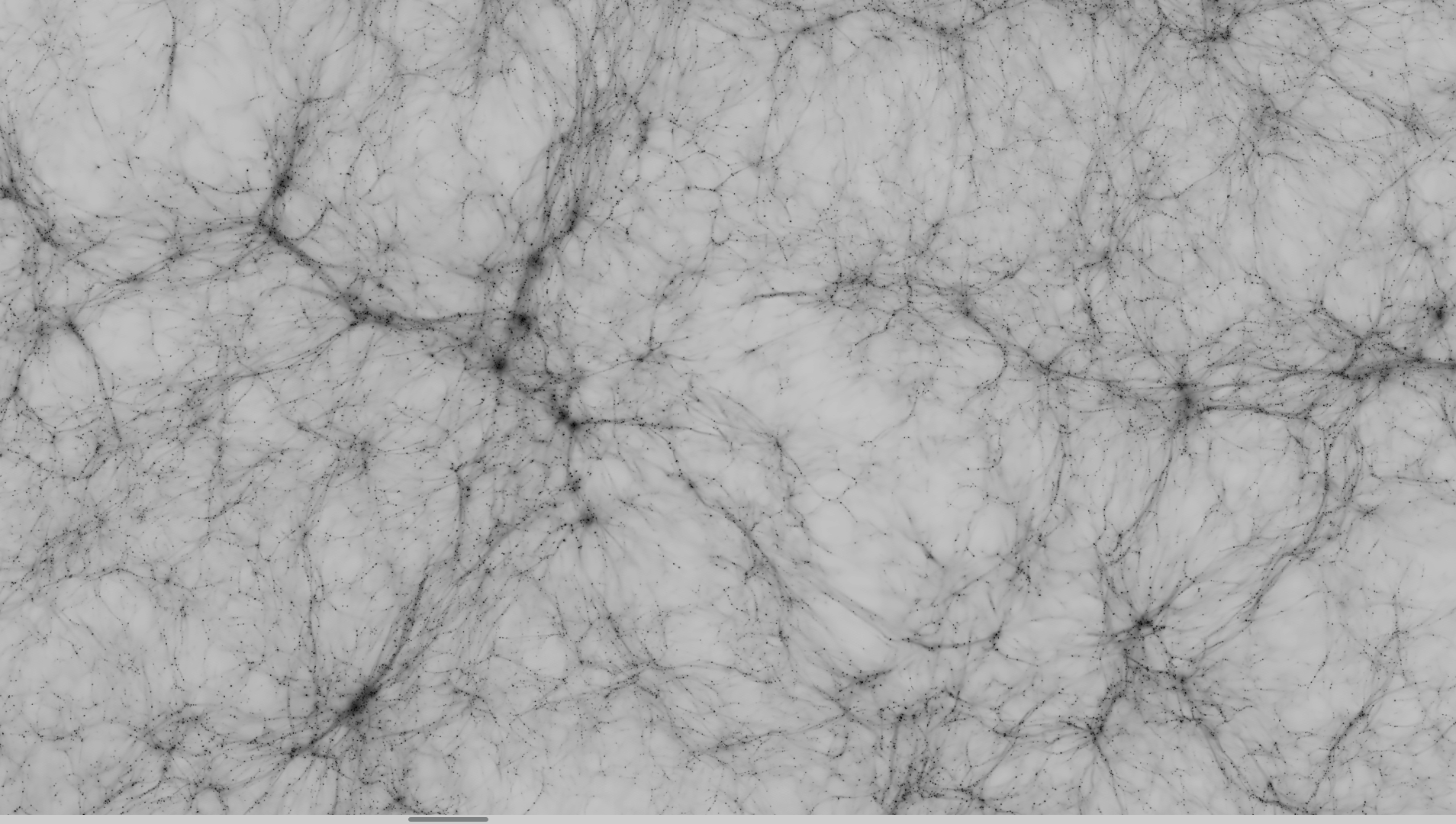
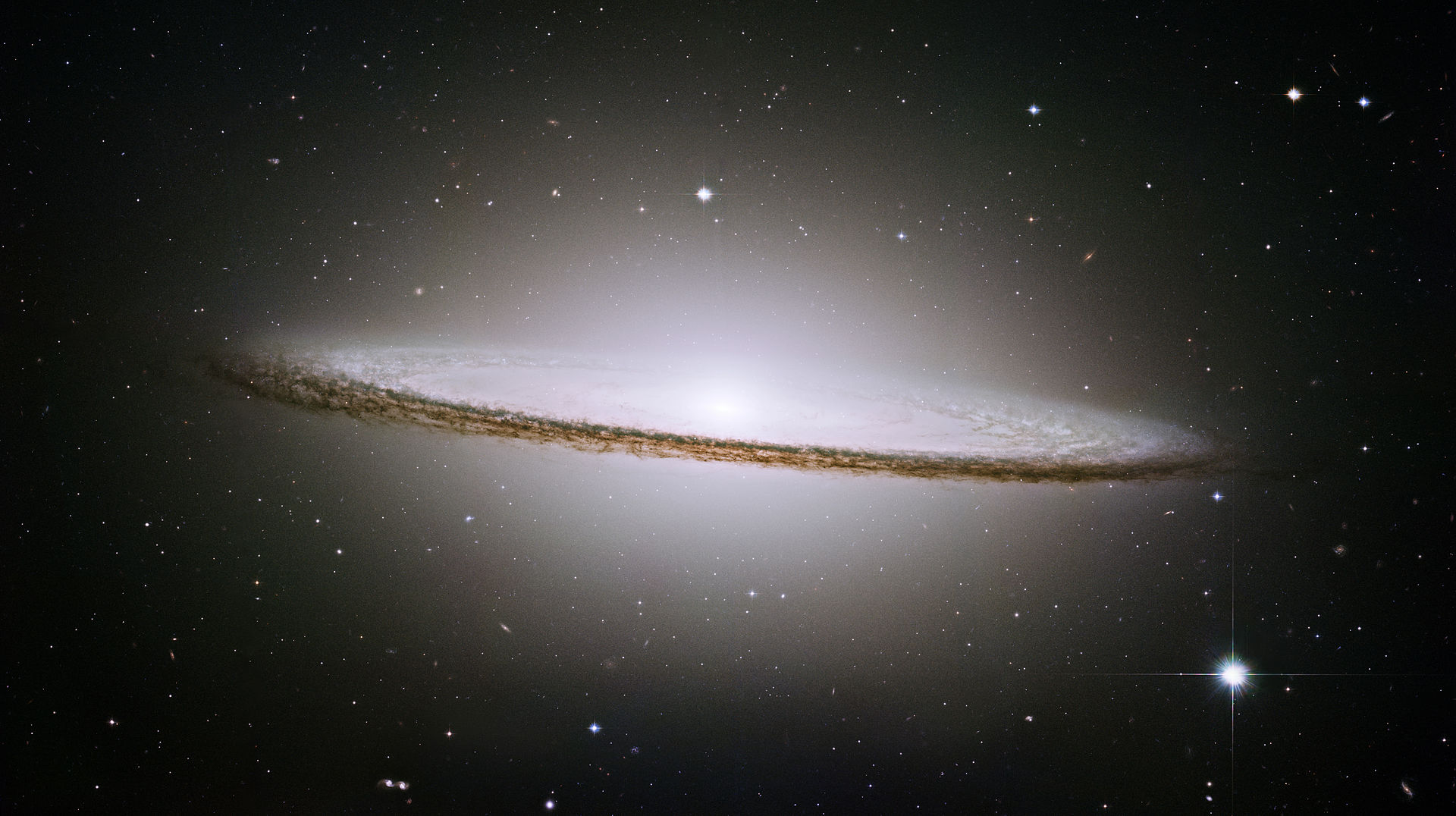
What if the galaxy had formed here instead?
What if the galaxy had formed here instead?
or here?
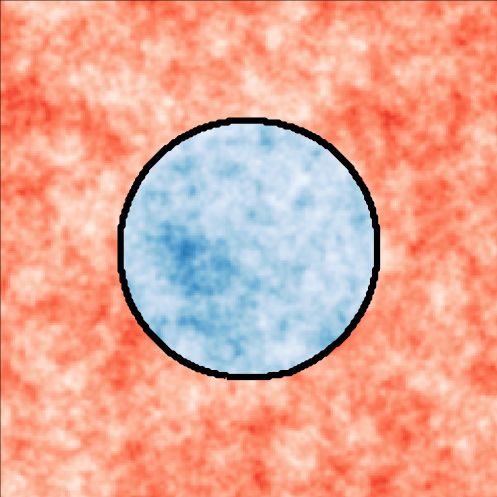
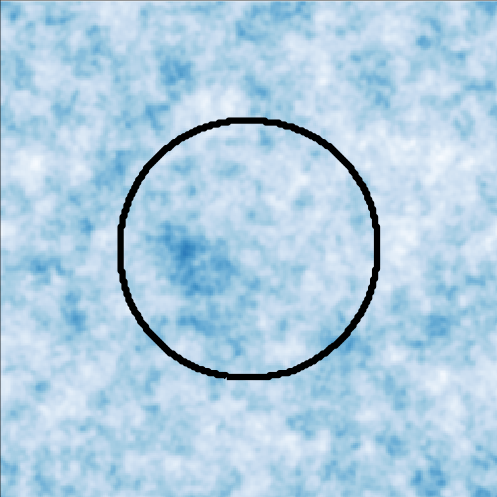
The “splicing” technique
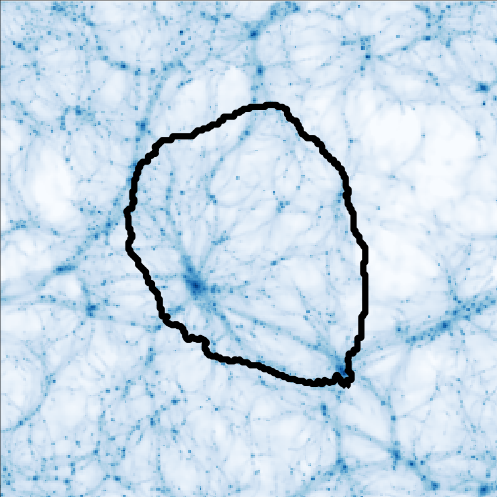
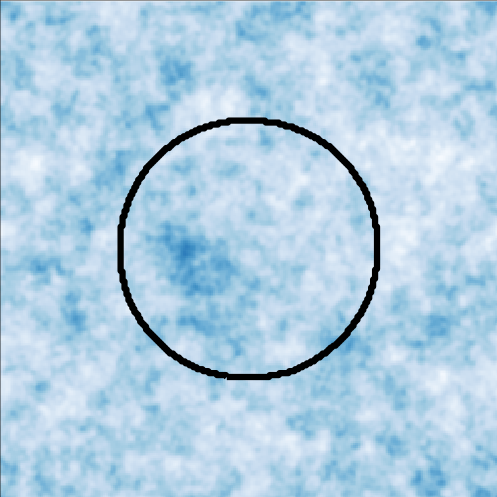
- Generate ICs
- Integrate (\(N\)-body)
- Select region of interest
- Trace back to ICs
- “Splice” the region
- Integrate again
\(t\)
Splicing: equivalent of constraining density field at all points in region
\(\longleftarrow 50\,\mathrm{Mpc} \longrightarrow\)
Splicing in 1D
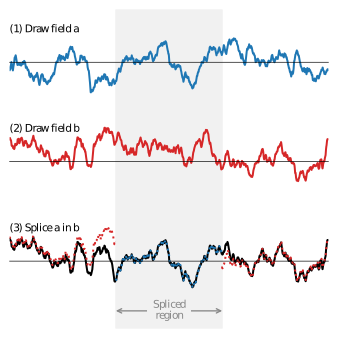
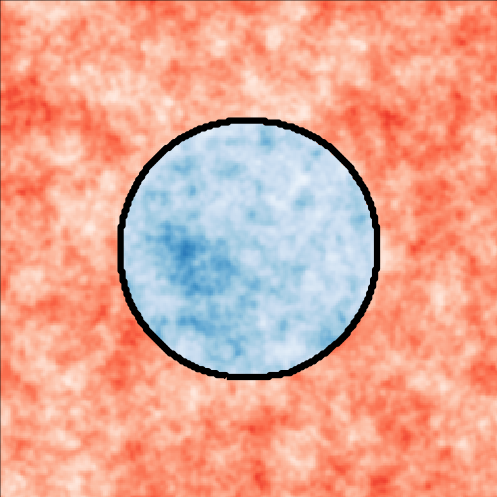
Splicing in 1D
Most likely field \(f\) with
- same value in spliced region (\(a\)),
- as close as possible outside (\(b\))
Mathematically, \({\color{green}f}\) is the unique solution that satisfies:
- \( {\color{green}f(x)}= {\color{blue}a(x)},\qquad\qquad\qquad\forall x \in\Gamma\)
- minimizes \[\mathcal{Q} = ({\color{red}b}-{\color{green}f})^\dagger\mathbf{C}^{-1}({\color{red}b}-{\color{green}f}),\quad \forall x \not\in \Gamma \]
-

-
The causal origin of DM halo concentration
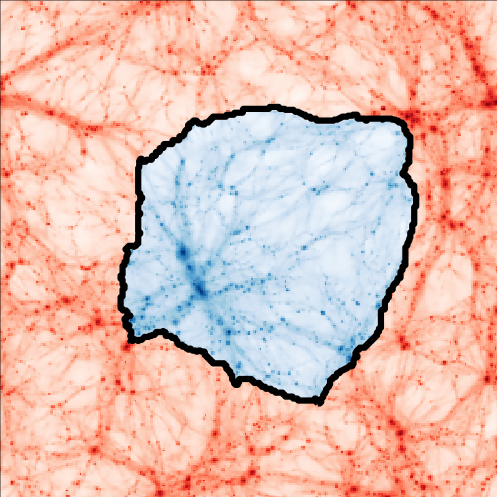
\(M^{(1)}_{200\mathrm{c}}, c^{(1)}_\mathrm{NFW}, \dots\)
\(M^{(2)}_{200\mathrm{c}}, c^{(2)}_\mathrm{NFW}, \dots\)
\(M^{(\dots)}_{200\mathrm{c}}, c^{(\dots)}_\mathrm{NFW}, \dots\)
\(M^{(10)}_{200\mathrm{c}}, c^{(10)}_\mathrm{NFW}, \dots\)
Same halo in 10× different environments
Repeat experiment for 7 halos (70 realisations in total)
Same halo in 10× different environments
Repeat experiment for 7 halos (70 realisations in total)
\(M^{(1)}_{200\mathrm{c}}, c^{(1)}_\mathrm{NFW}, \dots\)
\(M^{(2)}_{200\mathrm{c}}, c^{(2)}_\mathrm{NFW}, \dots\)
\(M^{(\dots)}_{200\mathrm{c}}, c^{(\dots)}_\mathrm{NFW}, \dots\)
\(M^{(10)}_{200\mathrm{c}}, c^{(10)}_\mathrm{NFW}, \dots\)
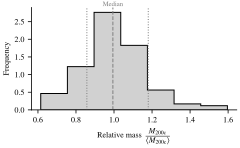
The causal origin of DM halo concentration
Same halo in 10× different environments
Repeat experiment for 7 halos (70 realisations in total)
\(M^{(1)}_{200\mathrm{c}}, c^{(1)}_\mathrm{NFW}, \dots\)
\(M^{(2)}_{200\mathrm{c}}, c^{(2)}_\mathrm{NFW}, \dots\)
\(M^{(\dots)}_{200\mathrm{c}}, c^{(\dots)}_\mathrm{NFW}, \dots\)
\(M^{(10)}_{200\mathrm{c}}, c^{(10)}_\mathrm{NFW}, \dots\)
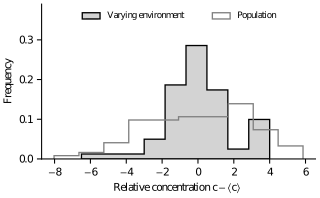
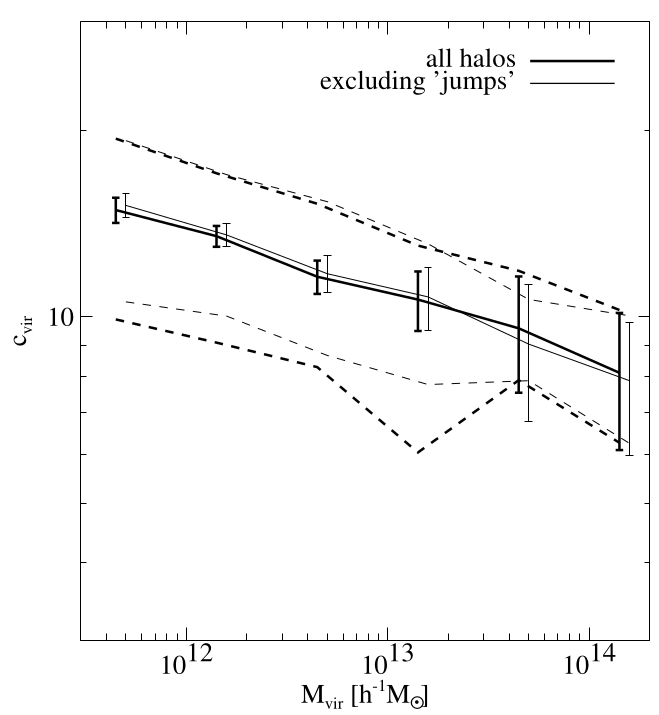
The causal origin of DM halo concentration
50% of population
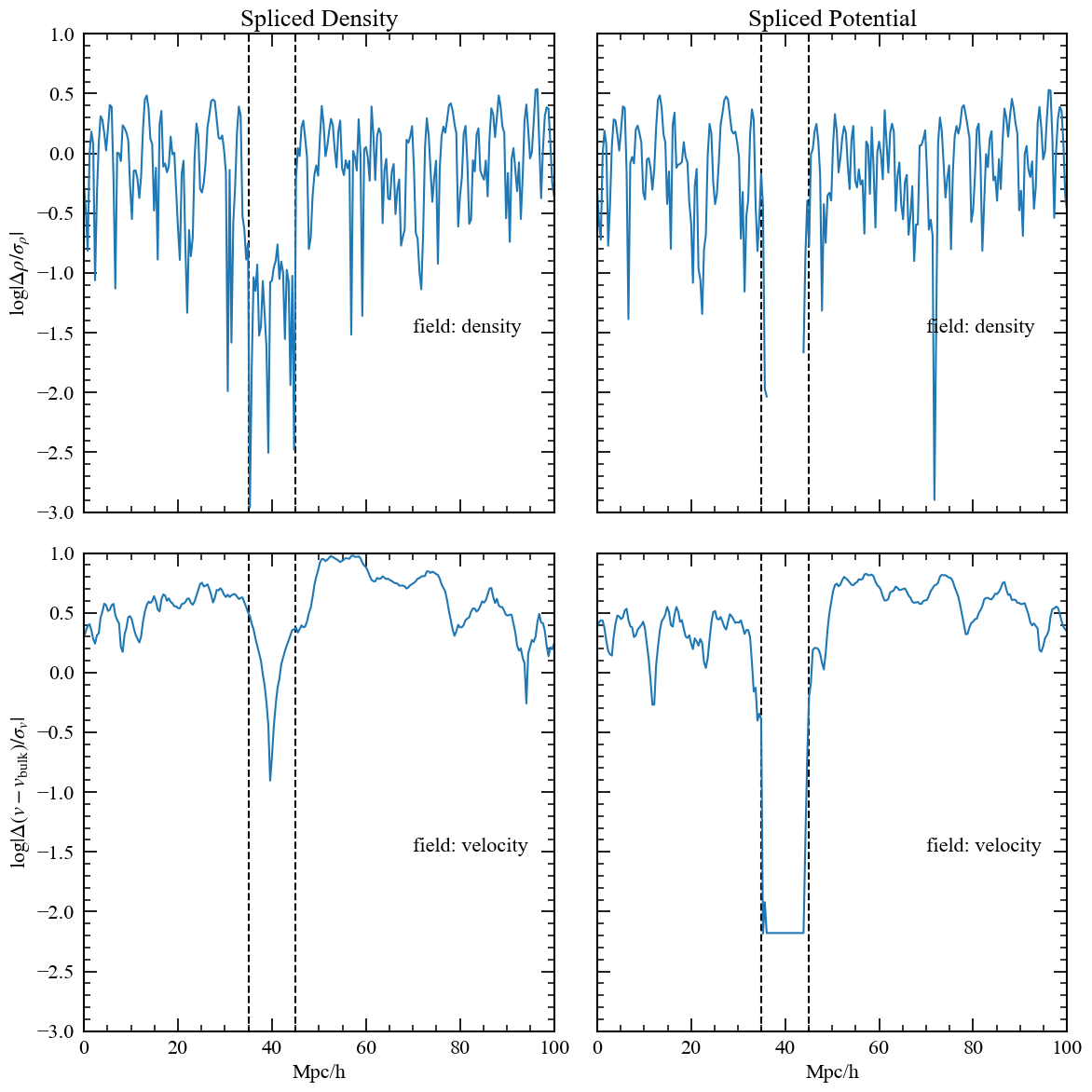
\(\log\left|\dfrac{{\color{blue}\rho_\mathrm{i}} - \color{red}\rho_\mathrm{i}}{\sigma_\rho}\right|\)
\(\log\left|\dfrac{{\color{blue}v_\mathrm{i}} - \color{red}v_\mathrm{i}}{\sigma_v}\right|\)
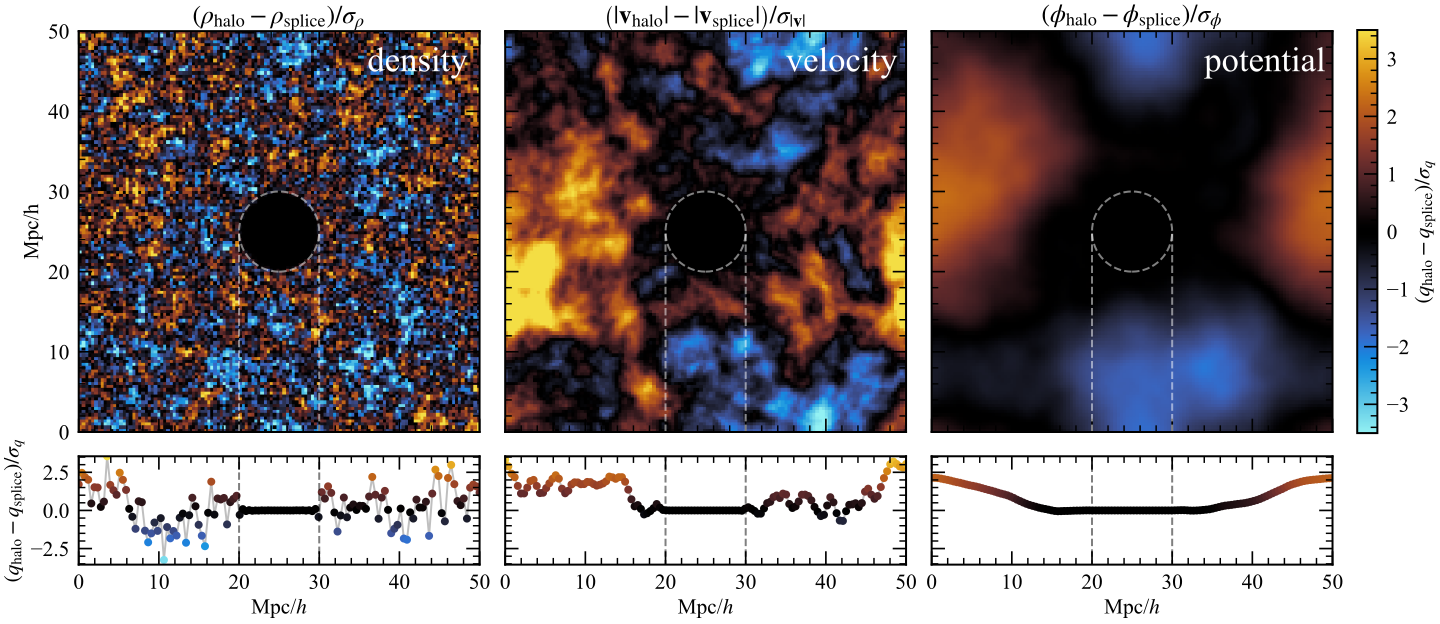
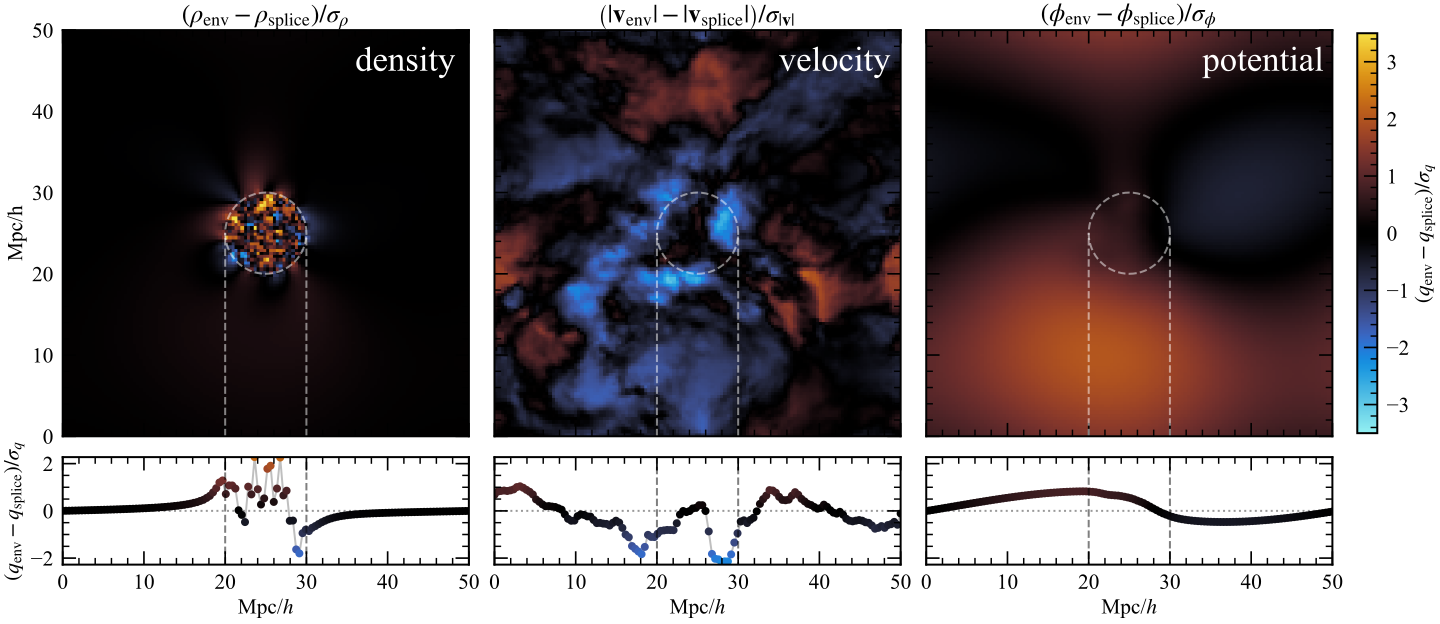
Issue : splicing the density does not fix the velocity & tides
Issue : splicing the density does not fix the velocity & tides
Solution: splice the potential
\(\log\left|\dfrac{{\color{blue}\rho_\mathrm{i}} - \color{red}\rho_\mathrm{i}}{\sigma_\rho}\right|\)
\(\log\left|\dfrac{{\color{blue}v_\mathrm{i}} - \color{red}v_\mathrm{i}}{\sigma_v}\right|\)
Remember \(\nabla^2\phi = 4\pi G\rho\) so
\[\rho_n\propto\frac{\phi_{n+1}-2\phi_n+\phi_{n-1}}{\Delta x^2}\]
\[v_n\propto\frac{\phi_{n+1}-\phi_{n-1}}{2\Delta x}\]
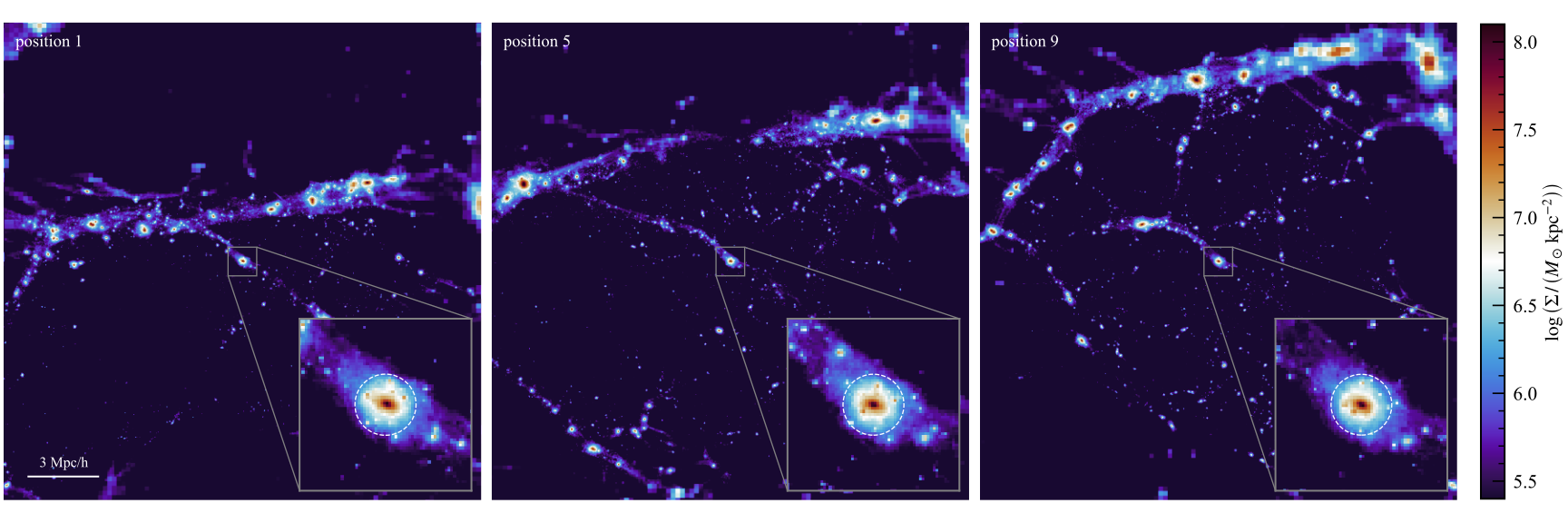
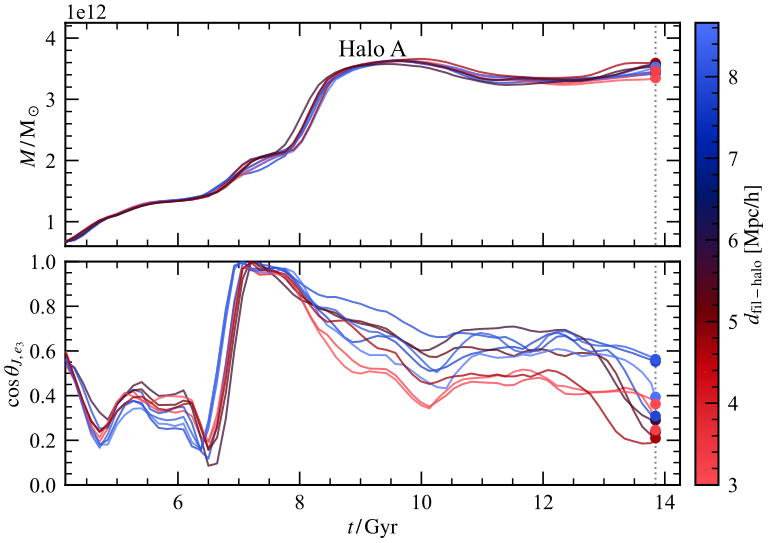
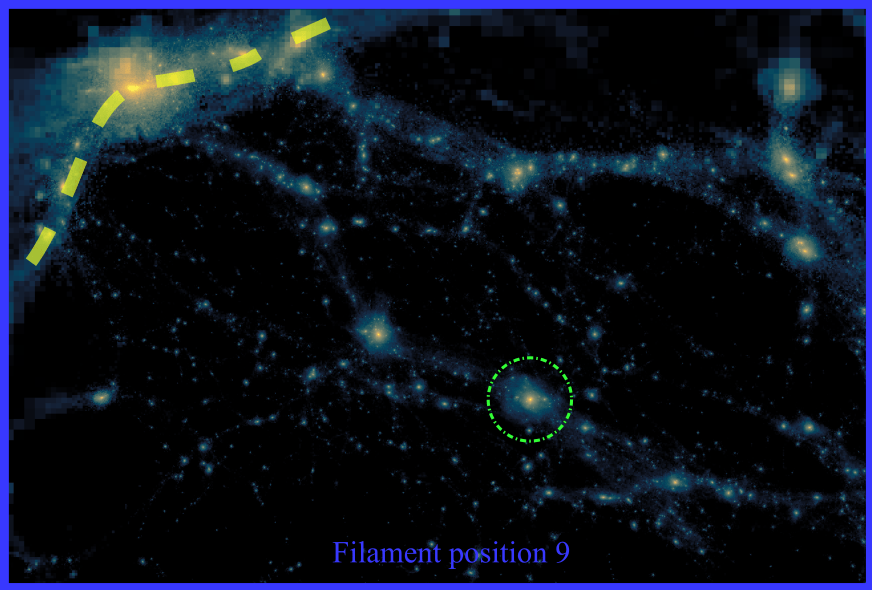
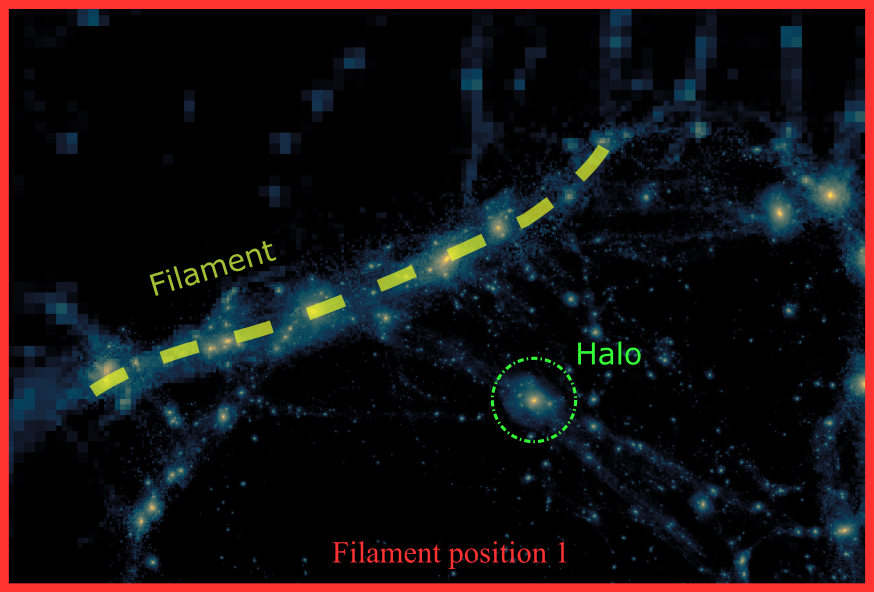
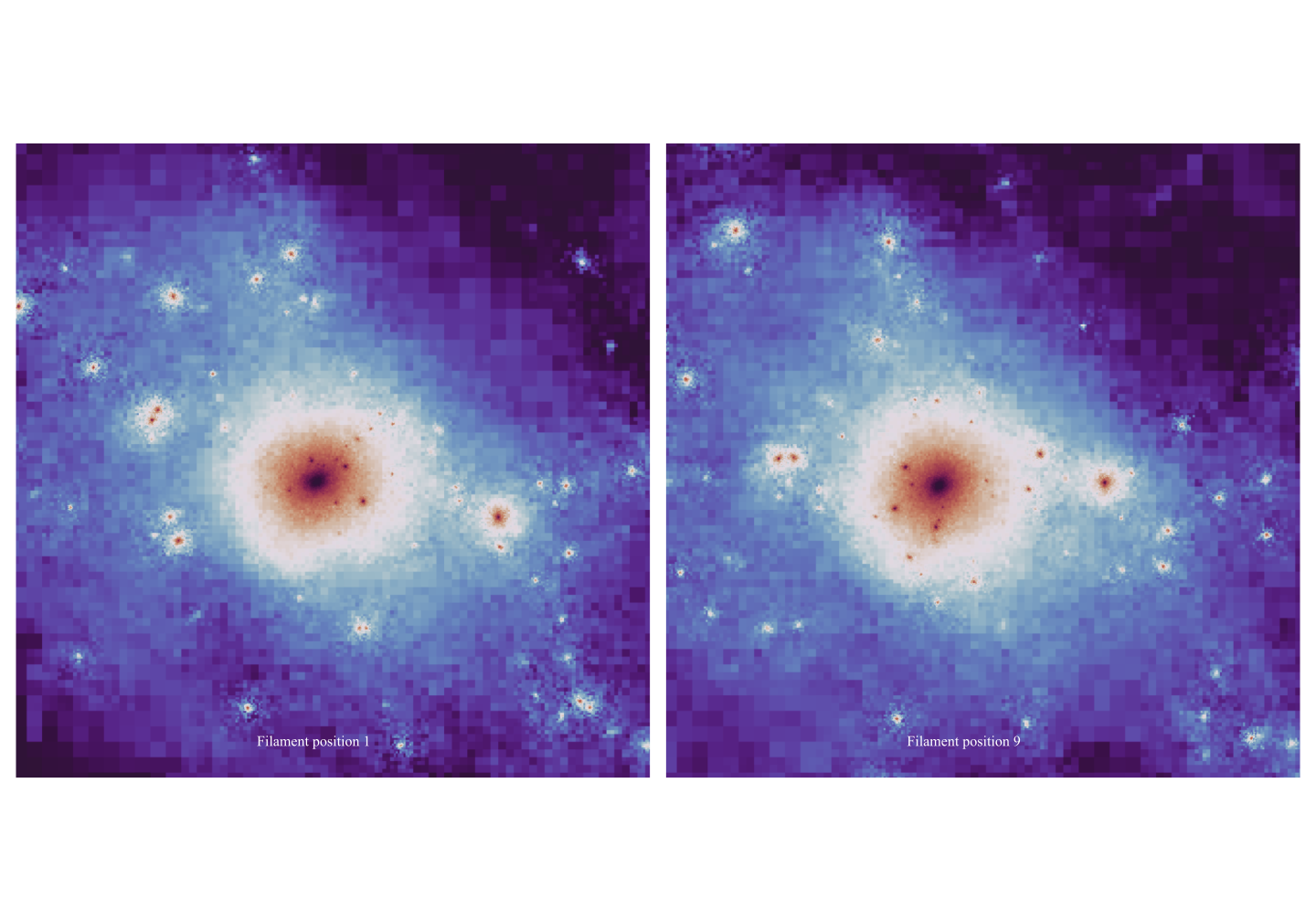
Same halo (same initial tides + density)
forming closer and closer to filament
Repeat for 5 halos, 9 positions
\(\sigma\)
\(\langle q\rangle\)
Deviation from the mean
For different quantities
spin alignment
shape alignment

\(\sigma\)
\(\langle q\rangle\)
Intrinsic alignment signal
In practice, we change the potential so we're testing sensitivity to non-linear gravitational coupling to large-scale structures
Angular momentum transport: CGM structure
Results from Cadiou+25
(& Rey+CC+25 — Katz+CC+25 — Storck+CC+25 — Choustikov+CC+25)
See also CC+22 — Kocjan+CC+24,
5
kpc
100 kpc
Mpc
Gravitational
collapse
Baryonic physics, star form, AGNs
Feedback processes
Perturbations
Simulations
Perturbation
theory
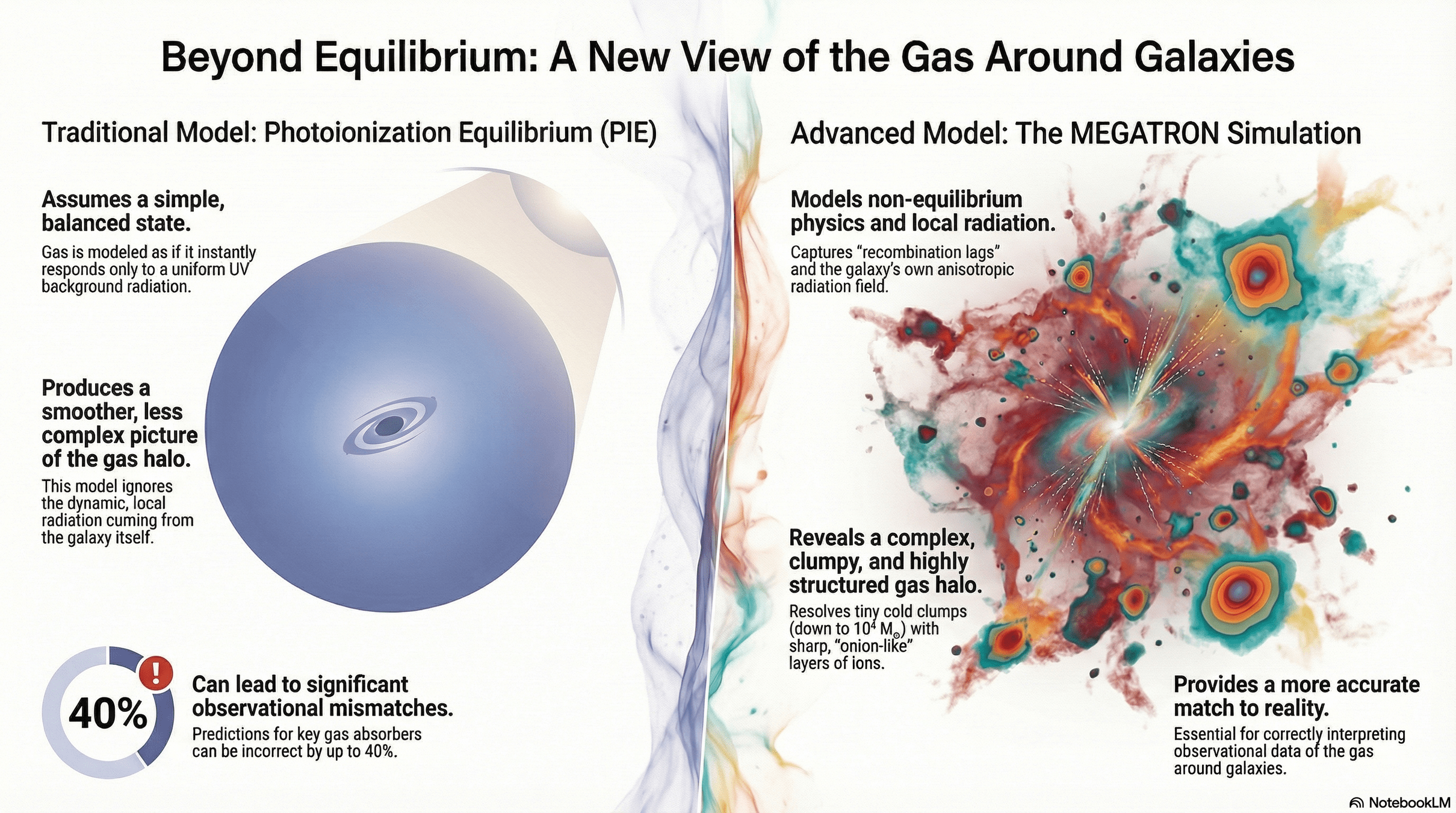
Simple isothermal CGM vs. Complex multiphase CGM
- Well-mixed (isothermal)
- "Bathtub" modelling
- Not well-mixed (turbulence)
- How much gas reaches the galaxy?
Megatron simulations:
first simulation to combine at high-\(z\)
+ non-equilibrium chemistry
+ radiative transport
+ \(\sim 50-100\,\mathrm{pc}\) resolution
Reveals
- Complex, multiphase structure,
- Smallest structures at resolution limit,
-
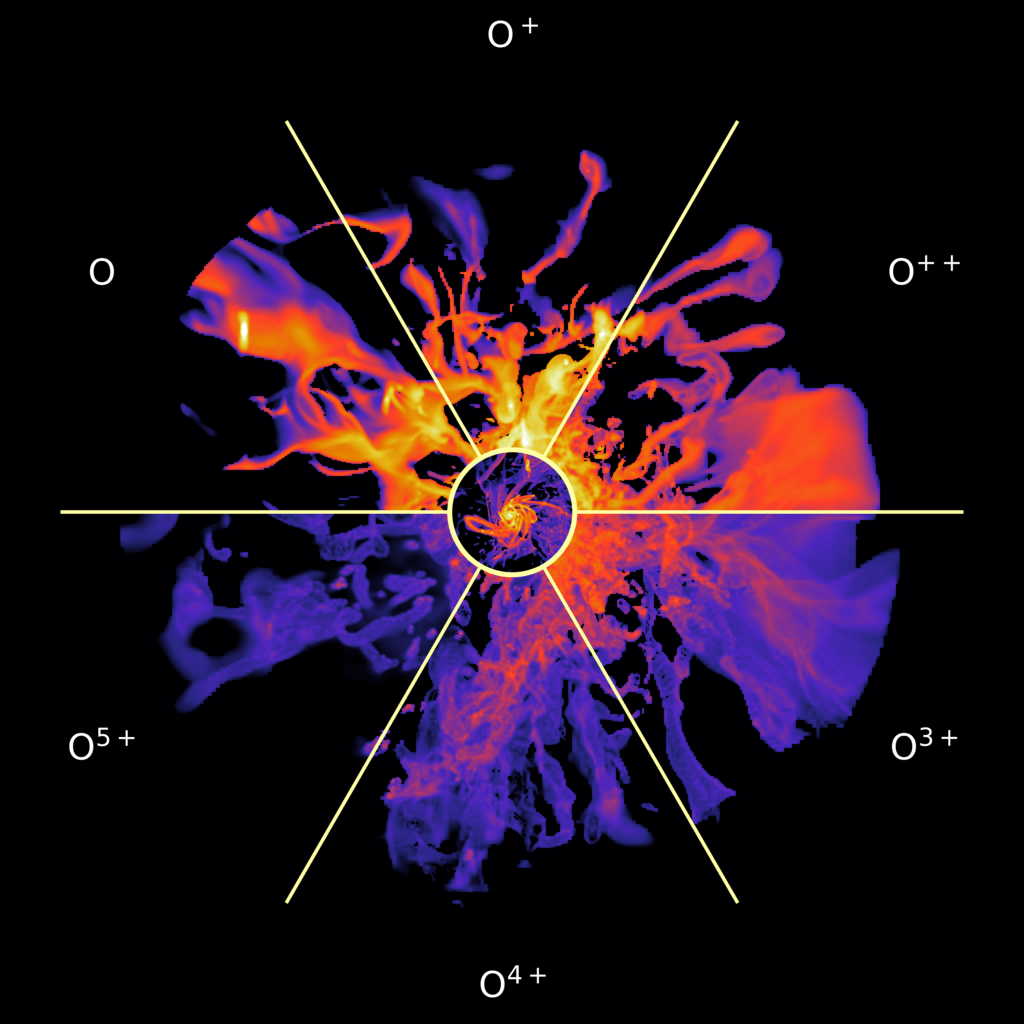
Non-equilibrium ionized structures
- impact on thermochemical structure,
- impact on observations.
O I
O II
O III
Megatron simulations:
first simulation to combine at high-\(z\)
+ non-equilibrium chemistry
+ radiative transport
+ \(\sim 50-100\,\mathrm{pc}\) resolution
Reveals
- Complex, multiphase structure,
- Smallest structures at resolution limit,
-
Non-equilibrium ionized structures
- impact on thermochemical structure,
- impact on observations.
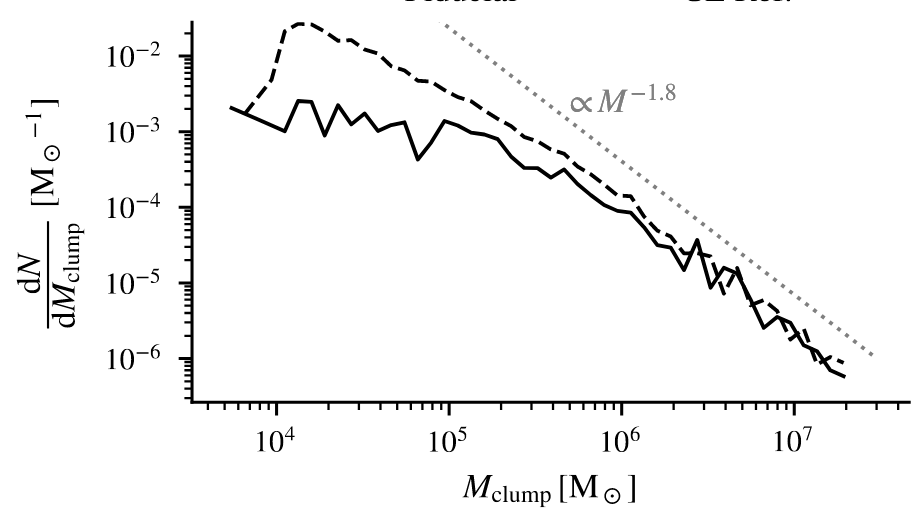
Increase of resolution:
⇒ more small scale structures
Megatron simulations:
first simulation to combine at high-\(z\)
+ non-equilibrium chemistry
+ radiative transport
+ \(\sim 50-100\,\mathrm{pc}\) resolution
Reveals
- Complex, multiphase structure,
- Smallest structures at resolution limit,
- Non-equilibrium ionized structures
- impact on thermochemical structure,
- impact on observations.
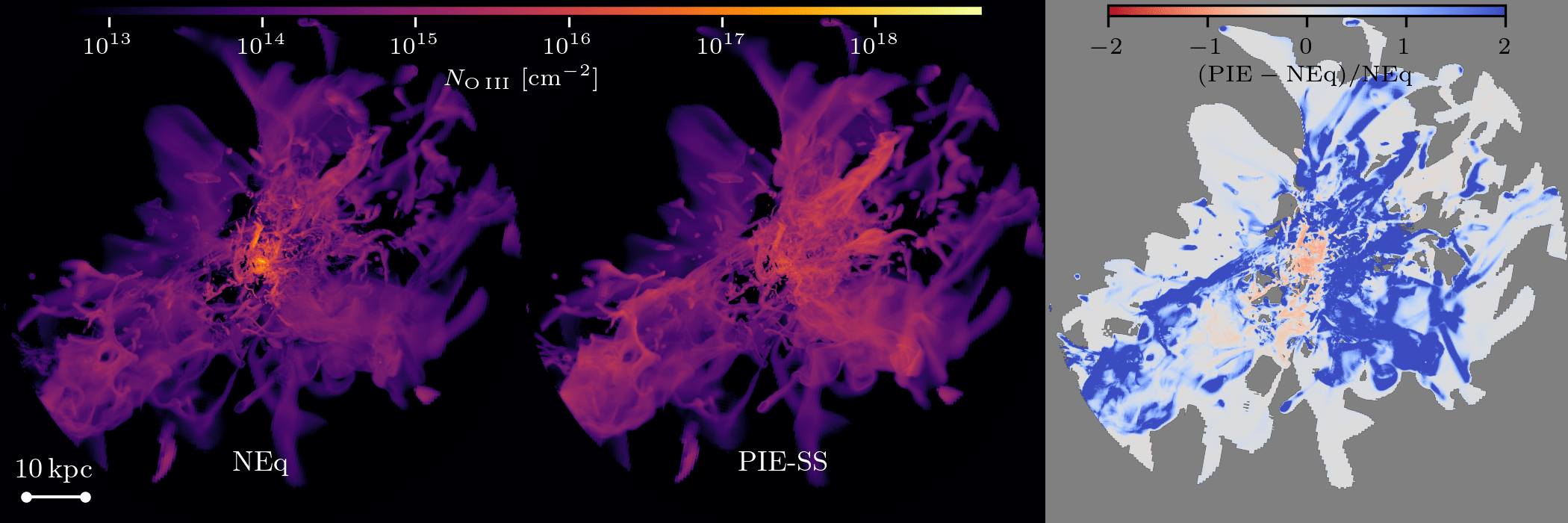
OIII column density
in simulation
assuming ionization equilibrium
\(40\,\%\)-change in
HI covering fraction
Dyablo: next-gen
hydrodynamical code
6
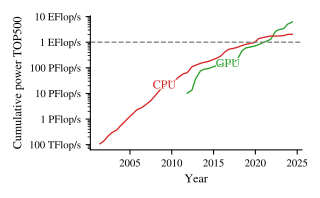
Data: Top-500
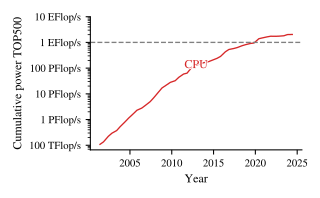
Most powerful clusters are switching to GPUs
(following the AI hype...)
Manage grid, simple computation
Computation-heavy
(hydro, gravity, …)
CPU
GPU
[…]
wasted
time
wasted
time
Typical approach: offloading*
Dyablo's approach:
* Arepo, Gadget3, RAMSES, ...
Amdahl's law: latency kills gains of parallelisation
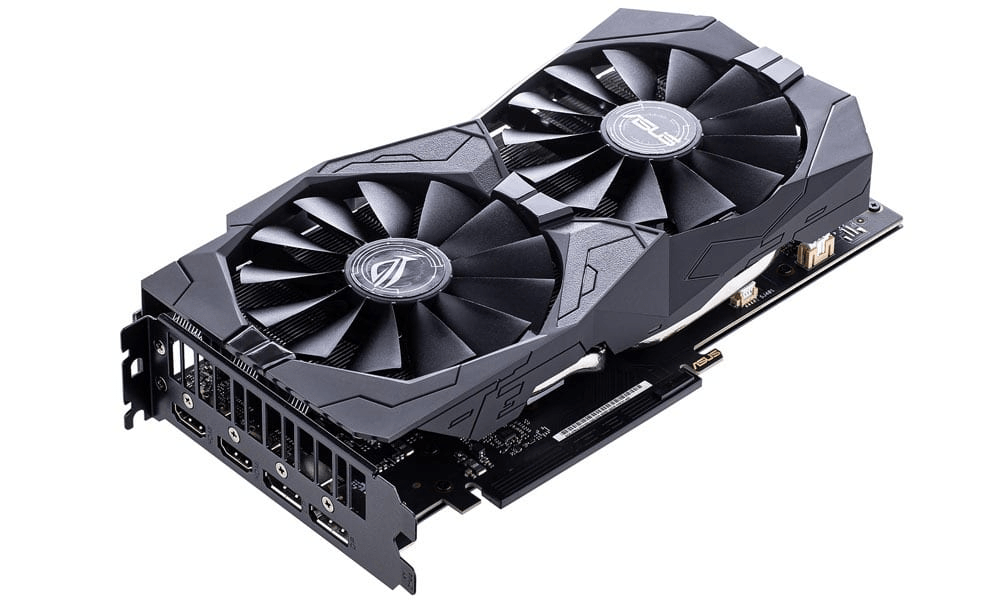
Manage grid, simple computation
Computation-heavy
(hydro, gravity, …)
CPU
GPU
(or CPUs)
[…]
Typical approach: offloading
Dyablo's approach: “true” GPU computing, CPU as a puppeteer
Dyablo: Implemented physics
- Adaptive mesh-refinement,
- Hydrodynamics / MHD / radiative transfer
- Gravity
- Particles,
- Gas cooling
- Star formation and feedback,
- Cosmology,
- Diffusion terms: thermal conduction, viscosity,
- Cosmic rays, thermochemistry...
Hydro-only simulation
Hydro + feedback
Agora initial conditions, Kim+16
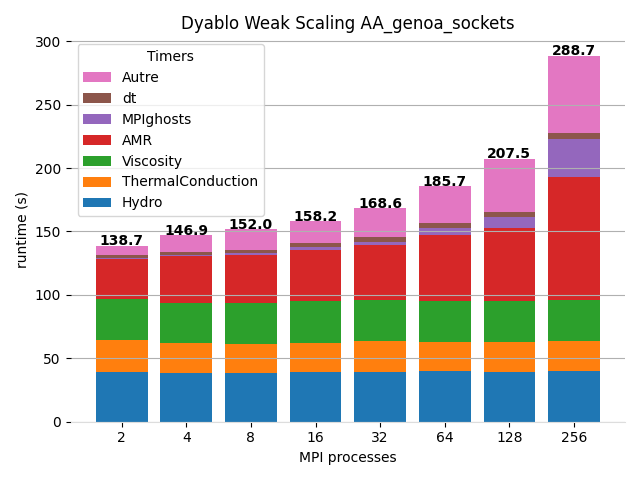
Dyablo: how does it scale?
weak scaling: solar convection
Image credits: Maxime Delorme
Ad Astra CPU (2 x AMD Epyc Genoa 96 cores)
24,576 cores
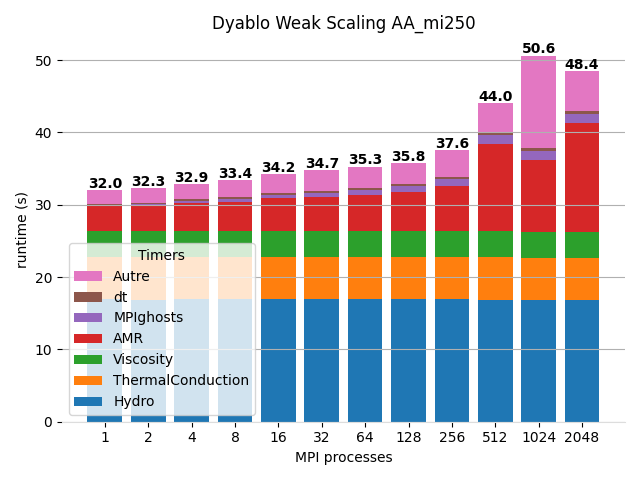
Ad Astra GPU (4 AMD MI250 x2 GCD )
Note: some updates in the code between left & right, raw perfs cannot be compared directly
Hydro only \(\sim 200\,\mathrm{Mcell/s}\)
AthenaK \(\sim1000\,\mathrm{Mcell/s}\), Stone+24
Cholla-MHD \(\sim 200\, \mathrm{Mcell/s}\), Caddy+24,
AREPO-RT \(\sim 1\,\mathrm{Mcell/s}\), Zier+24
Shamrock \(\sim 10\,\mathrm{Mcell/s}\), David-Cléris+25
13,631,488 “cores”
Conclusions
-
Tides set merger orbital parameters & angular momentum accretion
Mergers are not stochastic/not rerolling the dice
-
Trickling down to galactic scale, which drives scaling relations
Galaxies are less stochastic than expected
Galaxy & DM spin are partially independent at the level of individual galaxies
-
Non-linear effects on halo shape and alignment are comparable to population-level
Crucial to investigate further for the success of Euclid or LSST
-
Knowledge/modelling frontier: Circum Galactic Medium transport
Non-equilibrium, multiphase state in obs. (low-\(z\)) and sims (high-\(z\))
Cosmic web → CGM → ISM: how does AM evolve in this picture?
Tracing cosmic evolution
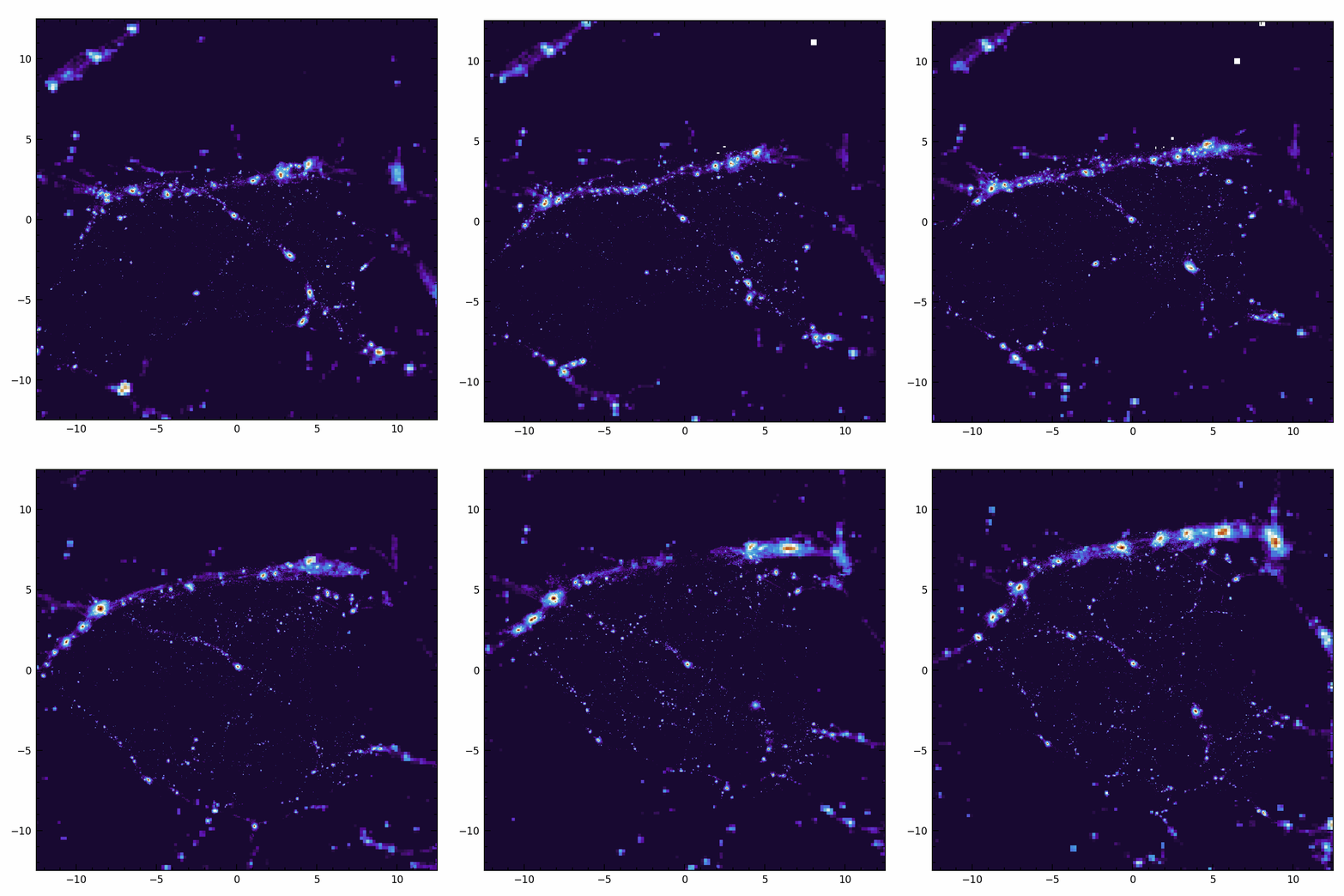
Conclusions
The (not so) new frontier:
physics in the circumgalactic medium
Tracing cosmic evolution: what's next?
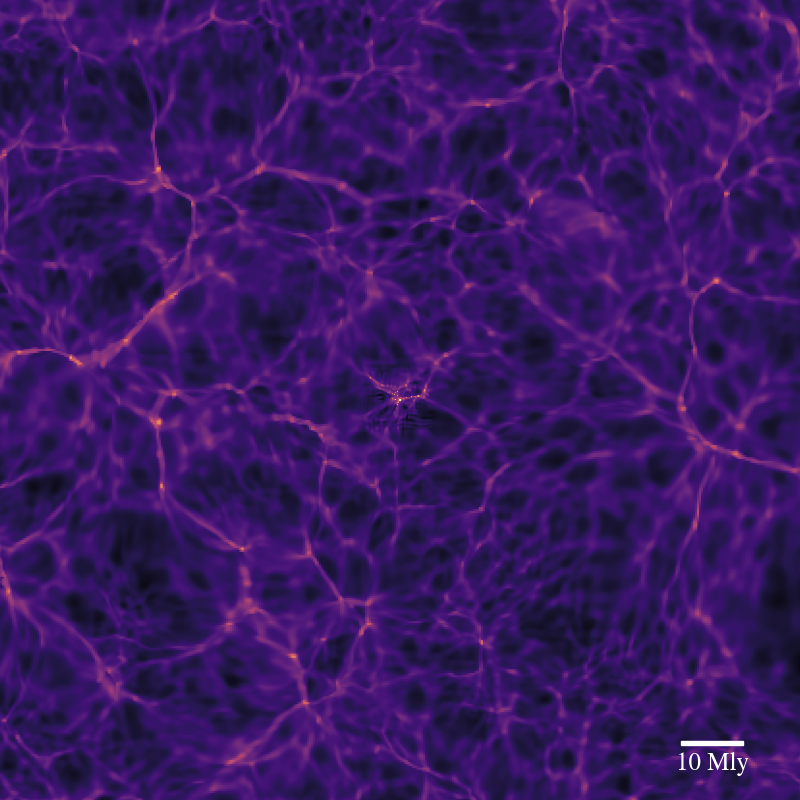
Conclusions
Come talk to me if you're interested in…
- galaxy formation,
- the cosmic web,
- numerical simulations (on GPUs, load-balancing, on-the-fly, …),
- data visualization (interactive, volume rendering, …).
🖥️ 118c — cadiou@iap.fr — https://cphyc.github.io —@cphyc.bsky.social
Processes that control ion and molecular properties:
-
Collisional, photo, cosmic-ray ionization
-
Radiative, dielectronic, dust recombination
-
Charge exchange
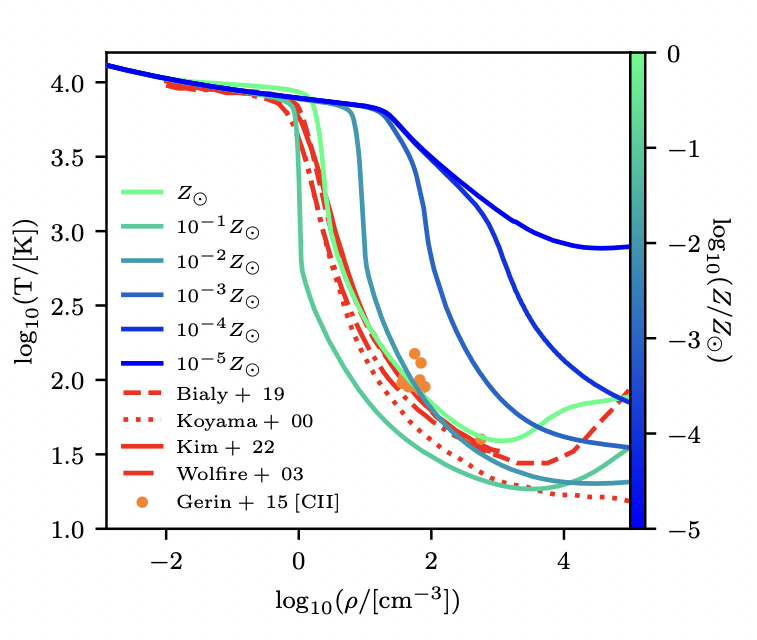
RAMSES-RTZ + PRISM: Non-equilibrium chemistry coupled to on-the-fly radiative transfer
Processes that control gas temperature:
- Cosmic-ray, photo, photo-electric, H2, dust heating
- Primordial, \(\mathrm{H}_2\), CO, metal, dust* recombination, dust-gas collisional cooling
- Adiabatic (expansion), shocks (e.g. SN, turbulence), gravitational, etc.
Image: Cadiou/Katz/Rey+in prep


Angular momentum:
- Qualitatively understood
- Abrupt changes with mergers
- Crucial for galaxy formation + weak lensing
Corentin Cadiou
Porciani+02
Vitviska+02, Benson+20
Fall+80
Corentin Cadiou
Vitviska+02, Benson+20
Porciani+02
Fall+80
Angular momentum:
- Qualitatively understood
- Abrupt changes with mergers
- Crucial for galaxy formation + weak lensing
Corentin Cadiou
Fall+80
Vitviska+02, Benson+20
Porciani+02
Angular momentum:
- Qualitatively understood
- Abrupt changes with mergers
- Crucial for galaxy formation + weak lensing
Angular momentum:
- Abrupt changes with mergers
- Qualitatively understood
- Crucial for galaxy formation + weak lensing
Corentin Cadiou
Fall+80
Vitviska+02, Benson+20
Porciani+02
- What's the origin of angular momentum?
- Are mergers truly stochastic?
- How does it translate to galaxy properties?
See Cadiou+21a
based on genetic modifications: Roth+16, Rey&Pontzen 18, Stopyra+20
“Find the most likely \(\Lambda\)CDM realisation
that increases the torques by factor \(f\)”
This is actually done by minimizing \((\delta_\mathrm{new}-\delta_\mathrm{old})^\dagger \textbf{C}^{-1}(\delta_\mathrm{new}-\delta_\mathrm{old})\)
with the constrains \(\tau^{(i)}_\mathrm{new} = f \tau^{(i)}_\mathrm{old}, \quad i=x,y,z\)
MEGATRON simulation
With Rey & Katz
- Large volumes (TNG, HAGN, …)
- statistical results only
- relatively poor resolution
- Small volumes & zoom-ins
- few formation scenarios
- Genetically modified simulations
Large-scale torques control mergers deterministically
which controls secondary galaxy properties
… what happens to the gas?
Corentin Cadiou
Large-scale torques control mergers deterministically
which controls secondary galaxy properties
… what happens to the gas?
Corentin Cadiou
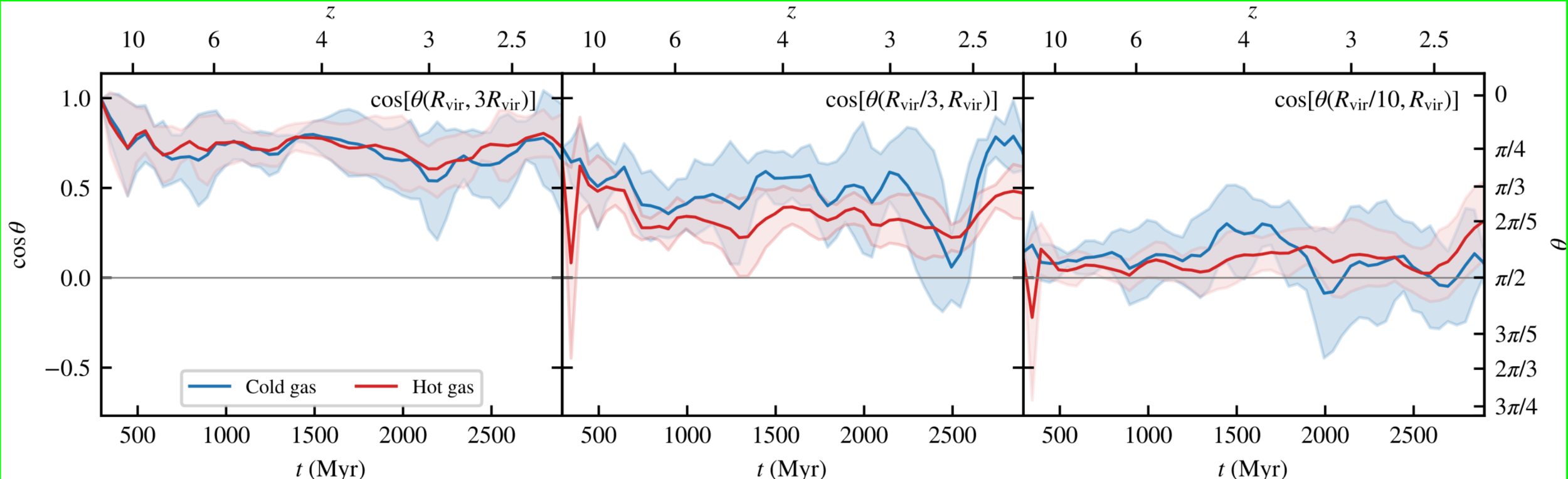
Most of re-alignment happens in the inner CGM \(0.1\leq \displaystyle\frac{r}{R_\mathrm{vir}}\leq 0.3\)
The longer gas remains in inner CGM, the more it realigns (with disk)
Corentin Cadiou
Tracers: Cadiou+19
Cadiou+21b, see also Danovich+15, Prieto+17
Tracking Lagrangian trajectories, comparing \(\vec{j}\) to
\(\parallel\) to direction @ \(R_\mathrm{vir}\)
\(\perp\) to direction @ \(R_\mathrm{vir}\)
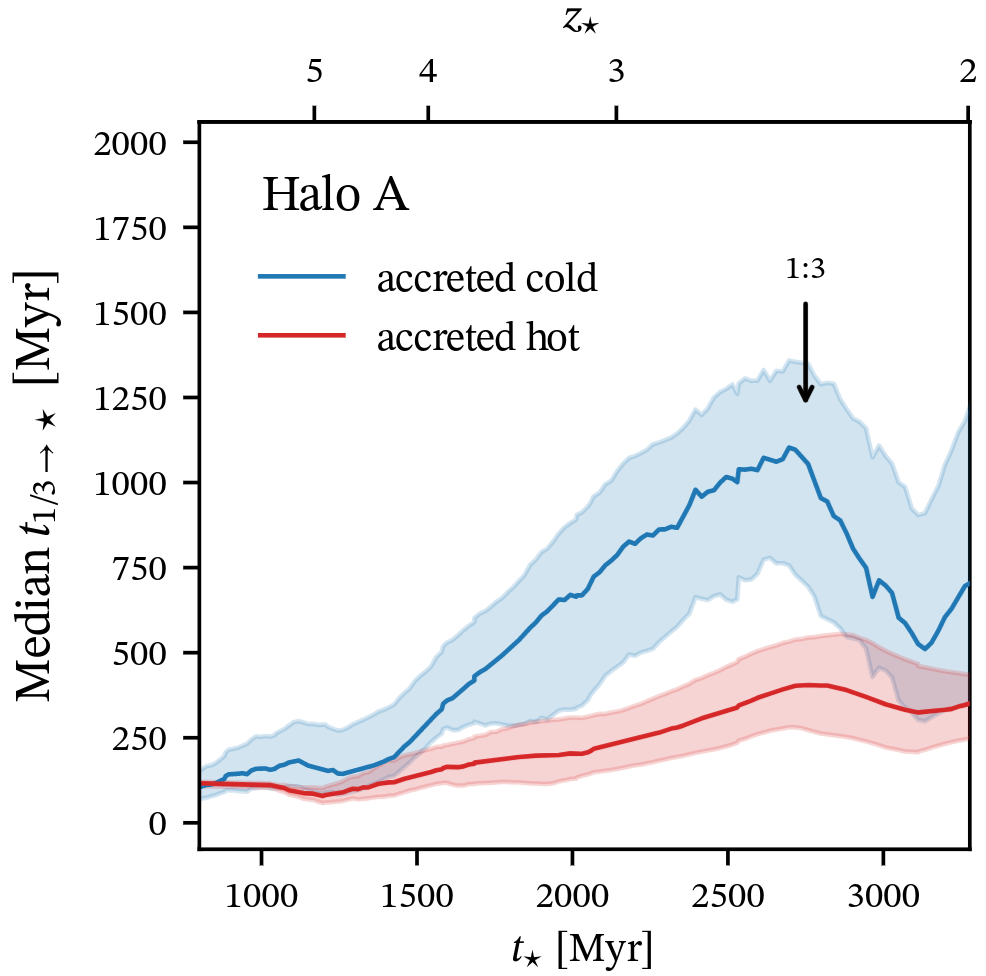
⚠️ Only looking at gas that will form stars eventually
Kocjan, Cadiou+24
Corentin Cadiou
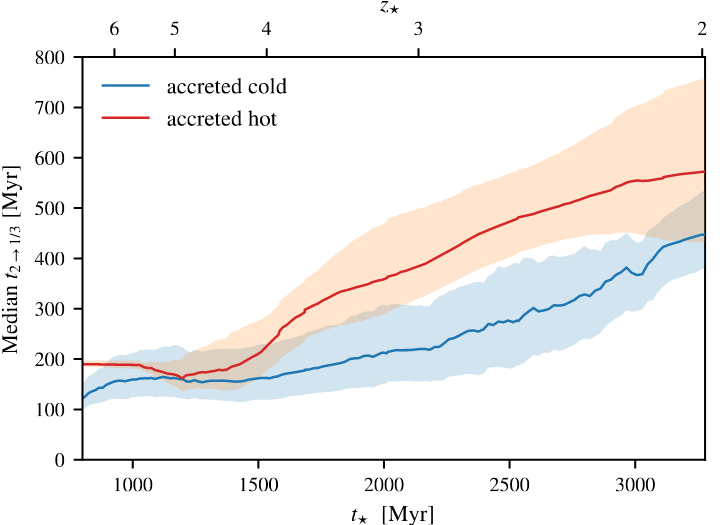
Time \(2R_\mathrm{vir}\rightarrow R_\mathrm{vir}/3\)
Time \(R_\mathrm{vir}/3 \rightarrow ⭐\)
Angular momentum: bridging galaxy formation to cosmology
2 Spin \(\leftrightarrow\) morphology
Romanowsky&Fall 12
Harrison+17
Hasan+23 (TNG)
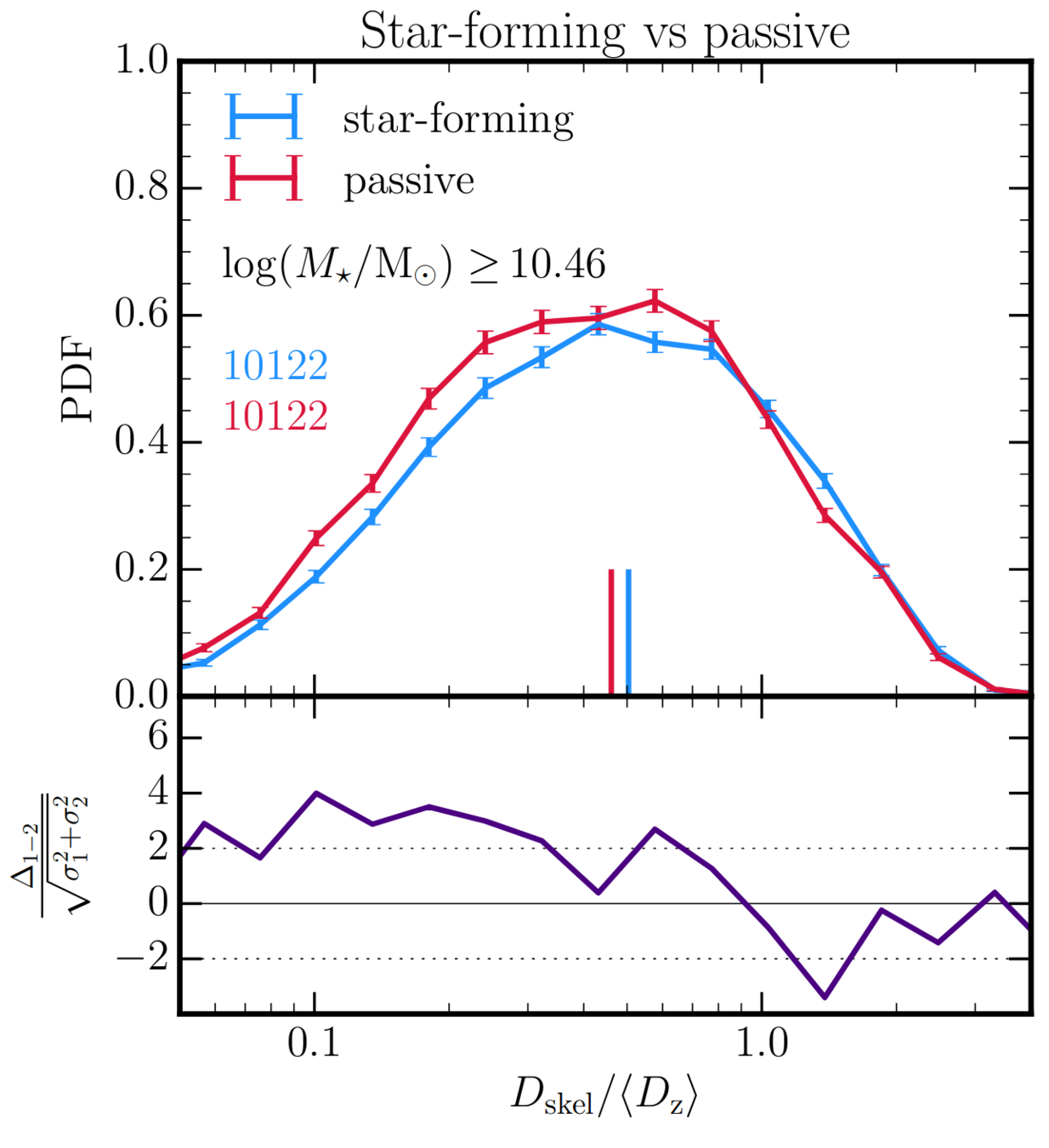
3 Cosmic web \(\leftrightarrow\) SFR
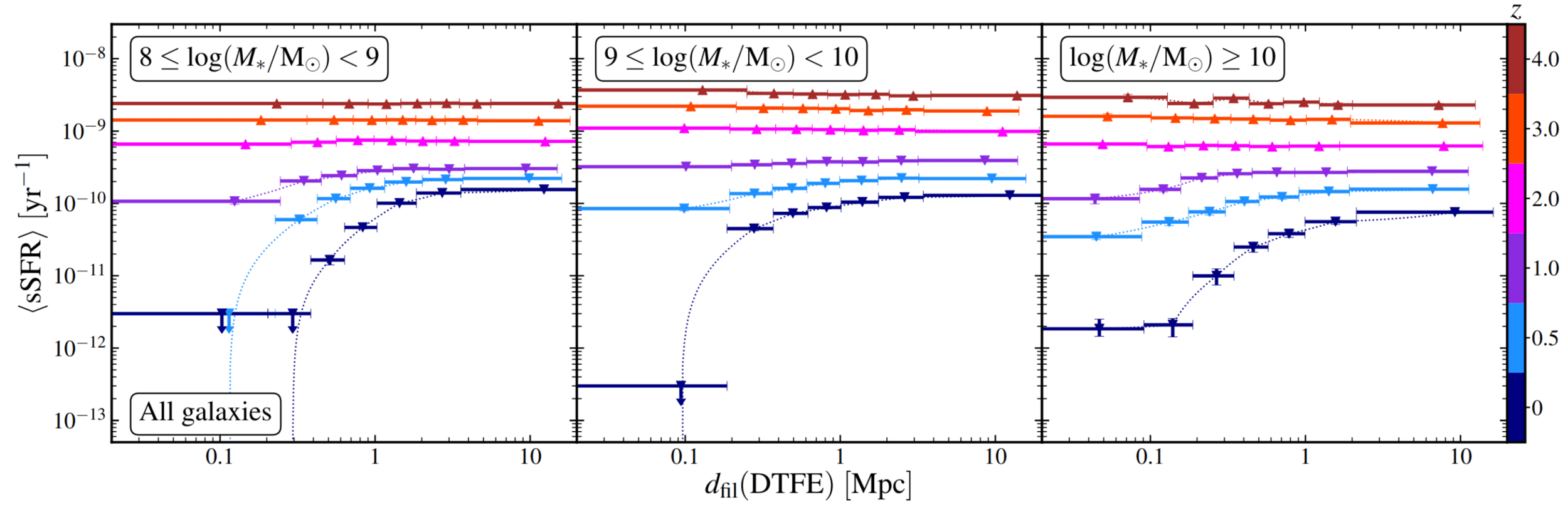
Kraljic+CC+19 (HAGN)
1 Cosmic web \(\leftrightarrow\) spin
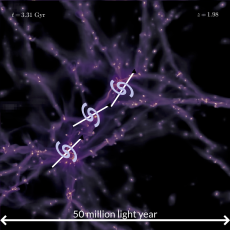
1 Cosmic web \(\leftrightarrow\) spin
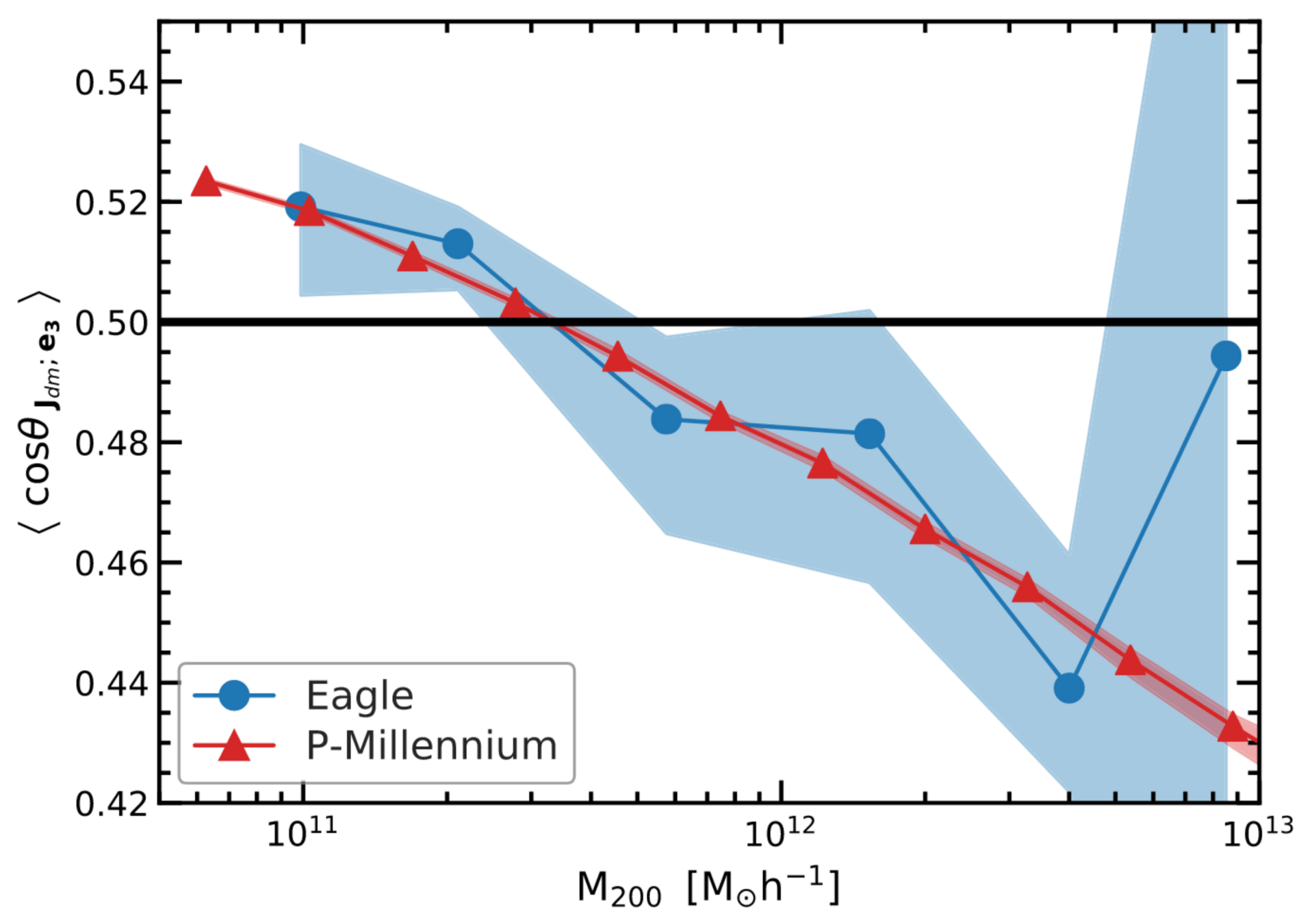
Ganeshaiah Veena+21
Corentin Cadiou
Angular momentum: bridging galaxy formation to cosmology
2 Spin \(\leftrightarrow\) morphology
Romanowsky&Fall 12
Harrison+17
Hasan+23 (TNG)
3 Cosmic web \(\leftrightarrow\) SFR
Kraljic+CC+19 (HAGN)
1 Cosmic web \(\leftrightarrow\) spin
1 Cosmic web \(\leftrightarrow\) spin
Ganeshaiah Veena+21
Corentin Cadiou
- Why is the effect of the cosmic web at % level?
- What's the arrow of causality?
CW ⇒ spin ⇒ morphology? - How stochastic is galaxy formation?
\(z=0\)
\( z = 100\)
[Genetic modifications: Roth+16, see also Rey&Pontzen 18, Stopyra+20]
Tide \(\nearrow\) delay merger
Tide \(\searrow\) hasten merger
Corentin Cadiou
Corentin Cadiou
Cadiou+21b
So far, I've shown effect of linear perturbations on galaxy formation.
How to probe non-linear couplings?
Corentin Cadiou
Splicing technique Cadiou, Pontzen & Peiris 21
Extended by A. Storck
Corentin Cadiou
Splicing technique Cadiou, Pontzen & Peiris 21
Extended by A. Storck
Corentin Cadiou
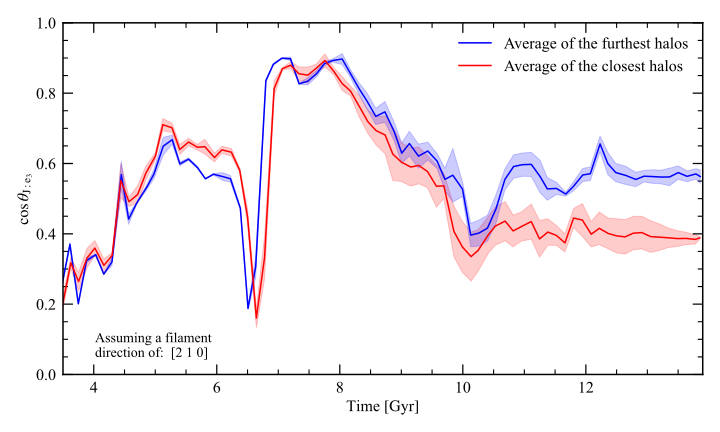
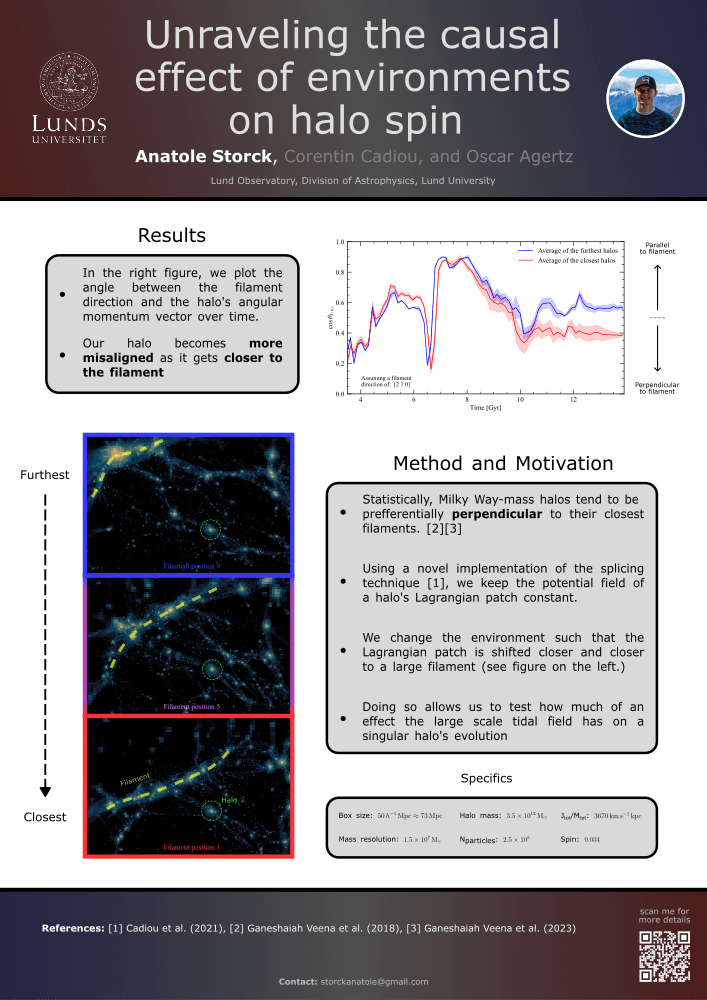
See Anatole Storck's poster for more information!
Far
Close
Halo (mis-)aligns itself to filament
Corentin Cadiou
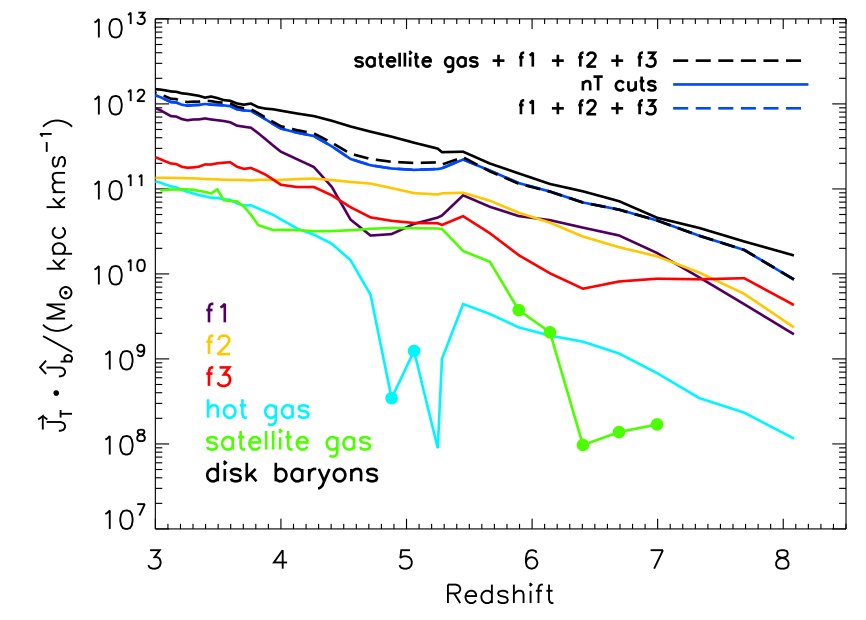
Tillson+15
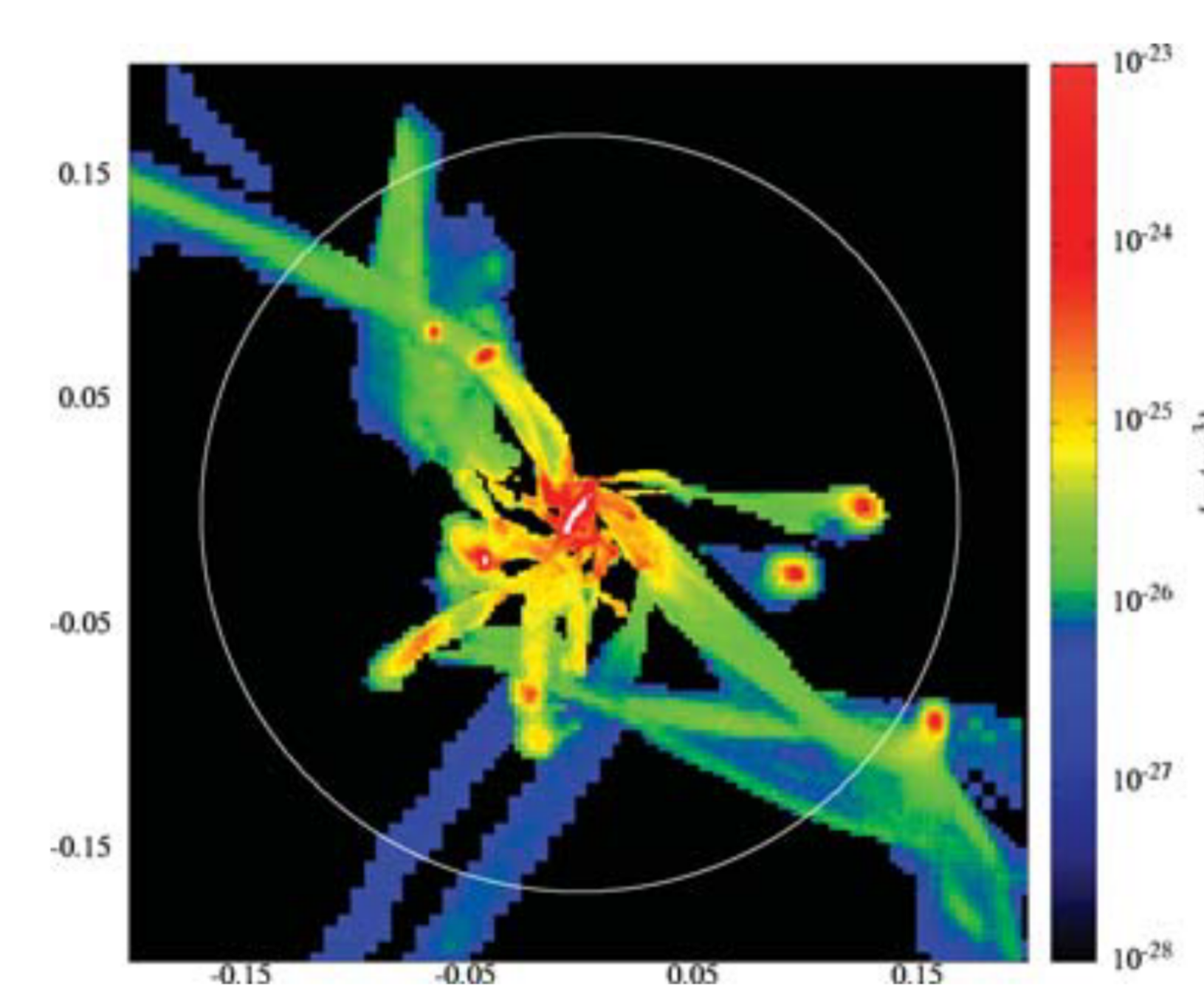
Dekel&Birnboim 06
High-z:
most of mass + AM flow along filaments
How do we study these effects?
Large volumes
sample \(p(M_\star, M_\mathrm{DM},\mathbf{J}, d_\mathrm{fil}, \dots)\)
This talk
sample \(p(\mathbf{J}|M_\star, M_\mathrm{DM}, d_\mathrm{fil}, \dots)\)
Angular momentum: bridging galaxy to cosmology
Lower-zs:
intrinsic alignment problem
Angular momentum: where are we?
Porciani+02
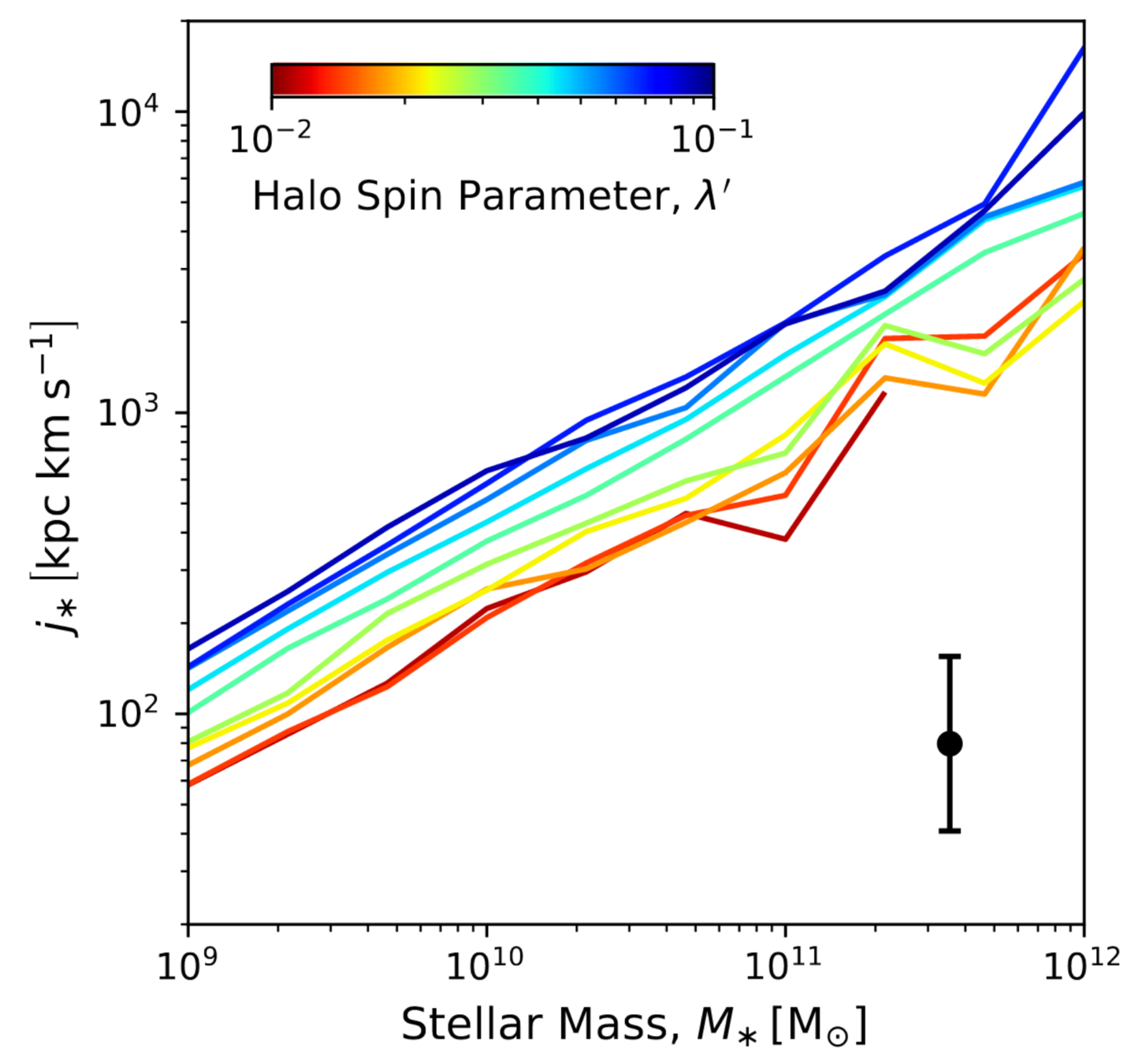
Rodriguez-Gomez+22
Predictions for \(j_\mathrm{DM}\) remain qualitative
\(j_\mathrm{DM}-j_\mathrm{\star}\)
weak correlation
(statistically strong)
- Is \(j_\mathrm{DM}\) chaotic or our theory poor?
- Do \(j_\mathrm{gal}\) retain memory of their environment?
-
How is AM transported to the disk?
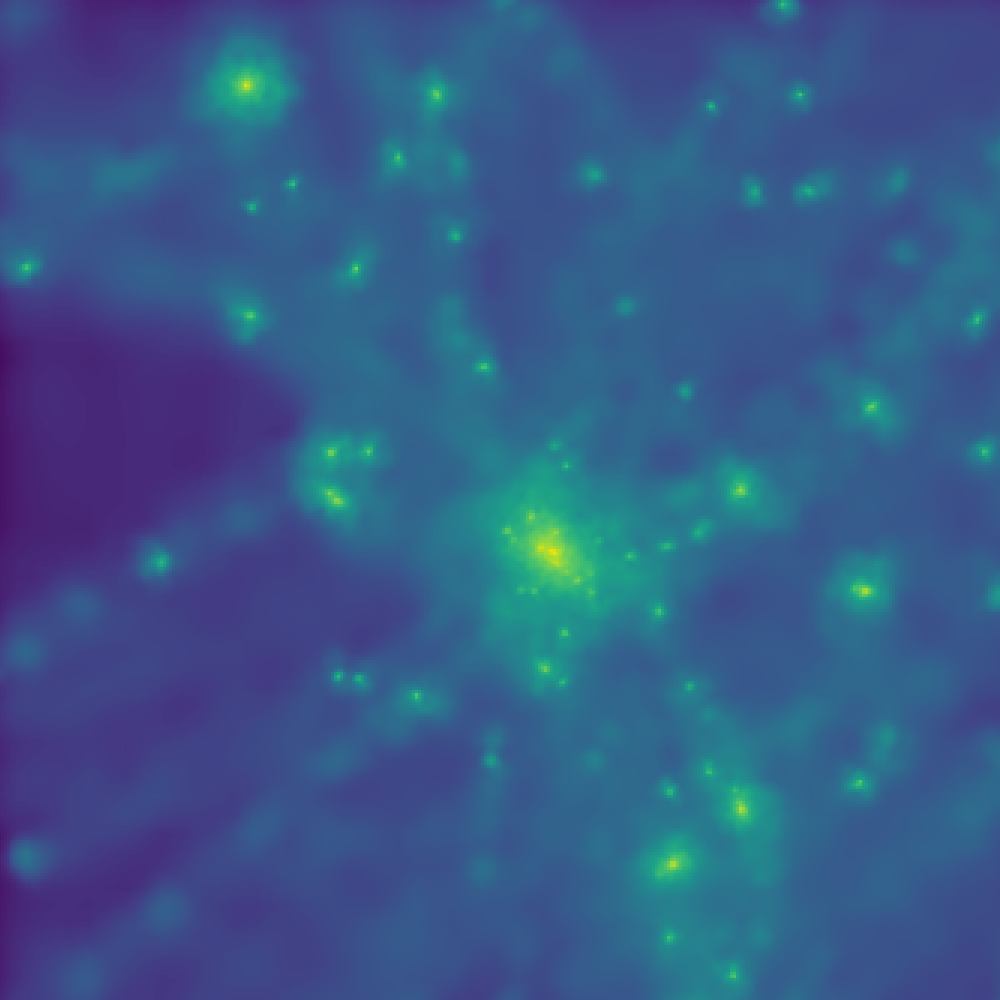

1. Is \(j_\mathrm{DM}\) chaotic or our theory poor?
First controlled experiment of testing tidal torque theory for individual halos
CC+21a, arXiv: 2012.02201
2. Do \(j_\mathrm{gal}\) retain memory
of the environment?
3. How is AM transported
to the disk?
1. Is \(j_\mathrm{DM}\) chaotic or our theory poor?
2. Do \(j_\mathrm{gal}\) retain memory
of the environment?
First controlled experiment of angular momentum accretion on individual galaxies
CC+22, arXiv: 2206.11913
Main idea: stars are deeper in potential well so less sensitive to what happens at large scales
⇒ stellar Lagrangian patch should be more stable to perturbations
3. How is AM transported
to the disk?
1. Is \(j_\mathrm{DM}\) chaotic or our theory poor?
2. Do \(j_\mathrm{gal}\) retain memory
of the environment?
3. How is AM transported
to the disk?
CC+Pichon+Dubois, 21, arXiv: 2110.05384
Kocjan, CC in prep.
Dynamics of angular momentum
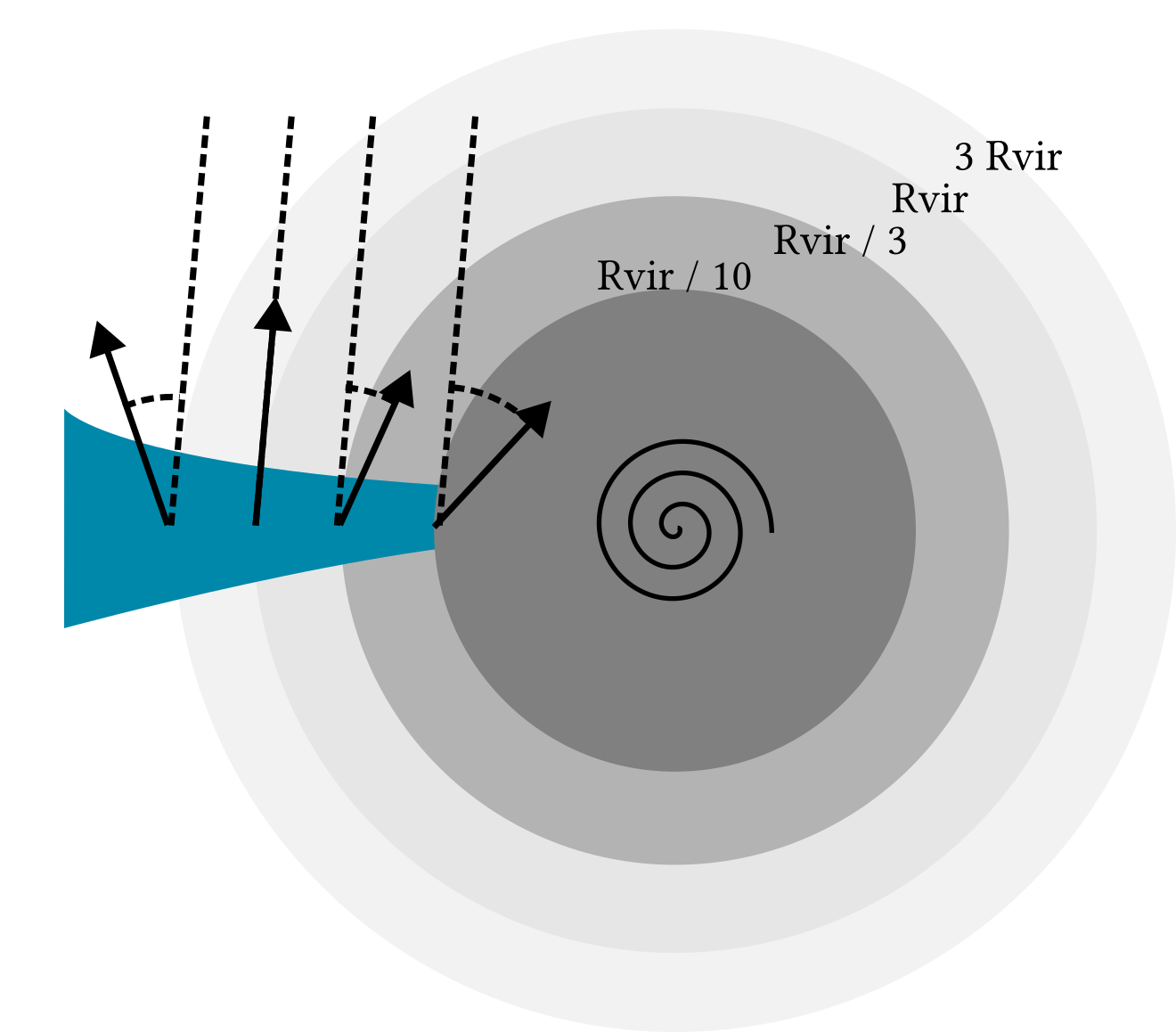
Realignment between…
…\(3R_\mathrm{vir}\) and \(R_\mathrm{vir}\)
…\(R_\mathrm{vir}\) and \(R_\mathrm{vir}/3\)
…\(R_\mathrm{vir}\) and \(R_\mathrm{vir}/10\)
✅ Most of realignment happens in “CGM” (\(\leq R_\mathrm{vir}/3\))
Mostly due to grav. torques (consistent with e.g. Danovich+15)
[CC+21]
\(t_{1/3}\)
\(t_{\star}\)
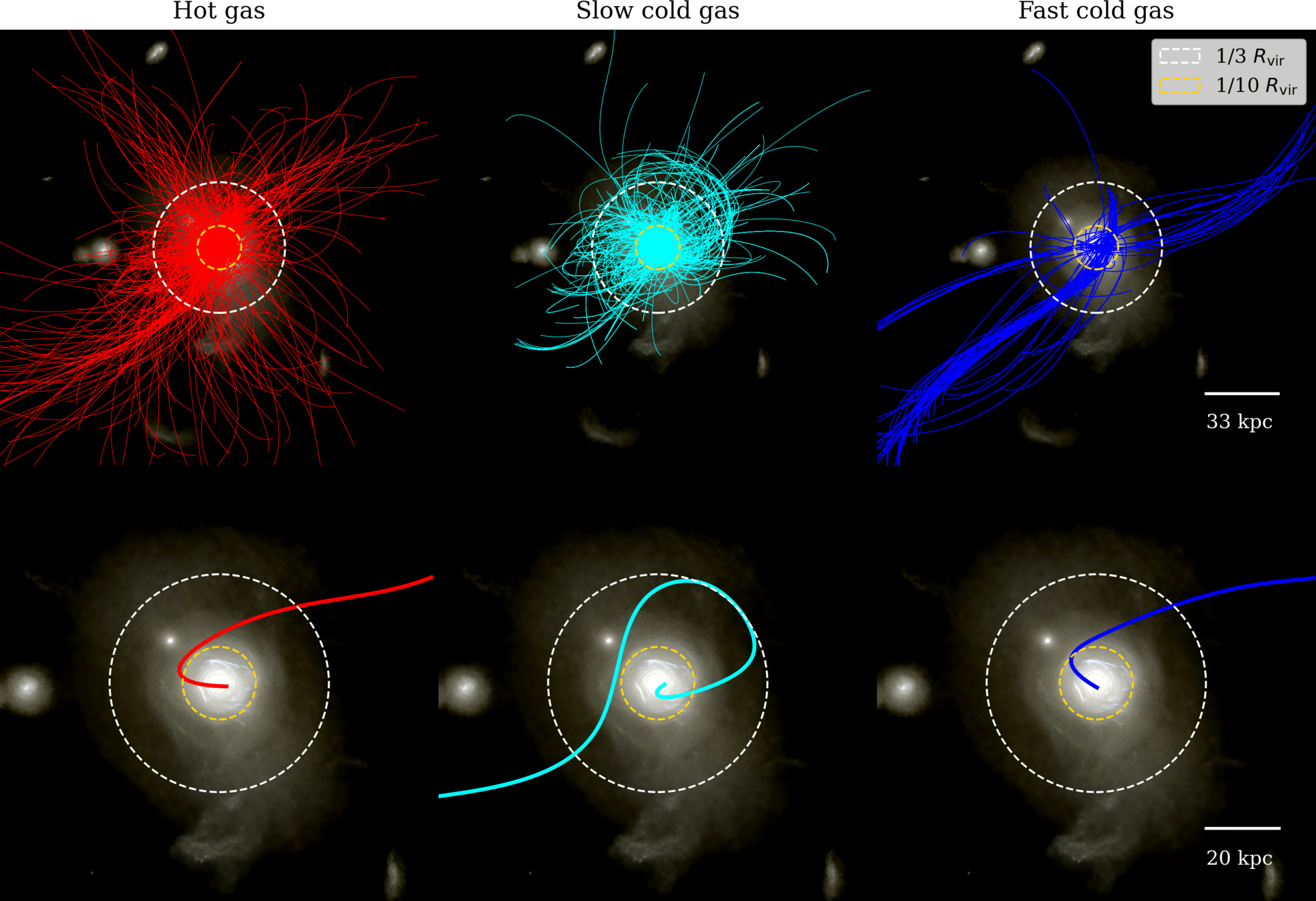
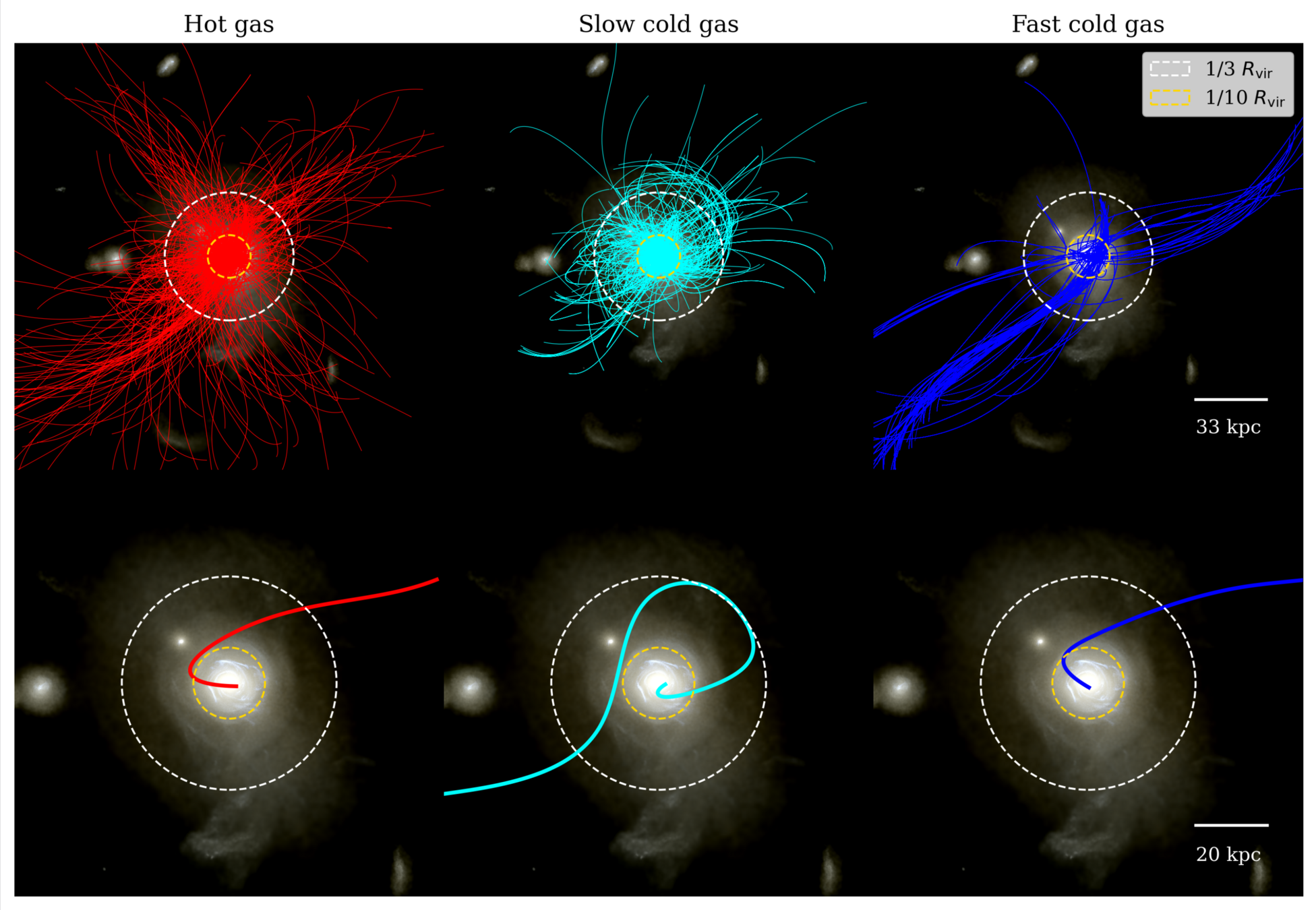
\(T_\mathrm{max}\) between \(2 R_\mathrm{vir}\) and \(R_\mathrm{vir}/3\)?
\(\leq 3\times10^4\,\mathrm{K}\)
Cold accretion
\(\geq 5\times10^5\,\mathrm{K}\)
Hot accretion
[Kocjan, CC+ in prep]
What happens in the CGM?
Ongoing work by Z. Kocjan
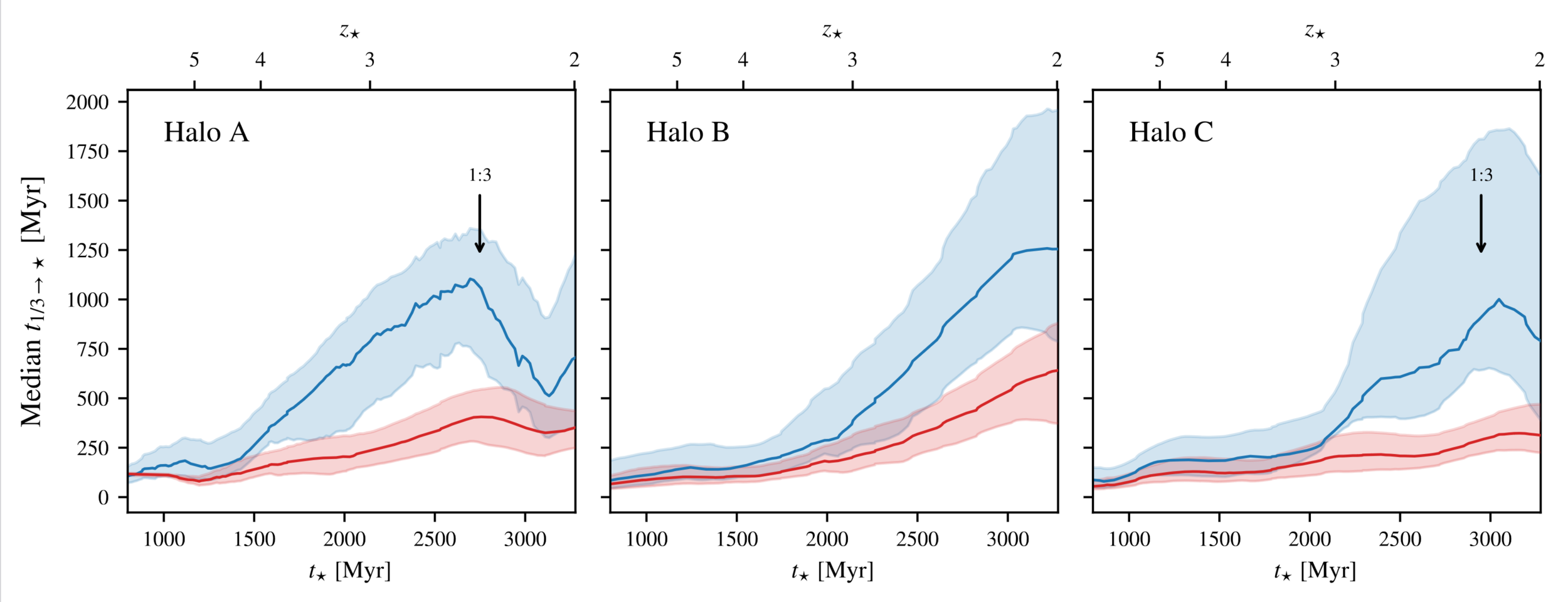
✅ Cold accretion is slow to form stars
Quick depletion right after merger
[Kocjan, CC+ in prep]
The effects of environment on halo properties
Kraljic+18 [see also Laigle15, Song+21,…]
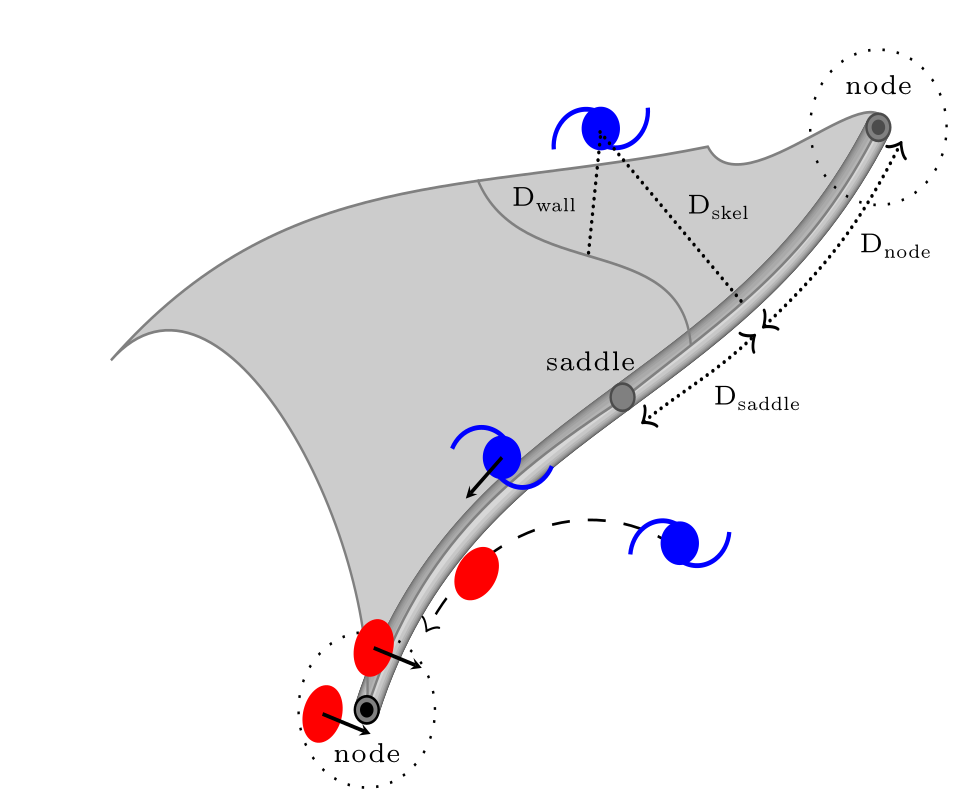
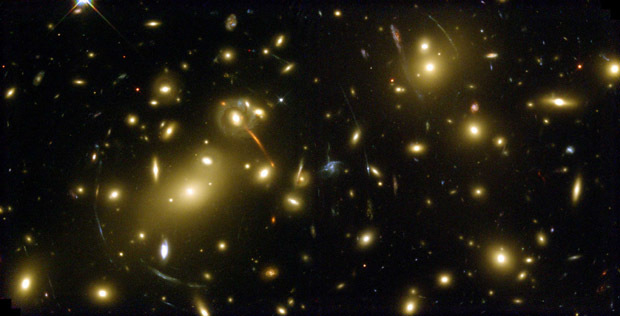
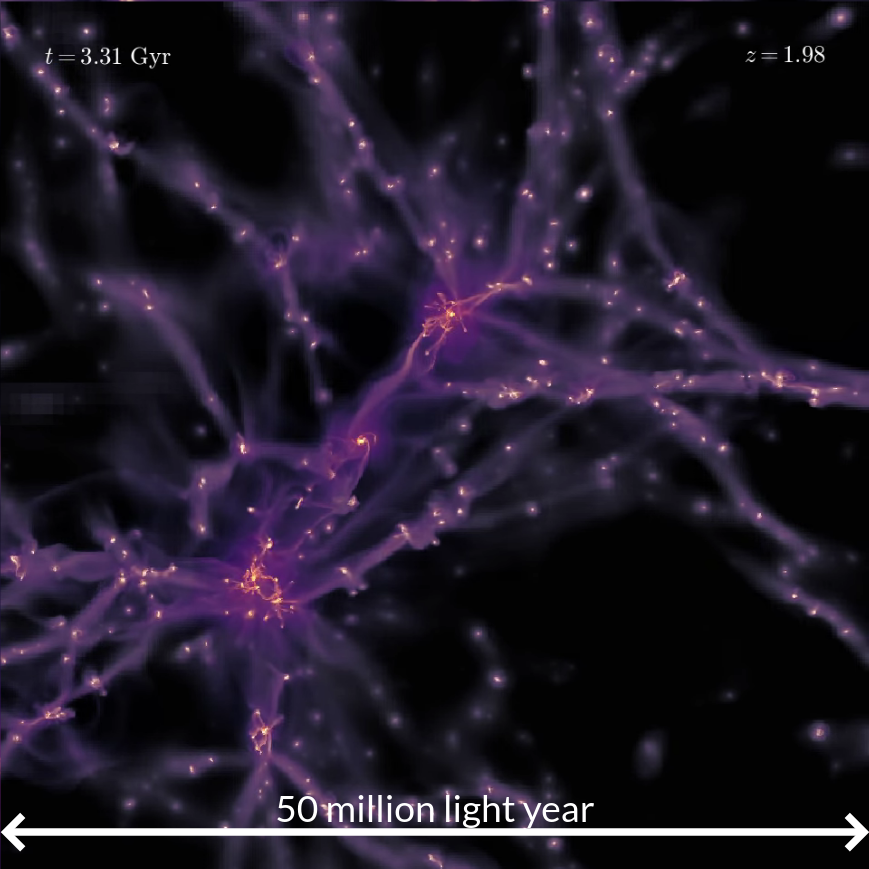
- \( M_\mathrm{DM}(\text{node}) \) > \(M_\mathrm{DM}(\text{fil}) \) >\(M_\mathrm{DM}(\text{void})\), higher clustering
- spins align with cosmic web ⇒ issue for weak lensing
- \(v/\sigma(\mathrm{fil})>v/\sigma(\mathrm{void})\) ⇒ bias in galaxy formation
- ….
The effects of environment on halo properties
Isotropic effects
Kaiser bias, cluster vs. groups, ...
From theory: \(M\propto \int\mathrm{d}^3R\rho\)
Mass regulated
An-isotropic effects
Intrinsic alignment, formation of disks?
From theory: \(J \propto \int\mathrm{d}^3R \nabla \phi\)
Angular momentum regulated?
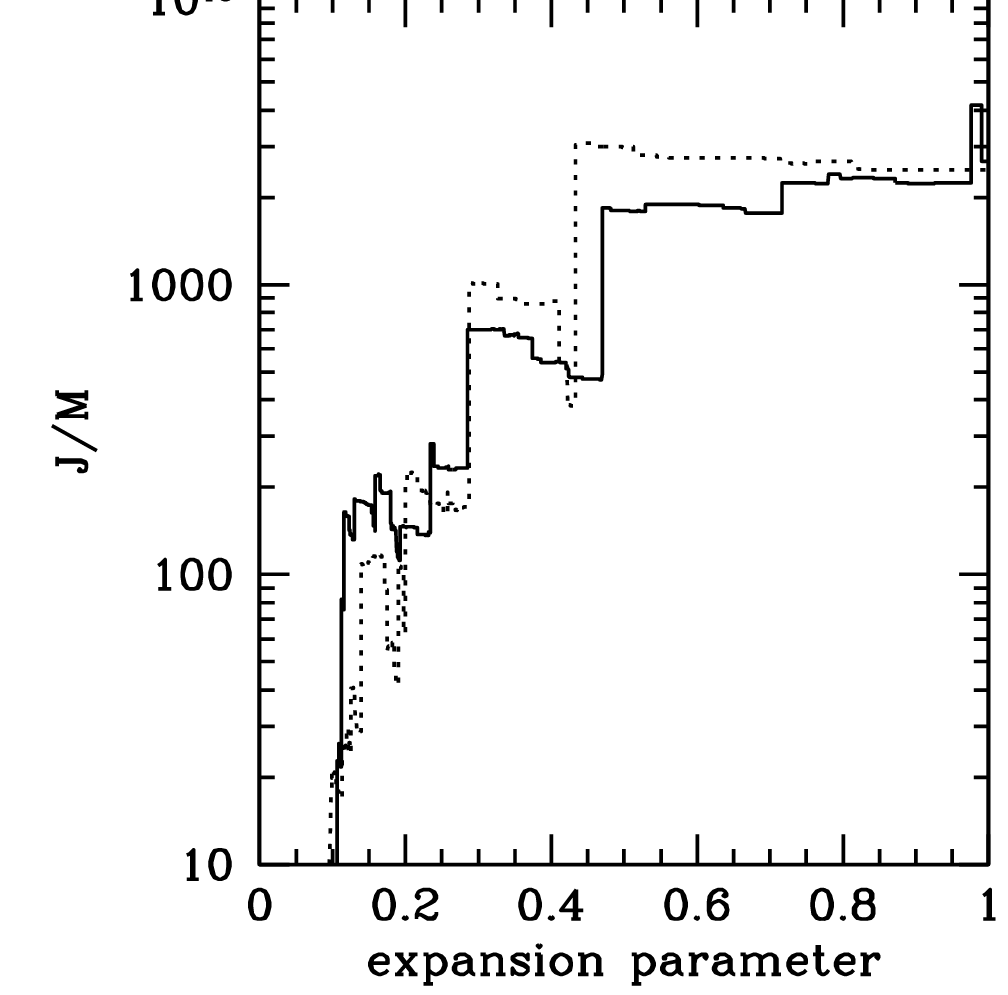
Predicting angular momentum
\(z=0\)
\( z = 100\)
\[\mathbf{L}_\mathrm{lin.} \propto \int\mathrm{d}^3q(\mathbf{q}-\bar{\mathbf{q}})\times \nabla\phi\]
Position w.r.t. center
Velocity
[White 84]
Note: vanishes at 1st order in a sphere
\[ \int_\Gamma \mathrm{d}^3{q}(\mathbf{q}-\mathbf{\bar{q}}) \times\nabla\phi = \int_{\partial\Gamma}\phi(q)(\mathbf{q}-\mathbf{\bar{q}})\times\mathrm{d}\mathbf{S}\]
Note: the following is a (poor) approximation:
\[ \mathbf{L} \propto \epsilon_{ijk} T_{jl}I_{lk},\quad\text{with \textbf{T} the tidal tensor and \textbf{I} the inertia tensor}\]
Ongoing work by Z. Kocjan

[Kocjan, CC+ in prep]
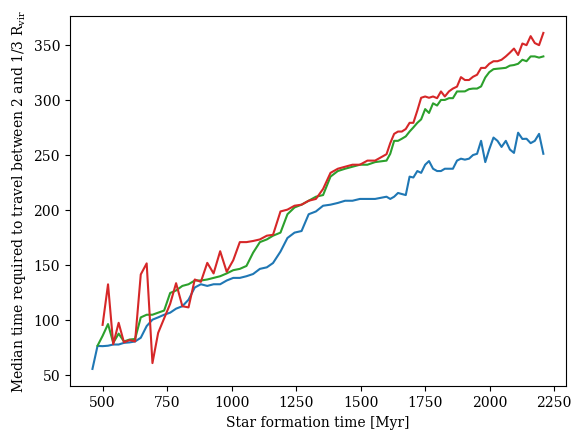
Filamentary accretion ~ Cold flow = \(T \leq 10^5\mathrm{K}\) for \(0.3R_\mathrm{vir} < r < 2R_\mathrm{vir}\)
Filamentary accretion ~ Cold flow = \(T \leq 10^5\mathrm{K}\) for \(0.3R_\mathrm{vir} < r < 2R_\mathrm{vir}\)
Not necessarily fast-track to star formation ⇒ lose connection to CW?
[Kocjan, CC+ in prep]
\(M_\mathrm{DM}(z=2)\approx 10^{11}-10^{12} \mathrm{M_\odot}\)
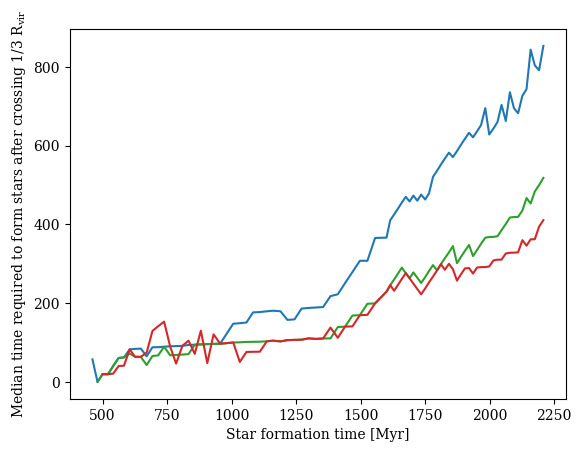
Ongoing work by Z. Kocjan
Ex Uno Plures: direct measure of the impact of the cosmic web on individual objects to shed light on their population statistics


Corentin Cadiou
The Co-evolution of the CW and Galaxies across Cosmic Time

The causal origin of DM halo concentration
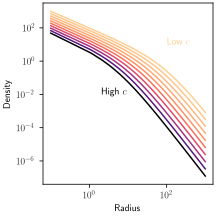
$$\rho_\mathrm{DM}(r) = \frac{\rho_0}{\frac{r}{R_\mathrm{vir}/c} \left(1 + \frac{r}{R_\mathrm{vir}/c}\right)^2}$$
Wechsler+02
Origin of scatter at fixed \(M_\mathrm{vir}\)?
Predicting angular momentum
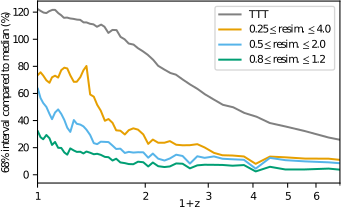
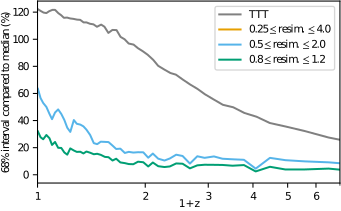

- Angular momentum of individual regions can be predicted accurately.
- AM of halos ⇒ requires boundaries of patch
\[\mathbf{L}_\mathrm{lin.} \propto \int\mathrm{d}^3q(\mathbf{q}-\bar{\mathbf{q}})\times \nabla\phi\]
[On patch boundaries: see Lucie-Smith+18]
Can we control baryonic
angular momentum?
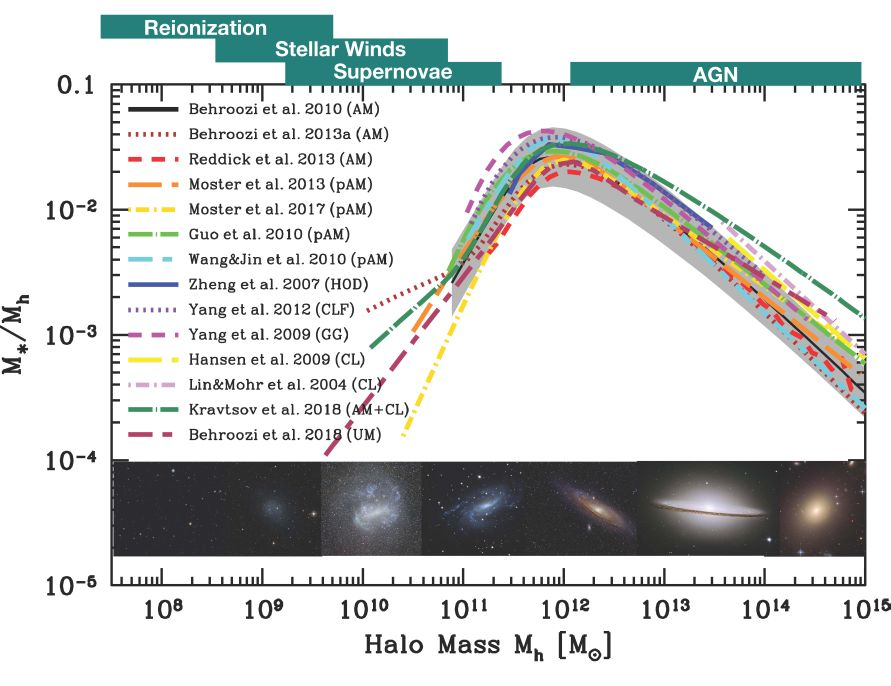
Wechsler & Tinker 18
\({\color{red}M_\star} / M_\mathrm{h} \ll \Omega_b / \Omega_m \)
⇒ baryons & DM stem from different regions
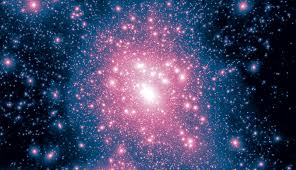
Baryons more strongly bound
⇒ less prone to being ejected
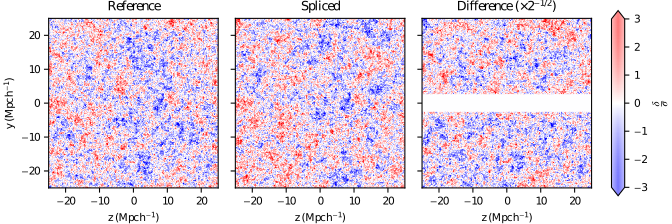
Verify that
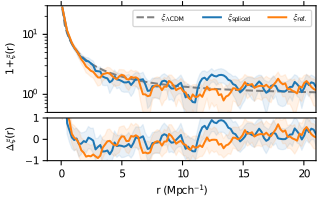
\[\xi_\mathrm{lin}(r) \sim \left\langle {\color{green}\underbrace{\delta(x=d)}_\mathrm{in}} {\color{purple} \underbrace{\delta(x=d+r)}_\mathrm{out}}\right\rangle \]
is the same in spliced / ref simulation.
Verify that
\[\xi_\mathrm{lin}(r) \sim \left\langle {\color{green}\underbrace{\delta(x=d)}_\mathrm{in}} {\color{purple} \underbrace{\delta(x=d+r)}_\mathrm{out}}\right\rangle \]
is the same in spliced / ref simulation.
Verify that
\[\xi_\mathrm{lin}(r) \sim \left\langle {\color{green}\underbrace{\delta(x=d)}_\mathrm{in}} {\color{purple} \underbrace{\delta(x=d+r)}_\mathrm{out}}\right\rangle \]
is the same in spliced / ref simulation.
Temporary conclusions
-
angular momentum is predictable
-
boundary of halos in the ICs is a hard problem
⇒ limits practicality of predictions (for now)
-
baryons appear to be simpler!
⇒ good news for weak lensing predictions
⇒ key to understand morphology
Galaxy formation in cosmology: the role of the environment

Environmental effects:
- source of “pollution” in weak lensing surveys
⇒ intrinsic alignment
- extra parameters in semi-analytical models
⇒ galaxy-halo correlation
+
\( R_{1/2} \)
\( l_0 \times 1.2\)
\( l_0 \times 1.5\)
\( l_0 \times 0.66\)
\( l_0 \times 0.8\)
\( l_0 \times 0.66\)
\( l_0 \times 0.8\)
\( l_0 \times 1.2\)
\( l_0 \times 1.5\)
\( l_0 \times 1.2\)
\( l_0 \times 1.5\)
\( l_0 \times 0.66\)
\( l_0 \times 0.8\)

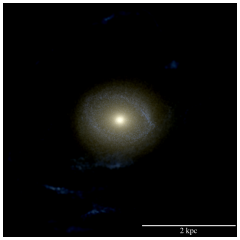
\( l_0 \times 1.2\)
\( l_0 \times 1.5\)
\( l_0 \times 0.66\)
\( l_0 \times 0.8\)
- AM of baryons originates from initial conditions…
- can be controlled…
- and regulate galaxy morphology
- Negligible AGN/SN global self-regulation
Galaxy formation
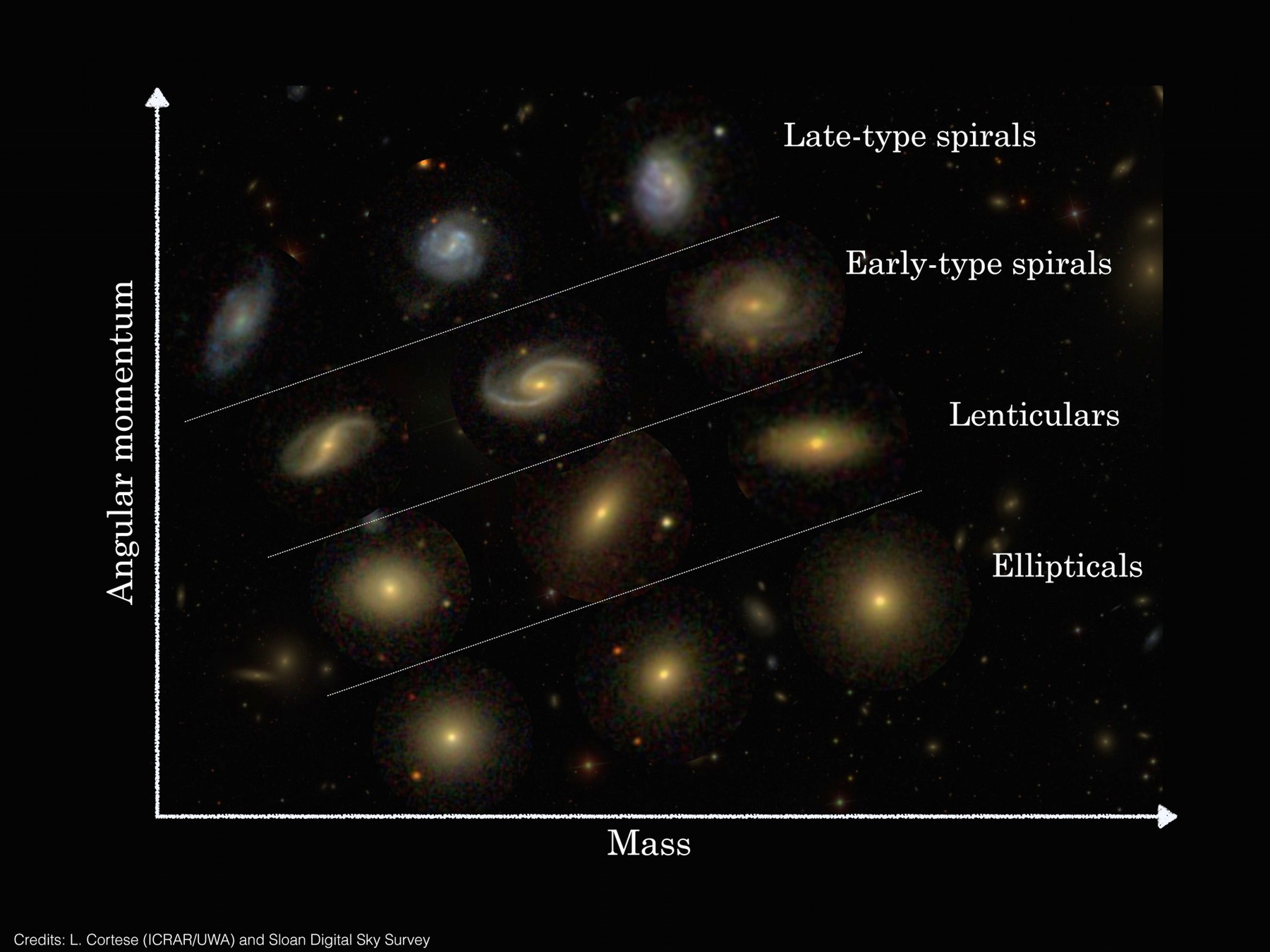
[L. Cortese; SDSS.]
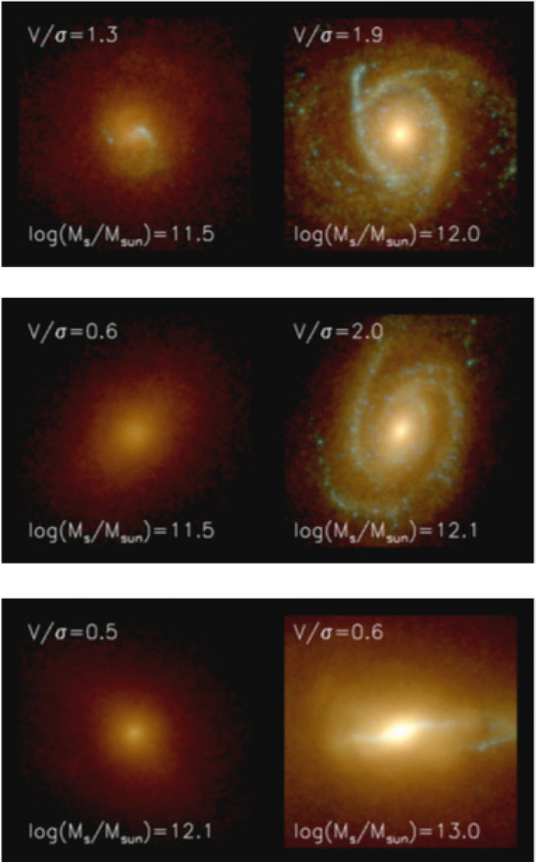
[Dubois+16]
AGN no AGN
Origin of morphological diversity at fixed mass?
[L. Cortese; SDSS.]
[Dubois+16]
AGN no AGN
Origin of morphological diversity at fixed mass?
How to explain environmental effects?
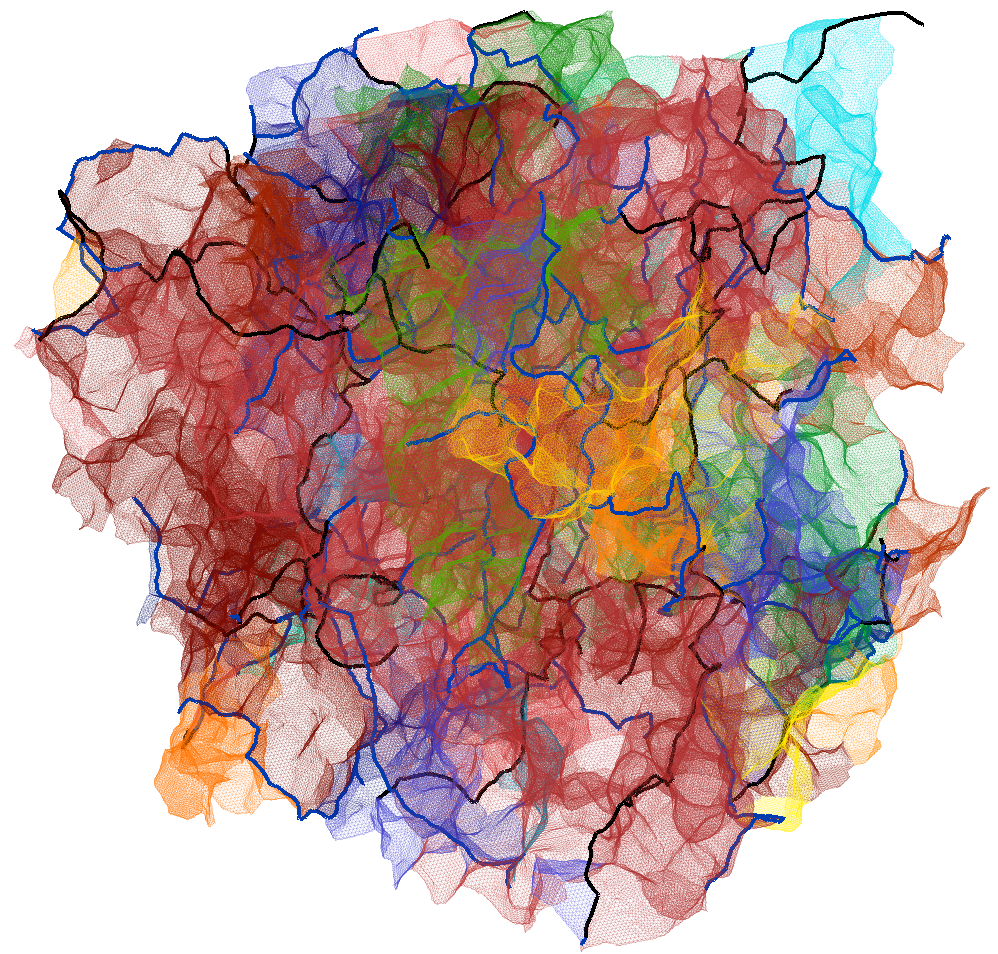
[Kraljic+ in prep]

Galaxy formation

[Danovich+15]
The origin of high \(z\) angular momentum
[Danovich+15]
I. Torque with cosmic web
The origin of high \(z\) angular momentum
[Danovich+15]
I. Torque with cosmic web
II. Transport at constant AM
The origin of high \(z\) angular momentum
[Danovich+15]
I. Torque with cosmic web
II. Transport at constant AM
III. Torque down in inner halo
The origin of high \(z\) angular momentum
[Danovich+15]
I. Torque with cosmic web
II. Transport at constant AM
III. Torque down in inner halo
IV. Mixing in inner disk & bulge
The origin of high \(z\) angular momentum
The origin of high \(z\) angular momentum
[Danovich+15]
IV. Mixing in inner disk & bulge
Fraction that ends up in disk vs. IGM?
Influence of galactic physics?
III. Torque down in inner halo
Origin of torque down (pressure or gravity)?
Loss of link with cosmic AM?
II. Transport at constant AM
Same evolution in cold/hot accretion modes?
I. Torque with cosmic web
Predict pre-accretion AM?
Alignment with environment?
The origin of high \(z\) angular momentum
[Danovich+15]
IV. Mixing in inner disk & bulge
Fraction that ends up in disk vs. IGM?
Influence of galactic physics?
III. Torque down in inner halo
Origin of torque down (pressure or gravity)?
Loss of link with cosmic AM?
See Cadiou+21c
II. Transport at constant AM
Same evolution in cold/hot accretion modes?
I. Torque with cosmic web
Predict pre-accretion AM?
Alignment with environment?
The origin of high \(z\) angular momentum
[Danovich+15]
IV. Mixing in inner disk & bulge
Fraction that ends up in disk vs. IGM?
Influence of galactic physics?
III. Torque down in inner halo
Origin of torque down (pressure or gravity)?
Loss of link with cosmic AM?
II. Transport at constant AM
Same evolution in cold/hot accretion modes?
I. Torque with cosmic web
Predict pre-accretion AM?
Alignment with environment?
Tracing Cosmic Evolution: From the CMB to the Web, the CGM, and Galactic Disks @ OCA
By Corentin Cadiou
Tracing Cosmic Evolution: From the CMB to the Web, the CGM, and Galactic Disks @ OCA
Seminar Lagrange - OCA