















Content ITV PRO
This is Itvedant Content department
Learning Outcome
5
Adapt communication based on audience and situation
4
Apply strategies to overcome communication barriers
3
Use voice modulation for clear and effective communication
2
Identify common communication barriers
1
Tone & Voice Basics (Pitch, Pace, Volume)
You’ve learned how to communicate and listen effectively...
Now imagine you’re in an interview.
Do you think the interviewer will be impressed?”
You give the perfect answer , but your voice is low, flat, and unclear.
Probably not.
Because in that moment, your words are right—
but your delivery is weak.
Getting the answer right is not enough
how you say it matters.
That’s where Tone and Voice Modulation come in…
and when nervousness or fear affects you, it becomes a communication barrier.”
Why Tone & Voice Modulation matter ?
1.Right message can fail due to poor delivery
2.Voice reflects confidence and clarity
3.Monotone speech reduces engagement
4.Impacts interviews, presentations, and daily communication
5.Strong voice = strong impression
What is Tone & Voice Modulation ?
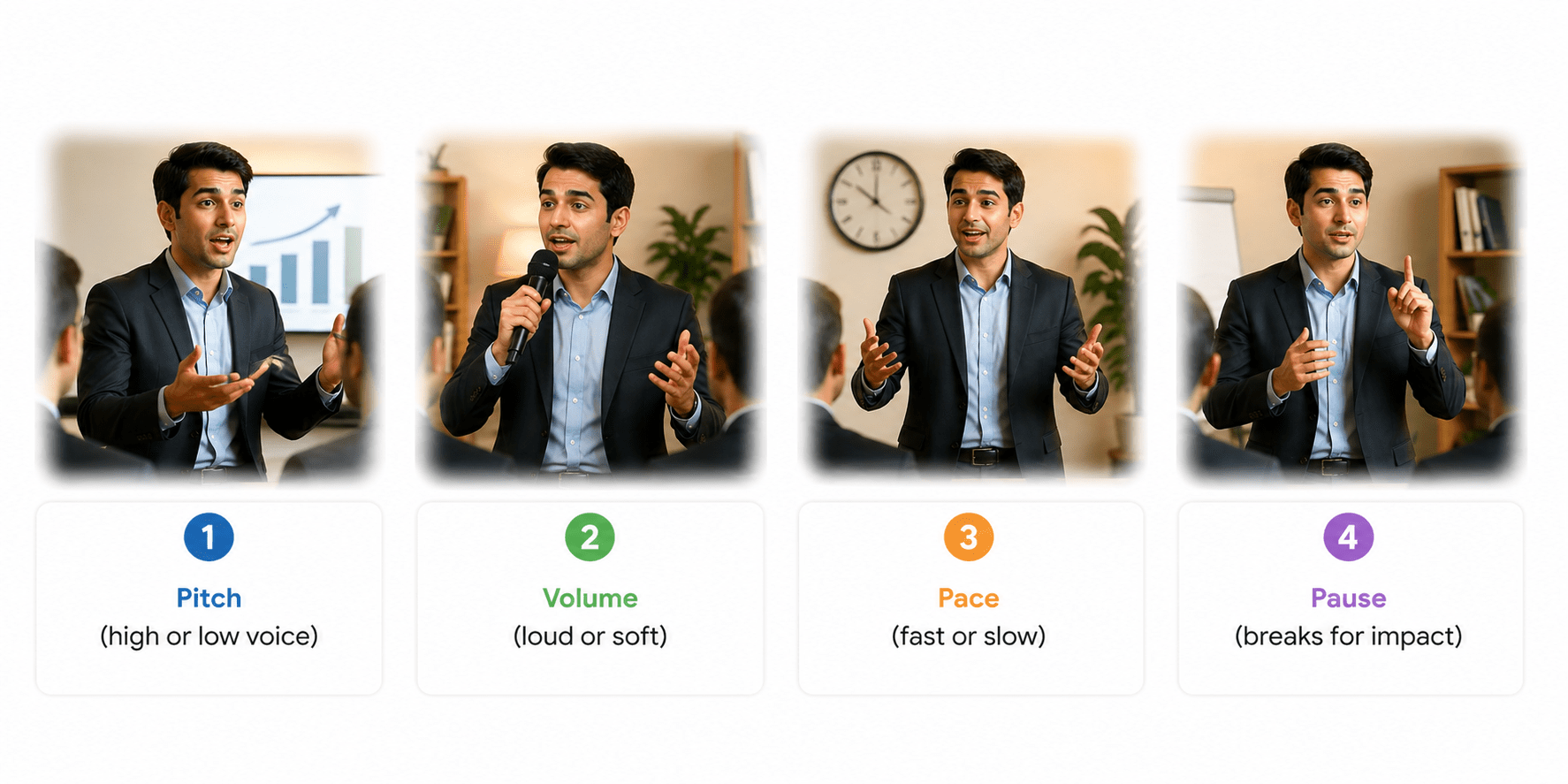
Voice modulation is the variation in how you speak.
It answers: How do you deliver your voice?
It includes:
1.Pitch (high or low voice)
2.Volume (loud or soft)
3.Pace (fast or slow)
4.Pause (breaks for impact)
Example:
Speaking at the same speed and tone throughout sounds robotic, while variation keeps listeners interested.In Simple Terms
Why It Matters
4.Ensures your message is understood the right way
2.Builds confidence and credibility
1.Makes communication more engaging
3.Helps in interviews, presentations, and conversations
How to use Tone & Voice Modulation
1.Adjust tone based on situation and audience
2.Control pace avoid speaking too fast or too slow
3.Use pauses for emphasis
4.Practice speaking with expression
5.Record and review your voice
Why Communication Barriers
5.Blocks message delivery
3.Impacts relationships and teamwork
1.Causes misunderstandings and confusion
2.Reduces clarity and effectiveness
4.Leads to missed opportunities (e.g., interviews)
What are Communication Barriers
1.Physical (noise, distance)
2.Psychological (fear, stress, lack of confidence)
3.Language (vocabulary, fluency issues)
4.Cultural (differences in background)
5.Perceptual (assumptions, biases)
How to Overcome Barriers
1.Practice active listening
2.Speak clearly and confidently
3.Ask questions to clarify
4.Be aware of tone and body language
5.Adapt communication to audience
Activity 1
Role Play (Workplace Conversation)
Objective:
Practice real workplace communication scenarios
Instructions:
Form pairs/groups of 2–3
Each group gets a scenario
Prepare for 2 minutes
Perform a 2–3 minute role play
Focus Areas:
Clarity of message
Professional tone
Active listening
Role Play Scenarios
1.Employee asking for leave
2.Giving feedback to a colleague
3.Handling a customer complaint
4.Requesting help from a manager
5.Resolving a misunderstanding
observation Task For Audience:
Was the communication clear?
Was the tone appropriate?
Were there any barriers?
Note: Give 1 positive + 1 improvement feedback
Activity 2
Tone & Voice Modulation Practice
Objective:
Improve voice control and expression
Example Sentence:
“I will complete this task.”
Instructions:
Say the same sentence in different tones:
Happy
Angry
Confident
Nervous
Voice Control Practice
Practice Elements:
Pitch (high/low)
Pace (fast/slow)
Volume (loud/soft)
Task-
Speak one sentence using different variations
Class guesses the emotion
Ask Learners:
What was easy or difficult?
How did tone change meaning?
Did voice affect confidence?
Summary
5
Adapting communication leads to better outcomes
4
Simple strategies help overcome these barriers
3
Communication barriers can cause misunderstandings
2
Pitch, pace, and volume improve clarity and impact
1
Tone and voice impact how messages are understood
Quiz
Tone in communication refers to:
A. The words used
B. The emotion behind the message
C. The grammar used
D. The length of message
Quiz-Answer
Tone in communication refers to:
A. The words used
B. The emotion behind the message
C. The grammar used
D. The length of message
By Content ITV