











Content ITV PRO
This is Itvedant Content department
Learning Outcome
6
Implement hyperparameter tuning using Scikit-Learn
5
Describe how RandomizedSearchCV works
4
Describe how GridSearchCV works
3
Explain the purpose of hyperparameter tuning
2
Distinguish between model parameters and hyperparameters
1
Understand what hyperparameters are
Topic Name-Recall(Slide3)
Hook/Story/Analogy(Slide 4)
Transition from Analogy to Technical Concept(Slide 5)
Why Hyperparameter Tuning is Important?
Improves Model Performance
The right hyperparameter values allow the model to capture patterns more effectively.
1
Reduces Overfitting
Proper tuning prevents models from becoming overly complex.
2
Reduces Underfitting
Poor parameter choices may make models too simple.
3
Improves Generalization
Well-tuned models perform better on unseen data.
4
Hyperparameter Tuning Techniques: GridSearchCV
How it works?
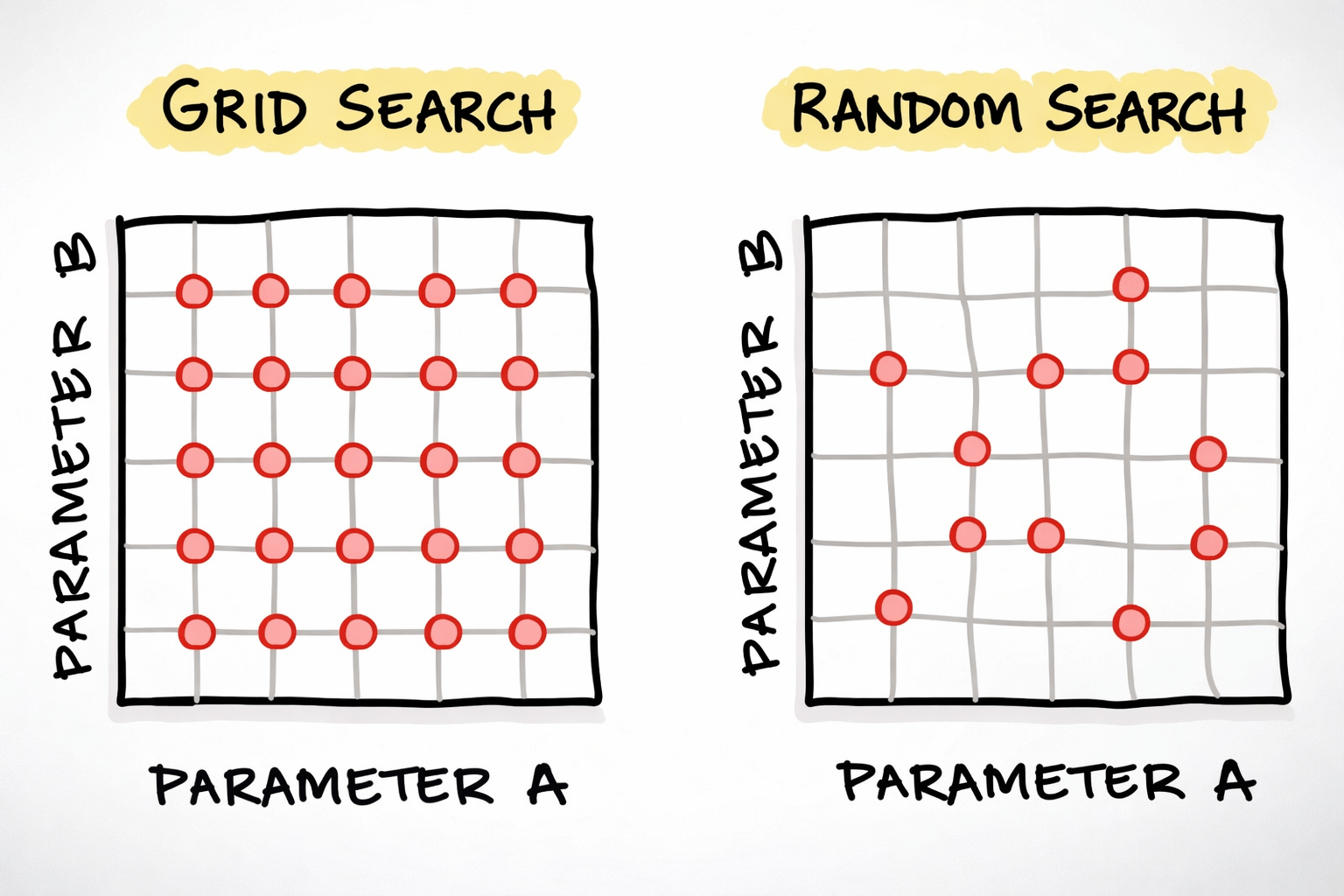
It performs an exhaustive search across all possible combinations of hyperparameters
Example parameter grid:
max_depth
criterion
[2,4,6,8]
['gini','entrophy']
Limitations
Advantages
Hyperparameter Tuning Techniques: RandomizedSearchCV
Implementation in Python (Scikit-Learn)
Step 1 — Import required libraries
from sklearn.datasets import load_iris
from sklearn.tree import DecisionTreeClassifier
from sklearn.model_selection import GridSearchCV, RandomizedSearchCV
Step 2 — Load the dataset
X, y = load_iris(return_X_y=True)Step 3 — Initialize the model
model = DecisionTreeClassifier()Step 4 — Define the parameter grid
param_grid = {
    'max_depth': [2, 4, 6, 8],
    'criterion': ['gini', 'entropy']
}
Step 5 — Apply GridSearchCV
grid_search = GridSearchCV(model, param_grid, cv=5)

grid_search.fit(X, y)

print("Best parameters from GridSearchCV:", grid_search.best_params_)
GridSearchCV will:
Try all parameter combinations
Perform cross-validation
Select the best-performing configuration
Step 6 — Apply RandomizedSearchCV
from scipy.stats import randint

param_dist = {
    'max_depth': randint(2, 10),
    'min_samples_split': randint(2, 10)
}

random_search = RandomizedSearchCV(
    model,
    param_distributions=param_dist,
    n_iter=10,
    cv=5,
    random_state=0
)

random_search.fit(X, y)

print("Best parameters from RandomizedSearchCV:", random_search.best_params_)
RandomizedSearchCV randomly samples parameter combinations and evaluates them using cross-validation
Summary
5
Both use cross-validation for reliable evaluation
4
GridSearchCV tests all combinations; RandomizedSearchCV samples randomly
3
Proper tuning improves performance and generalization
2
Hyperparameters are set manually, not learned
1
Hyperparameter tuning finds the best model settings
Quiz
What does GridSearchCV do?
A. Tests random parameter combinations
B. Tests all possible parameter combinations
C. Removes irrelevant features
D. Splits data into folds
Quiz-Answer
What does GridSearchCV do?
A. Tests random parameter combinations
B. Tests all possible parameter combinations
C. Removes irrelevant features
D. Splits data into folds
By Content ITV