A Gospel of Health and Salvation
Applying Computational Methods to the Study of Religious History
Jeri E. Wieringa | http://jeriwieringa.com
About Me
- phd candidate in history (George Mason Univ.)
- mar in history of christianity (Yale Divinity)
- ba in philosophy and english (Calvin College)
- comparative lit major (UC Irvine)
started programming in 2011
Structure of Talk
- Research Question & Subject Area
- Sources
- Methods & Initial Findings
- Presentation Methods
- Conclusions on computational methods and religious history.
Research Area
Nineteenth-Century American Religion
- Period of religious innovation, particularly in terms of millennialism and rise of new movements.
- Marked by opportunities for women's religious leadership during periods of revival and unrest.
Research Question
What is the relationship between
- religious beliefs and practices,
- constructions of time (anticipation of a coming judgment or millennium), and
- gender constructions
in the development of Seventh-day Adventism during the 19th and early 20th centuries?
What is Seventh-day Adventism?
- Started around 1844 when the world didn't end
- Formalized as a denomination in 1863
- Organized around distinctive views regarding end-times and health principles
- One of a handful of religious movements led initially by a woman - Ellen G. White
- Currently boasts over 20 million members
Sources
- Periodical literature
- Produced from within four geographic regions of the U.S.
- Published before 1921
- Digitized by the denomination
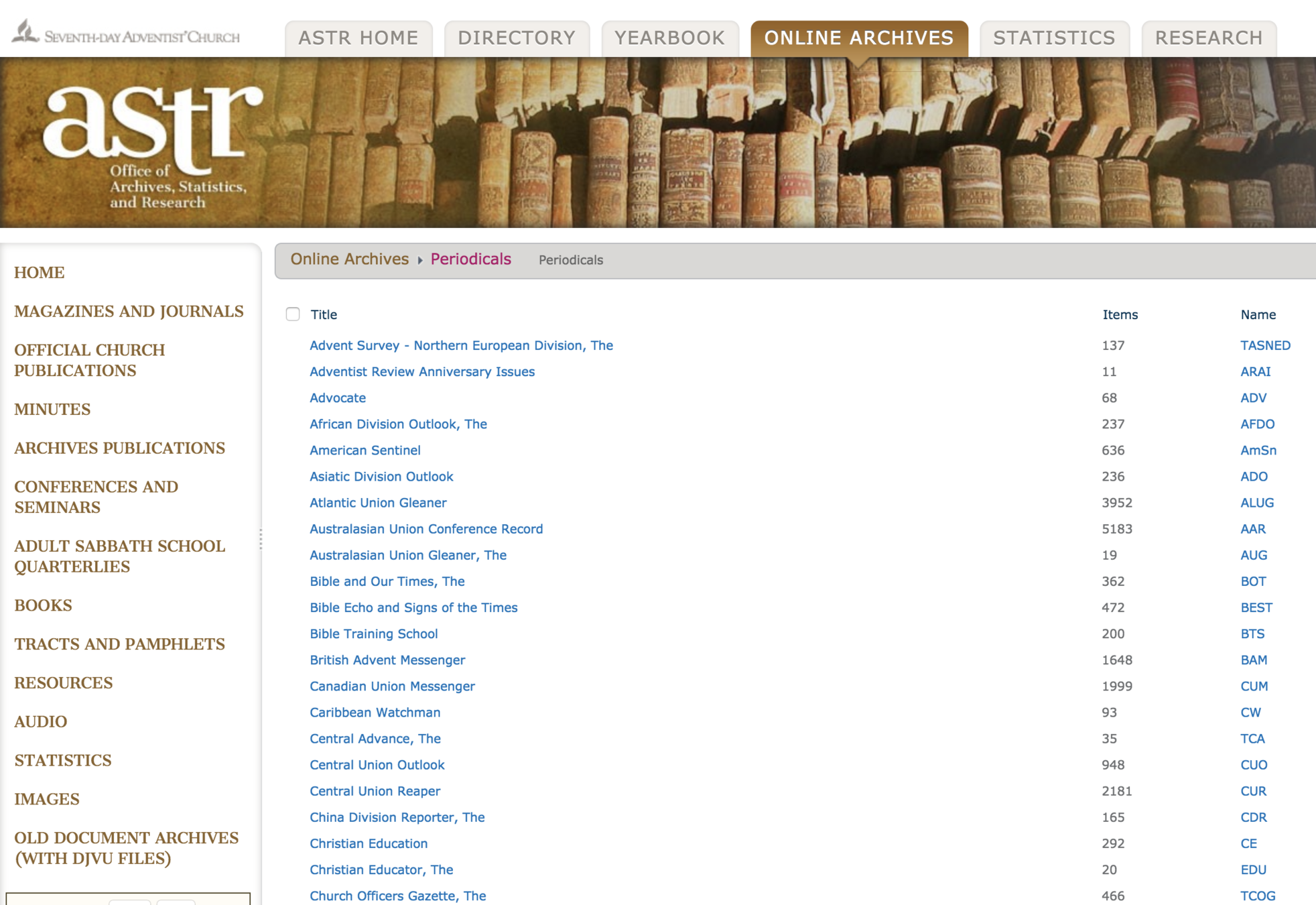
Sources used for context:
- Books and other literature
- Institutional records
- Letters and archival materials
Process & Methods
- Data Assessment and Cleaning
- Text Preprocessing
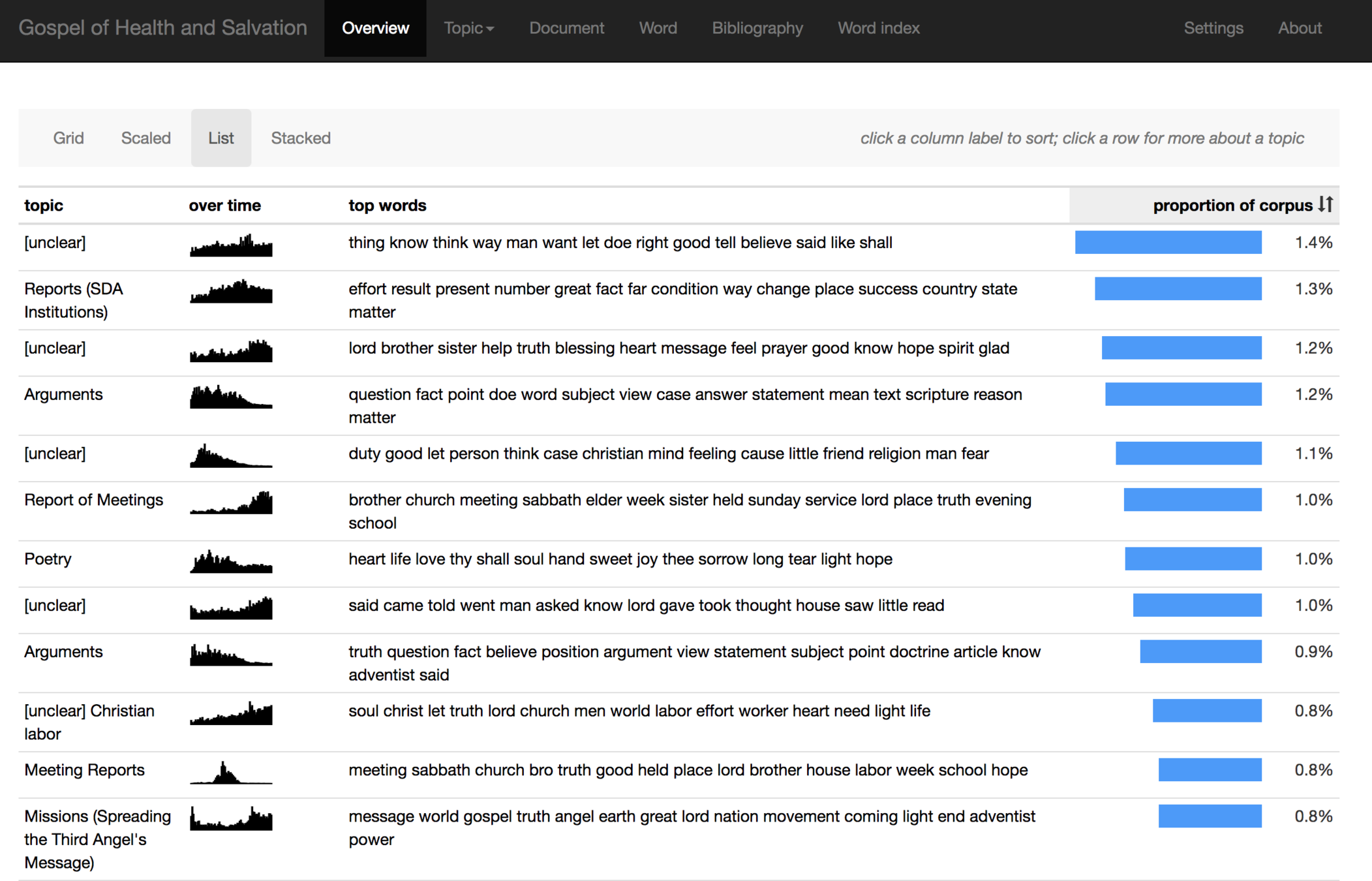
- Topic Modeling
- Topic Labeling
- Analyzing the Topic Model

Preliminary Findings
- Four cycles of end-times expectation between 1848 and 1920.
- Expanding circles of focus in evangelical effort, seen as leading to the second coming, from belief to behavior to reaching the nation to reaching the world.
- Vision of women's role in the church, as articulated by EGW and others, linked to that central concern.
Presentation
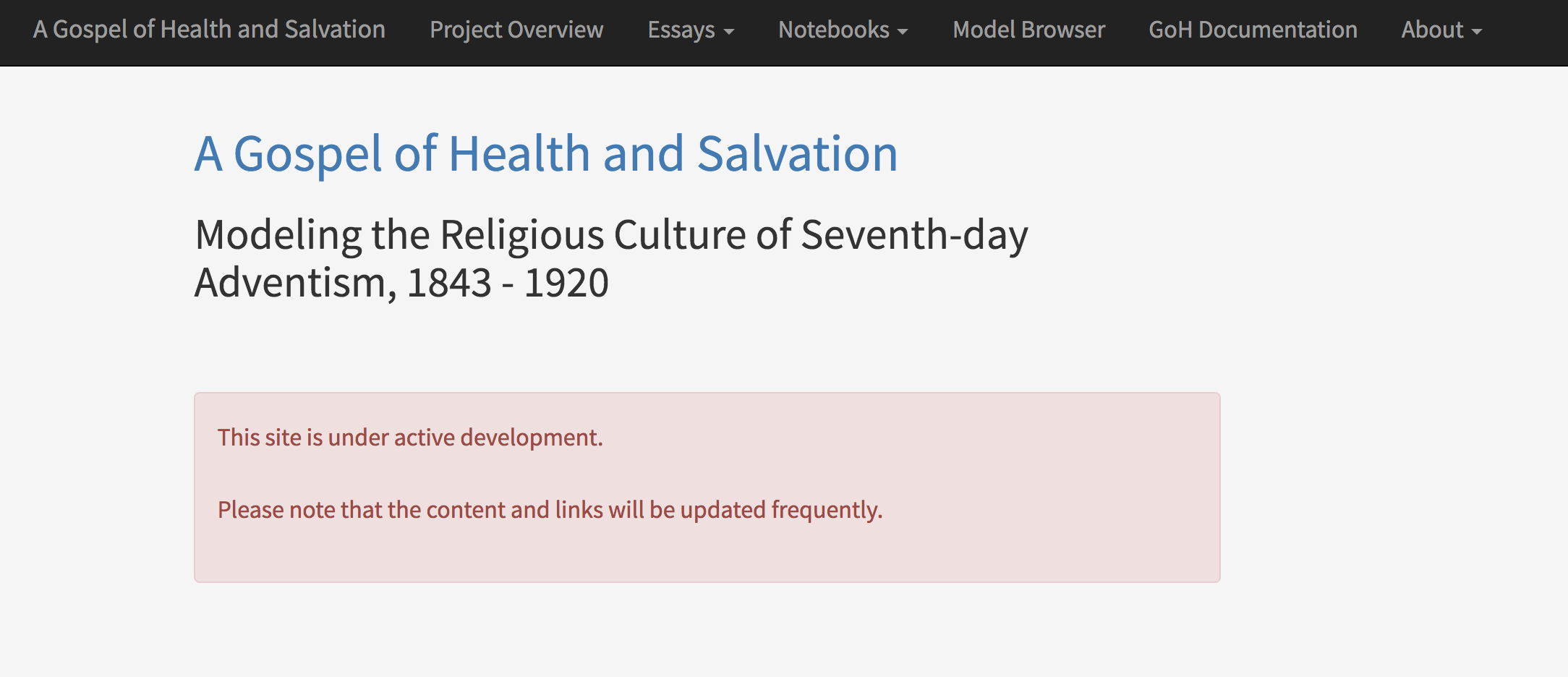
- Website
- Topic model browser
- Jupyter notebooks
- Python library (& docs)
Leading to:
- Journal articles on methods and theory
- Website 2.0 (essays and browser integrated)
- Generalized code libraries
Conclusions
- Able to use topic modeling to explore broad patterns in the literature.
- Pair computational model with close readings and traditional archival research in constructing a historical argument.
- Requires flexible and creative publishing strategies to manage requirements of reproducibility, interactivity, narrative, and methodological transparency.
Thank you!
Gospel of Health and Salvation for Wabash
By Jeri Wieringa