Hydrogen transport simulations made easy
Webinar | May 15th, 2026
Presented by:
James Dark & Remi Delaporte-Mathurin

Brief history of FESTIM
2019
Start of Development
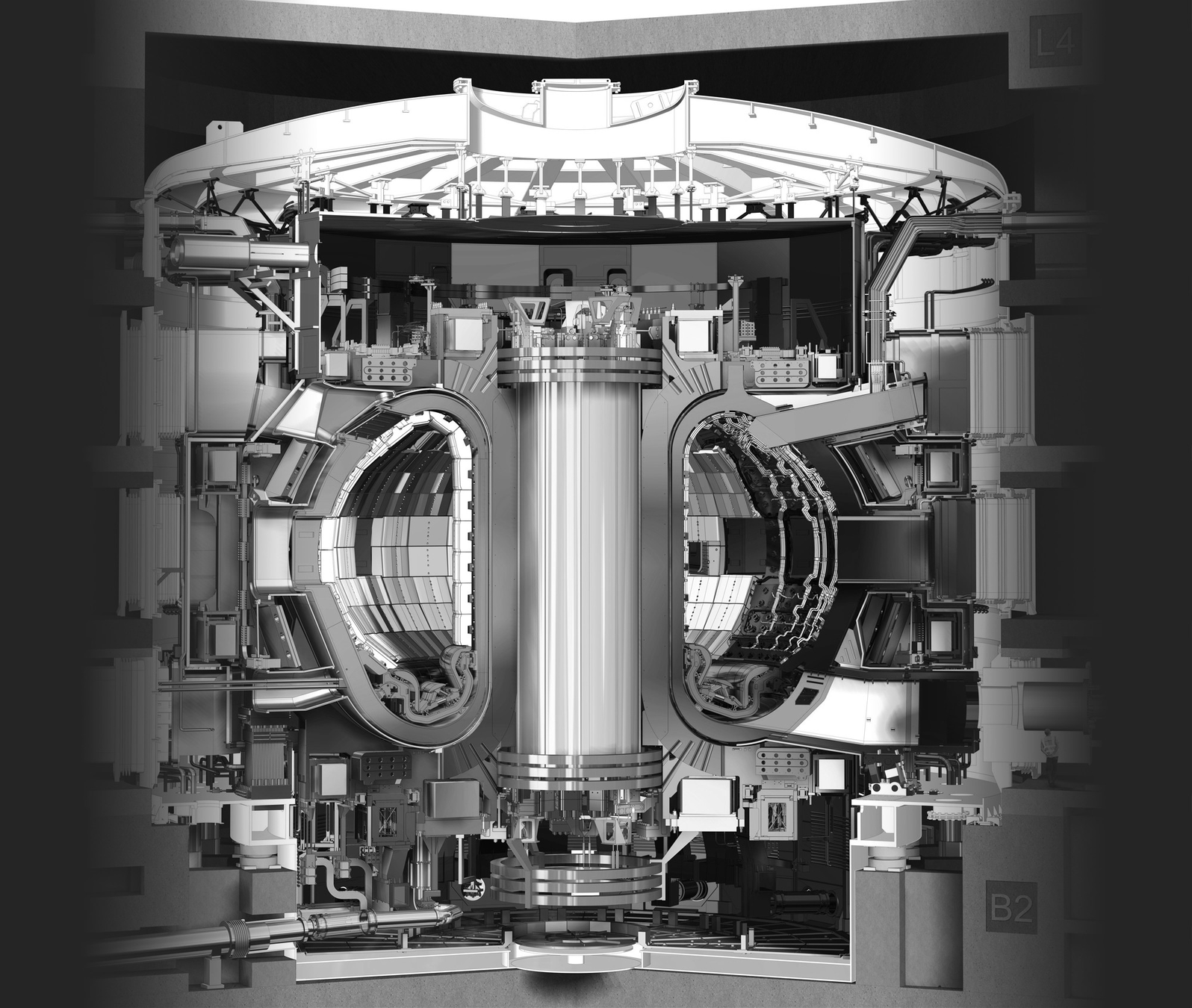
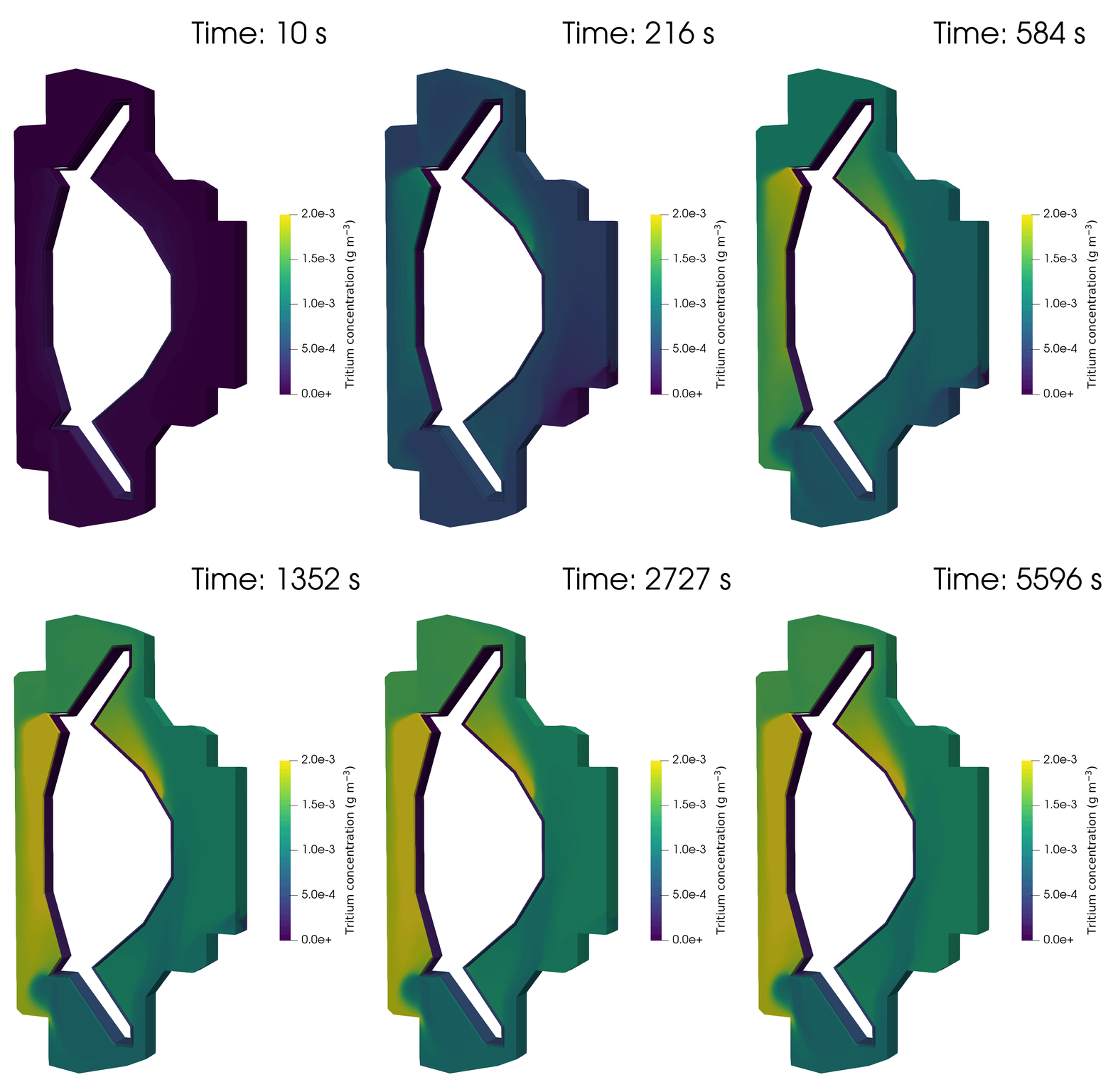
Predicting tritium retention in 3D ITER monoblocks.
Predicting tritium retention in 3D ITER monoblocks.

Brief history of FESTIM
2024
FESTIM becomes a NumFOCUS affiliate

FESTIM2 in a nutshell
User friendly - Intuitive, Python API easy to use
Apache 2.0 license - Suitable for academic and commercial
Easy install - conda install -c conda-forge festim
Online tutorials - Dozens of tutorials
Online documentation - Auto-generated
3,000+ forum views/month - Public, searchable Q&A
27+ institutions - Adopted by universities, labs and industry
30+ contributors - Open to new developers and users
Monthly dev meetings - Community-driven roadmap
130+ Slack users - Active developer and user support
Built on FEniCSx - Proven FEM backend, 1.5M+ downloads
5 team members at MIT - more around the world
On GitHub - Transparent, version-controlled development
NumFOCUS affiliation - Backed by a sustainability non-profit
CI/CD workflows - Rigorous testing and streamlined releases
Performance

FEniCSx - JIT to fast C++ rapid assembly
High-performance solvers - PETSc back-end
Built for HPC - Native MPI, runs on 1000’s of cores
Tuned control - Custom meshes, solvers, finite elements
Fast I/O - Parallel mesh loading, low memory footprint
Usability
Sustainability
Community



The FESTIM team at MIT and beyond


James Dark
Postdoctoral associate
Huihua Yang
Postdoctoral associate

Rémi Delaporte-Mathurin
Research Scientist

Kaelyn Dunnell
Graduate Student

Chirag Khurana
Graduate Student
MIT Team

Joe Dean
Research Associate
University of Cambridge
University of Cambridge

Jørgen Dokken
Senior Research Scientist
Simula Research Laboratory
Simula Research Laboratory
FEniCS collaborators



GitHub Community
31+ contributors
FESTIM Fellowship programme commenced in 2026

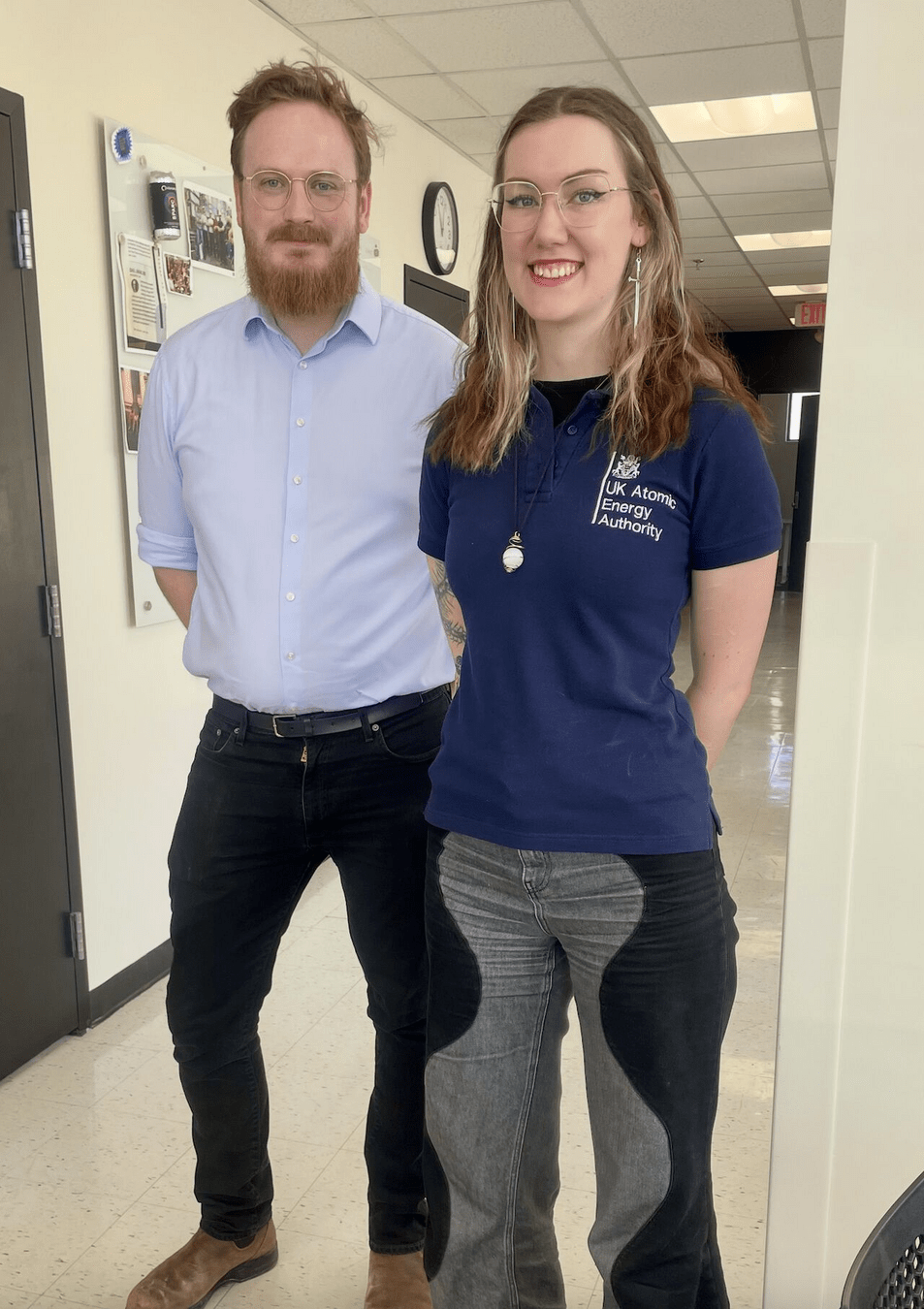
"Even though it's quite nice to be the FESTIM v2 expert on site (!!!), I would absolutely recommend the programme to my colleagues."
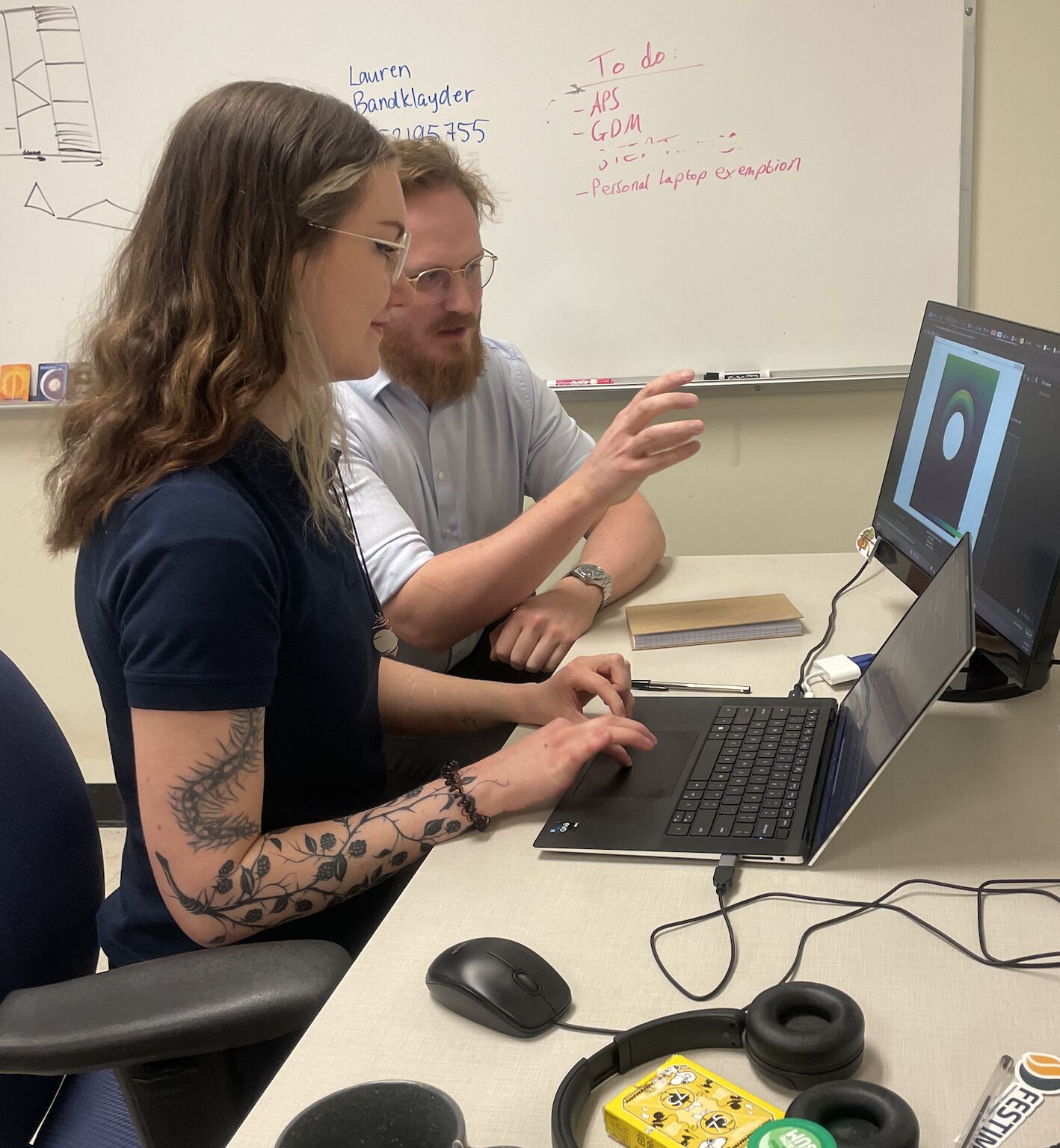
First FESTIM fellow - Tez Orr (UKAEA)
Hands-on-learning - Tez worked directly with the dev team on UKAEA cases and fixed a bug in v2.0
Immediate impact - Became UKAEA's resident FESTIM expert, contributing to both the LIBRTI and STEP programmes
FESTIM today
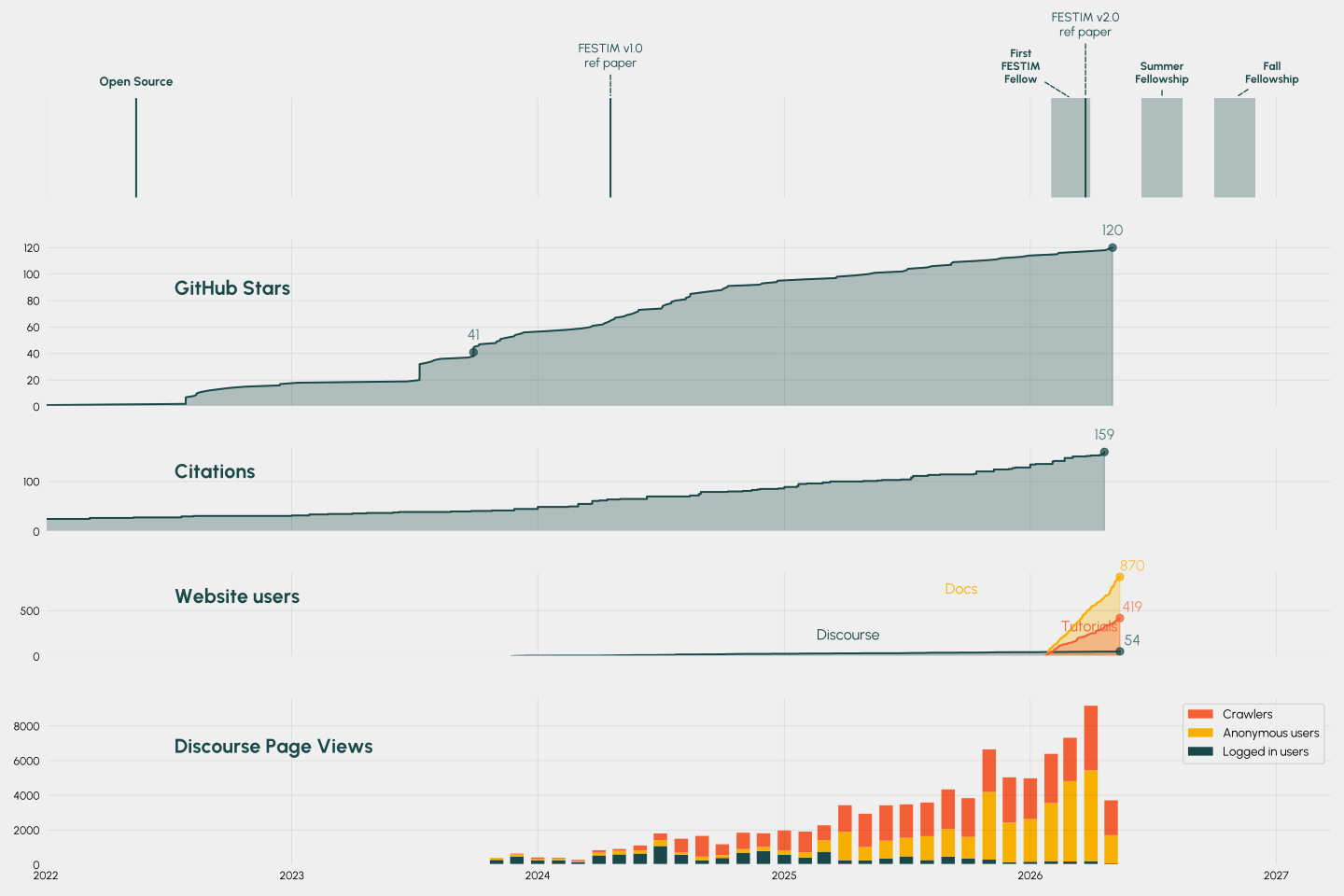
See more FESTIM stats:
festim-dev.github.io/pose
See all FESTIM papers:
FESTIM is used worldwide
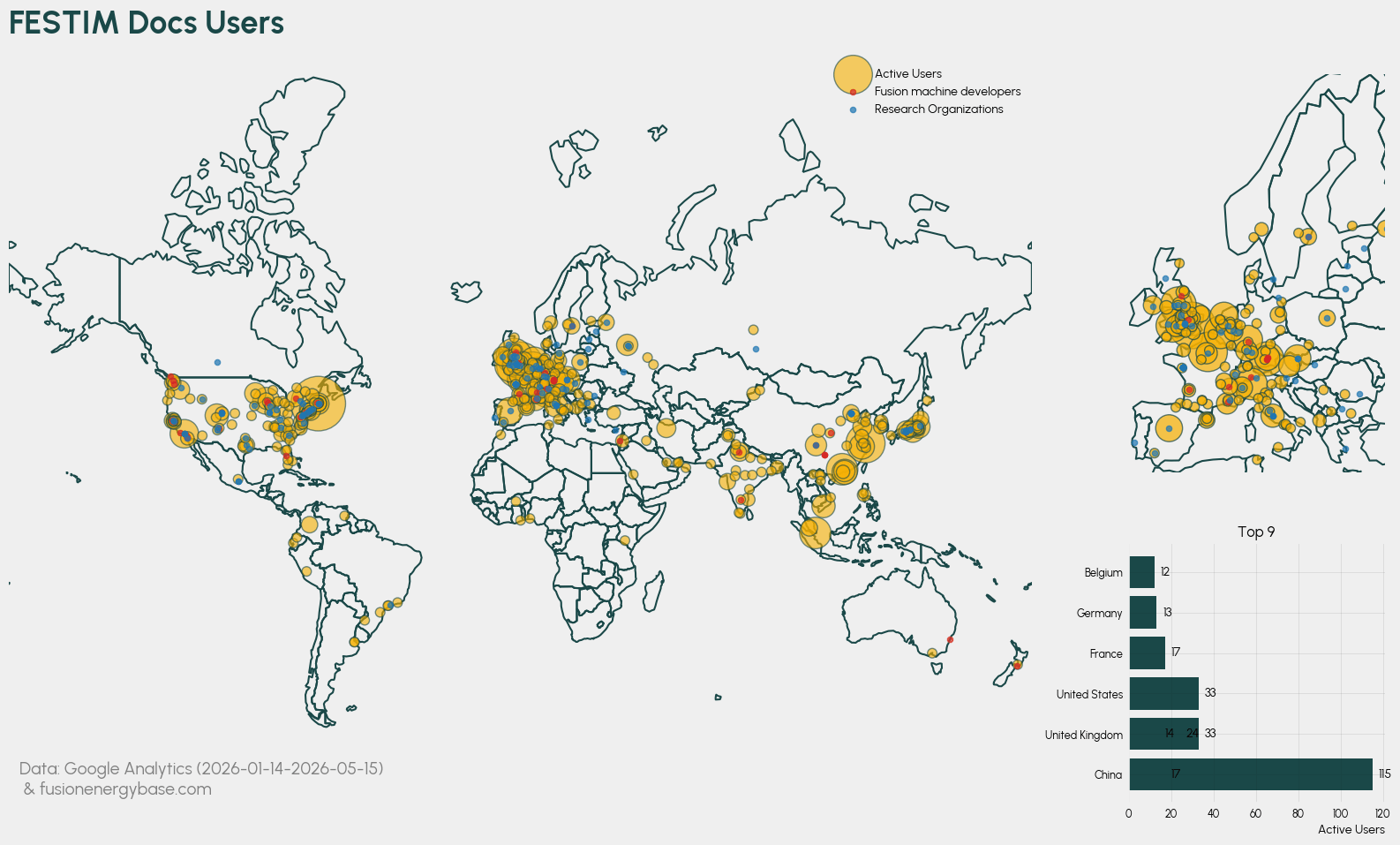
Docs users
Trusted by researchers worldwide
























Are you using FESTIM?
Fill in this form!
github.com/festim-dev/FESTIM/issues

Upgrade from legacy-FEniCS to FEniCSx
Before
- Change of variable required - did not scale well
- Single solver method available
- No submesh coupling
- Limited mesh element types
Now
- Mixed-domain: no substitution needed
- Multiple solver methods (Penalty, Nitches)
- Submesh coupling: 1D to 2D problems
- Mixed topology meshes
- Improved parallel I/O
~11x faster
Before
- Monolithic approach
- Change of variable required
- Poor scaling
- Little control over interface equations
- Adding advection was tricky
Now
- Mixed-domain: no substitution needed
- No change of variable needed
- Improved performance
- Full control over interface conditions
- Very suitable for multi-physics
Multi-material handling
Monoblock
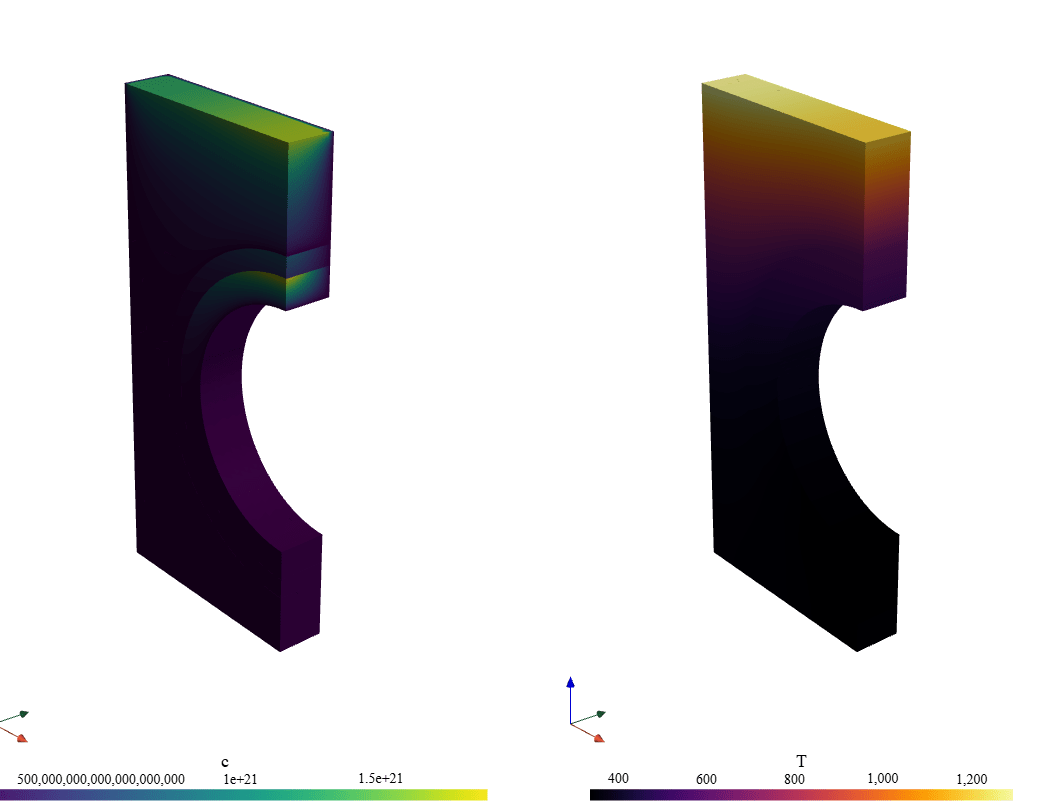
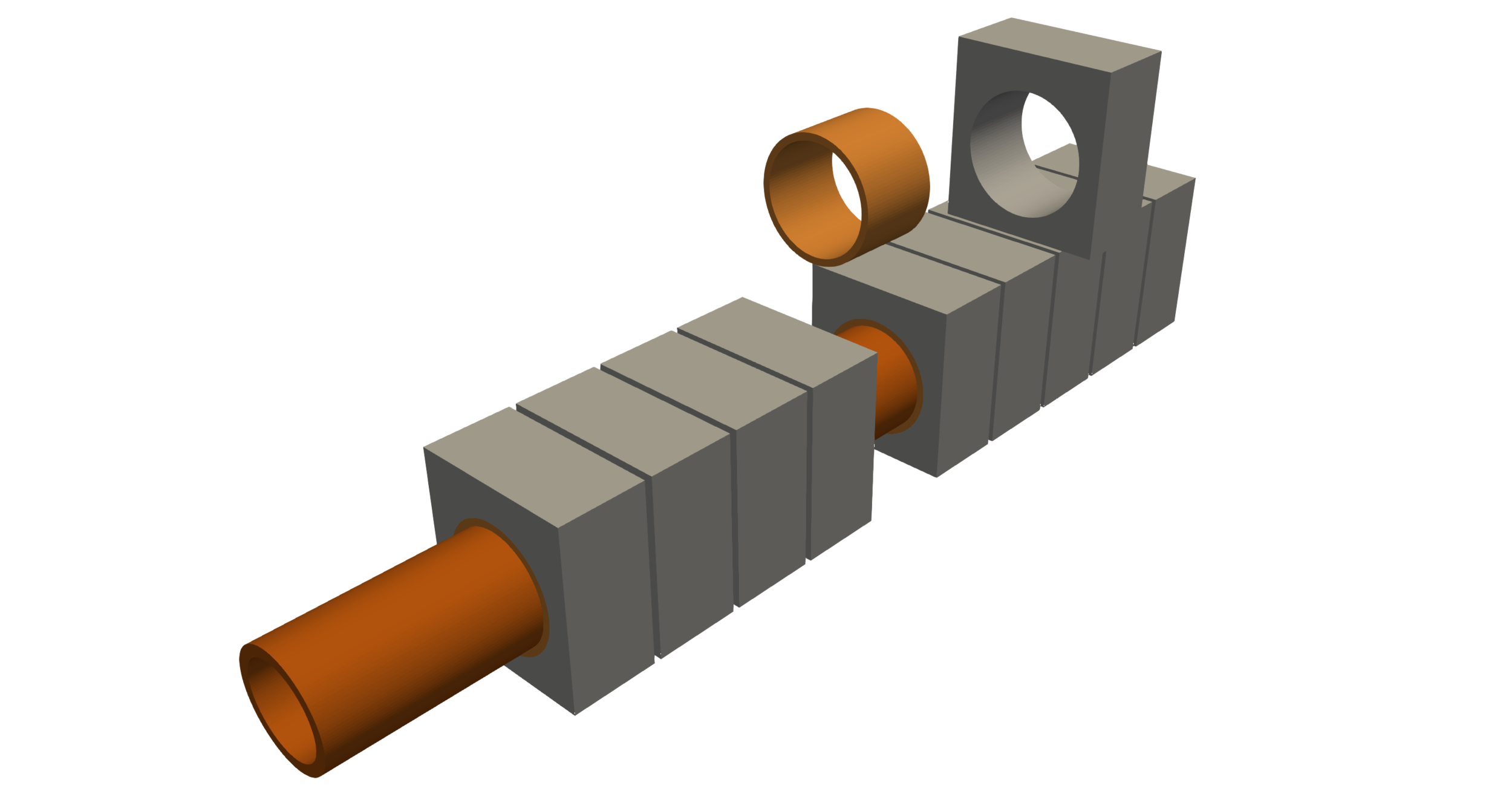
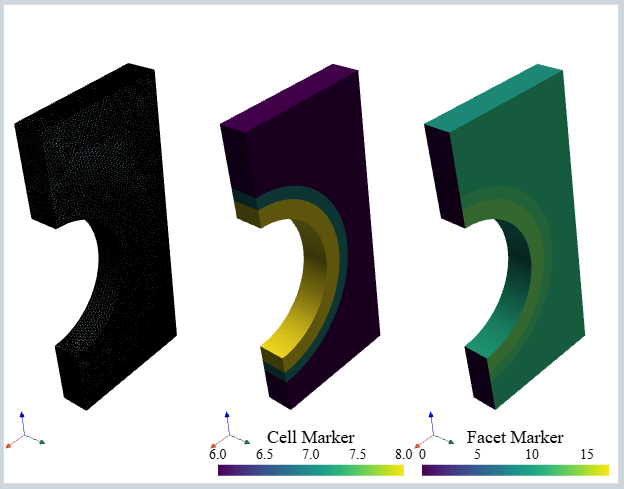
CAD based simulations
Read a mesh from GMSH
mesh_data = gmshio.read_from_msh(
    "gmsh/mesh3D.msh", MPI.COMM_WORLD, 0, gdim=3
)
mesh = mesh_data.mesh

facet_tags = mesh_data.facet_tags

cell_tags = mesh_data.cell_tags
Can also import meshes from other sources thanks to io4dolfinx
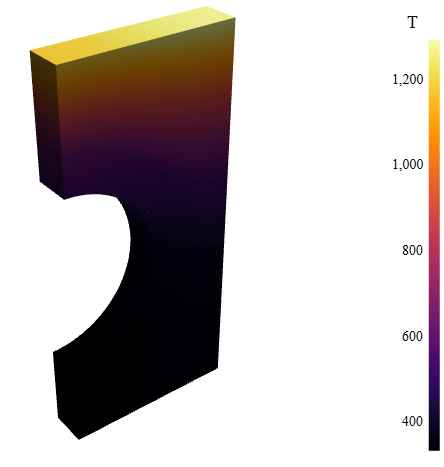
Heat transfer simulation
Run heat conduction simulation
heat_transfer_problem = F.HeatTransferProblem()

...

heat_flux_top = F.HeatFluxBC(subdomain=top_surface, value=10e6)

convective_flux_coolant = F.HeatFluxBC(
    subdomain=cooling_surface, value=lambda T: h_convective * (T_coolant - T)
)

...

heat_transfer_problem.run()
10^6 \ \mathrm{W/m^2}
Convective cooling
H transport problem
Pass the temperature field to the H transport problem
my_model = F.HydrogenTransportProblemDiscontinuous()

my_model.temperature = heat_transfer_problem.u

my_model.method_interface = "penalty"

my_model.subdomains = all_subdomains

H = F.Species("H", subdomains=my_model.volume_subdomains)
my_model.species = [H]

my_model.mesh = mesh

my_model.surface_to_volume = {
    top_surface: tungsten_volume,
    cooling_surface: cucrzr_volume,
    poloidal_gap_w: tungsten_volume,
    poloidal_gap_cu: copper_volume,
    poloidal_gap_cucrzr: cucrzr_volume,
    toroidal_gap: tungsten_volume,
    bottom: tungsten_volume,
}

penalty_term = 1e20
my_model.interfaces = [
    F.Interface(
        id=16, subdomains=(tungsten_volume, copper_volume), penalty_term=penalty_term
    ),
    F.Interface(
        id=17, subdomains=(copper_volume, cucrzr_volume), penalty_term=penalty_term
    ),
]

import ufl

# Plasma implantation flux BC
phi = 1.61e22
R_p = 9.52e-10
implantation_flux_top = F.FixedConcentrationBC(
    subdomain=top_surface,
    value=lambda T: phi * R_p / (tungsten.D_0 * ufl.exp(-tungsten.E_D / F.k_B / T)),
    species=H,
)

# Instantaneous molecular recombination flux BCs at all other surfaces (fixed concentration of 0)
recombination_fluxes = [
    F.FixedConcentrationBC(subdomain=surf, value=0, species=H)
    for surf in [
        toroidal_gap,
        bottom,
        poloidal_gap_w,
        poloidal_gap_cu,
        poloidal_gap_cucrzr,
        cooling_surface,
    ]
]

my_model.boundary_conditions = [implantation_flux_top] + recombination_fluxes

exports = {
    "poloidal_gap_cu_flux": F.SurfaceFlux(surface=poloidal_gap_cu, field=H),
    "poloidal_gap_cucrzr_flux": F.SurfaceFlux(surface=poloidal_gap_cucrzr, field=H),
    "poloidal_gap_w_flux": F.SurfaceFlux(surface=poloidal_gap_w, field=H),
    "toroidal_gap_flux": F.SurfaceFlux(surface=toroidal_gap, field=H),
    "bottom_flux": F.SurfaceFlux(surface=bottom, field=H),
    "inventory_w": F.TotalVolume(field=H, volume=tungsten_volume),
    "inventory_cu": F.TotalVolume(field=H, volume=copper_volume),
    "inventory_cucrzr": F.TotalVolume(field=H, volume=cucrzr_volume),
}


my_model.exports = list(exports.values())

my_model.settings = F.Settings(
    atol=1e-8,
    rtol=1e-10,
    transient=False,
    max_iterations=10,
)

my_model.initialise()
my_model.run()
Implantation from plasma
c = 0
Field Exports
Writes a time-dependent field to a file

- Solutions: concentrations, temperature
- Checkpoints: restart a simulation from a previous result
- Reaction rate
- Custom field export
New in FESTIM2!


Derived Quantities
Compute quantities obtained from the solution
Thermo-Desorption Spectroscopy tutorial
festim-workshop.readthedocs.io/en/latest/content/applications/task02.html
left_flux = F.SurfaceFlux(surface=left_boundary, field=H)
right_flux = F.SurfaceFlux(surface=right_boundary, field=H)
total_trapped_H1 = F.TotalVolume(field=trapped_H1, volume=volume_subdomain)
contribution_trap_1 = -np.diff(total_trapped_H1.data) / np.diff(total_trapped_H1.t)- Built-in quantities:
- Surface flux
- Average/Total volume
- Average/Total surface
- Min/max
CustomQuantity
Multi-species
H = F.Species("H")

my_model.species = [H]
Defining species
\mathrm{H}
Multi-species
H = F.Species("H")
D = F.Species("D")


my_model.species = [H, D]
\mathrm{H}, \mathrm{D}
Defining species
Multi-species
H = F.Species("H")
empty_traps = F.Species("empty", mobile=False)
trapped_H = F.Species("trapped_H", mobile=False)


my_model.species = [H, empty_traps, trapped_H]
Adding a reaction
\mathrm{H} + [\ ] \xrightleftharpoons[p]{k} [\mathrm{H}]
trapping = F.Reaction(
	reactant=[H, empty_traps],
    product=[trapped_H],
    k_0=...,
    E_k=...,
    p_0=...,
    E_p=...,
)


my_model.reactions = [trapping]
Multi-species
H = F.Species("H")
empty_traps = F.Species("empty", mobile=True)
trapped_H = F.Species("trapped_H", mobile=False)


my_model.species = [H, empty_traps, trapped_H]
Mobile traps?
\mathrm{H} + [\ ] \xrightleftharpoons[p]{k} [\mathrm{H}]
trapping = F.Reaction(
	reactant=[H, empty_traps],
    product=[trapped_H],
    k_0=...,
    E_k=...,
    p_0=...,
    E_p=...,
)


my_model.reactions = [trapping]
Multi-species
H = F.Species("H")
empty_traps = F.Species("empty", mobile=False)
empty_traps2 = F.Species("empty2", mobile=False)
trapped_H = F.Species("trapped_H", mobile=False)
trapped_H2 = F.Species("trapped_H2", mobile=False)

my_model.species = [
  H, empty_traps, trapped_H,
  empty_traps2, trapped_H2
]
2 traps
\mathrm{H} + [\ ] \xrightleftharpoons[p]{k} [\mathrm{H}]
trapping = F.Reaction(
	reactant=[H, empty_traps],
    product=[trapped_H],
	...
)

trapping2 = F.Reaction(
	reactant=[H, empty_traps2],
    product=[trapped_H2],
	...
)


my_model.reactions = [trapping, trapping2]
\mathrm{H} + [\ ]_2 \xrightleftharpoons[p_2]{k_2} [\mathrm{H}]_2
Multi-species
H = F.Species("H")
D = F.Species("D")
empty_traps = F.Species("empty", mobile=False)
trapped_H = F.Species("trapped_H", mobile=False)
trapped_D = F.Species("trapped_D", mobile=False)


my_model.species = [
  H, D, empty_traps,
  trapped_H, trapped_D
]
1 trap, 2 isotopes
\mathrm{H} + [\ ] \xrightleftharpoons[p]{k} [\mathrm{H}]
trapping = F.Reaction(
	reactant=[H, empty_traps],
    product=[trapped_H],
	...
)

trapping2 = F.Reaction(
	reactant=[D, empty_traps],
    product=[trapped_D],
	...
)


my_model.reactions = [trapping, trapping2]
\mathrm{D} + [\ ] \xrightleftharpoons[p]{k} [\mathrm{D}]
Multi-species
H = F.Species("H")
empty_traps = F.Species("empty", mobile=False)
trapped_H = F.Species("trapped_H", mobile=False)
trapped_H2 = F.Species("trapped_H2", mobile=False)

my_model.species = [
  H, empty_traps,
  trapped_H, trapped_H2
]
Multi-occupancy trapping
\mathrm{H} + [\ ] \xrightleftharpoons[p]{k} [\mathrm{H}]
trapping = F.Reaction(
	reactant=[H, empty_traps],
    product=[trapped_H],
	...
)

trapping2 = F.Reaction(
	reactant=[H, empty_traps2],
    product=[trapped_H2],
	...
)


my_model.reactions = [trapping, trapping2]
\mathrm{H} + [\mathrm{H}] \xrightleftharpoons[p]{k} [\mathrm{HH}]
Multi-species
A = F.Species("A")
B = F.Species("B")
C = F.Species("C")
D = F.Species("D")

my_model.species = [A, B, C, D]
\mathrm{A} + \mathrm{B} \xrightleftharpoons[p]{k} \mathrm{C} + \mathrm{D}
"Species" can be anything...
Multi-species
A = F.Species("A")
B = F.Species("B")
C = F.Species("C")
D = F.Species("D")

my_model.species = [A, B, C, D]
\mathrm{A} + \mathrm{B} \xrightleftharpoons[p]{k} \mathrm{C} + \mathrm{D}
reac = F.Reaction(
    reactant=[A, B],
    product=[C, D],
    ...
)
Arbitrary numbers of reactants and products
Multi-species
A = F.Species("A")
B = F.Species("B")


my_model.species = [A, B]
\mathrm{A} + \mathrm{B} \xrightarrow{k} \emptyset
reac = F.Reaction(
    reactant=[A, B],
    product=[],
    ...
)
Arbitrary numbers of reactants and products
Can be used for:
- Vacancy-Interstitial anhiliation
- Radioactive decay
- Defect annealing
- ...
Multi-species
H = F.Species("H")


my_model.species = [H]

reac = F.SurfaceReactionBC(
    reactant=[H, H],
    pressure=10,
    ...
)

my_model.boundary_conditions = [reac]
Surface reactions
2 \mathrm{H} \xrightleftharpoons[K_d]{K_r} \mathrm{H}_2
Soon: support for dynamically computed gas pressures (enclosures)
Coupling CFD to FESTIM using foam2dolfinx
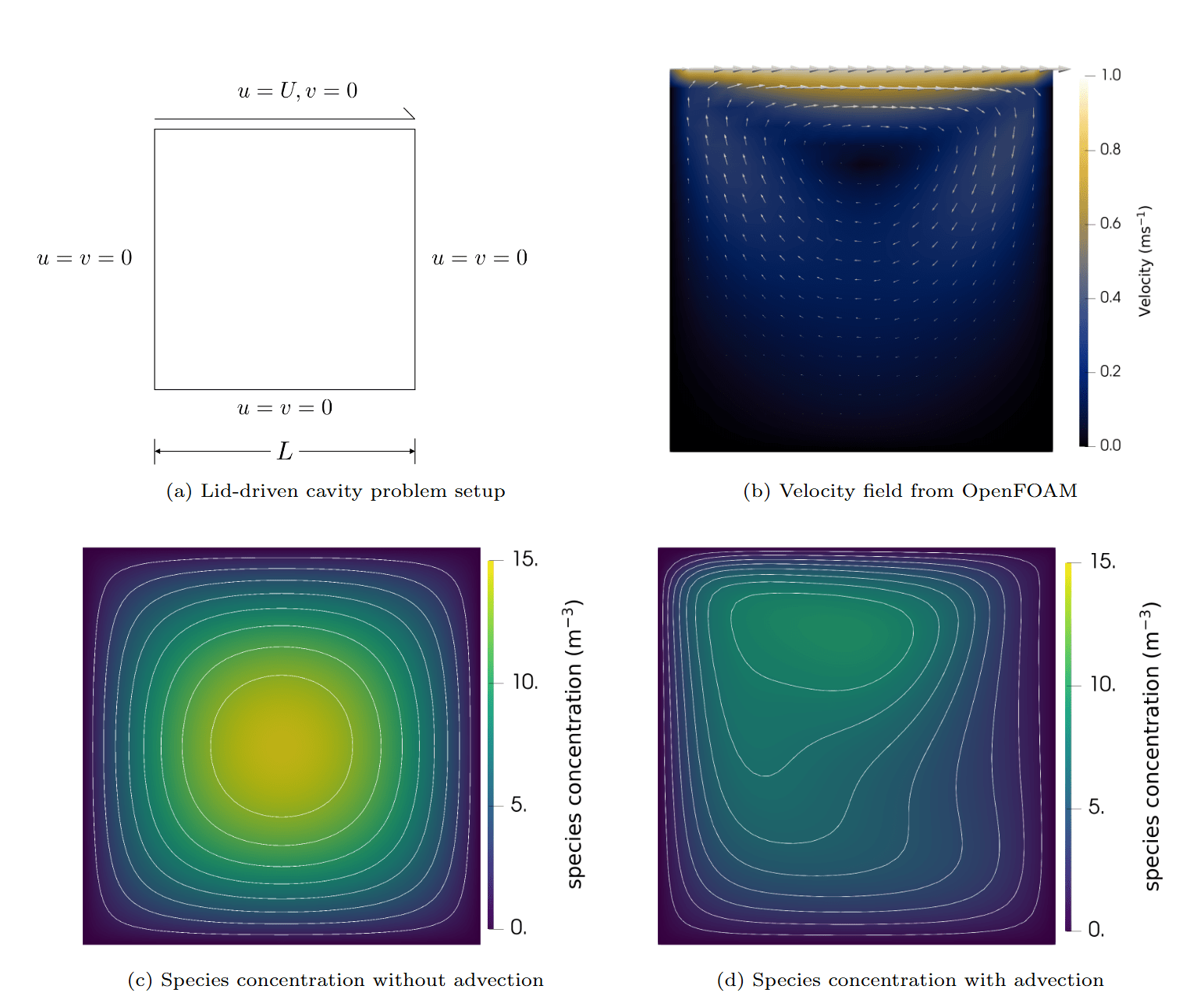

Using foam2dolfinx we can pass velocity fields calculated from OpenFOAM to FESTIM
Reading OpenFOAM data using foam2dolfinx
from foam2dolfinx import OpenFOAMReader

reader = OpenFOAMReader(filename="my_foam_case.foam", cell_type=10)


# read fields
u = reader.create_dolfinx_function_with_point_data(t=100, name="U")


# read mesh
foam_mesh = reader.dolfinx_meshes_dict["default"]


# read meshtags
facet_mt = reader.create_facet_meshtags()
volume_mt = reader.create_cell_meshtags()
Read a local OpenFOAM case file
- Specify time stamp of data
- Can extract any field type
- Extract dolfinx mesh
- Extract meshtags
Tets


Hexes
Support for:
Reading and writing using io4dolfinx
import io4dolfinx

checkpoint_file = Path("sim_checkpoint.bp")

io4dolfinx.write_mesh(checkpoint_file, msh)
io4dolfinx.write_function(checkpoint_file, u, time=100, name="U")
io4dolfinx.write_meshtags(checkpoint_file, msh, facet_mt, meshtag_name="facet_tags")
io4dolfinx.write_meshtags(checkpoint_file, msh, cell_mt, meshtag_name="cell_tags")

..

msh = io4dolfinx.read_mesh(checkpoint_file, COMM)
facet_mt = io4dolfinx.read_meshtags(checkpoint_file, msh, meshtag_name="facet_tags")
cell_mt = io4dolfinx.read_meshtags(checkpoint_file, msh, meshtag_name="cell_tags")

gdim = msh.geometry.dim
el = basix.ufl.element("Lagrange", msh.topology.cell_name(), 1, shape=(gdim,))
w = fem.Function(fem.functionspace(msh, el), name="U")
io4dolfinx.read_function(checkpoint_file, u, time=100, name="U")
Using OpenFOAM data in FESTIM
...


my_model.mesh = foam_mesh

my_model.surface_meshtags = facet_meshtags
my_model.volume_meshtags = cell_meshtags


...


my_model.advection_terms = [
  F.AdvectionTerm(velocity=u, species=H, subdomain=fluid)
]
Pass mesh and meshtags to FESTIM
Pass velocity field using F.AdvectionTerm()
Adding advection to FESTIM means adding a term in the formulation
\frac{\partial c}{\partial t} = \nabla\cdot(D \nabla c) + S
- \nabla \cdot ( \mathbf{u} c)
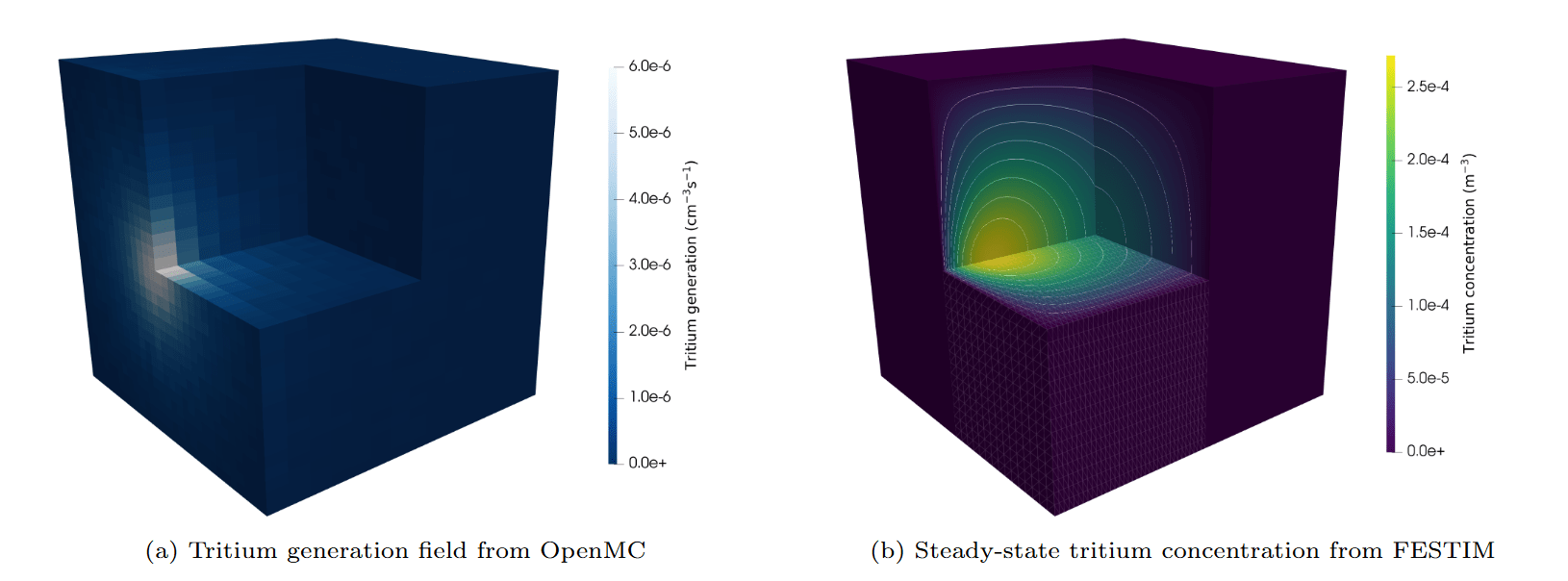

Coupling neutronics to FESTIM using openmc2dolfinx
Using openmc2dolfinx we can pass fields calculated from OpenMC to FESTIM
from openmc2dolfinx import UnstructuredMeshReader, StructuredMeshReader

# UnstructuredMeshReader for tets
reader = UnstructuredMeshReader(filename="out.vtk")

# StructuredMeshReader for hexs
reader = StructuredMeshReader(filename="out.vtk")

# read fields
source_from_openmc = reader.create_dolfinx_function(name="mean")
Reading OpenMC data using openmc2dolfinx
Read .vtk file produced by OpenMC
- Extract any mesh tally:
- Tritium production
- Heat generation
- He production ...
Tets
Hexes
Support for:
...


my_model.sources = [
  F.ParticleSource(value=source_from_openmc, species=T, subdomain=volume)
]


...
Using OpenMC data in FESTIM
Input into FESTIM as a source term
Machine Learning with FESTIM

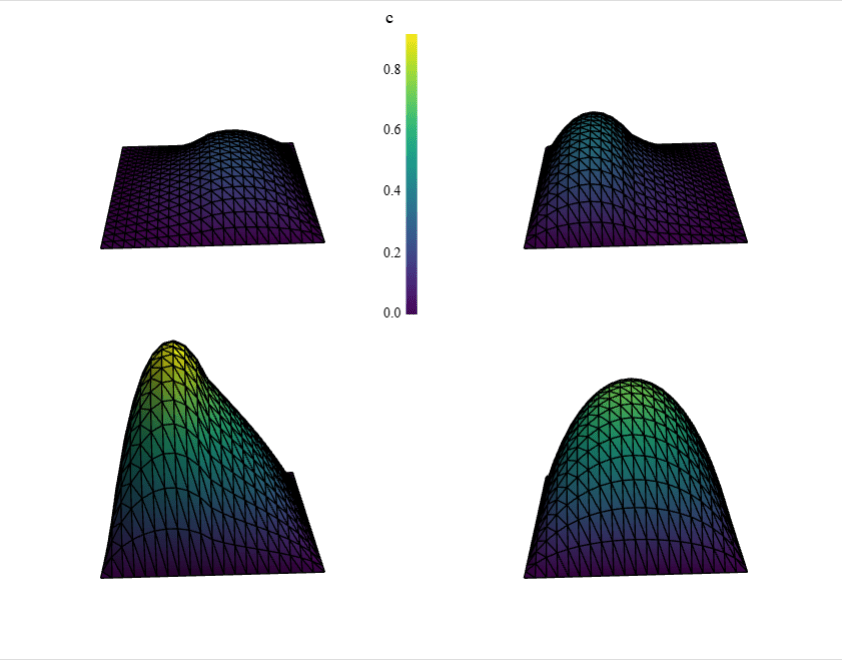
1. Parametric FESTIM model
2. Produce training data


3. Train surrogate/emulator
Parametric optimisation with FESTIM


Goal: find the trapping parameters to reproduce an experimental thermo-desorption spectrum
Integrating FESTIM with fuel cycle models
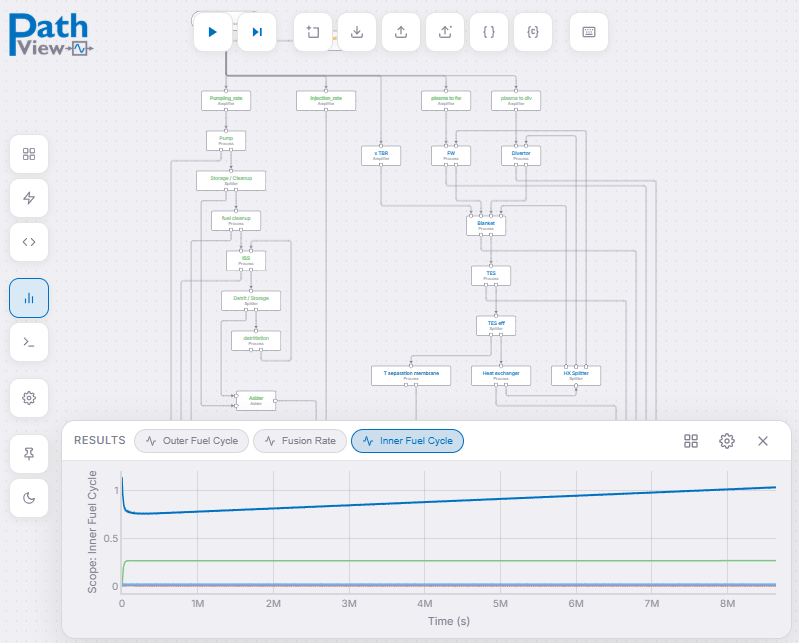
PathView/PathSim: a python package for system modelling
Can be seamlessly coupled with FESTIM for multi-fidelity fuel cycle simulations
FESTIM website
Everything in one place!
festim.readthedocs.io
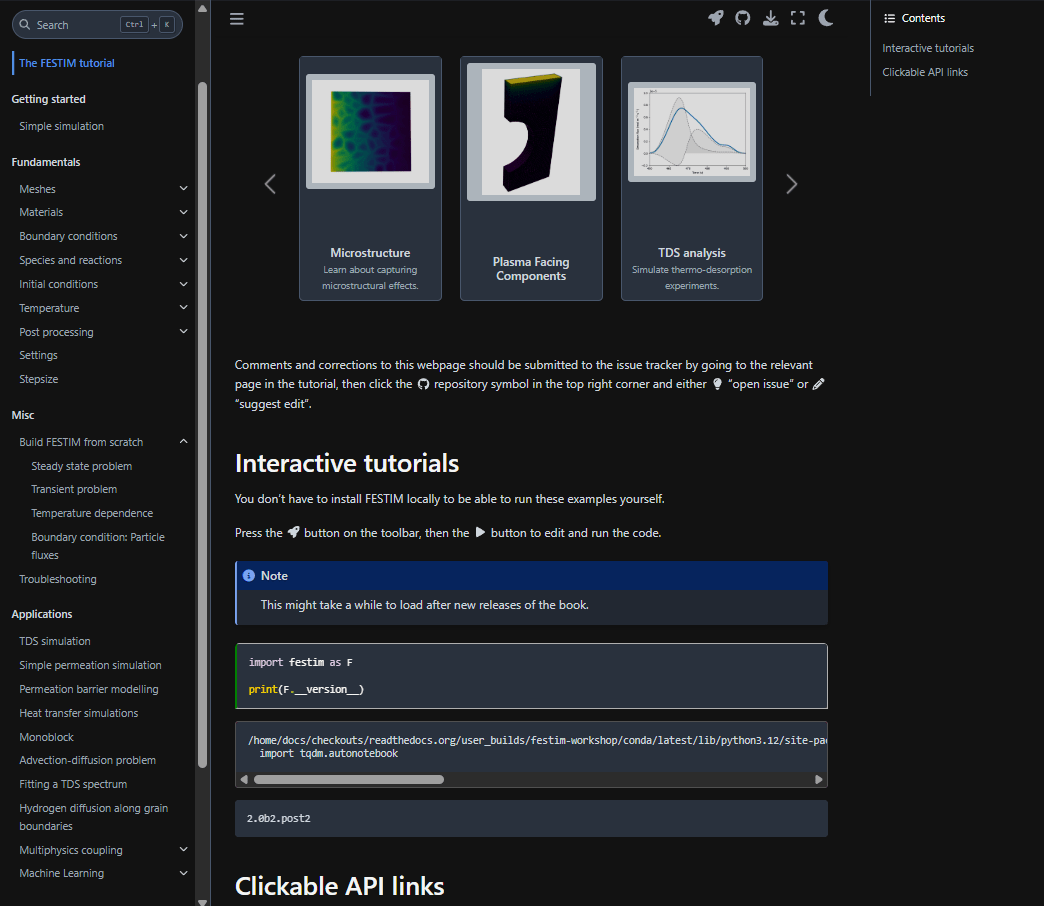
Fundamentals: Core physics and FESTIM building blocks.
Learning & Tutorials
Visit the tutorial
festim-workshop.readthedocs.io
Misc: troubleshooting, tips & tricks, "build FESTIM from scratch"
Learning & Tutorials
Visit the tutorial
festim-workshop.readthedocs.io
Applications: Full application cases like monoblock, TDS, multi-physics, machine learning...
Learning & Tutorials
Visit the tutorial
festim-workshop.readthedocs.io
FESTIM Fellowship Program
What it is
A selective, project-based
programme for experienced FESTIM users to develop advanced simulation expertise working directly alongside the MIT development team.
How it works
Fall 2026 Intake - Applications open now | Deadline: August 1st Apply: festim.readthedocs.io/en/latest/fellowship.html
What you gain
~10 weeks, flexible, Remote or in person at MIT PSFC. Fellows bring a focused project and get guided technical support, code reviews, and hands-on collaboration.
Become an advanced FESTIM user. Capable of building complex models independently, contributing to the codebase, and supporting colleagues with FESTIM.
FESTIM Community




Slack Channel
Discourse
Monthly Dev meetings
Where we share updates on FESTIM activities and collaborate day-to-day. The best place to get involved and stay connected
Our public forum for questions, troubleshooting and discussion. Post any issue, and the team will repsond
Open Development meetings of the last Thursday of each month.
Next one May 28th!
FESTIM webinar
By Remi Delaporte-Mathurin