Overview of the PSFC blanket and fuel cycle modelling activities

Guaranteed Digital Twin-free
Remi Delaporte-Mathurin, Nikola Goles, James Dark, Kaelyn Dunnell, Chirag Khurana, Collin Dunn, Sara Ferry, Abhishek Saraswat, Ethan Peterson, Stefano Segantin, Huihua Yang, Weiyue Zhou, Kevin Woller

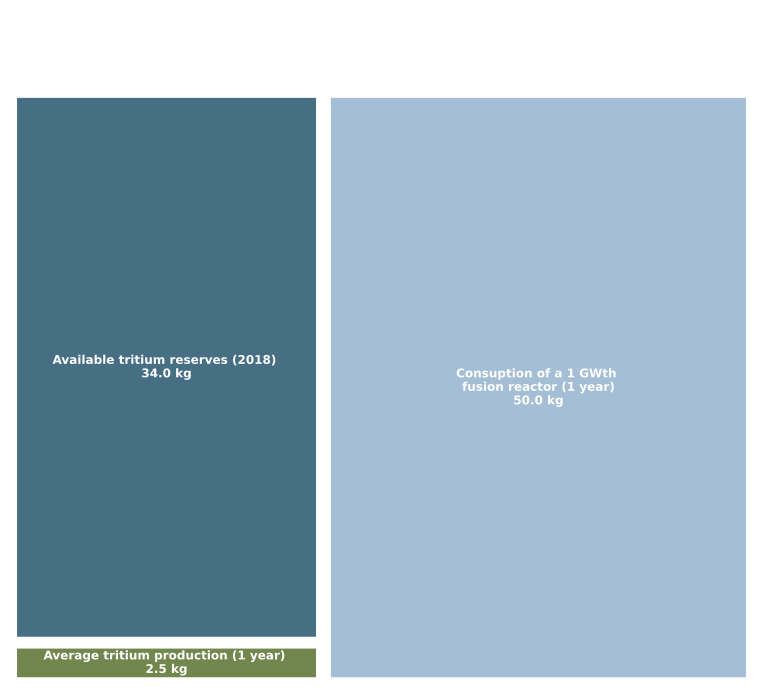
Half-life: 12 years
\mathrm{T} \rightarrow \mathrm{He} + \mathrm{e}^-
☢
Consumption of a 1 GWth fusion reactor (1 year)
50 kg
\mathrm{n} + ^6\mathrm{Li} \rightarrow \mathrm{T} + \mathrm{He} + 4.8 \ \mathrm{MeV}
\mathrm{n} + ^7\mathrm{Li} \rightarrow \mathrm{T} + \mathrm{He} + \mathrm{n} - 2.5 \ \mathrm{MeV}
\mathrm{D} + \mathrm{T} \rightarrow \mathrm{He} + \mathrm{n}
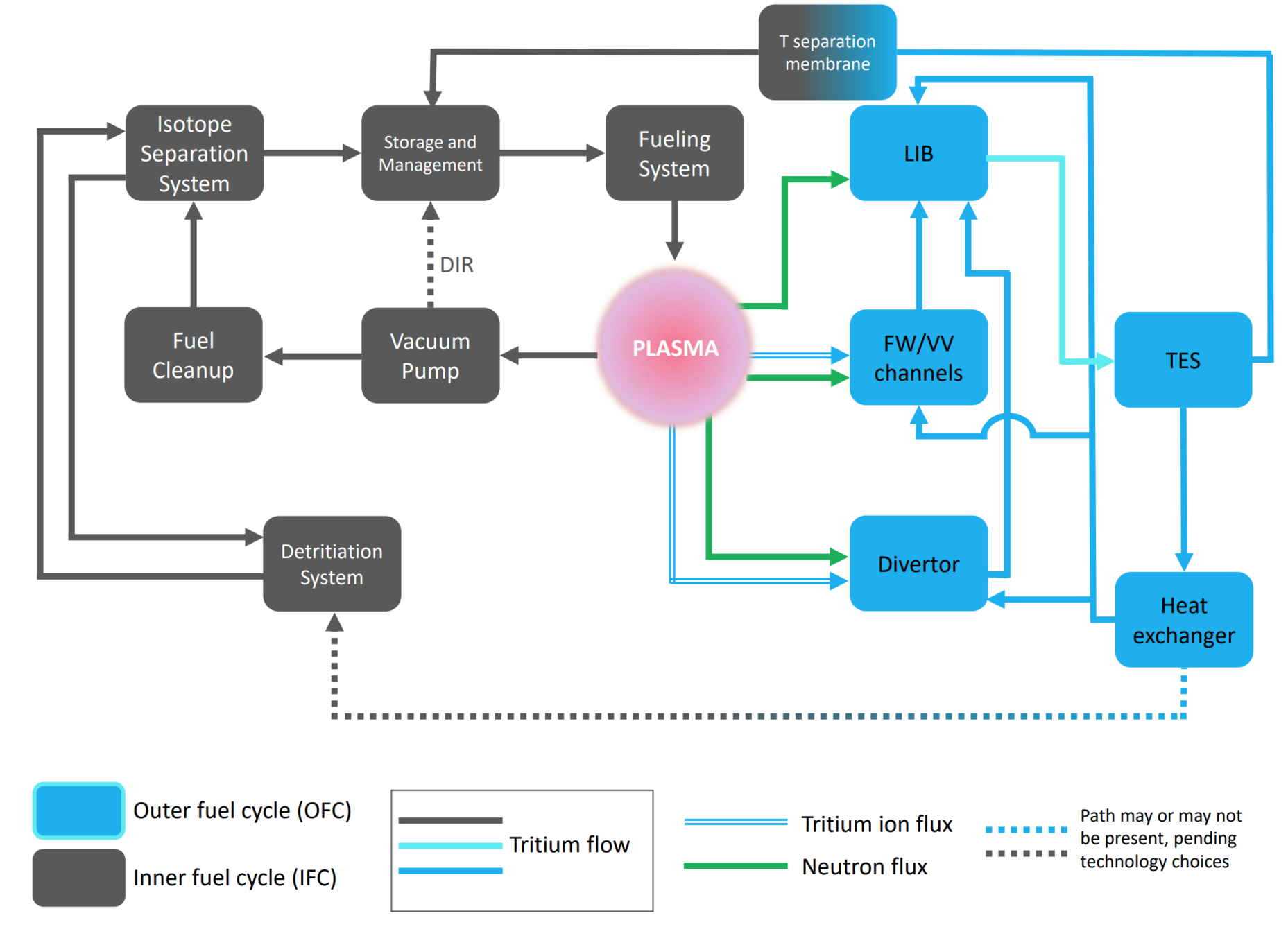
The fusion fuel cycle
Component
Material
What is the required TBR? Startup tritium inventory?
What are the minimum dimensions of the extractor?
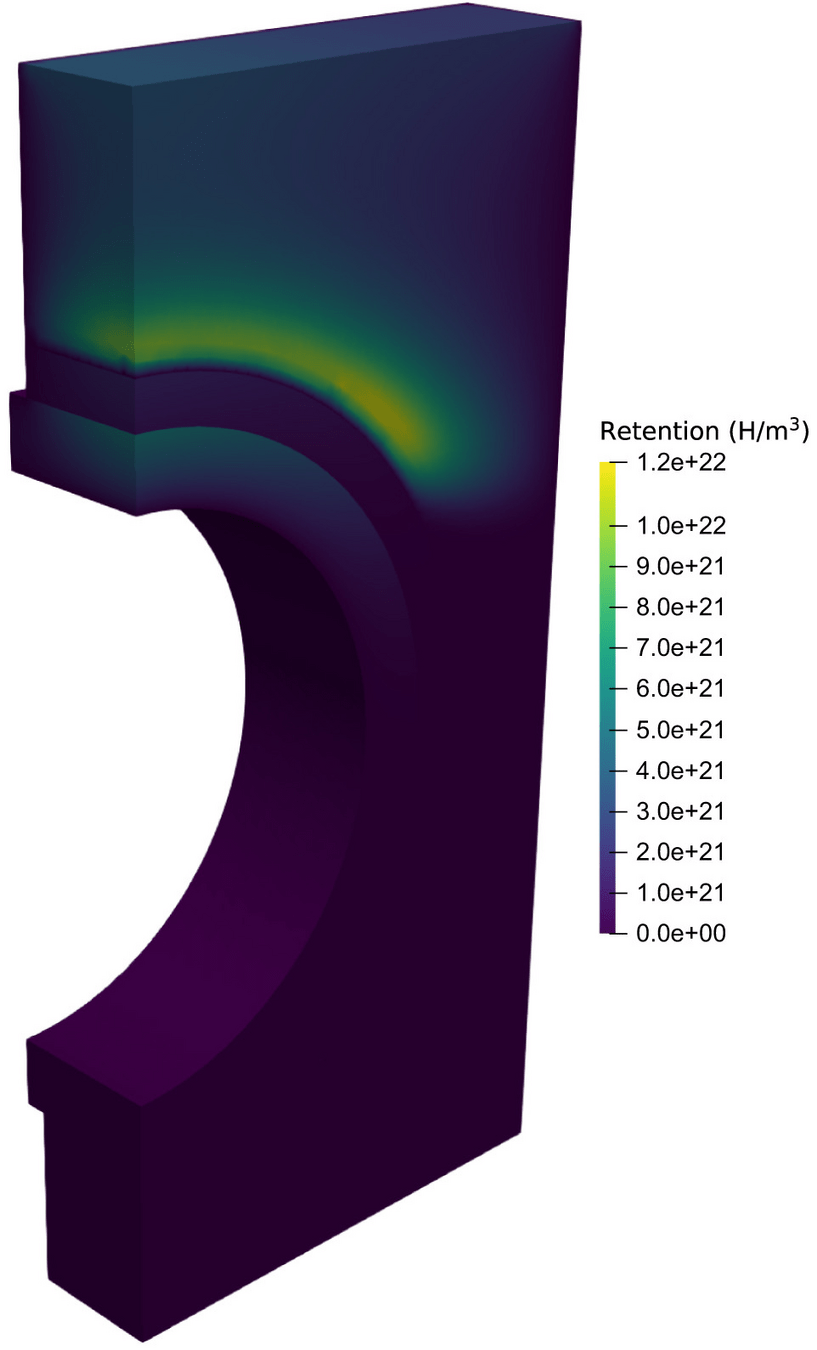
How much T is retained in the plasma facing materials?
What is the T concentration at the blanket outlet?
What is the diffusivity of EUROFER?
Trapping properties of tungsten?
Permeation reduction factor of this coating?
System
Multi-scale tritium design
Design issues propagate
Component
Material
System
Material tritium science
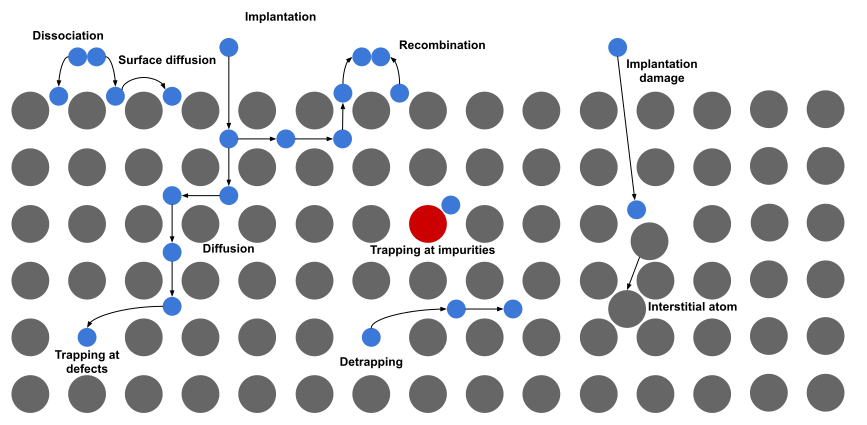
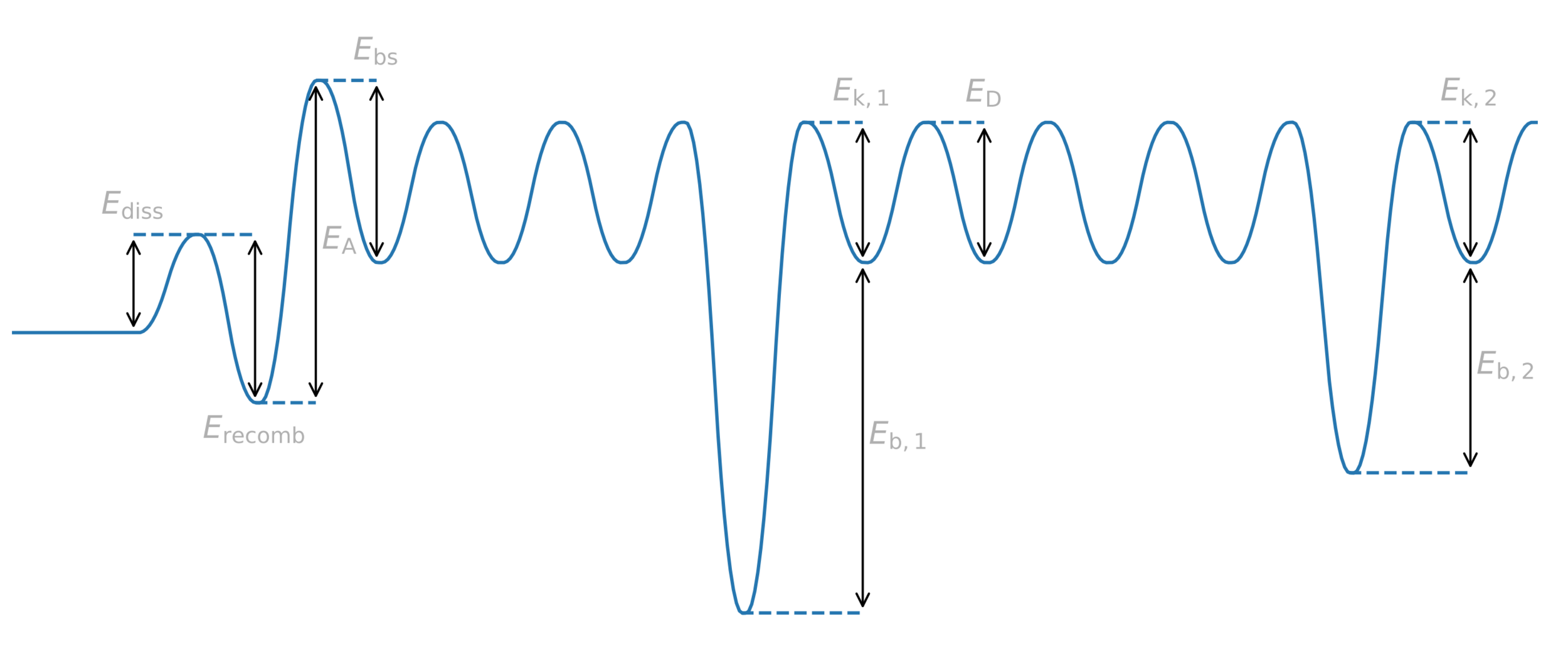
Hydrogen transport theory
H
Potential energy
Reaction coordinate
\frac{\partial c_\mathrm{m}}{\partial t} = \nabla \cdot \left(D\nabla c_\mathrm{m} \right) + S - \sum \frac{\partial c_\mathrm{t,i}}{\partial t}
\frac{\partial c_\mathrm{t, i}}{\partial t} = k_i \ c_\mathrm{m} \ (n_\mathrm{trap,i} - c_\mathrm{t,i}) - p_i c_\mathrm{t,i}
McNabb & Foster model
(diffusion and trapping)
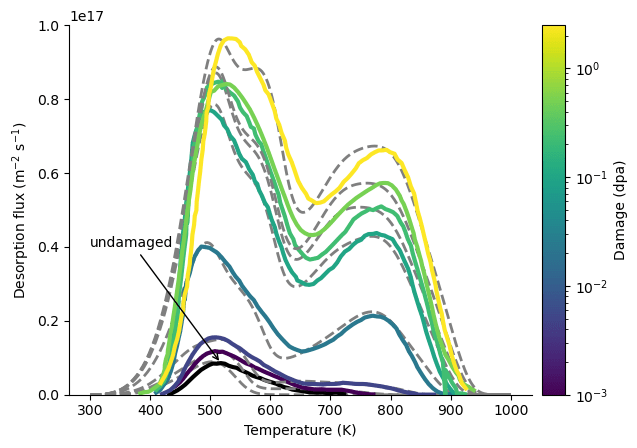
TDS is used to determine trap properties
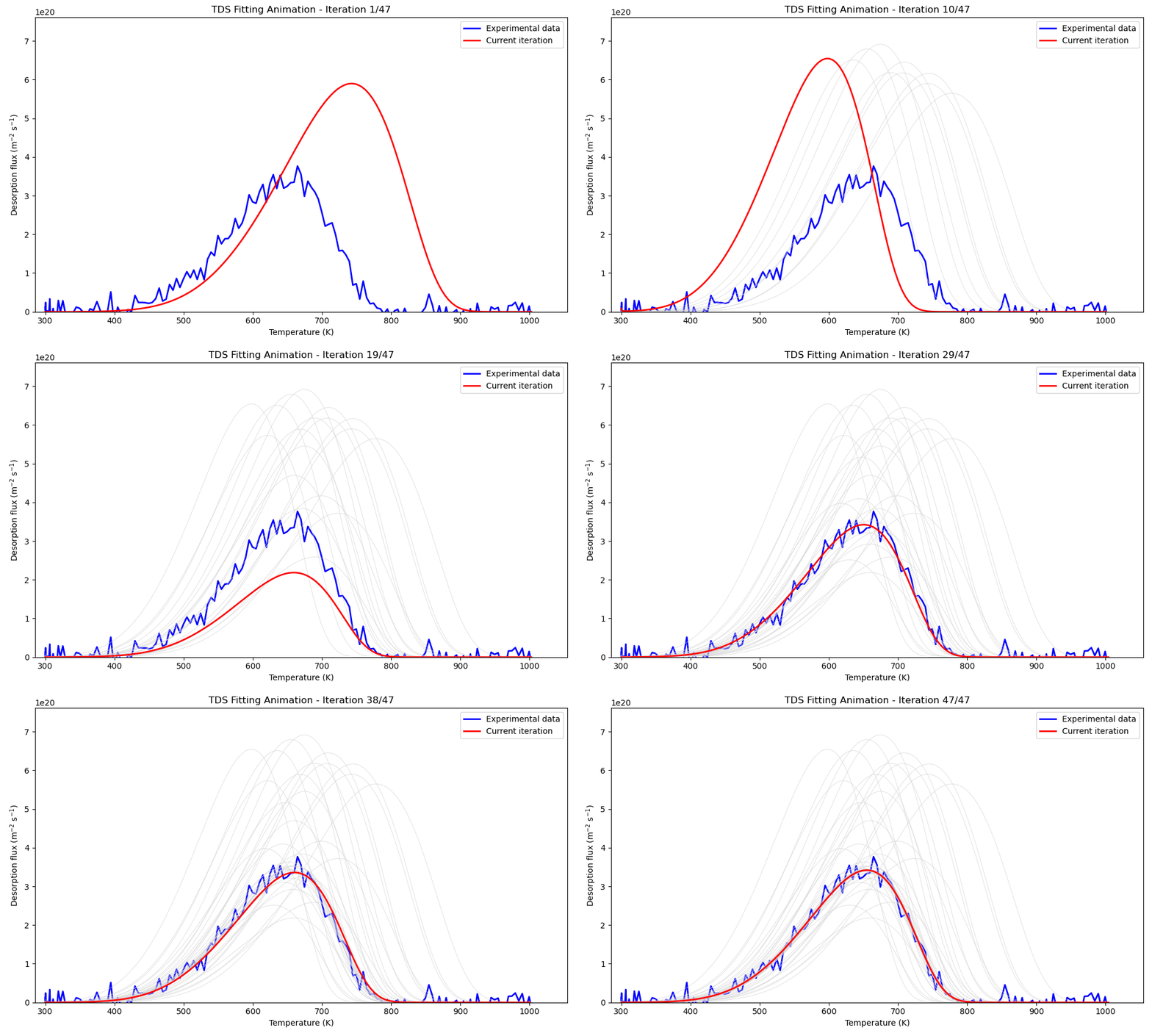
Does this qualify as Machine Learning?🤷
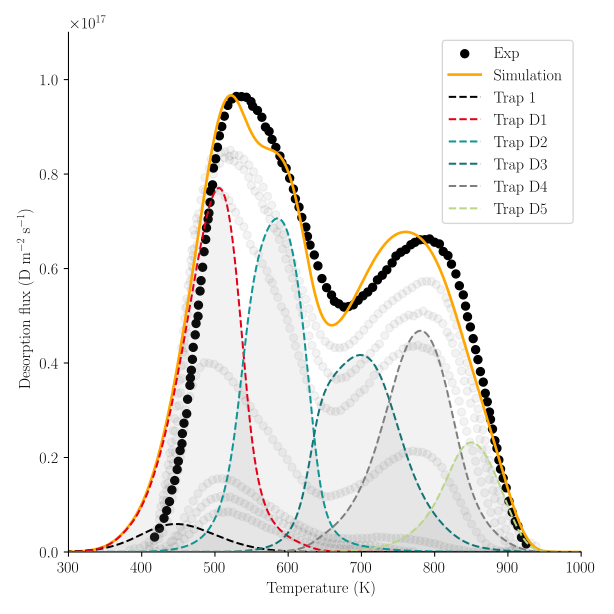
Integrated with parametric optimisation tools
Studying the influence of neutron-induced trapping
Different traps/defects
- James Dark et al 2024 Nucl. Fusion 64 086026
- Delaporte-Mathurin et al 2021 NME Volume 27, June 2021, 100984
Hydrogen transport through microstructures
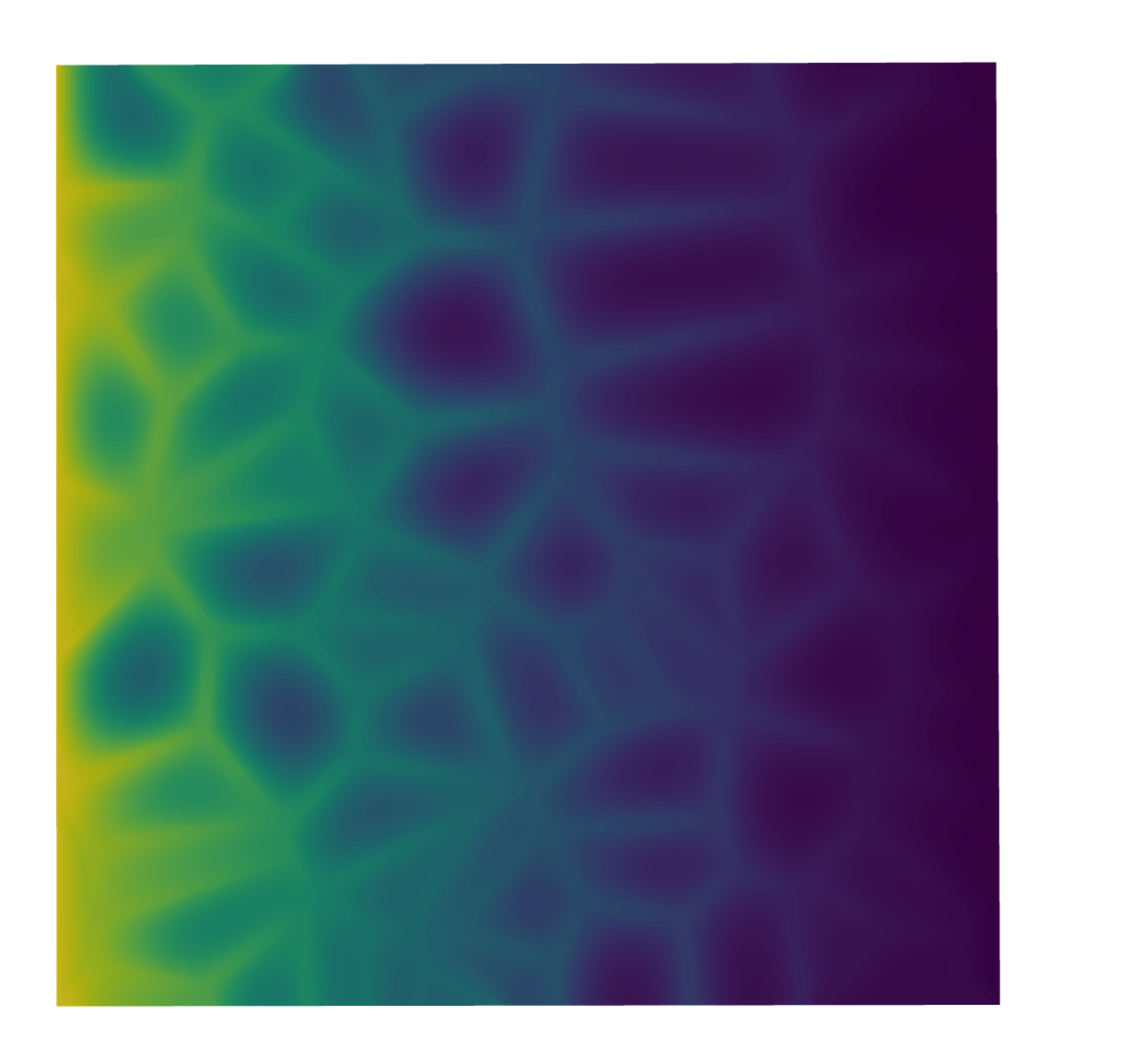

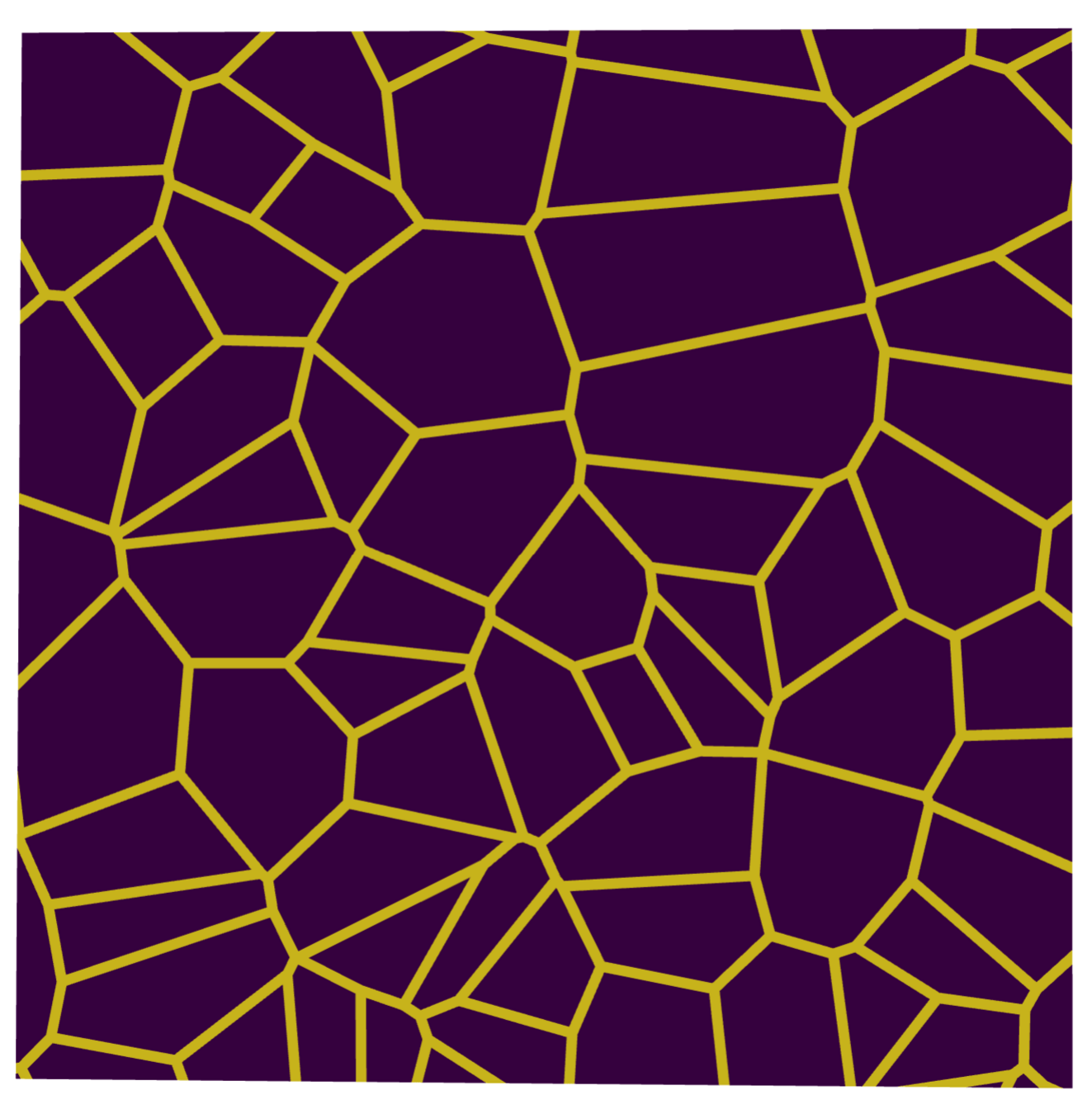
Representative Volume Element (RVE)

- Impact of GB width?
- Can be used to derive anisotropic diffusivity
- Tutorial available online
GB is less diffusive
GB is more diffusive
Grain
Grain Boundaries
HYPERION: hydrogen permeation through liquids
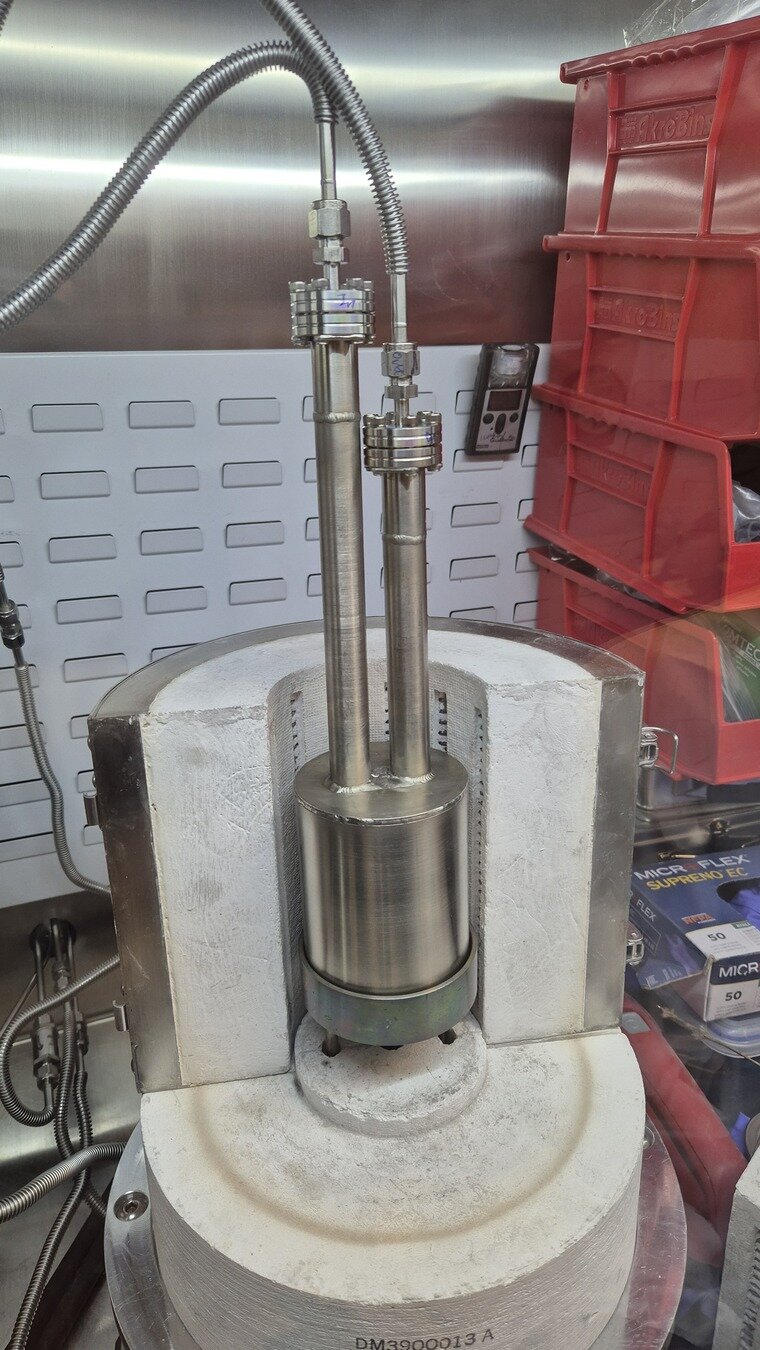
FLiBe
Metal layer
to GC
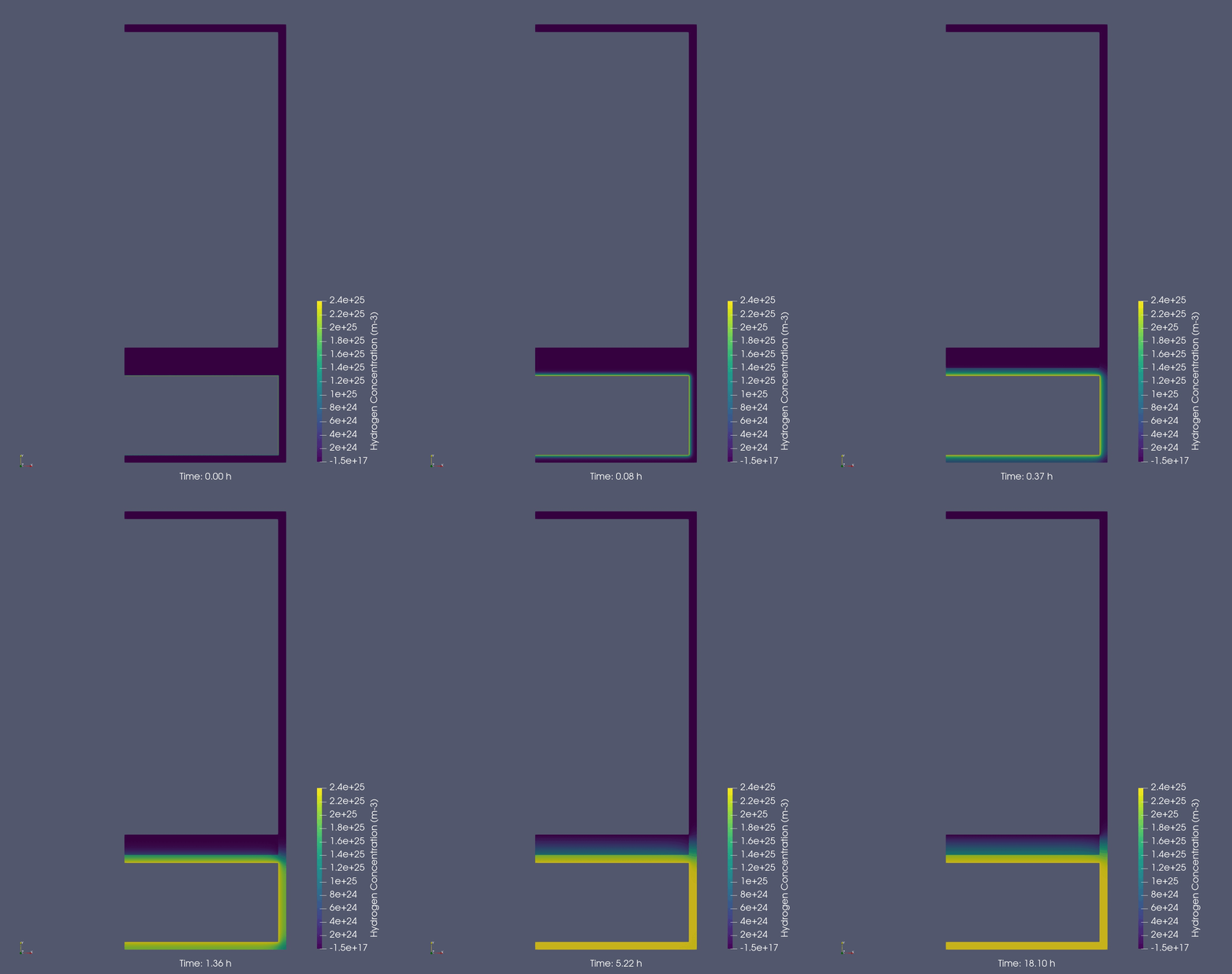
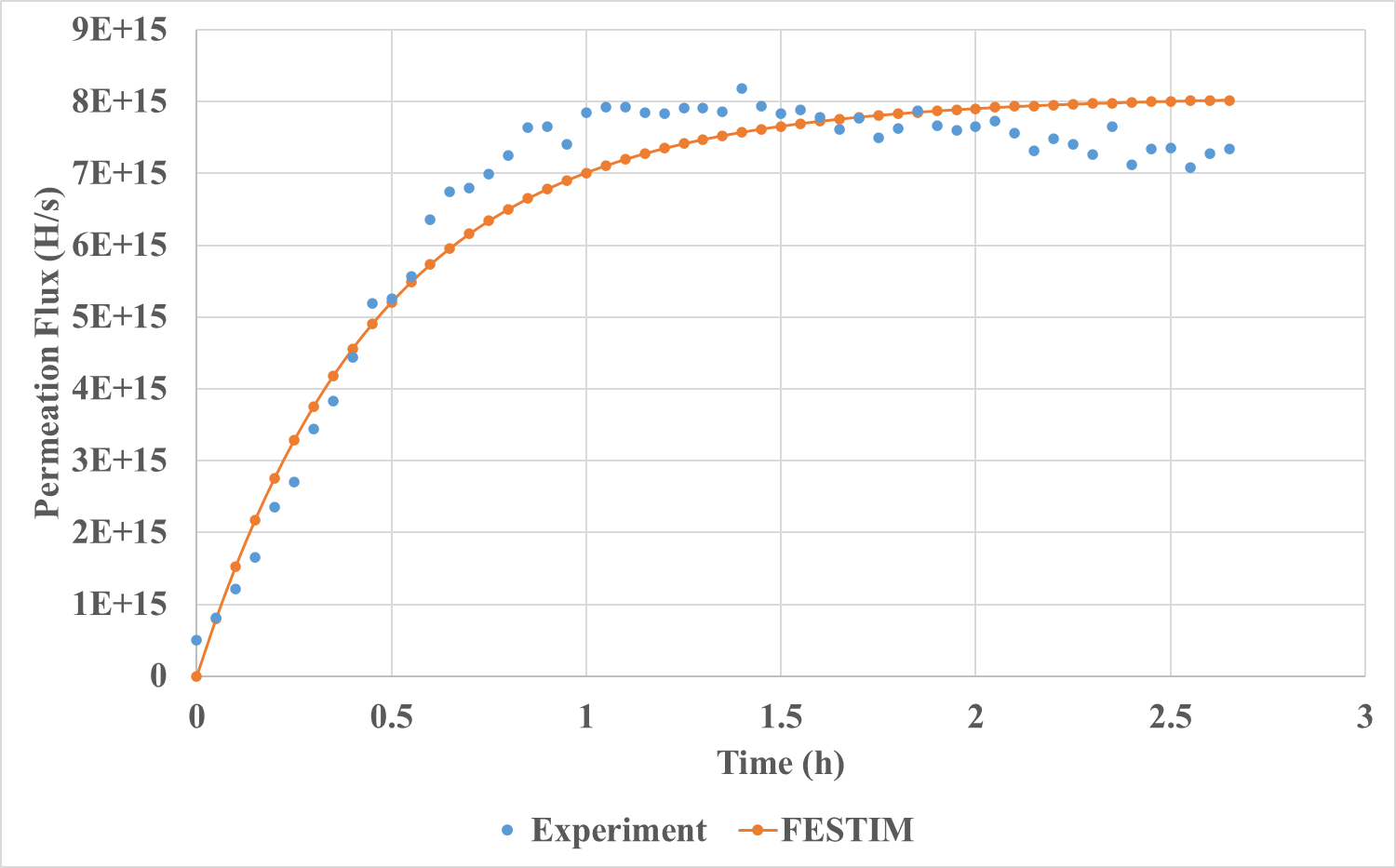
See Huihua Yang's talk: Validation of FESTIM Hydrogen Transport Modeling in FLiBe Through HYPERION Permeation Data
Component
Material
System
Component design
The multiphysics approach of FESTIM


velocity, temperature, turbulent viscosity...
tritium production
Heat source
Temperature
Neutronics
Thermo-hydraulics
Tritium transport
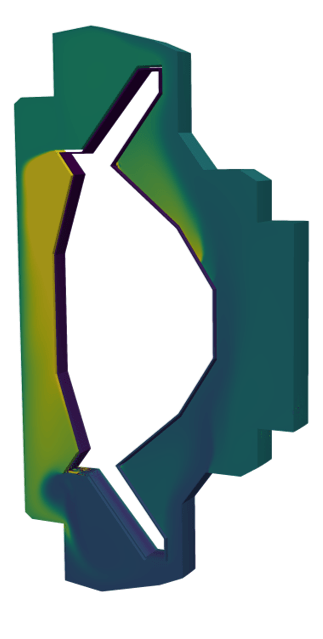
Tritium transport modelling of the ARC Liquid Immersion Blanket
Dark et al, Tritium 2025, 10.13140/RG.2.2.28729.84321
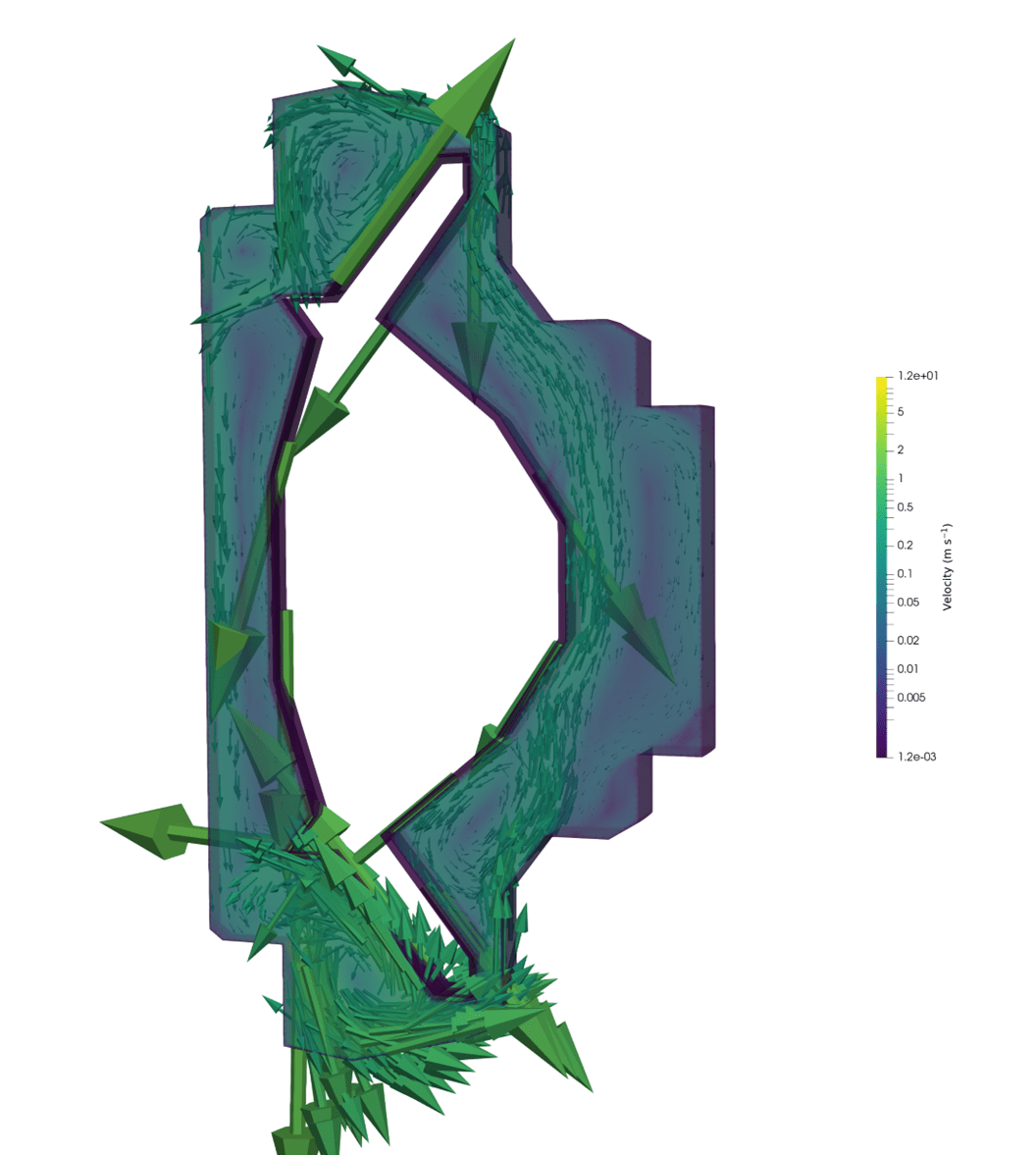
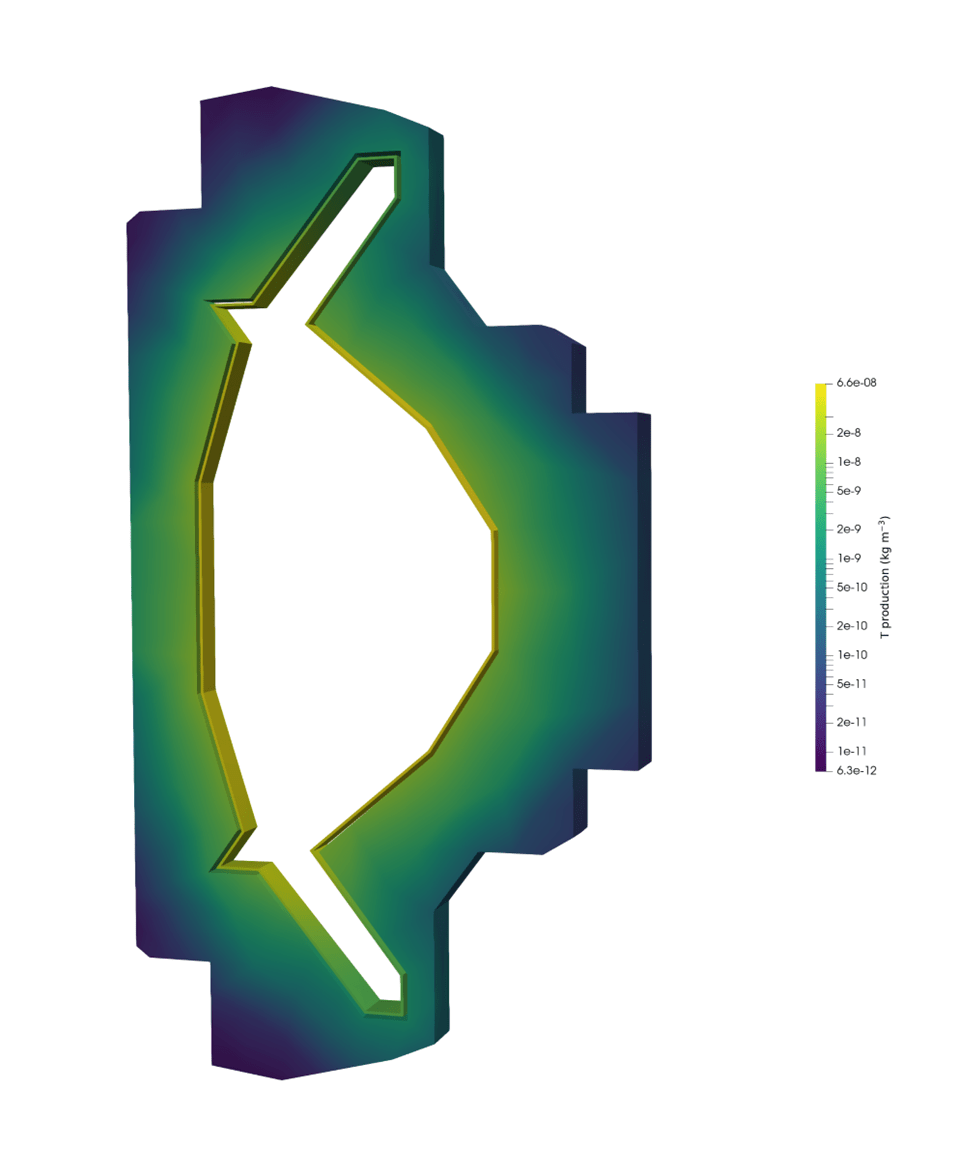
See James Dark's talk: Multi-physics tritium transport modelling of the ARC breeding blanket with FESTIM
LIBRA: derisking breeding blankets
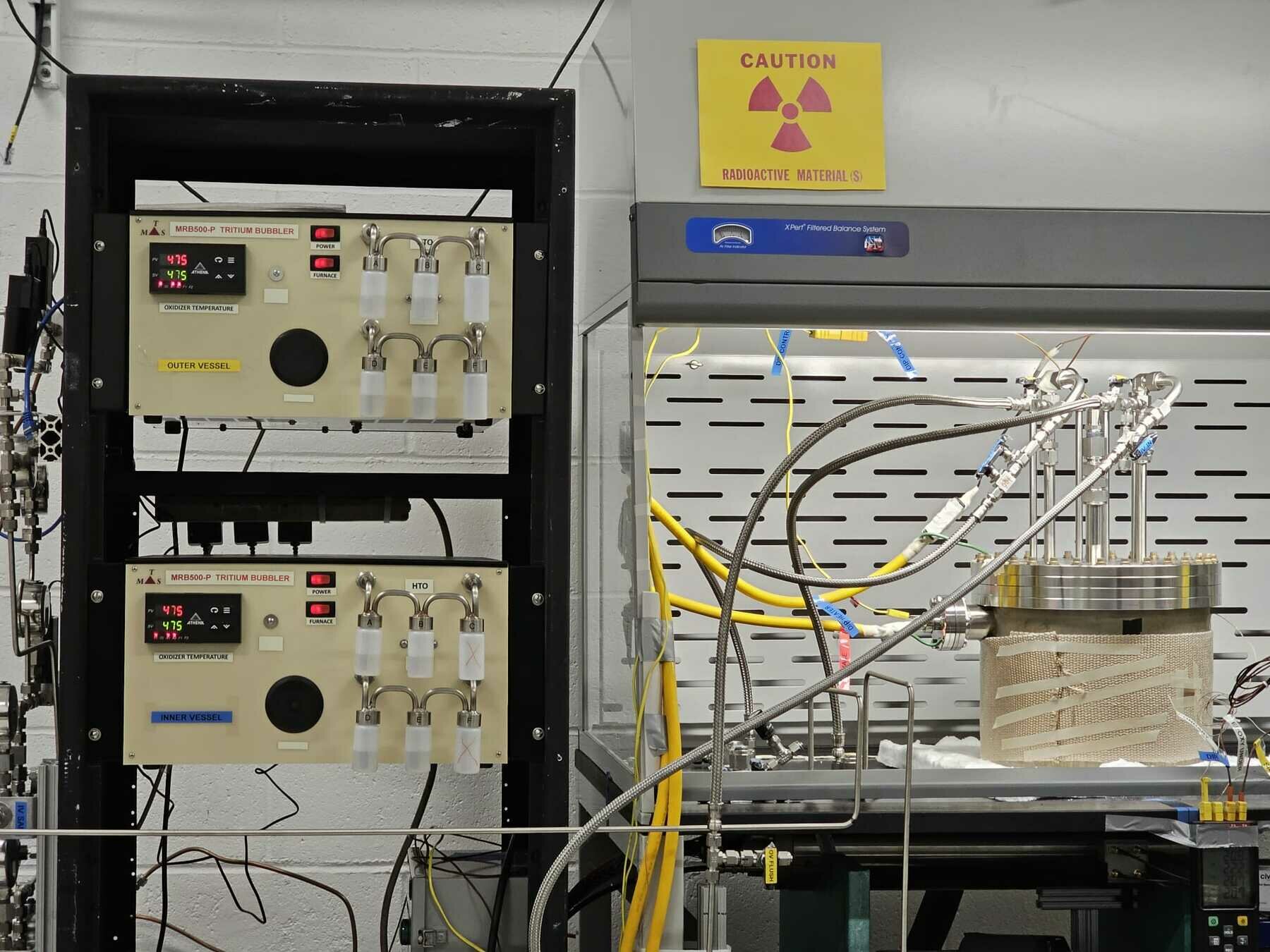
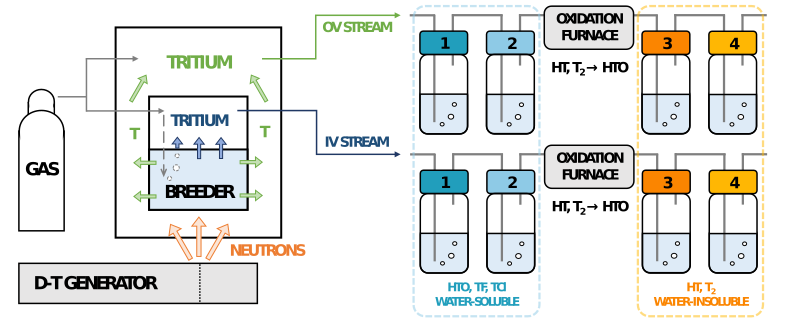

- TBR measurement and neutronics
- Tritium speciation
- Extraction dynamics
- Tritium permeation
Rémi Delaporte-Mathurin et al 2025 Nucl. Fusion 65 026037
Rémi Delaporte-Mathurin et al "BABY 1L: First Tritium Breeding Campaign Results." arXiv preprint arXiv:2509.26174 (2025).
LIBRA produces validation data for multiphysics models
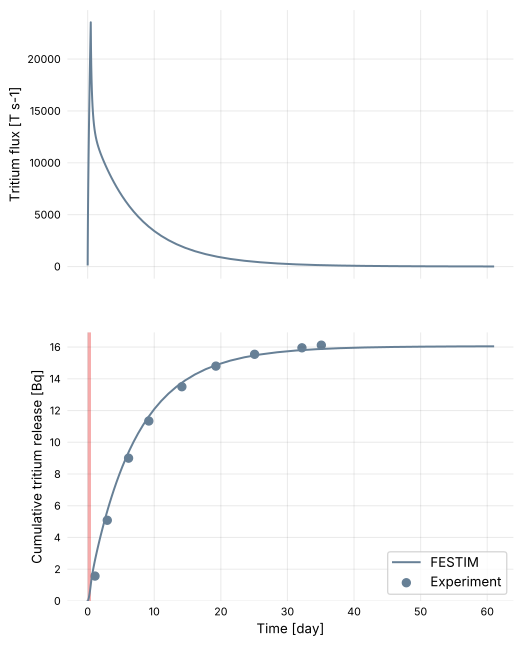
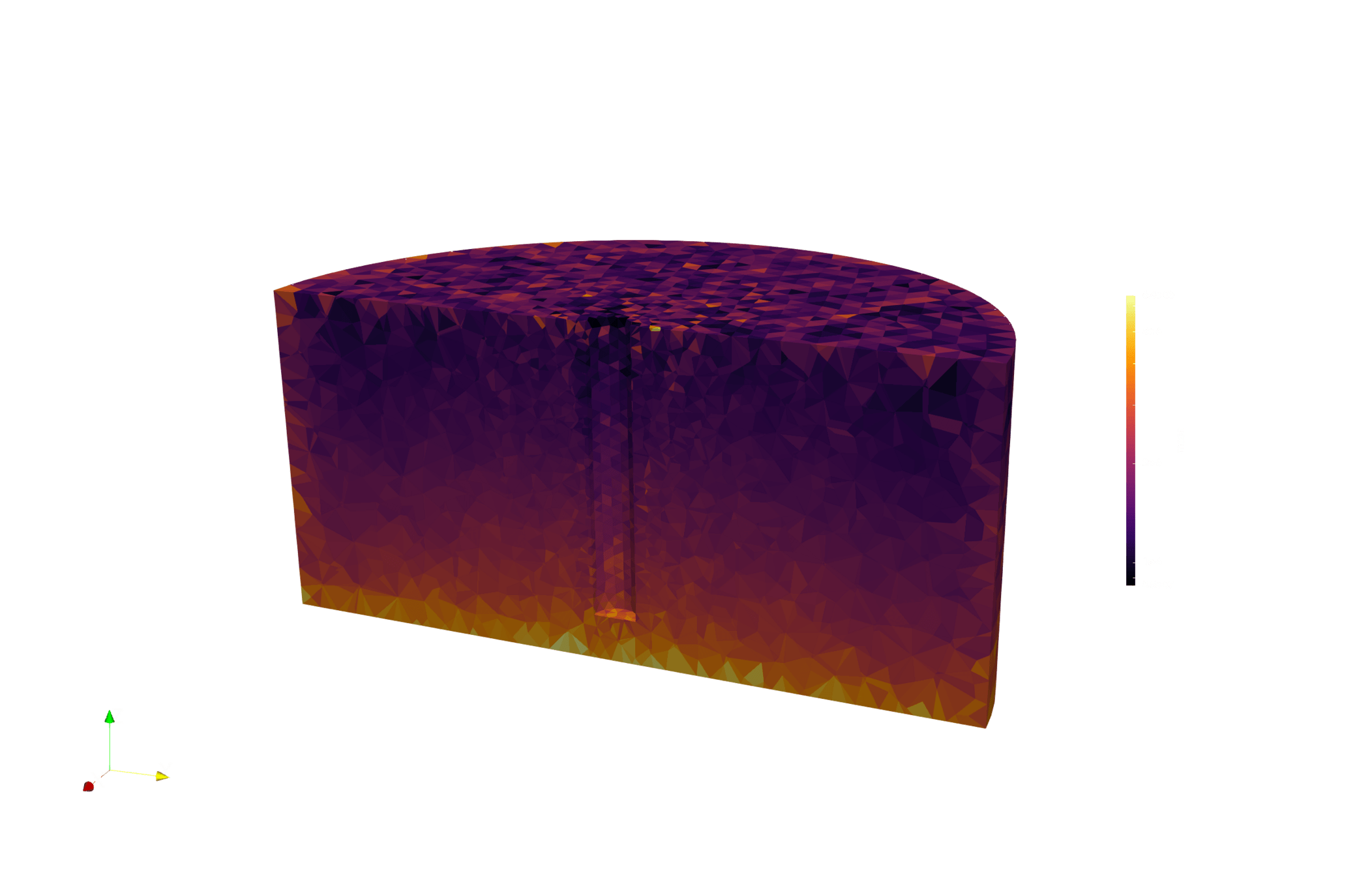
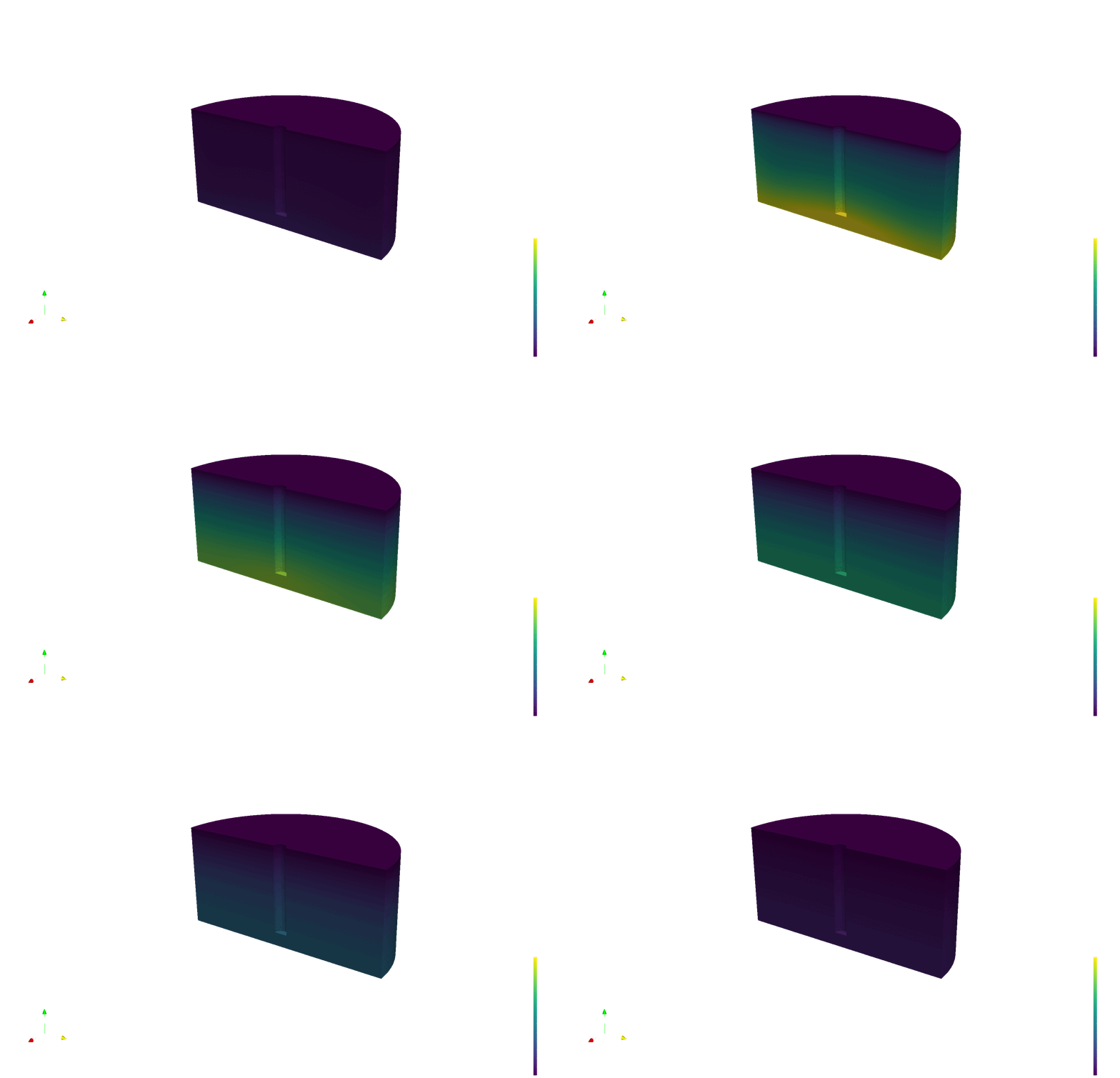
Tritium production
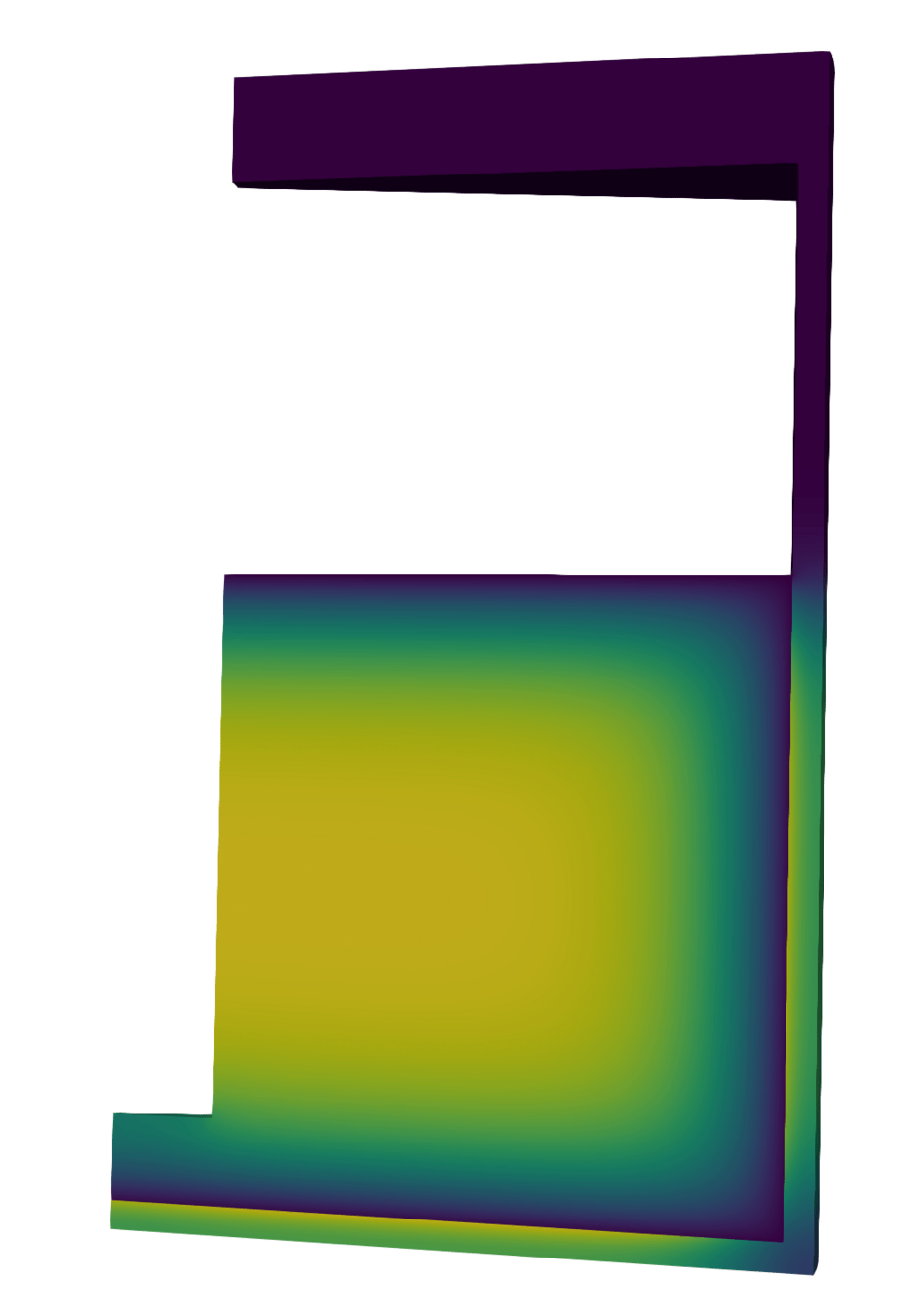
Tritium concentration
Max conc. 1.4E13 T/m3
[T/n/cm3]
Natural convection neglected
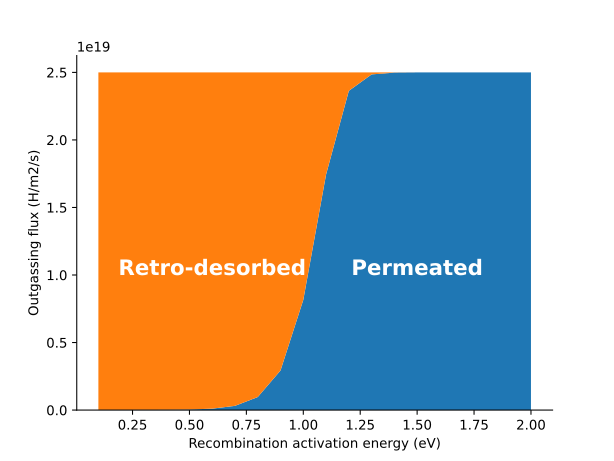
Outgassing flux
LIBRA produces validation data for multiphysics models
\varphi = K_r \ c_T ^ 2 + K_r' \ c_T \ P_\mathrm{H_2}
\mathrm{H_2 + T (ad)} \rightleftarrows \mathrm{ HT +H (ad)}
\mathrm{2 T (ad)} \rightleftarrows \mathrm{ T_2}
\frac{c^-}{K_H} = \left(\frac{c^+}{K_S}\right)^2
Interface discontinuity
Surface recombination
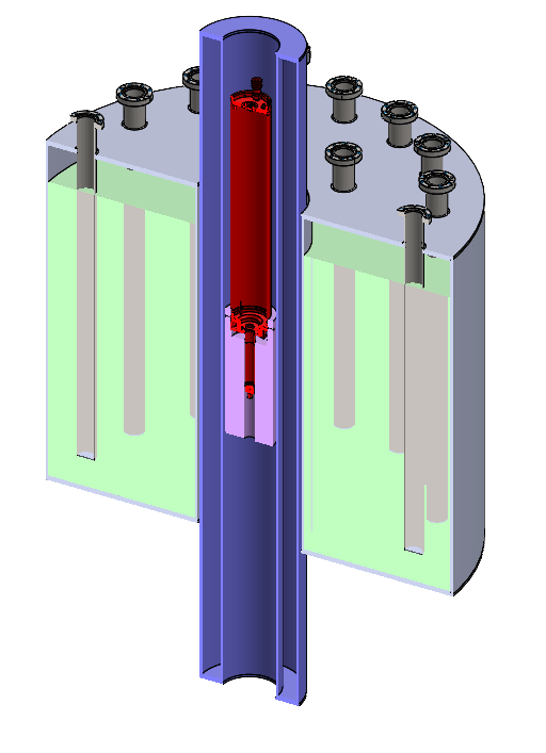
LIBRA ONE
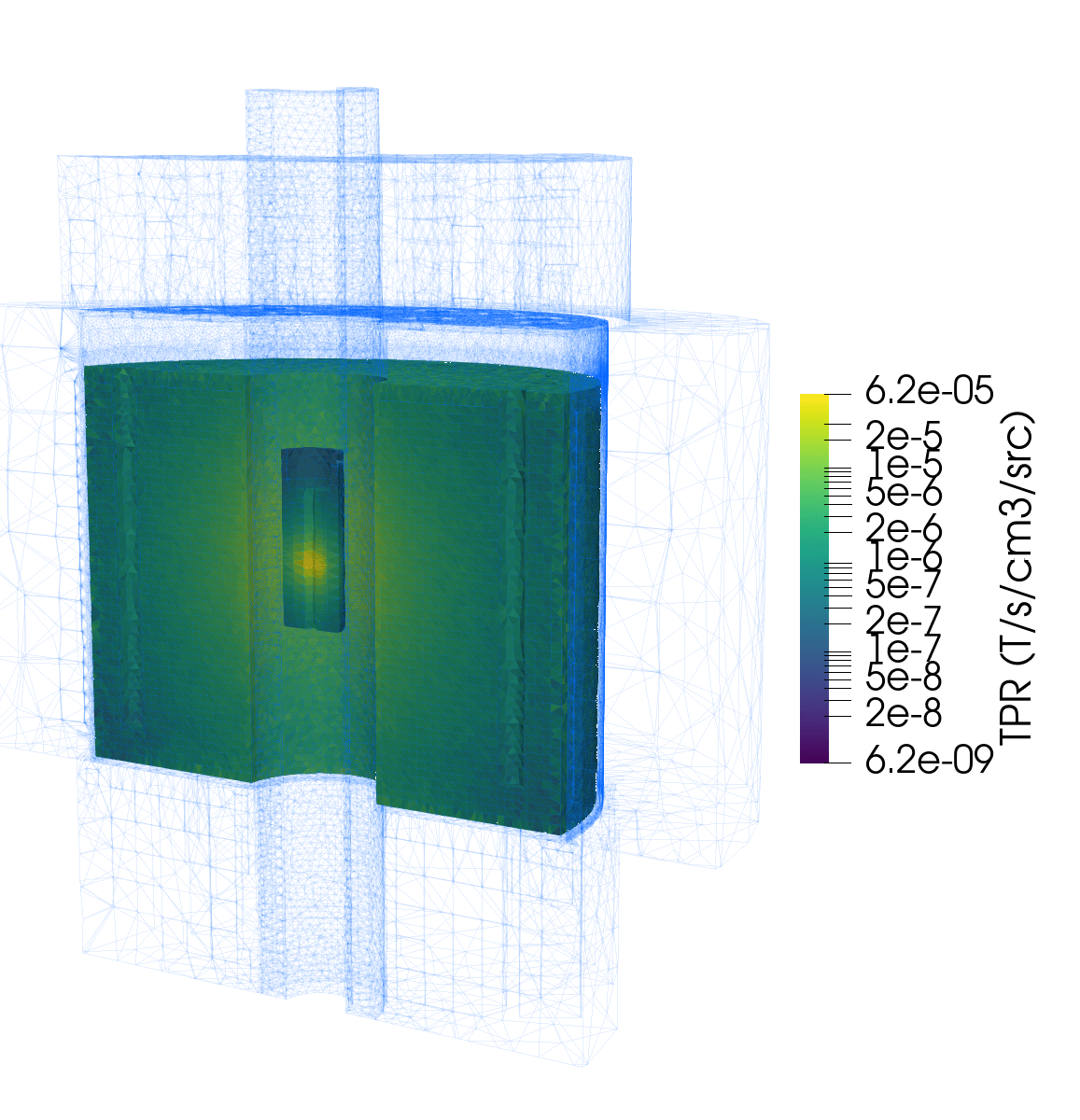
Next step: include sparging modelling for tritium extraction
See Stefano Segantin's poster: Digital Engineering for Fusion: Uncertainty Quantification in Neutronics Modeling
CAD-based neutronics model for LIBRA ONE
Tritium extraction: Permeation Against Vacuum
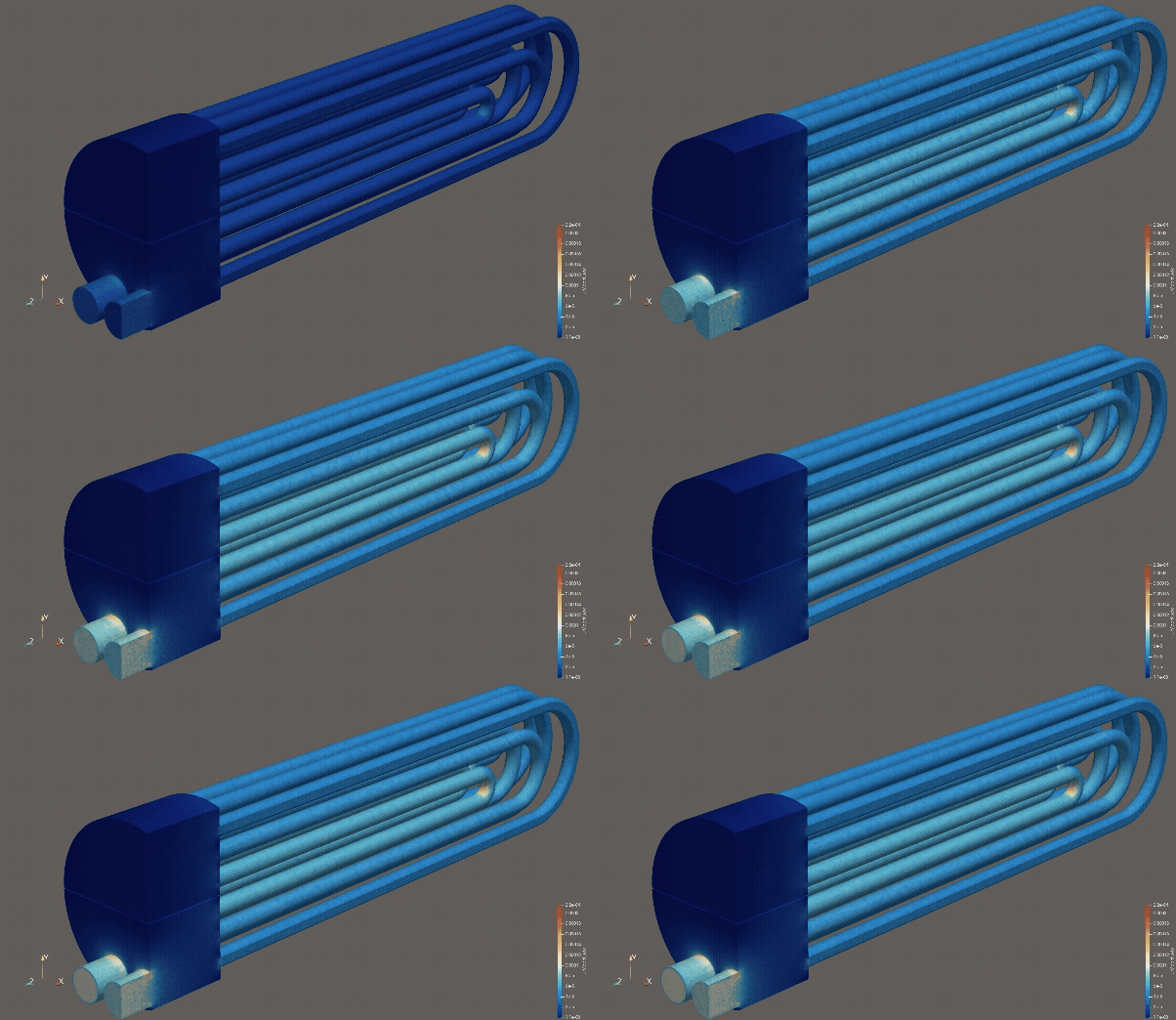
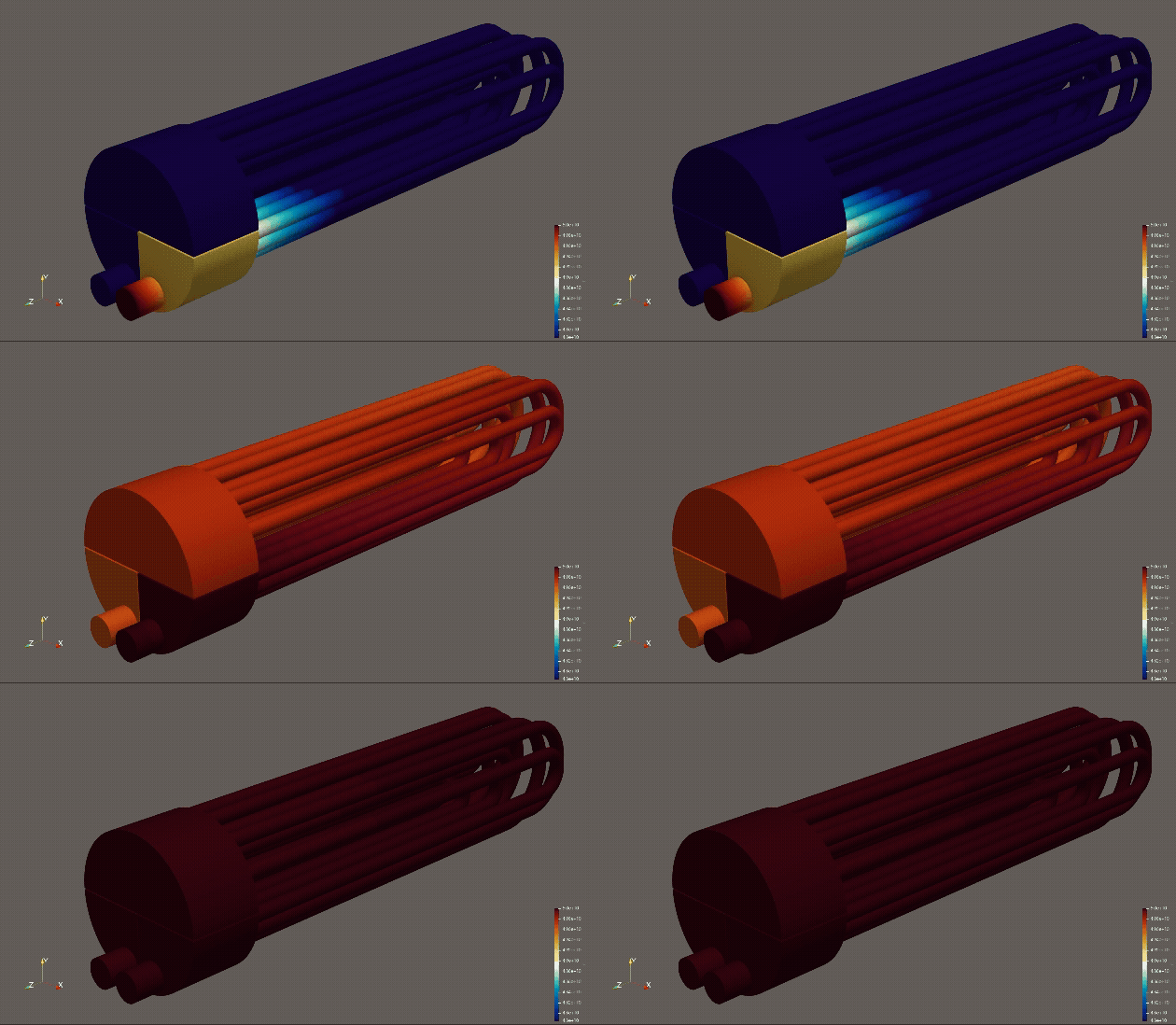
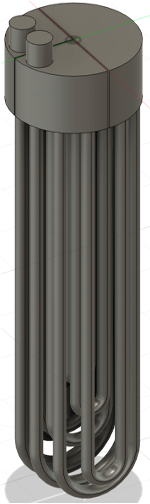
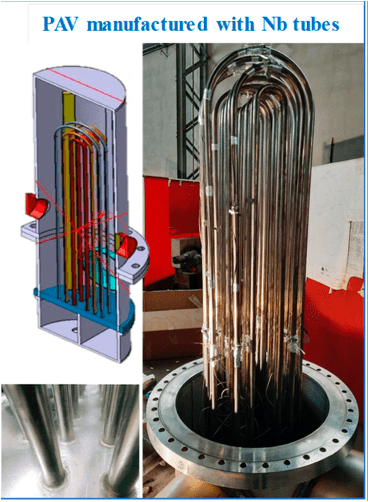
Students: Chirag Khurana, Kaelyn Dunnell
Utili, Marco, et al. "Design and integration of the WCLL Tritium Extraction and Removal System into the European DEMO tokamak Reactor." Energies 16.13 (2023): 5231

Goals:
- Estimate extraction efficiency
- Inform and optimise design
LiPb inlet/outlet
To vacuum
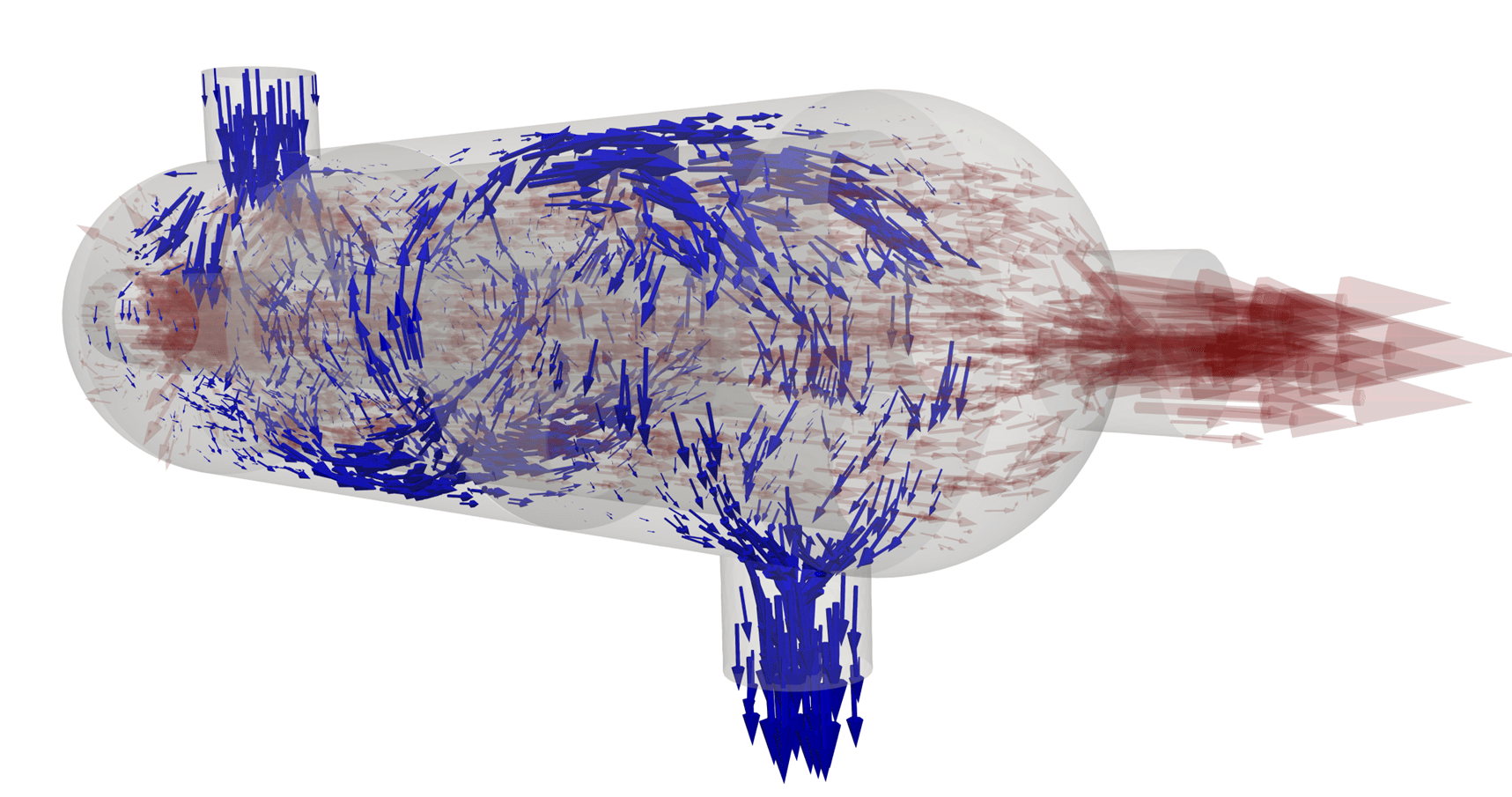
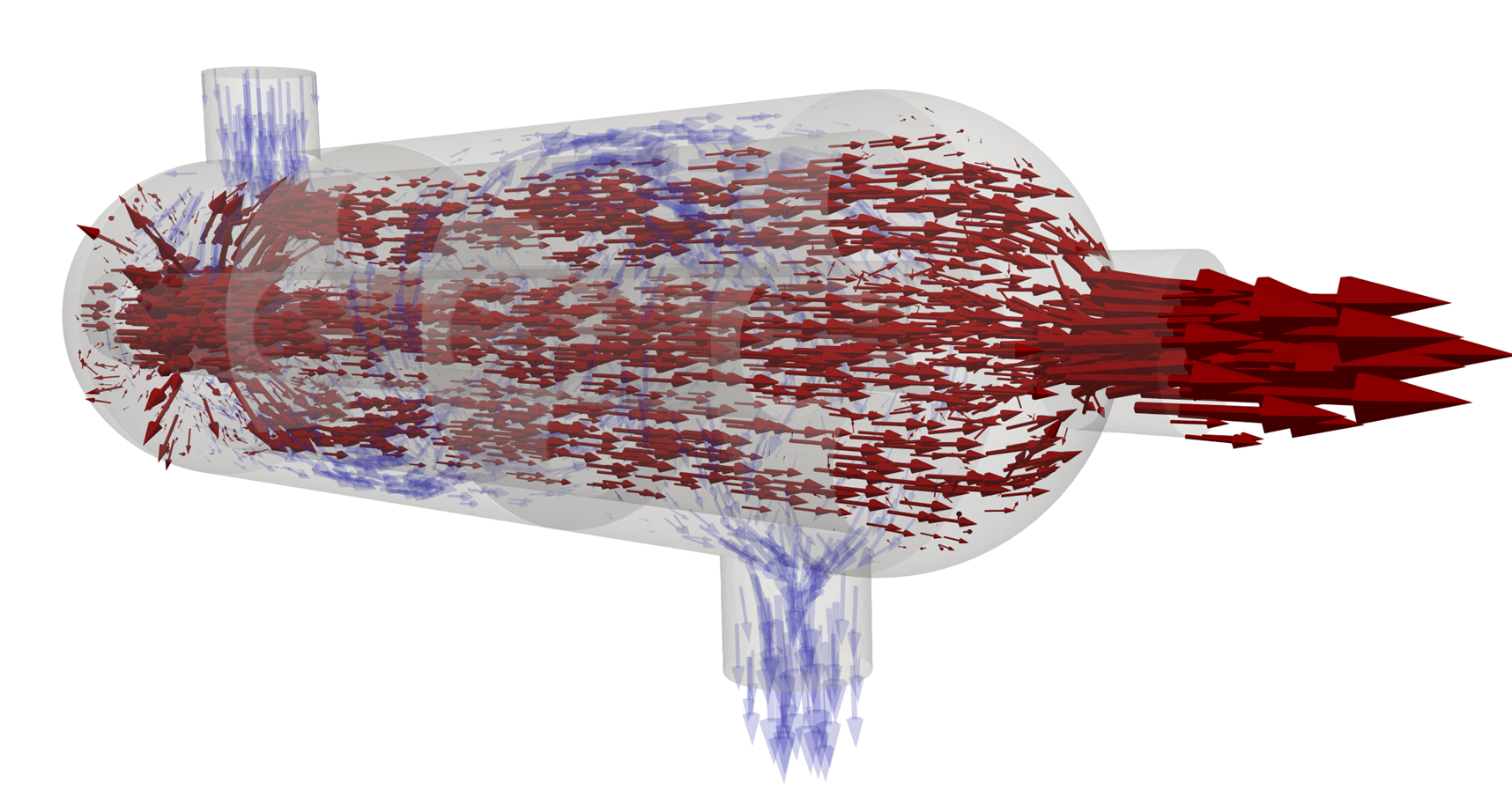
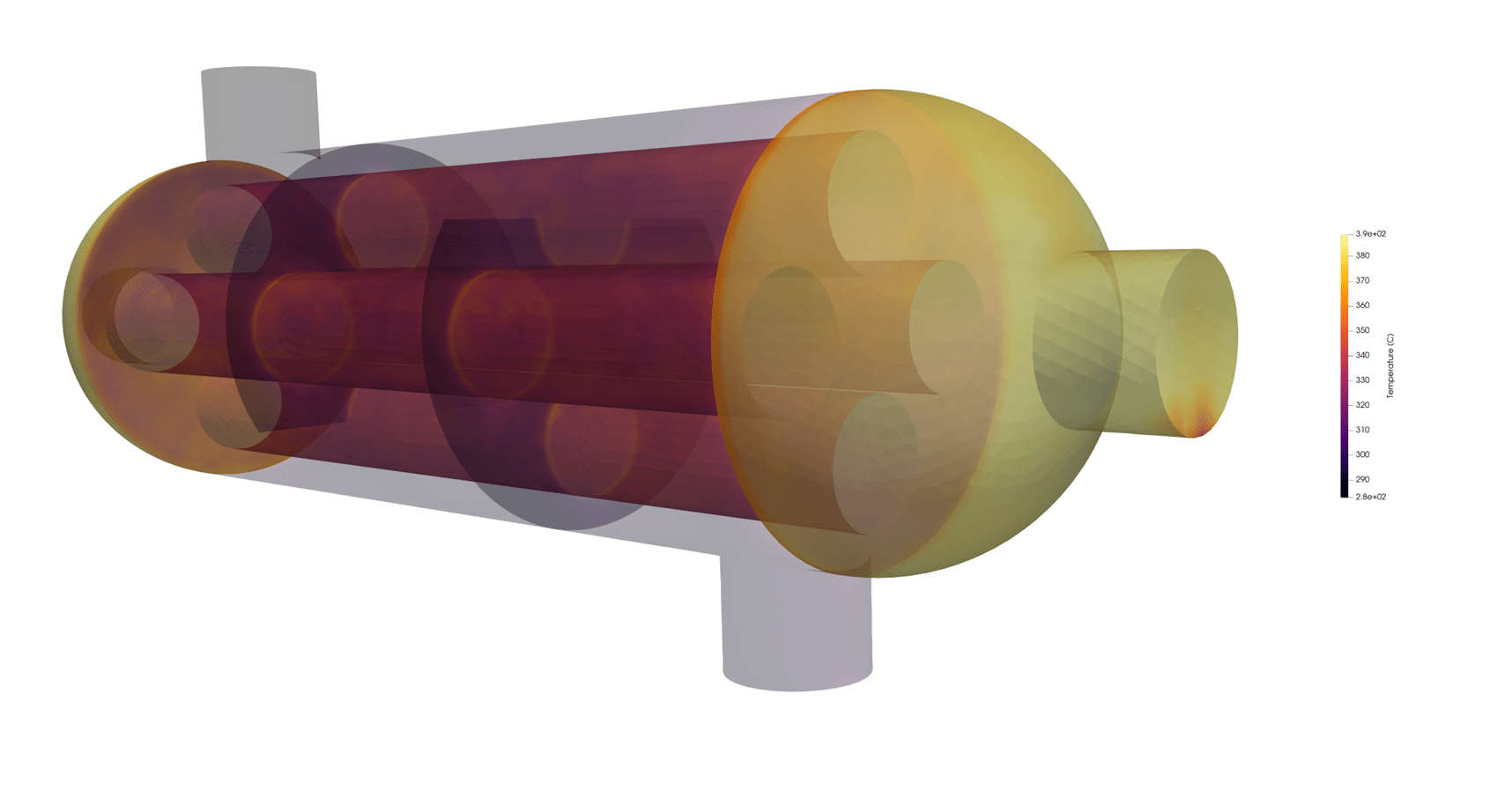
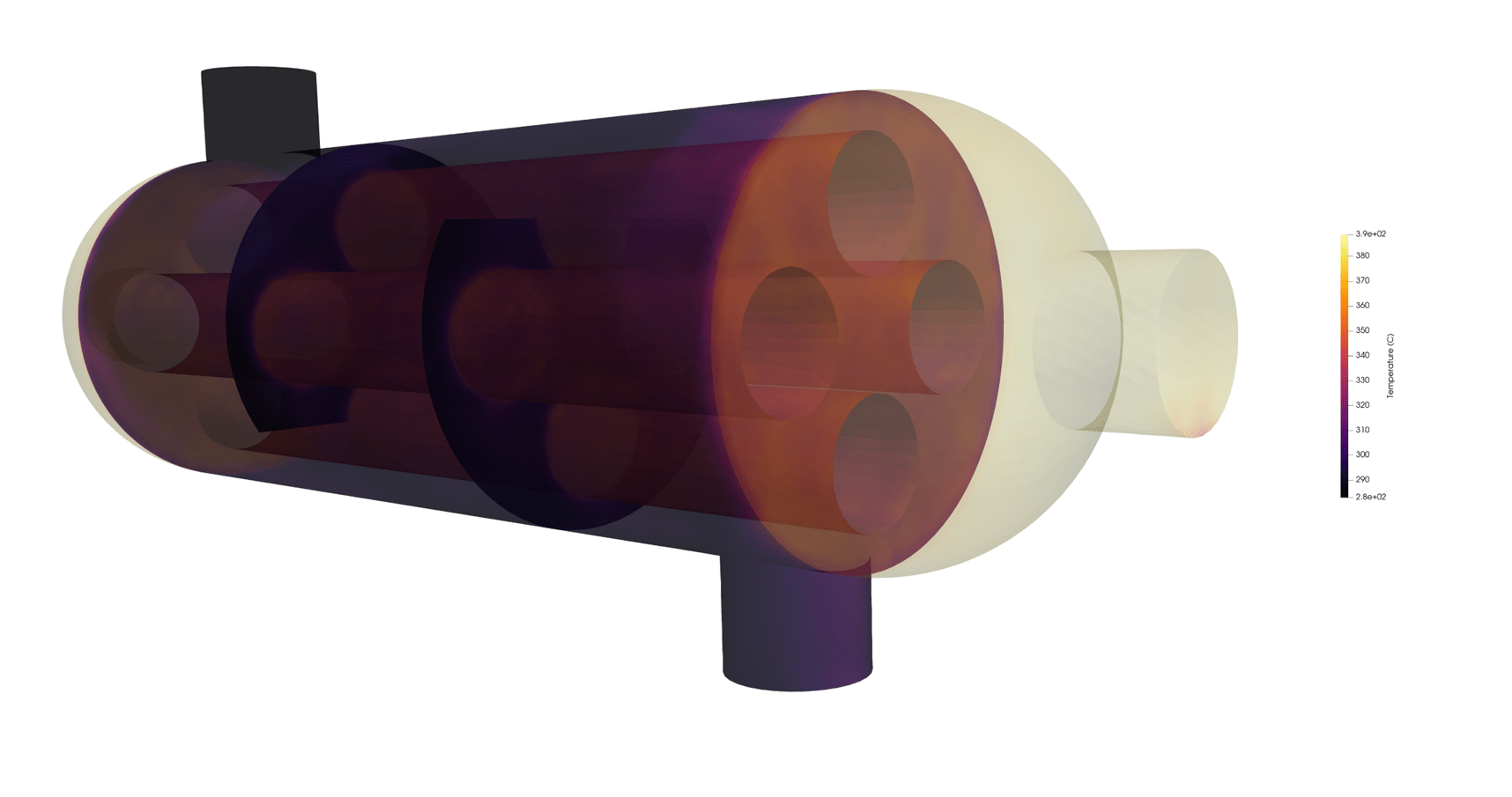
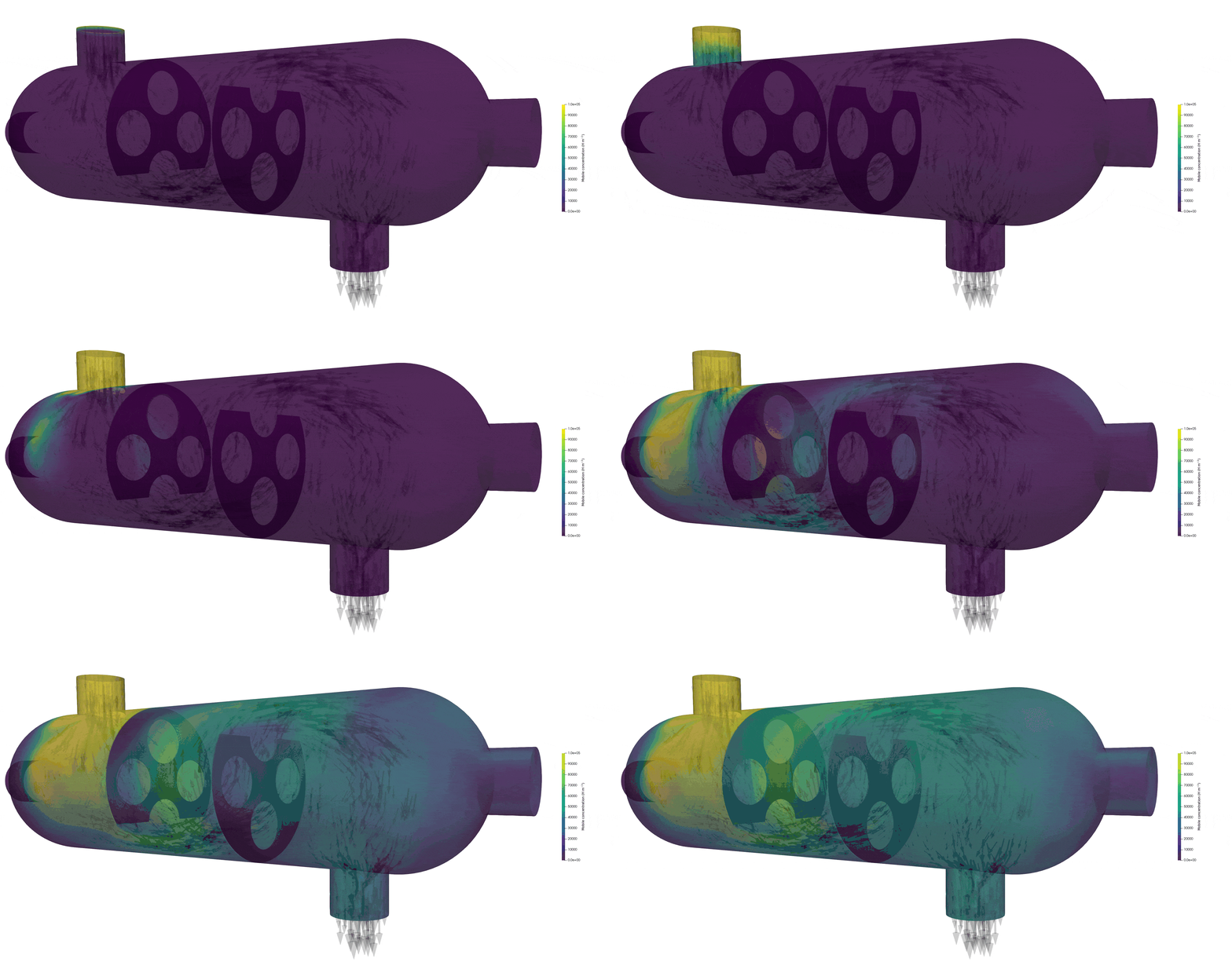
Tritium contamination in Heat Exchangers
c_\mathrm{inlet, hot}
c_\mathrm{outlet, cold}
Goals:
- Estimate tritium contamination to secondary coolant
- Inform and optimise design
Students: Chirag Khurana, Kaelyn Dunnell
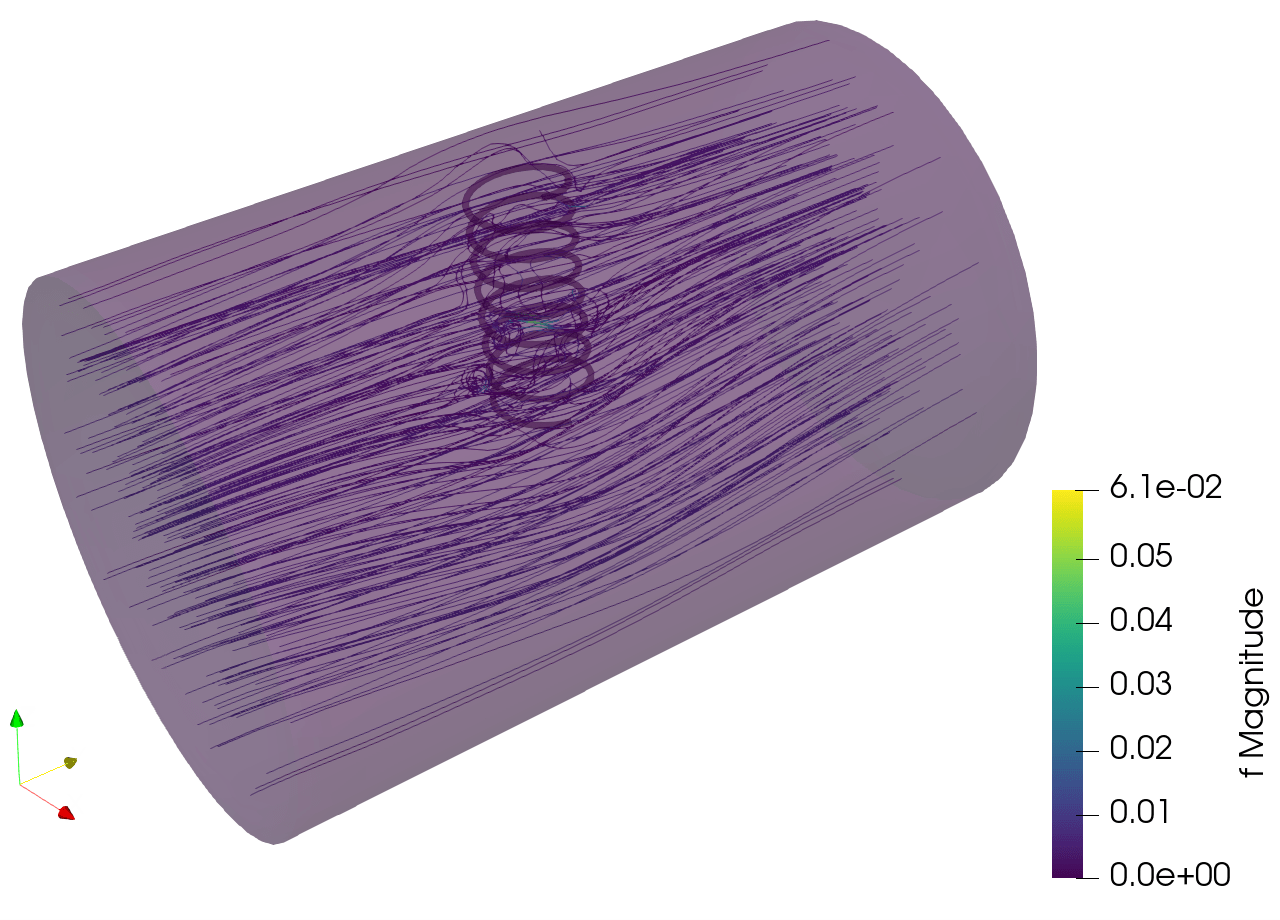
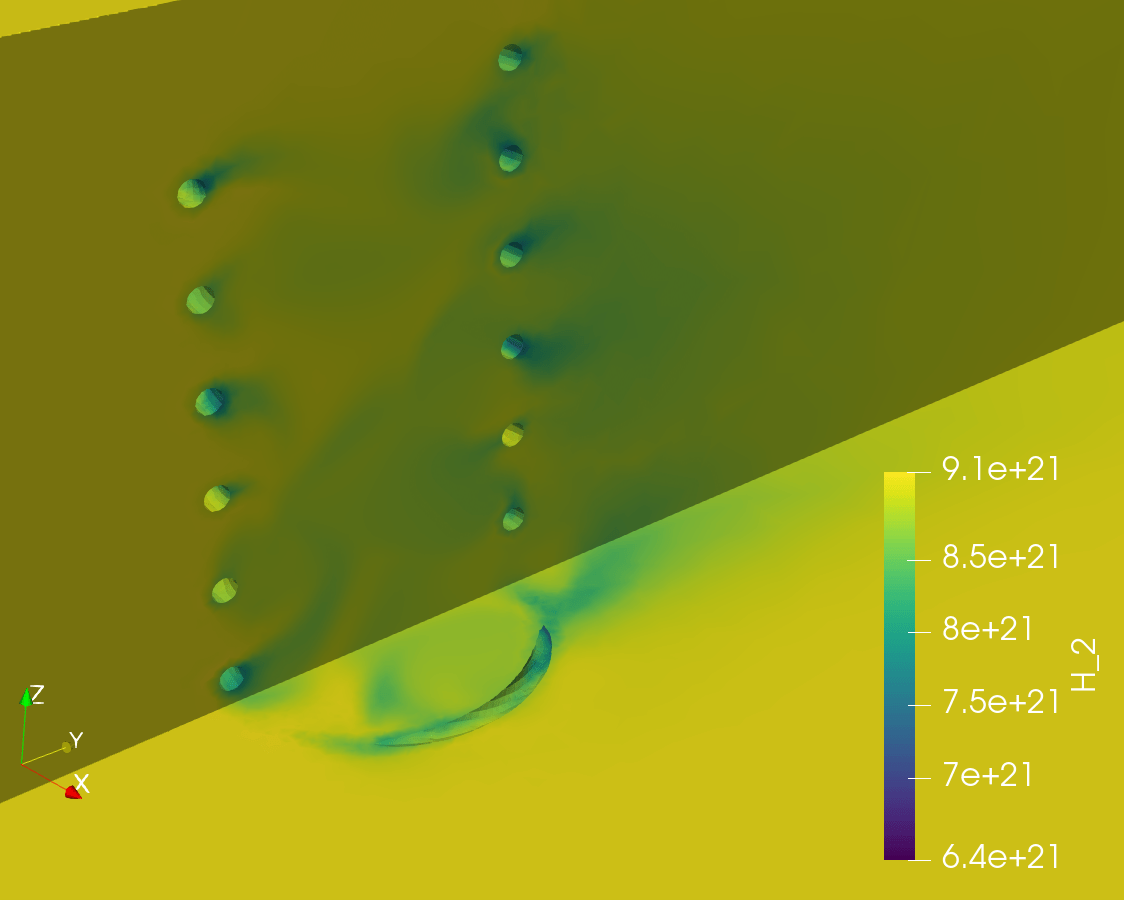
- 1D assumption may not be valid
- Can we optimise placement?
- Is the diffusion-limited assumption valid?
- Provide a behaviour law for tritium sensing
Designing permeation probes for tritium detection
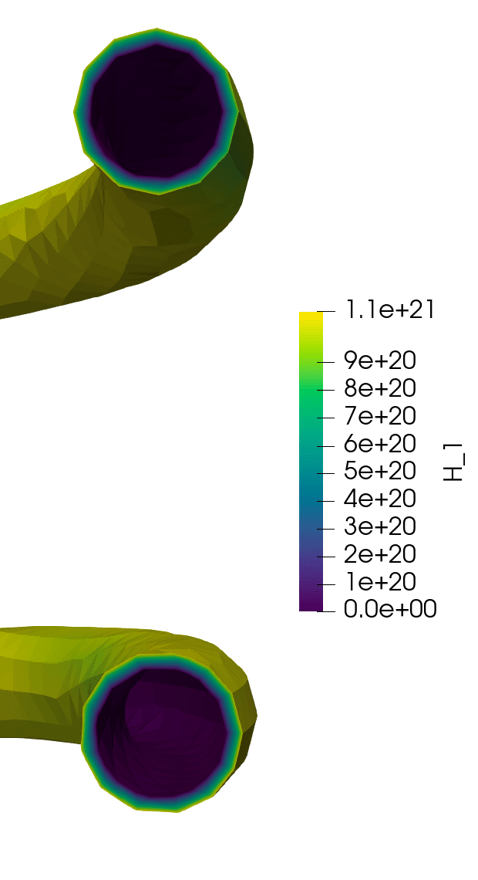
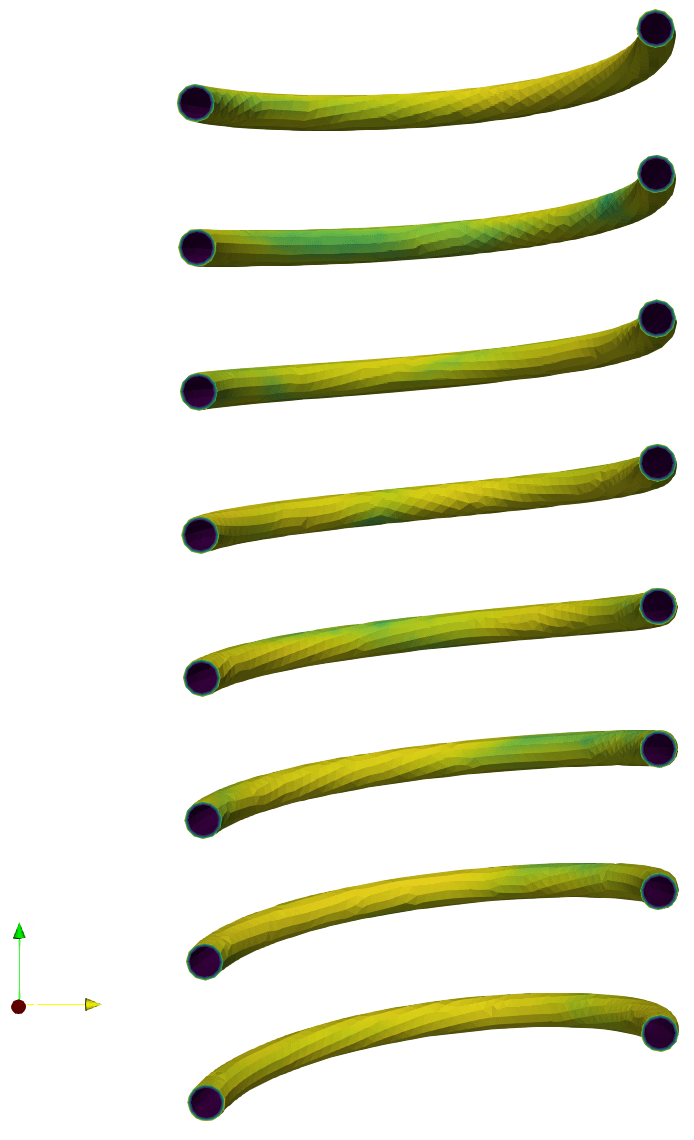
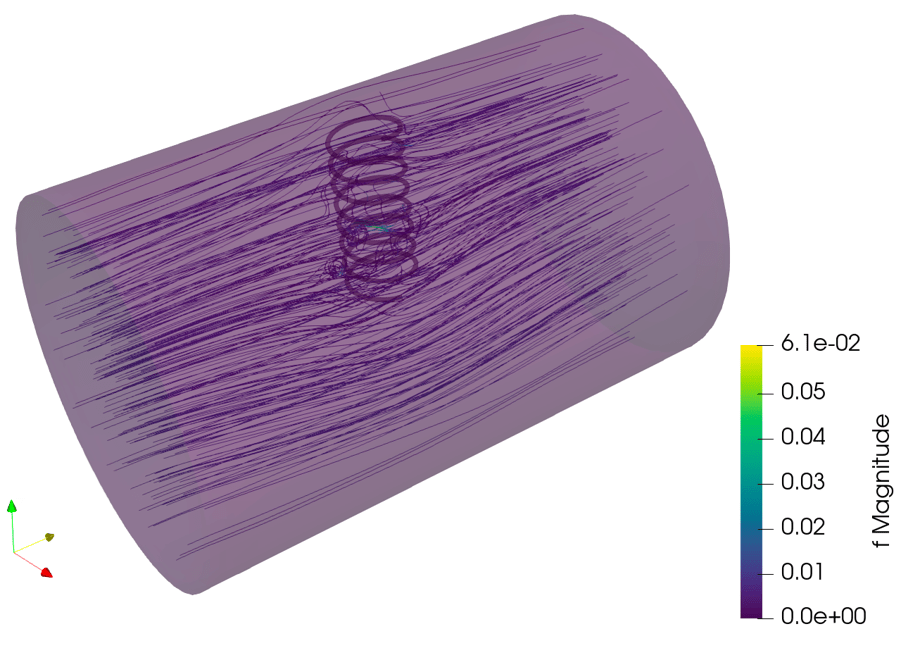
Velocity (m/s)
T concentration (T/m3)
Student: Kaelyn Dunnell
Component
Material
System
System analysis
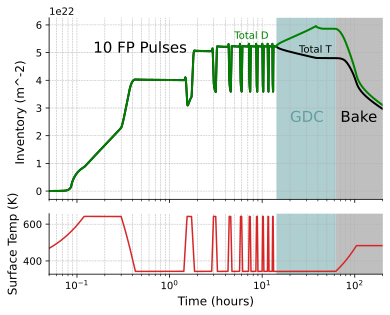
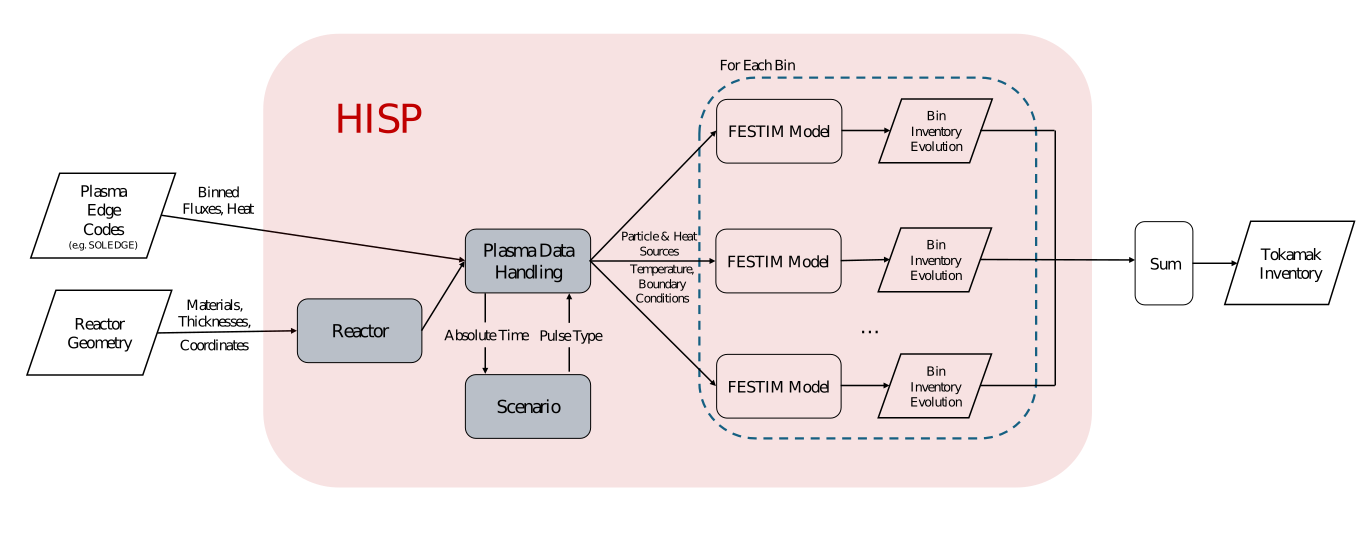
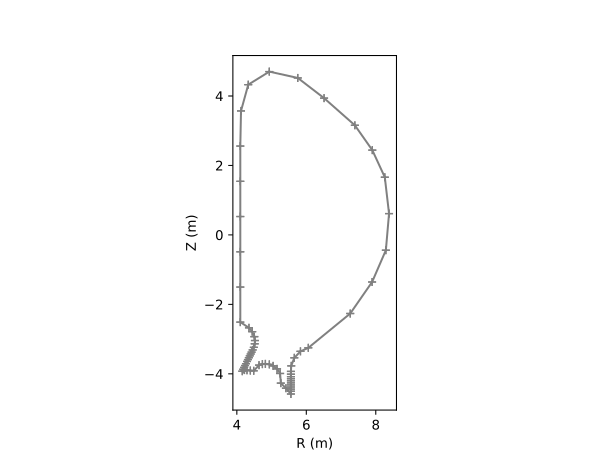
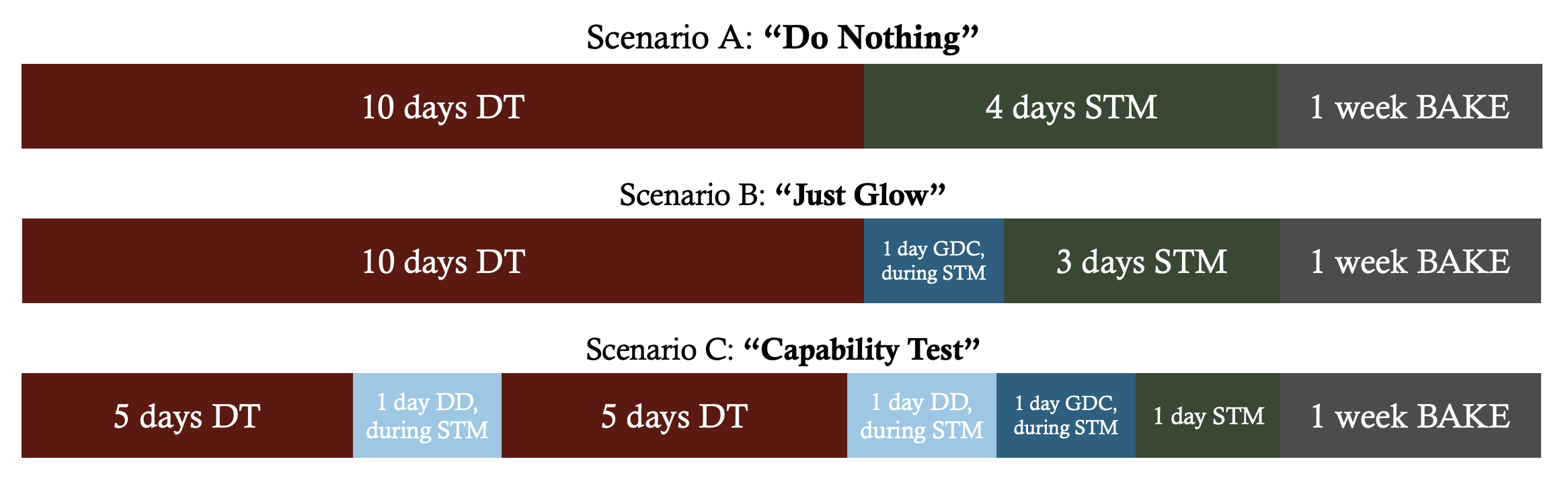
HISP couples plasma codes to FESTIM


Text
Goal: find the best strategy for minimising ITER's tritium inventory
PathSim: an open-source system modelling tool
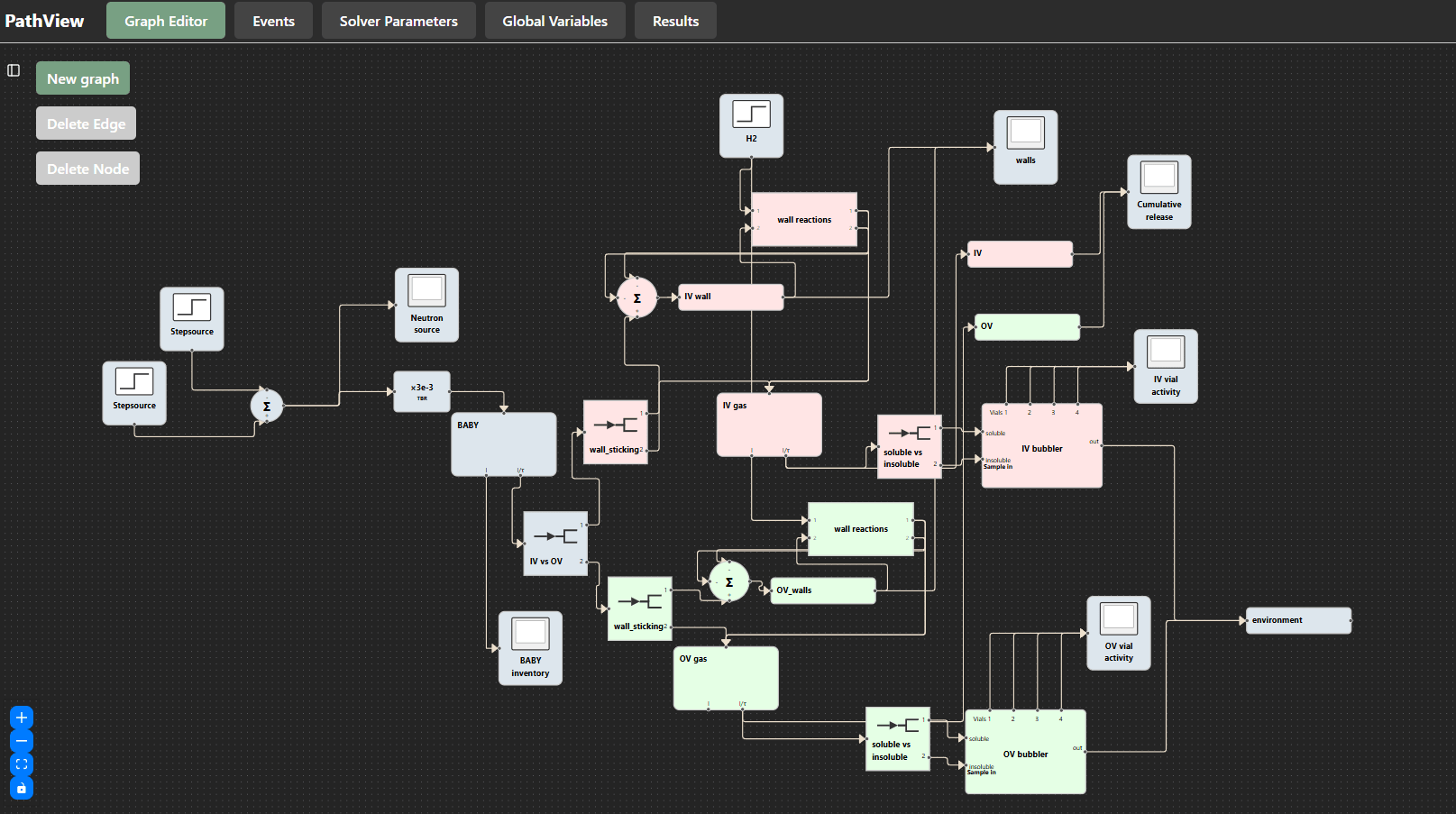
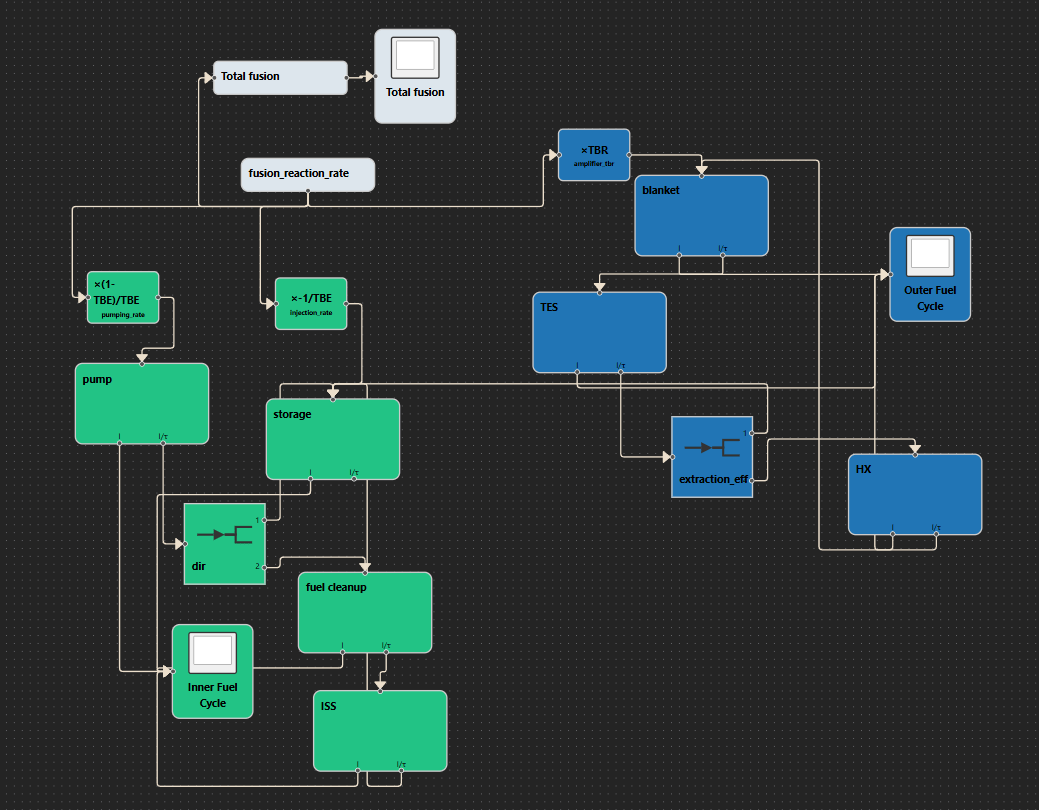
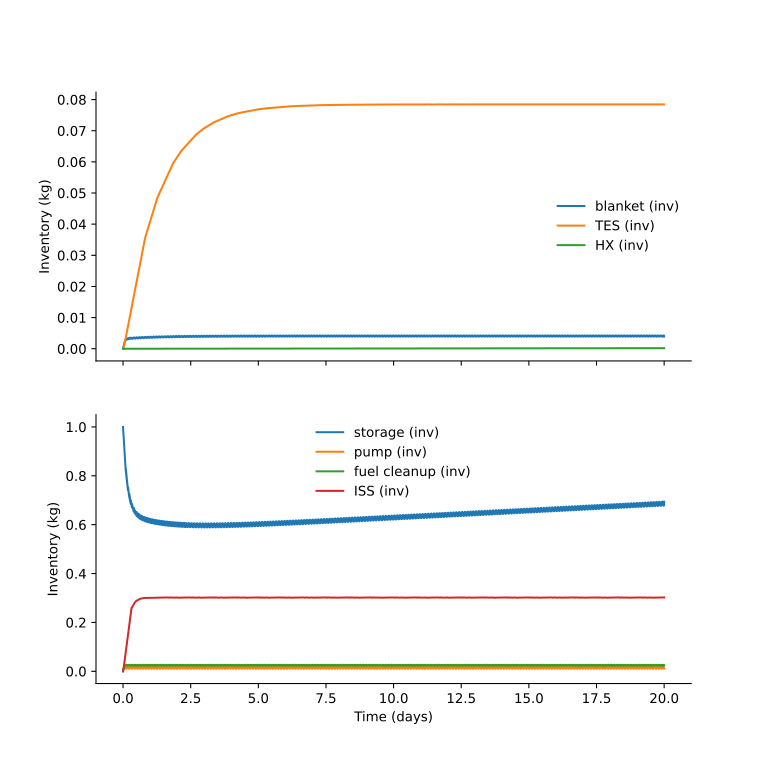
- PathView: open-source web-app for dynamic system modelling
- Already used for power plant modelling and LIBRA
- Seemless integration with FESTIM
See Milan Rother's talk: PathSim: An Open-Source Python Framework for Digital Twin Applications in Fusion Fuel-Cycle Modeling
ARC fuel cycle
MIT BABY experiment
Tracking the tritium inventory in each fuel cycle component
New tritium release model
Salt volume
IV metal surface
OV metal surface
IV bubbler
OV bubbler
S = \Gamma_n \cdot \mathrm{TBR}
(1-f_\mathrm{sticking, OV}) A_\mathrm{OV} \ k_\mathrm{OV} \ c_\mathrm{salt}
(1-f_\mathrm{sticking, IV}) \ A_\mathrm{IV} \ k_\mathrm{IV} \ c_\mathrm{salt}
f_\mathrm{sticking, IV} \ A_\mathrm{IV} \ k_\mathrm{IV} \ c_\mathrm{salt}
k_\mathrm{exchange} \ I_\mathrm{piping, IV} \ c_\mathrm{H2}
k_\mathrm{T2} \ I_\mathrm{piping, IV}^2
IV gas
OV gas
\frac{I_\mathrm{gas, IV}}{\tau_\mathrm{IV \ gas}}
\frac{I_\mathrm{gas, OV}}{\tau_\mathrm{OV \ gas}}
k_\mathrm{exchange} \ I_\mathrm{piping, OV} \ c_\mathrm{H2}
k_\mathrm{T2} \ I_\mathrm{piping, OV}^2
f_\mathrm{sticking, OV} \ A_\mathrm{OV} \ k_\mathrm{OV} \ c_\mathrm{salt}
TBR is here...
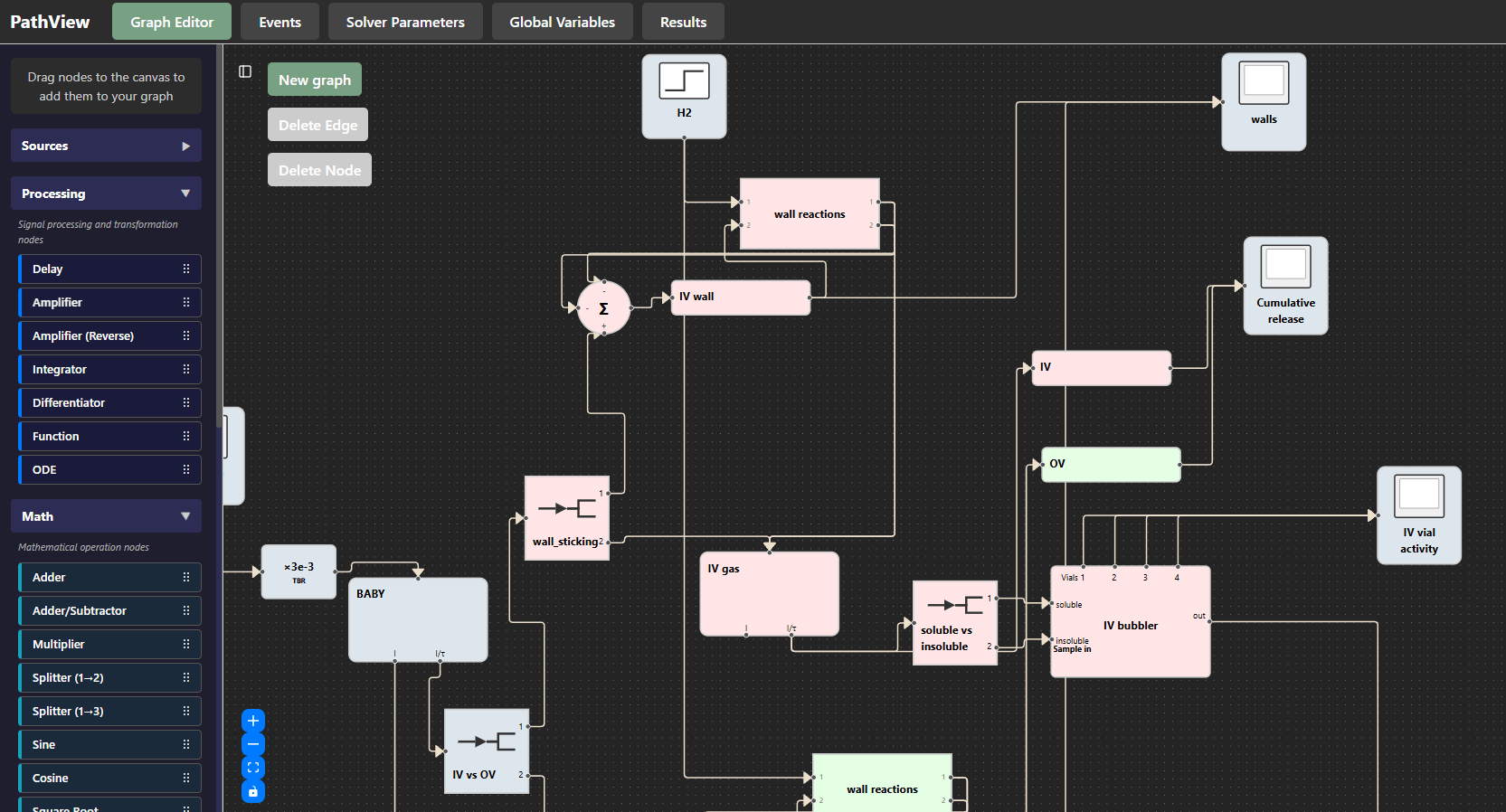
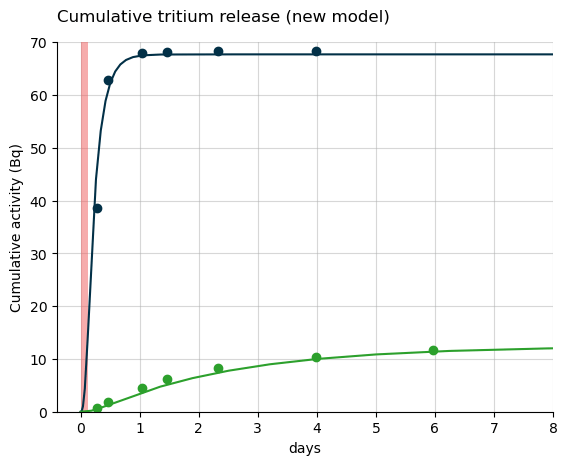
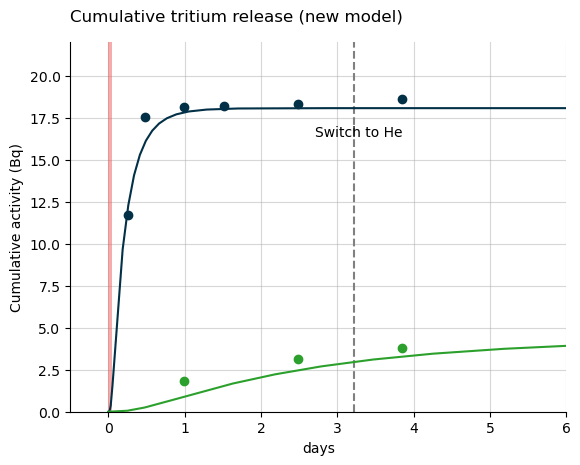
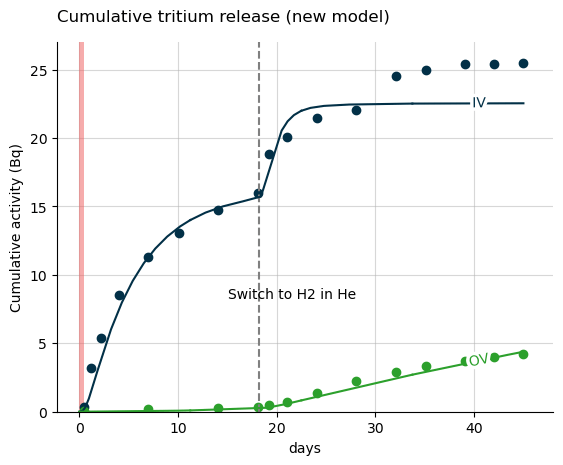
The new release model can capture the complex dynamics
Run 3
Run 6
Run 12
Implemented in PathView
Thank you!
Any questions?
✉️ remidm@mit.edu

PathView

FESTIM

Tutorials

See you at the Open Source Software for Fusion Energy conference?
Overview of the PSFC blanket and fuel cycle modelling activities
By Remi Delaporte-Mathurin