Bias-Variance Tradeoff

Cornell CS 3/5780 ยท Spring 2026

(down arrow to see handout slides)

1. Setting

1. Setting

  • Training data \(D = \{(\mathbf{x}_1, y_1), \ldots, (\mathbf{x}_n, y_n)\}\) drawn i.i.d. from \(P(X,Y)\)
  • Regression: \(y \in \mathbb{R}\) with squared loss
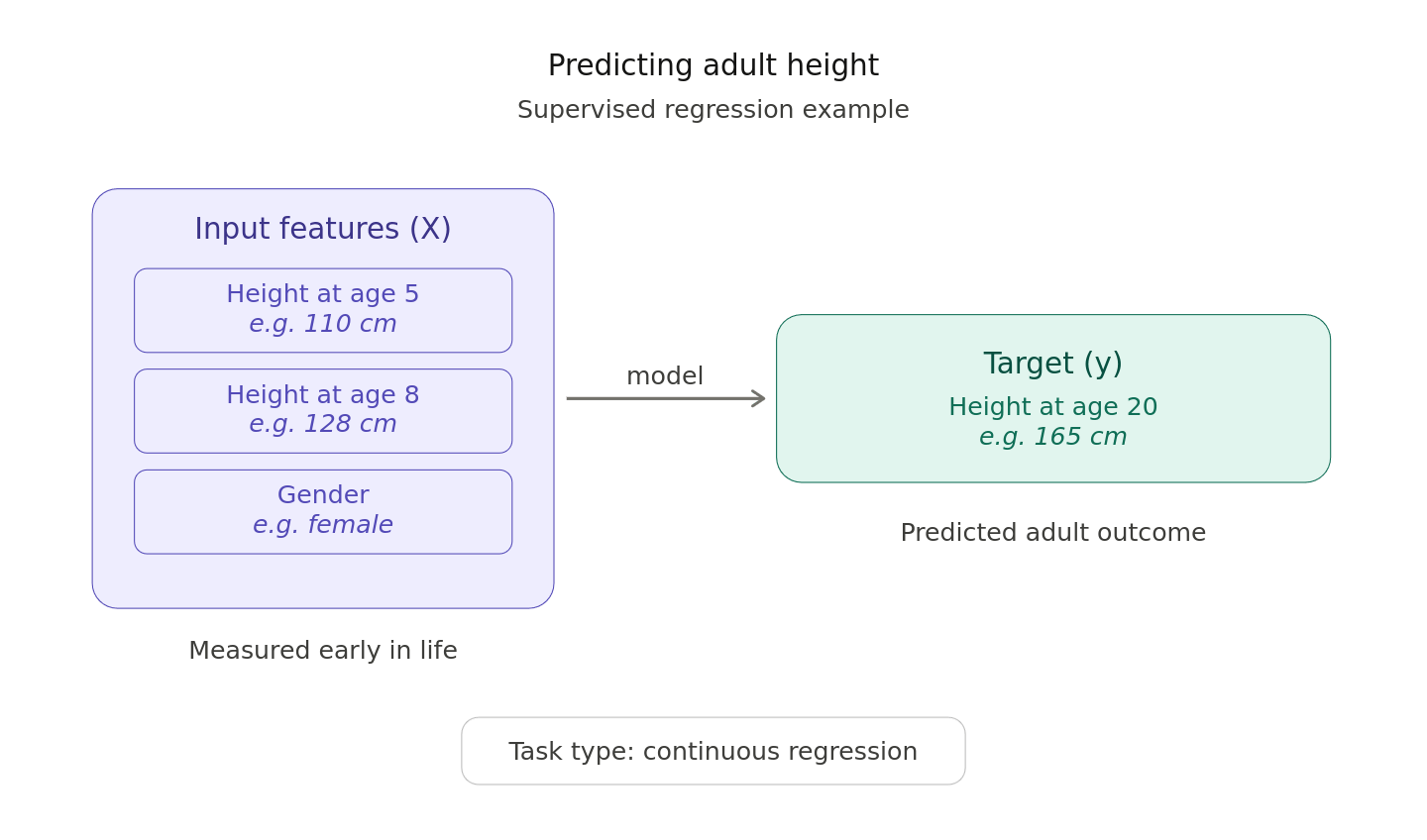
  • Today's question is about generalization: what is my expected test error? (after training on \(D\))
  • Definition: The expected label given \(\mathbf{x} \in \mathbb{R}^d\) (recall Bayes optimal prediction) $$ \bar{y}(\mathbf{x}) = E_{y|\mathbf{x}}[Y] = \int\limits_y y \, \Pr(y|\mathbf{x}) \partial y $$
  • Question: is \(\bar{y}(\mathbf{x})\) a perfect prediction? When is it better/worse?

1. Setting

2/3. Expected Test Errors

4/5. Decomposition derivation

6. Bias-Variance Decomposition

7. Bias-Variance Tradeoffs

2. Expected Test Error (given \(h\))

  • Apply machine learning algorithm \(\mathcal{A}\) to learn a hypothesis \(h\)
  • Notation: \(h_D = \mathcal{A}(D)\)
  • For a specific hypothesis \(h_D\) learned on dataset \(D\): $$ E_{(\mathbf{x},y) \sim P} \left[ (h_D(\mathbf{x}) - y)^2 \right] = \int\limits_x  \int\limits_y (h_D(\mathbf{x}) - y)^2 \Pr(\mathbf{x},y) \partial y \partial \mathbf{x} $$
  • This measures: How well does this particular hypothesis generalize?
  • Key observation: \(h_D\) is a random variable!
  • Different training sets \(D\) lead to different hypotheses
  • The hypothesis depends on which data points were sampled

3. Expected Test Error (Given \(\mathcal{A}\))

  • Taking expectation over both test data and training data: $$ E_{\substack{(\mathbf{x},y) \sim P\\ D \sim P^n}} \left[(h_D(\mathbf{x}) - y)^2\right] = \int_D \int_{\mathbf{x}} \int_y (h_D(\mathbf{x}) - y)^2 P(\mathbf{x},y) P(D) \partial \mathbf{x} \partial y \partial D $$
  • Evaluates the quality of algorithm \(\mathcal{A}\) given the distribution \(P(X,Y)\)
  • Note: \(D\) = training points and \((\mathbf{x}, y)\) = test point
  • It is also useful to compute the average hypothesis over all possible training sets: $$ \bar{h}(\mathbf{x}) = E_{D \sim P^n}[h_D(\mathbf{x})] = \int\limits_D h_D(\mathbf{x}) \Pr(D)  \partial D $$
  • "Average predictor" across all possible training datasets (weighted average with weight = probability)

1. Setting

2/3. Expected Test Errors

4/5. Decomposition derivation

6. Bias-Variance Decomposition

7. Bias-Variance Tradeoffs

4. Decomposition part 1

$$\textbf{Goal:     }E_{\mathbf{x}, y, D} \left[ \left( h_{D}(\mathbf{x}) - y \right)^{2} \right] = \underbrace{E_{\mathbf{x}, D} \left[ \left(h_{D}(\mathbf{x}) - \bar{h}(\mathbf{x}) \right)^{2} \right]}_{\text{Variance}} + E_{\mathbf{x}, y}\left[ \left( \bar{h}(\mathbf{x}) - y \right)^{2} \right]$$


Fill in below steps: Add and subtract, then expand, then simplify cross term  

$$E_{\mathbf{x},y,D}\left[(h_D(\mathbf{x}) - y)^2\right] = E_{\mathbf{x},y,D}\left[\left[(h_D(\mathbf{x}) - \qquad) + ( \qquad - y)\right]^2\right] $$


$$ = E_{\mathbf{x},D}\left[(h_D(\mathbf{x}) - \qquad)^2\right] + 2 E_{\mathbf{x},y,D}\left[(h_D(\mathbf{x}) - \qquad)( \qquad - y)\right] + E_{\mathbf{x},y}\left[( \qquad - y)^2\right] $$


$$\begin{aligned} E_{\mathbf{x}, y, D} \left[\left(h_{D}(\mathbf{x}) - \qquad\right) \left(\qquad - y\right)\right] &= E_{\underline{\qquad}} \left[E_{\underline{\qquad}} \left[ h_{D}(\mathbf{x}) - \qquad\right] \left(\qquad - y\right) \right] \\ &= E_{\underline{\qquad}} \left[ \left( E_{\underline{\qquad}} \left[ h_{D}(\mathbf{x}) \right] - \qquad \right) \left(\qquad - y \right)\right] \\ &= E_{\underline{\qquad}} \left[ \left(\qquad - \qquad\right) \left(\qquad - y \right)\right]\ \\ &= 0 \end{aligned}$$

5. Decomposition part 2

$$\textbf{Goal:     } E_{\mathbf{x}, y} \left[ \left(\bar{h}(\mathbf{x}) - y \right)^{2}\right] =  \underbrace{E_{\mathbf{x}, y} \left[\left(\bar{y}(\mathbf{x}) - y\right)^{2}\right]}_{\text{Noise}} + \underbrace{E_{\mathbf{x}} \left[\left(\bar{h}(\mathbf{x}) - \bar{y}(\mathbf{x})\right)^{2}\right]}_{\text{Bias}^2} $$


Fill in below steps: Add and subtract, then expand, then simplify cross term  

$$\begin{aligned} &E_{\mathbf{x}, y} \left[ \left(\bar{h}(\mathbf{x}) - y \right)^{2}\right] = E_{\mathbf{x}, y} \left[ \left(\bar{h}(\mathbf{x}) - \qquad )+(\qquad - y \right)^{2}\right] \\ &=E_{\mathbf{x}, y} \left[\left(\qquad - y\right)^{2}\right] + E_{\mathbf{x}} \left[\left(\bar{h}(\mathbf{x}) - \qquad\right)^{2}\right] + 2 E_{\mathbf{x}, y} \left[ \left(\bar{h}(\mathbf{x}) - \qquad\right)\left(\qquad - y\right)\right] \end{aligned}$$


$$\begin{aligned}E_{\mathbf{x}, y} \left[ \left(\bar{h}(\mathbf{x}) - \qquad\right)\left(\qquad - y\right)\right] &=  \\ &=  \\ &= 0 \end{aligned}$$

6. Bias-Variance Decomposition

7. Bias-Variance Tradeoffs

6. Bias-Variance Decomposition

$$\underbrace{E_{\mathbf{x}, y, D} \left[\left(h_{D}(\mathbf{x}) - y\right)^{2}\right]}_{\text{Expected Test Error}} = \underbrace{E_{\mathbf{x}, D}\left[\left(h_{D}(\mathbf{x}) - \bar{h}(\mathbf{x})\right)^{2}\right]}_{\text{Variance}} + \underbrace{E_{\mathbf{x}, y}\left[\left(\bar{y}(\mathbf{x}) - y\right)^{2}\right]}_{\text{Noise}} + \underbrace{E_{\mathbf{x}}\left[\left(\bar{h}(\mathbf{x}) - \bar{y}(\mathbf{x})\right)^{2}\right]}_{\text{Bias}^2}$$

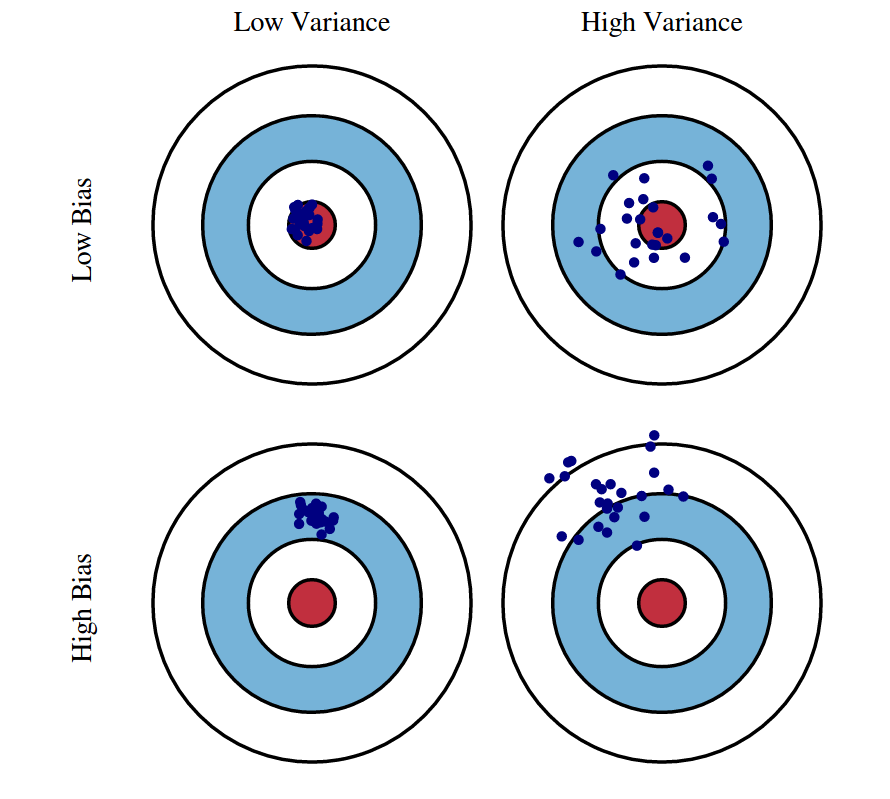
  1. Variance: How much does \(h_D\) vary across different training sets?
    • Model "overfits" to particular training examples
    • Cause: Model is too complex relative to amount of training data
  2. Bias: How far is the average hypothesis from the true expected label?
    • Model "underfits" the data, model class is not expressive enough
    • Cause: Model is too simple to capture the true pattern
  3. Noise: Inherent unpredictability in the labels
    • Performance of the Bayes optimal hypothesis
    • Cause: inherent uncertainty and/or uninformative features

7. Bias-Variance Tradeoffs

7. Bias-Variance Tradeoffs

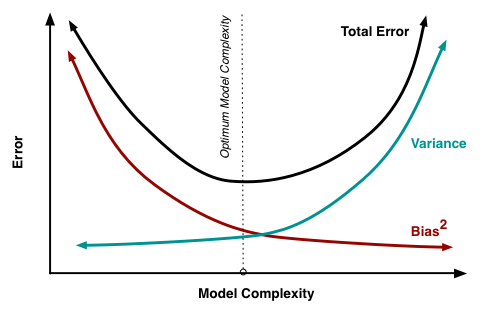
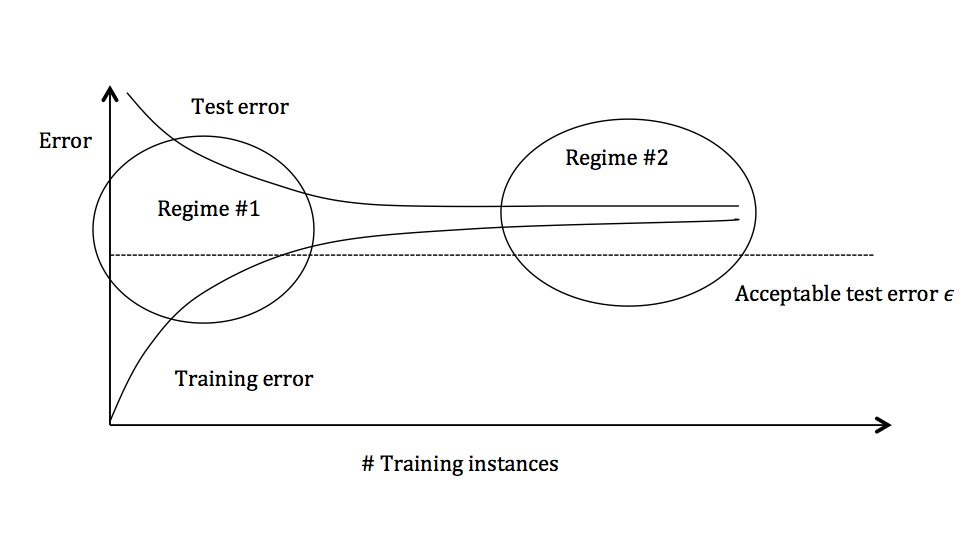
Insight: tune the model complexity to trade off Variance and Bias

Diagnosis: where does poor performance come from?

  1. High Variance (Regime 1) $$\text{train err} < \epsilon < \text{test err}$$ indicates overfitting
  2. High Bias (Regime 2) $$\epsilon < \text{train err} \approx \text{test err}$$ indicates underfitting

8. Summary

Bias-Variance Decomposition: $$ \text{Expected Test Error} = \text{Bias}^2 + \text{Variance} + \text{Noise} $$

  • Bias: Error from wrong model assumptions
  • Variance: Error from sensitivity to training data
  • Noise: Irreducible error from label randomness
  • Tradeoff: Complex models have low bias but high variance
  • Goal: Find the sweet spot that minimizes total error

Bias-Variance Tradeoff

By Sarah Dean

Private

Bias-Variance Tradeoff