Boosting with AdaBoost

Cornell CS 3/5780 · Spring 2026

(down arrow to see handout slides)

Ensemble Methods

Ensemble Methods

Boosting Setting

Boosting Algorithm Idea

Adaboost Algorithm

Boosting Theorem

Proof Steps 1-4

Ensemble Methods

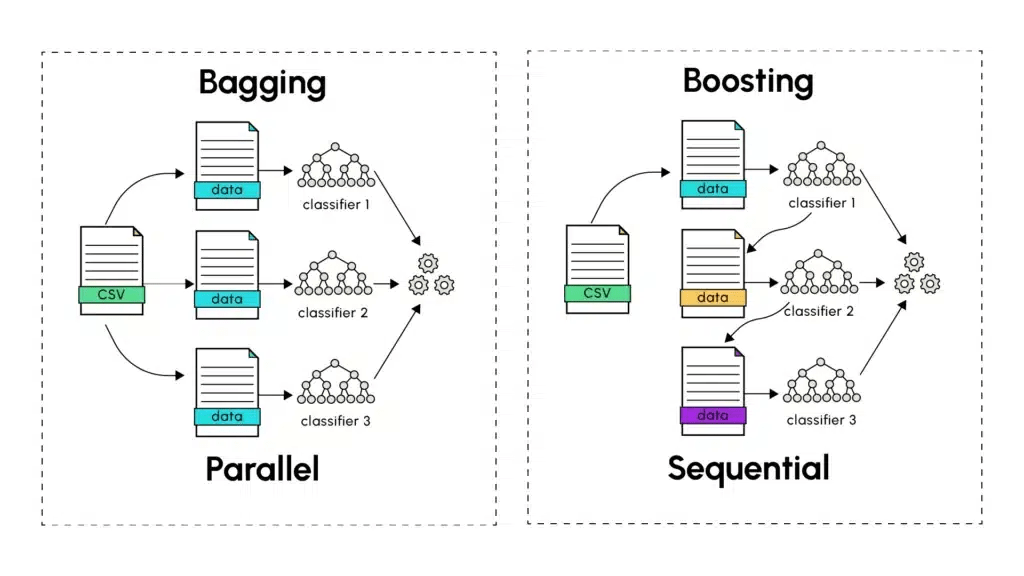
  • Train multiple models/hypotheses and combine them
  • Ensemble methods are plug-and-play (can be used with any base algorithm for learning)
  • Last lecture: bagging, which takes high variance/low bias methods and ensembles them to reduce variance (fixes overfitting) $$H_{\text{Bagged}}(\mathbf x) = \frac{1}{m} \sum_{i=1}^{m} h_i(\mathbf x)$$
    • Sample \(m\) points with replacement uniformly from training data
    • Random forest: bagged decision trees with max depth \(m\) and \(k < d\) subsampled features (often \(k=\sqrt(d)\))
  • Today: boosting, which takes high bias/low variance methods and ensembles them to obtain low bias model (fixes underfitting)

Boosting Setting & Algorithm Idea

Ensemble Methods

Boosting Setting

Boosting Algorithm Idea

Adaboost Algorithm

Boosting Theorem

Proof Steps 1-4

Boosting Setting

  • Training data \(D = \{(\mathbf{x}_1, y_1), \ldots, (\mathbf{x}_n, y_n)\}\) with \(y_i \in \{+1, -1\}\) (binary classification)
  • Weak learner: a high bias (simple) classification algorithm that does (slightly) better than chance
    • Examples: depth 1 decision tree, nearly random classifier
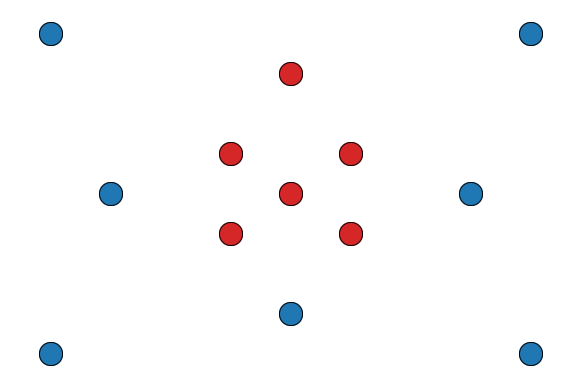
  • Question: how can you combine depth 1 DT to get zero training error for the following?

Boosting Algorithm Idea

  • How can we ensemble weak learners to get an algorithm with 0 training error?
  • Idea: sequentially weight and sample points from training data (more weight on points with errors)
  • Ensemble will have the form $$H_{\text{Boosted}}(\mathbf x) = \sum_{t=1}^{T} \alpha_t h_t(\mathbf x)$$
  1. Initialize equal weights \(w_1\)
  2. For \(t = 1\) to \(T\):
    1. Weight datapoints in \(D\) according to \(w_t\) to get \(D_t\)
    2. Use weak learning algorithm on \(D_t\) to obtain classifier \(h_t\)
    3. Add \(h_t\) to ensemble and update \(w_{t+1}\) based on errors
  3. Return ensembled classifier

Adaboost Algorithm

  1. set \(w_1[i]=\frac{1}{n}\) for all \(i\)   (initialize uniformly)
  2. set \(H_0=0\)   (initialize ensemble to 0)
  3. For \(t = 1\) to \(T\):
    1. Weight points in \(D\) according to \(w_t\) to get \(D_t\)
    2. Obtain \(h_t\) via weak learning algorithm on \(D_t\)
    3. Compute error and ensemble weight $$\epsilon_t = \sum_{i=1}^{n} w_t[i] \mathbf{1}\{h_t(\mathbf x_i) \neq y_i\}, \quad \alpha_t = \frac{1}{2} \log\left(\frac{1 - \epsilon_t}{\epsilon_t}\right)$$
    4. Update ensemble \(H_t=H_{t-1} + \alpha_t h_t\)
    5. Update weights \(w_{t+1}[i] = \frac{w_t[i] \exp(-\alpha_t y_i h_t(\mathbf x_i) )}{\sum_{j=1}^n w_t[j] \exp(-\alpha_t y_j h_t(\mathbf x_j) ) }\)

Ensemble Methods

Boosting Setting

Boosting Algorithm Idea

Adaboost Algorithm

Boosting Theorem

Proof Steps 1-4

Adaboost Algorithm

  1. set \(w_1[i]=\frac{1}{n}\) for all \(i\)   (initialize uniformly)
  2. set \(H_0=0\)   (initialize ensemble to 0)
  3. For \(t = 1\) to \(T\):
    1. Weight points in \(D\) according to \(w_t\) to get \(D_t\)
    2. Obtain \(h_t\) via weak learning algorithm on \(D_t\)
    3. Compute error and ensemble weight $$\epsilon_t = \sum_{i=1}^{n} w_t[i] \mathbf{1}\{h_t(\mathbf x_i) \neq y_i\}, \quad \alpha_t = \frac{1}{2} \log\left(\frac{1 - \epsilon_t}{\epsilon_t}\right)$$
    4. Update ensemble \(H_t=H_{t-1} + \alpha_t h_t\)
    5. Update weights \(w_{t+1}[i] = \frac{w_t[i] \exp(-\alpha_t y_i h_t(\mathbf x_i) )}{\sum_{j=1}^n w_t[j] \exp(-\alpha_t y_j h_t(\mathbf x_j) ) }\)

Boosting Theorem & Proof

  • Boosting Theorem: If the weak learner can achieve weighted classification error less than \(1/2 − \gamma\), the boosted classifier will have 0 training error after $$T = O\left(\frac{\log(n)}{\gamma^2}\right)$$

Ensemble Methods

Boosting Setting

Boosting Algorithm Idea

Adaboost Algorithm

Boosting Theorem

Proof Steps 1-4

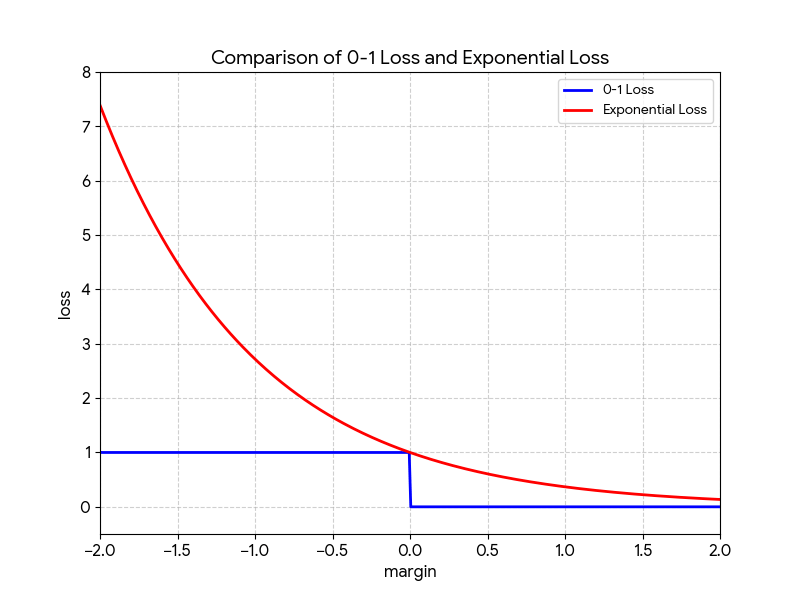
  • Training error (0-1 loss) $$\frac{1}{n} \sum_{i=1}^{n} \mathbf{1}\{H_T(\mathbf x_i) \neq y_i\}$$
  • Upper bounded by exponential loss: $$ \Phi_T = \frac{1}{n} \sum_i \exp(-y_i H_T(x_i)) $$

Boosting Theorem

  • Weak Learner Assumption: For all distributions over points in D, the weak learning algorithm can produce a hypothesis whose weighted classification error is less than \(1/2 − \gamma\).
  • Boosting Theorem: If the weak learner assumption holds with some margin \(\gamma\), the boosted classifier will have 0 training error after $$T = O\left(\frac{\log(n)}{\gamma^2}\right)$$
  • Implications of this theorem:
    • Each weak learner is high bias but low variance classifier
    • We only combine \(O(\log(n))\) of these weak learners
    • So Boosted classifier will not have too high of a variance

Proof Step 1: Bounding Error by Exponential Loss

  • We will bound the training error $$\frac{1}{n} \sum_{i=1}^{n} \mathbf{1}\{H_T(\mathbf x_i) \neq y_i\}$$
  • Define the exponential loss: $$ \Phi_T = \frac{1}{n} \sum_i \exp(-y_i H_T(x_i)) $$
  • Notice that if \(y_i H_T(\mathbf x_i) \le 0\), then \(\exp(-y_i H_T(x_i)) \ge 1\), so \(\Phi_T\) upper bounds the training error
  • We will show that the exponential loss decreases by a fixed multiplicative factor at each boosting round.

Proof Step 2: Loss Shrinks Multiplicatively

  • Recall the update rule $$ H_{t+1}(x) = H_t(x) + \alpha_{t+1} h_{t+1}(x) $$
  • Therefore, $$\begin{align*} \Phi_{t+1} = \frac{1}{n} \sum_{i=1}^n \exp(-y_i H_{t+1}(\mathbf x_i))\ &= \frac{1}{n} \sum_{i=1}^n \exp(-y_i H_t(\mathbf x_i)) \exp(-\alpha_{t+1} y_i h_{t+1}(\mathbf x_i)) \\&= \Phi_t  \sum_{i=1}^n \frac{\exp(-y_i H_t(\mathbf x_i))}{n \Phi_t} \exp(-\alpha_{t+1} y_i h_{t+1}(\mathbf x_i))  \end{align*} $$
  • Define weights: \(p_t[i] = {\exp(-y_i H_t(\mathbf x_i))}/\left({\sum_{j=1}^n \exp(-y_j H_t(\mathbf x_j))}\right)\)
    • Can show by induction that \(p_t[i]=w_t[i]\) algorithm weights
  • Define multiplier \(Z_{t+1}=\sum_{i=1}^n w_t[i]\exp(-\alpha_{t+1} y_i h_{t+1}(\mathbf x_i)) \)
  • Final recursive update is $$\Phi_{t+1} = \Phi_t Z_{t+1}$$

Proof Step 3: Using Weak Learner Assumption

  • Now we just need to show that \(Z_t=\sum_{i=1}^n w_{t-1}[i]\exp(-\alpha_{t} y_i h_{t}(\mathbf x_i))<1\)
  • Since both \(h_t(\mathbf{x}_i),y_i \in \{-1, +1\}\), the product \(y_i h_t(\mathbf{x}_i)\) is always \(\pm 1\):

    $$Z_t =\sum_{i:, h_t(\mathbf{x}i) = y_i} w_t[i] e^{-\alpha_t} + \sum_{i:, h_t(\mathbf{x}_i) \neq y_i} w_t[i] e^{\alpha_t}$$

  • Recall that $$\epsilon_t = \sum_{i=1}^{n} w_t[i] \mathbf{1}\{h_t(\mathbf x_i) \neq y_i\}, \quad \alpha_t = \frac{1}{2} \log\!\left(\frac{1 - \epsilon_t}{\epsilon_t}\right)$$

  • Therefore, $$ Z_t = (1 - \epsilon_t)e^{-\alpha_t} + \epsilon_t e^{\alpha_t} = 2\sqrt{\epsilon_t(1 - \epsilon_t)} $$
  • Under the weak learner assumption, \(\epsilon_t \le \frac{1}{2} - \gamma\) so $$ Z_t \le \sqrt{1 - 4\gamma^2} $$

Proof Step 4: Final Bound

  • Putting it all together, we show the exponential loss decreases quickly $$ \Phi_{t+1} = \Phi_t Z_{t+1} \leq \Phi_t \sqrt{1 - 4\gamma^2} \implies \Phi_T \le (\sqrt{1 - 4\gamma^2})^T\Phi_0 $$
  • Simplify using \(1 - x \le e^{-x}\) and \(\Phi_0= 1\): $$ \text{Training error} \;\le\; \Phi_T \;\le\; e^{-2\gamma^2 T} $$
  • Lastly, notice that by 0-1 loss, if the training error is less than \(\frac{1}{n}\), it must be exactly zero. $$ e^{-2\gamma^2 T} < \frac{1}{n} \iff T > \frac{\log(n)}{2\gamma^2}$$

Boosting Summary

  • Boosting sequentially trains high bias ("weak") learners and combines them into an ensemble
  • We sequentially define data weights based on ensemble errors
  • We add each new weak learner to the ensemble with weight depending on weighted training error
  • As long as weak learners can do better than random, only need logarithmically many ensemble members for zero training error

Ensemble Methods

Boosting Setting

Boosting Algorithm Idea

Adaboost Algorithm

Boosting Theorem

Proof Steps 1-4

Boosting with AdaBoost

By Sarah Dean

Private

Boosting with AdaBoost