
Estimating Probabilities from Data

Cornell CS 3/5780 · Spring 2026

(down arrow to see handout slides)

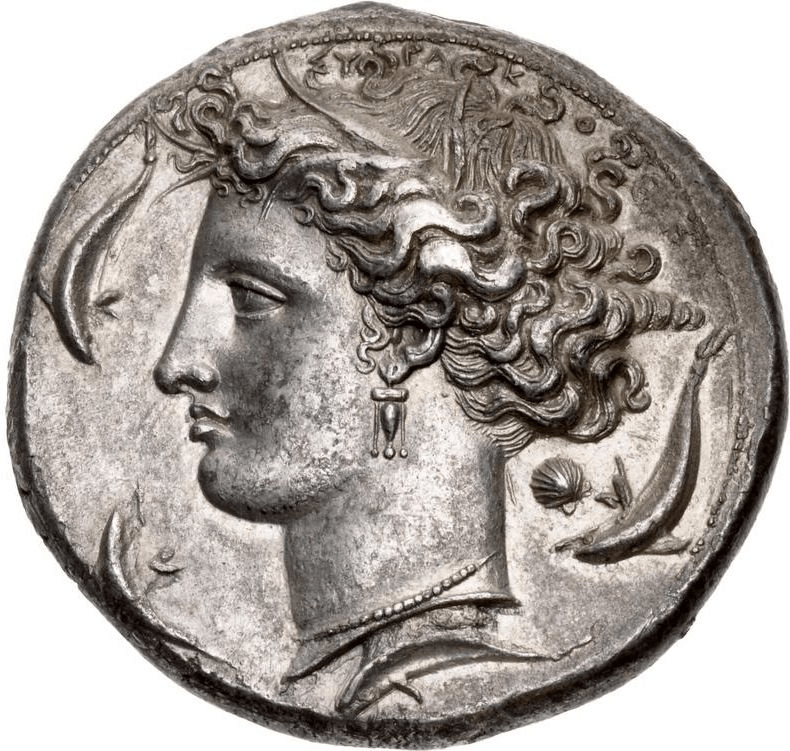
1. Coin Toss

1. Motivation: Bayes Optimal Classifier

  • Recall: Bayes Optimal classifier predicts \(\arg\max_y P(y|\mathbf{x})\)
  • Goal: Can we estimate \(P(X,Y)\) directly from training data?
  • Two approaches:
    • Generative learning: Estimate \(P(X,Y) = P(X|Y)P(Y)\)
    • Discriminative learning: Estimate \(P(Y|X)\) directly
  • How can we estimate probability distributions from samples?
  • Example: Tossing a possibly biased coin.

2/3. Maximum Likelihood Estimation (MLE)

  • Two-step procedure:
    1. Make assumption about distribution of data \(P(D; \theta)\)
    2. Set parameters \(\theta\) to maximize likelihood of observed data
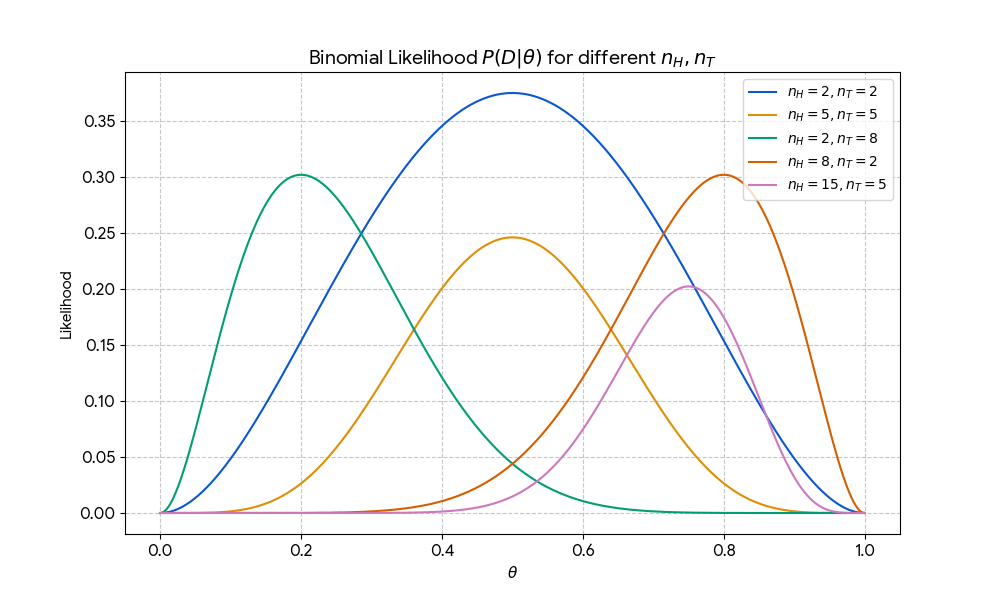
  • Example: binomial distribution models \(n\) independent Bernoulli trials with probability \(\theta\)

$$  P(D ; \theta) = \binom{n_H + n_T}{n_H} \theta^{n_H} (1-\theta)^{n_T} $$

2. Maximum Likelihood Estimation (MLE)

  • Two-step procedure:
    1. Make assumption about distribution of data \(P(D; \theta)\)
    2. Set parameters \(\theta\) to maximize likelihood of observed data
  • MLE Principle: Find \(\hat{\theta}\) to maximize likelihood $$ \hat{\theta}_{MLE} = \arg\max_\theta P(D; \theta) $$
  • Example: binomial distribution models \(n\) independent Bernoulli trials with probability \(\theta\) $$ P(D ; \theta) = \binom{n_H + n_T}{n_H} \theta^{n_H} (1-\theta)^{n_T} $$

3. MLE Derivation

  • General procedure: To solve for \(\hat{\theta}_{MLE}\)
    1. Plug data into distribution and take logarithm: \(\log P(D; \theta)\)
    2. Take the derivative and set it to zero
  • Question: What is the MLE derivation for the coin toss with a binomial distribution?


  • Pros: If \(n\) is large and model is correct, finds true parameters
  • Cons: Can overfit when \(n\) is small and can be wrong if model is incorrect

4. Incorporating Prior Knowledge

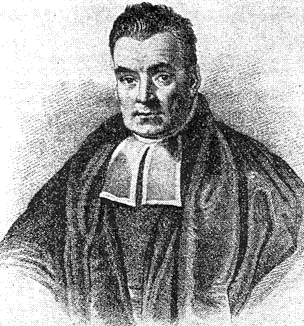
  • Bayesian Formalization: Model \(\theta\) as a random variable with prior distribution \(P(\theta)\)

4. Incorporating Prior Knowledge

  • Idea: Add imaginary data that mirrors our prior knowledge
    • Example: \(m_H\) imaginary heads and \(m_T\) imaginary tails $$ \hat{\theta} = \frac{n_H + m_H}{n_H + n_T + m_H + m_T}$$
  • Bayesian Formalization: Model \(\theta\) as a random variable with prior distribution \(P(\theta)\)
  • Bayes Rule: $$ P(\theta \mid D) = \frac{P(D \mid \theta) P(\theta)}{P(D)} $$
  • Components:
    • \(P(\theta)\): prior distribution (before seeing data)
    • \(P(D \mid \theta)\): likelihood of data
    • \(P(\theta \mid D)\): posterior distribution (after seeing data)

5/6. Maximum a Posteriori (MAP)

  • Two-step procedure:
    1. Make assumption about distribution of data and the distribution of \(\theta\)
    2. Set parameters to maximize likelihood of observed data and parameters
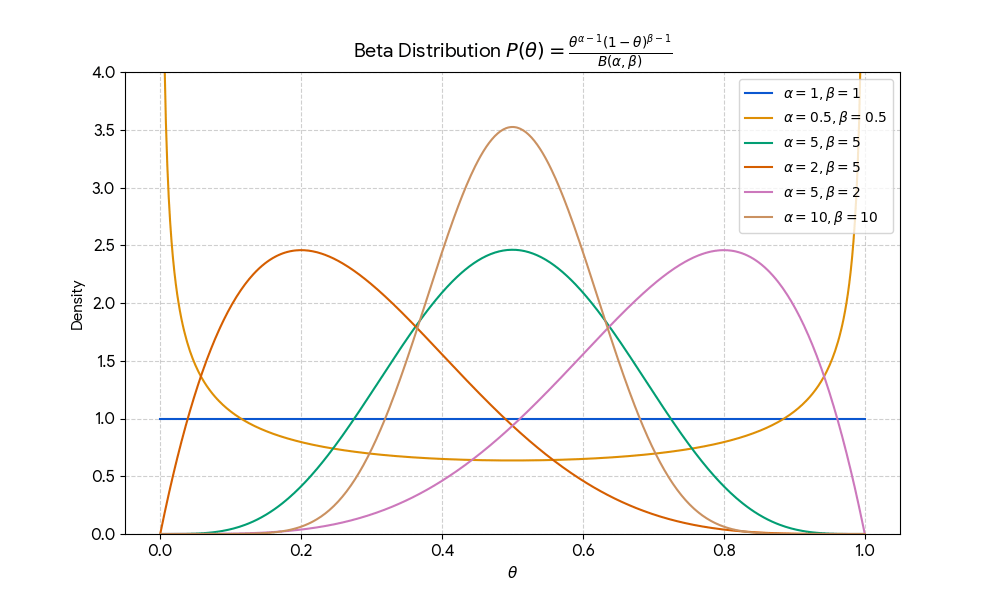
  • Example: Beta distribution as a coin prior $$ P(\theta) = \frac{\theta^{\alpha-1}(1-\theta)^{\beta-1}}{B(\alpha, \beta)}$$

5. Maximum a Posteriori (MAP)

  • Two-step procedure:
    1. Make assumption about distribution of data and the distribution of \(\theta\)
    2. Set parameters to maximize likelihood of observed data and parameters
  • MAP Principle: Choose most likely \(\theta\) given data and prior distribution $$ \begin{align*} \hat{\theta}_{MAP} &= \operatorname*{argmax}_{\theta} P(\theta \mid D)\\ \\ \\ \\& = \operatorname*{argmax}_{\theta} \log P(D | \theta) + \log P(\theta) \\ \end{align*} $$
  • Example: Beta distribution as a coin prior $$ P(\theta) = \frac{\theta^{\alpha-1}(1-\theta)^{\beta-1}}{B(\alpha, \beta)}$$
  • Question: What is the MAP derivation for the coin toss with a binomial distribution and a beta prior? How does it relate to "imaginary" data?

6. MLE and MAP Summary

Given training data \(D\), parameters \(\theta\), test point \(x_t\):

MLE:

  • Prediction: \(P(y \mid x_t; \theta)\)
  • Learning: \(\theta = \operatorname*{argmax}_{\theta} P(D; \theta)\)
  • \(\theta\) is a model parameter
  • Works if \(n\) is large enough and model is correct

MAP:

  • Prediction: \(P(y \mid x_t, \theta)\)
  • Learning: \(\theta = \operatorname*{argmax}_{\theta} P(\theta \mid D) \propto P(D \mid \theta)P(\theta)\)
  • \(\theta\) is a random variable
  • \(\log[P(\theta)]\) penalizes deviating from prior belief
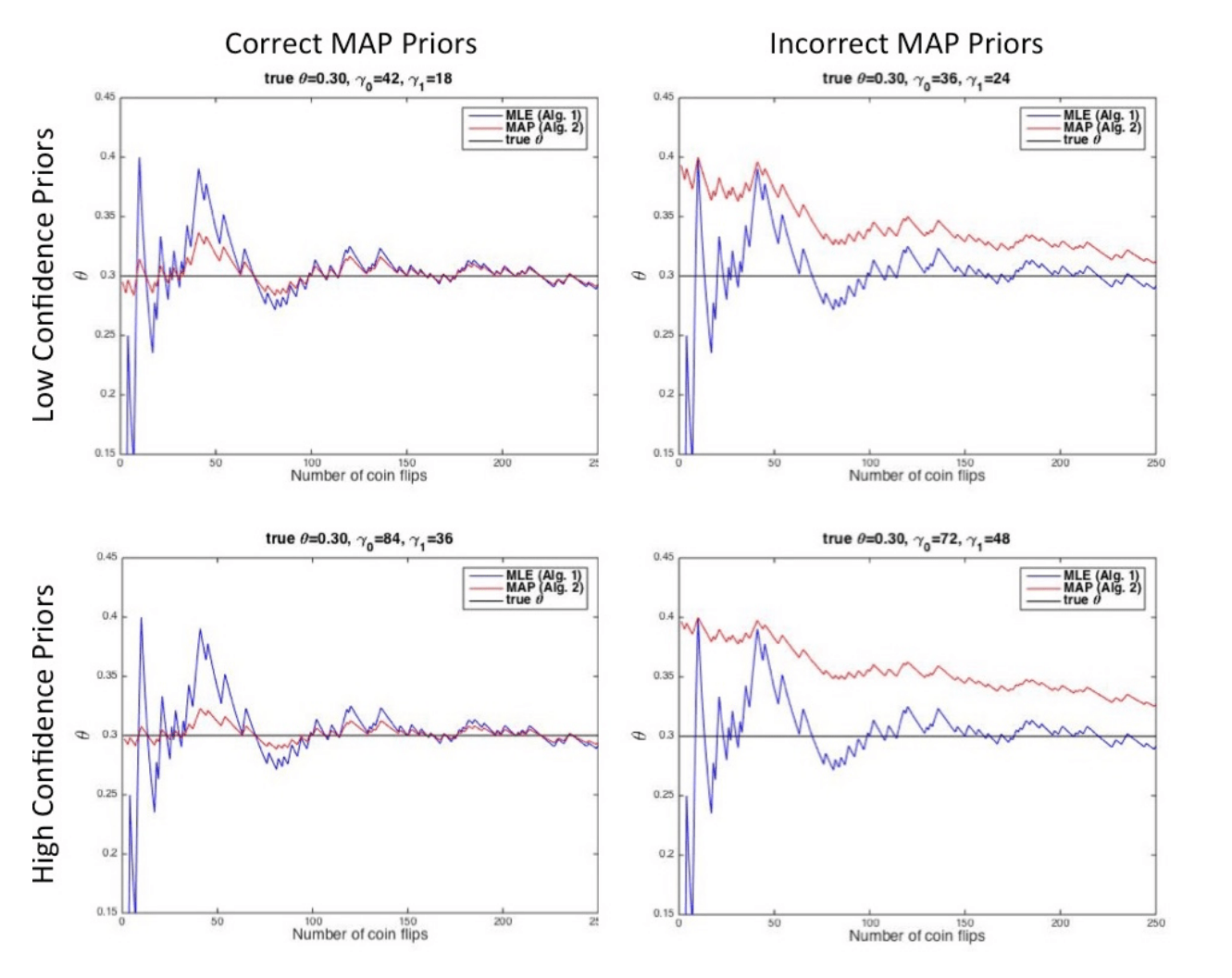
  • Can work for smaller \(n\) if the prior is correct (and the model)

Convergence: As \(n \to \infty\), \(\hat{\theta}_{MAP} \to \hat{\theta}_{MLE}\)

7. Estimating Distributions for ML

7. Estimating Distributions for ML

  • Training data: \(D = {(\mathbf{x}_1, y_1), \ldots, (\mathbf{x}_n, y_n)}\) drawn i.i.d. from \(P(X,Y)\)
  • Joint distribution:
    • \(\hat{P}(\mathbf{x},y) = \)
  • Marginal distributions:
    • \(\hat{P}(y) = \)
    • \(\hat{P}(\mathbf{x}) = \)
  • Conditional distributions:
    • \(\hat{P}(\mathbf{x}|y) = \)
    • \(\hat{P}(y|\mathbf{x}) =\)

Estimating Probabilities from Data

By Sarah Dean

Private

Estimating Probabilities from Data