k-Nearest Neighbors and the Curse of Dimensionality

Cornell CS 3/5780 · Spring 2026

(down arrow to see handout slides)

0. No Free Lunch

?

0. No Free Lunch

  • Every ML algorithm must make assumptions!
  • Choice of algorithm encodes assumptions about data set/distribution
  • There is no one perfect approach for all problems!


  • Common assumption: the relationship between \(\mathbf x\) and \(y\) is locally smooth

?

1. The k-NN Algorithm

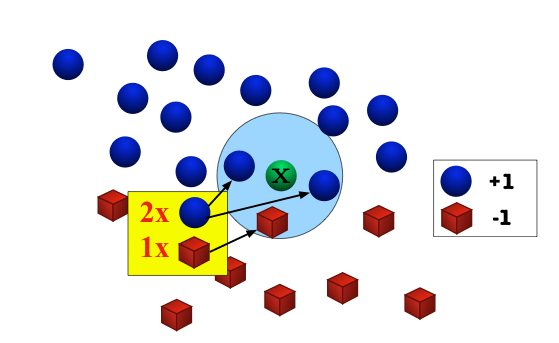
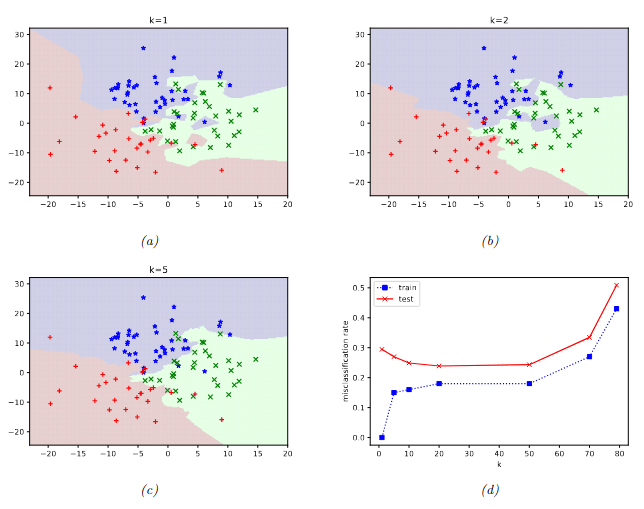
  • Question: What happens when \(k=1\)? \(k=| D| =n\)?

example: \(k=3\)

for test sample \(\mathbf x\), prediction is \(+1\)

1. The k-NN Algorithm

  • Core Assumption: Similar inputs have similar outputs.
  • Classification Rule: For a test input \(\mathbf{x}\), assign the most common label amongst its \(k\) most similar training inputs.
  • Formally: Let \(S_{\mathbf{x}} \subseteq D\) be the set of \(k\) neighbors such that $$\text{for all}~~(\mathbf{x}',y') \in D \setminus S_{\mathbf{x}},\qquad \text{dist}(\mathbf{x},\mathbf{x}') \ge \max_{(\mathbf{x}'',y'') \in S_{\mathbf{x}}} \text{dist}(\mathbf{x},\mathbf{x}'')$$ then the prediction is given by $$h(\mathbf{x}) = \text{mode}({y'' : (\mathbf{x}'',y'') \in S_{\mathbf{x}}})$$
  • Tie-Breaking Tip: In case of a draw, return the result of \(k\)-NN with a smaller \(k\).
  • Question: What happens when \(k=1\)? \(k=| D| =n\)?

2. Distance Metrics

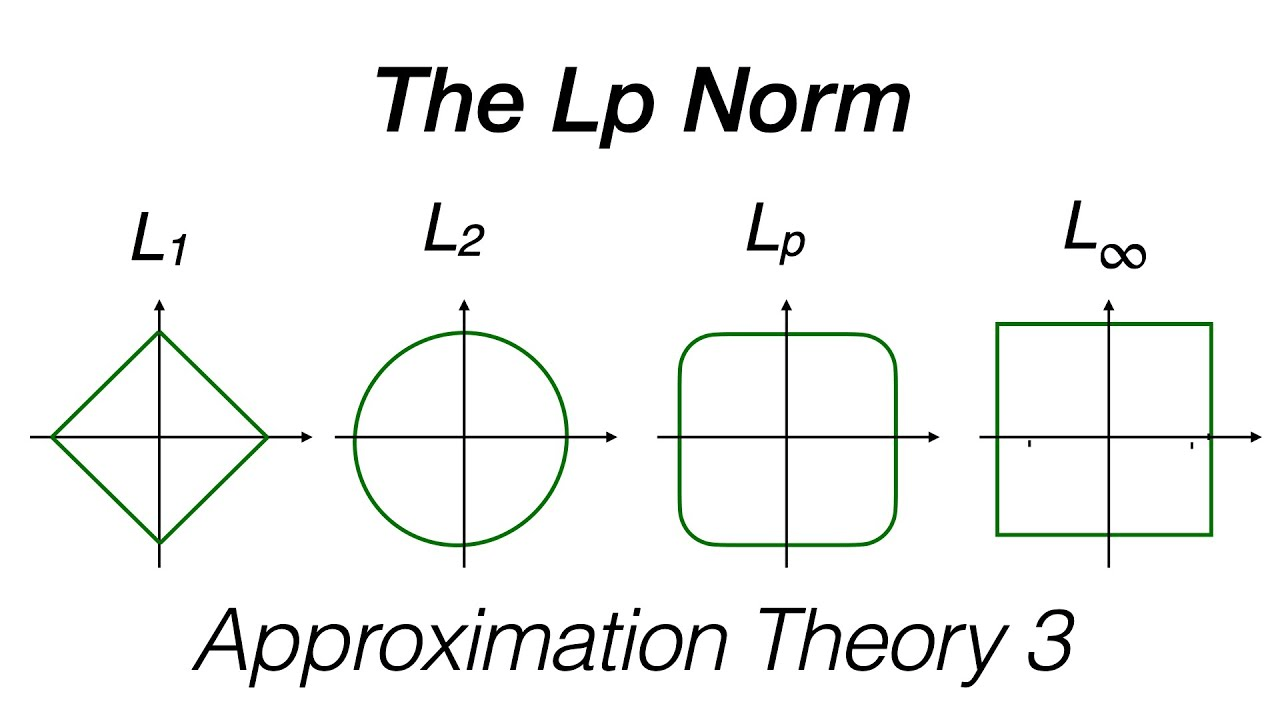
  • Question: what is the Minkowski Distance for:
    • \(p=1\)
    • \(p=2\)
    • \(p\to\infty\)

2. Distance Metrics

The classifier fundamentally relies on a distance metric; the better it reflects label similarity, the better the classifier.

Minkowski Distance

$$\text{dist}(\mathbf{x},\mathbf{x}') = \left(\sum_{r=1}^d |x_r - x'_r|^p\right)^{1/p}$$

  • Question: what is the Minkowski Distance for:
    • \(p=1\)
    • \(p=2\)
    • \(p\to\infty\)

3. Constant Classifier

  • Question: What is the best constant classifier?

3. Constant Classifier

  • Concept: Predicting the same label independent of the features.
  • Question: What is the best constant classifier?


  • Significance: Provides a baseline for debugging. Your classifier should perform much better!

4. Bayes Optimal Classifier

\(\mathbf x\)

\(y=+1\)

\(y=-1\)

\(y^*=+1\)

\(y^*=-1\)

4. Bayes Optimal Classifier

  • Concept: Predicting the most likely label if you knew the conditional distribution \(P(y|\mathbf{x})\).
  • Prediction: \(y^* = h_{\text{opt}}(\mathbf{x}) = \operatorname*{argmax}_y P(y|\mathbf{x})\).
  • Error Rate: \(\epsilon_{\text{BayesOpt}} = 1 - P(y^*|\mathbf{x})\).
  • Significance: Provides a theoretical lower bound on the achievable error rate.

5. 1-NN Convergence Proof

5. 1-NN Convergence Proof

  • Theorem (Cover and Hart, 1967): As \(n \to \infty\), the 1-NN error for binary classification is no more than twice the Bayes error.
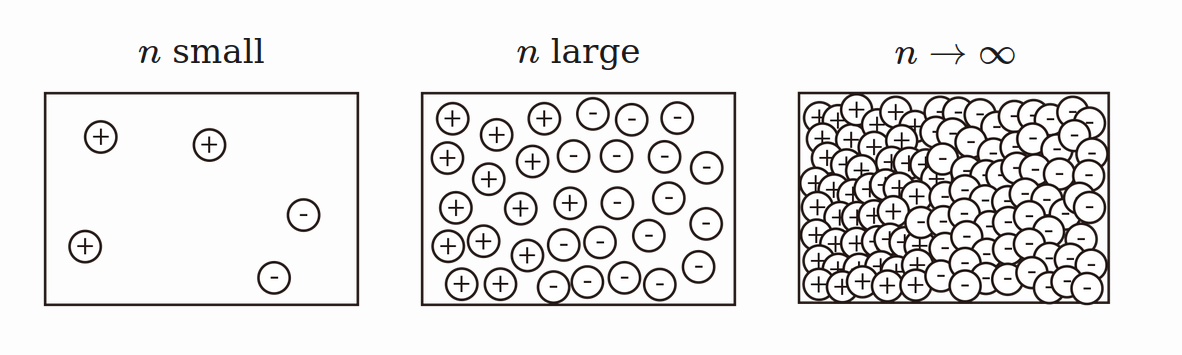
  • Key Mechanism: As \(n \to \infty\), the distance to the nearest neighbor \(\text{dist}(\mathbf{x}_{NN}, \mathbf{x}_t) \to 0\), making \(\mathbf{x}_{NN}\) identical to \(\mathbf{x}_t\).
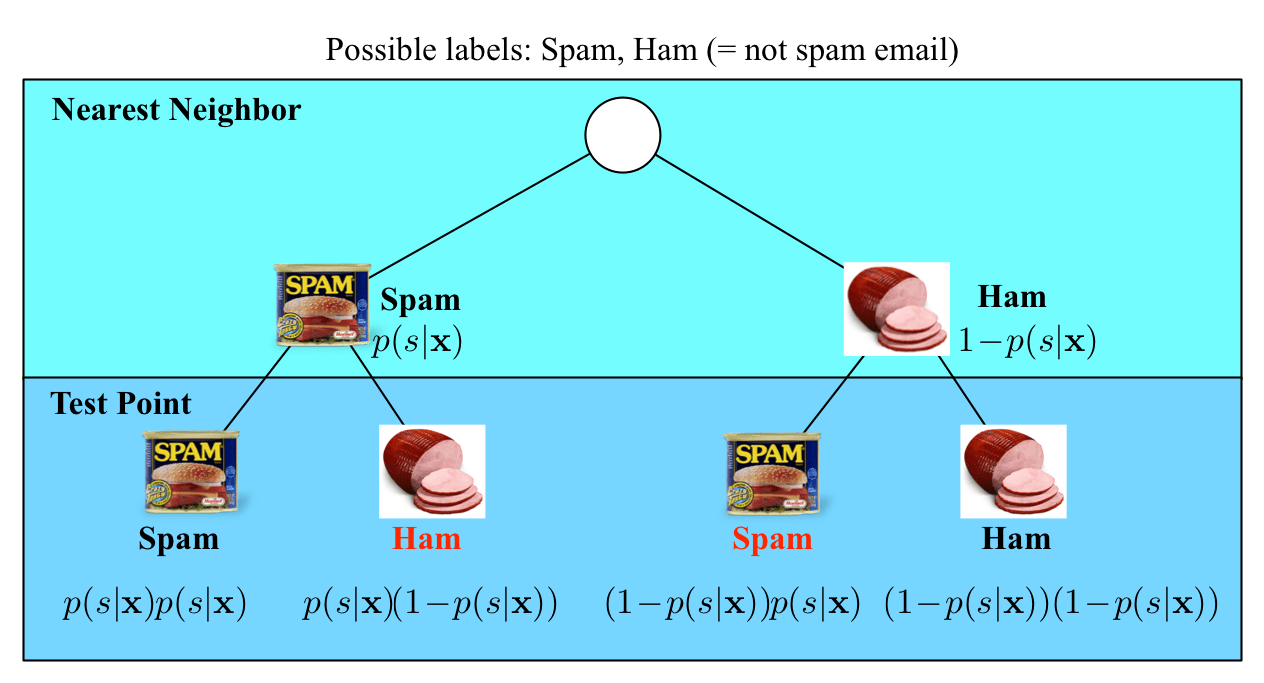
  • Proof Idea: What is the probability that the label of \(\mathbf{x}_\mathrm{NN}\) is not the label of \(\mathbf{x}_\mathrm{t}\)?  
  • Question: Explain each of the following steps
    • \(\epsilon_{NN}=\mathrm{P}(y^* | \mathbf{x}_{t})(1-\mathrm{P}(y^* | \mathbf{x}_{NN})) + \mathrm{P}(y^* | \mathbf{x}_{NN})(1-\mathrm{P}(y^* | \mathbf{x}_{t}))\)
       
    • \(\le (1-\mathrm{P}(y^* | \mathbf{x}_{NN}))+(1-\mathrm{P}(y^* | \mathbf{x}_{t})) \)
    • \(= 2(1-\mathrm{P}(y^* | \mathbf{x}_{t})) \)
    • \(= 2\epsilon_\mathrm{BayesOpt}\)

6. The Curse of Dimensionality

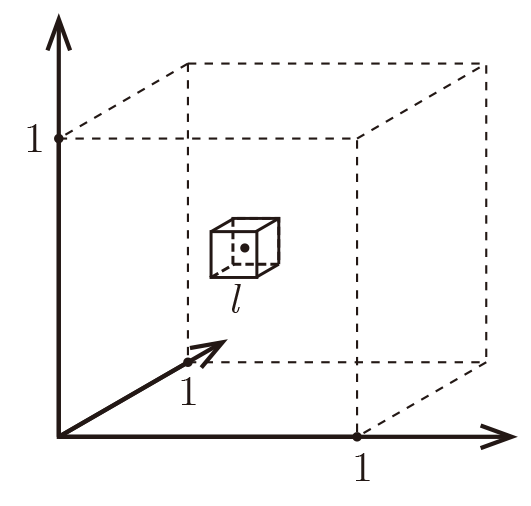
Dimension (\(d\)) Edge Length (\(\ell\))
2 0.1
10 0.63
100 0.955
1000 0.9954

For \(k=10, n=1000\)

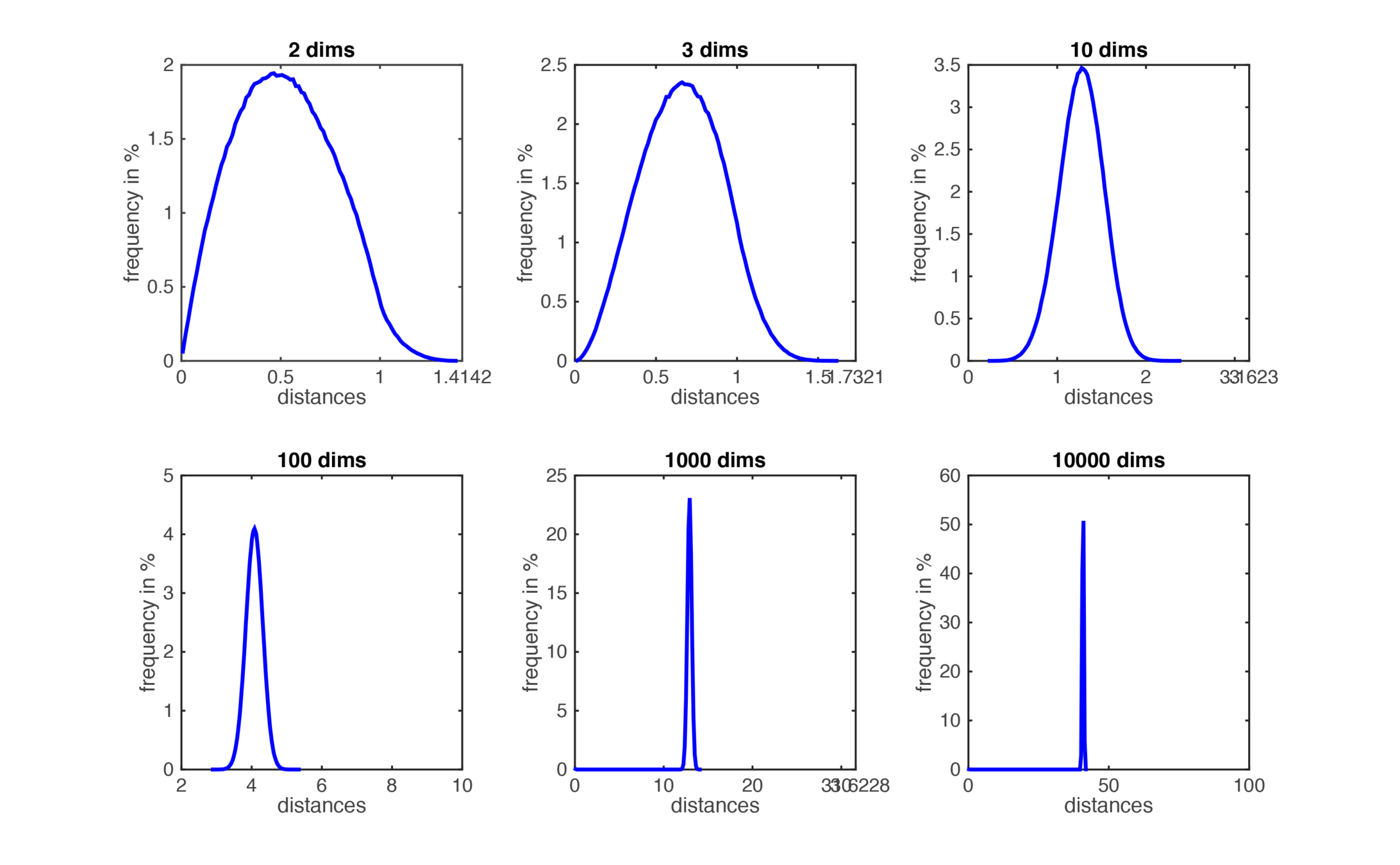
The distributions of all pairwise distances between randomly distributed points within \(d\)-dimensional unit squares.

6. The Curse of Dimensionality

  • Points drawn from a probability distribution tend to never be close together in high dimensions.
  • Volume Analysis: For uniform distribution on features, to capture \(k\) neighbors in a unit cube \([0,1]^d\), the required edge length \(\ell^d \approx k/n\)
  • Question:
    • What happens to \(\ell\) for \(k/n\) fixed and \(d\) getting big?
       
    • How big does \(n\) need to get to keep \(\ell\) constant?

7. Mitigating The Curse

7. Mitigating The Curse

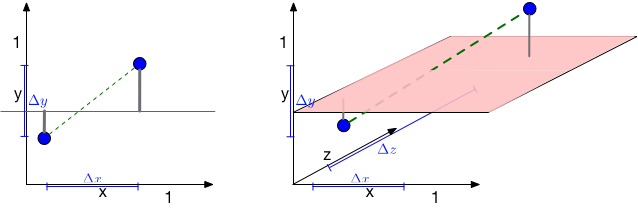
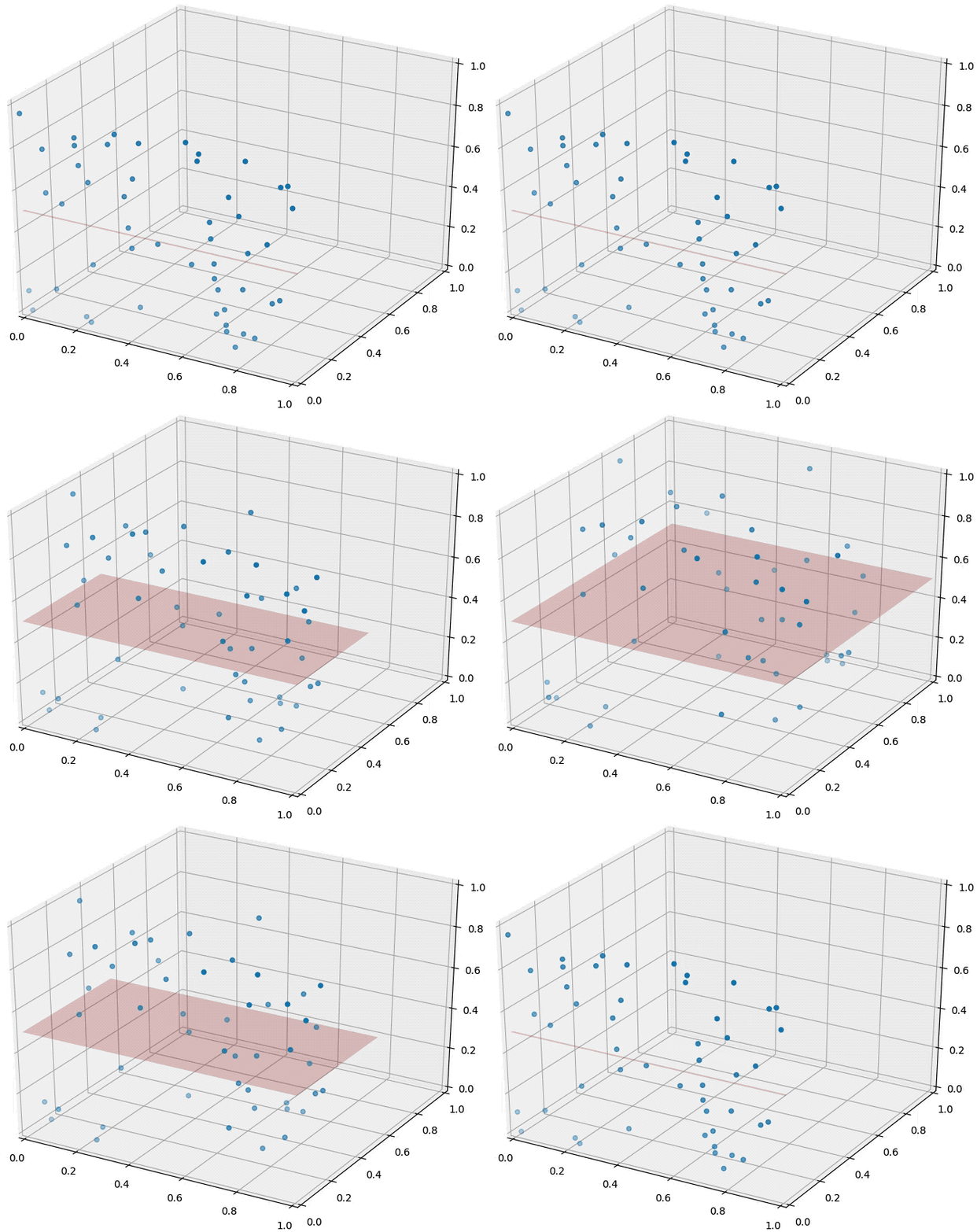
  • Linear Separation: Pairwise distances between points grow with dimensionality, but distances to hyperplanes do not.
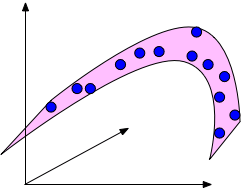
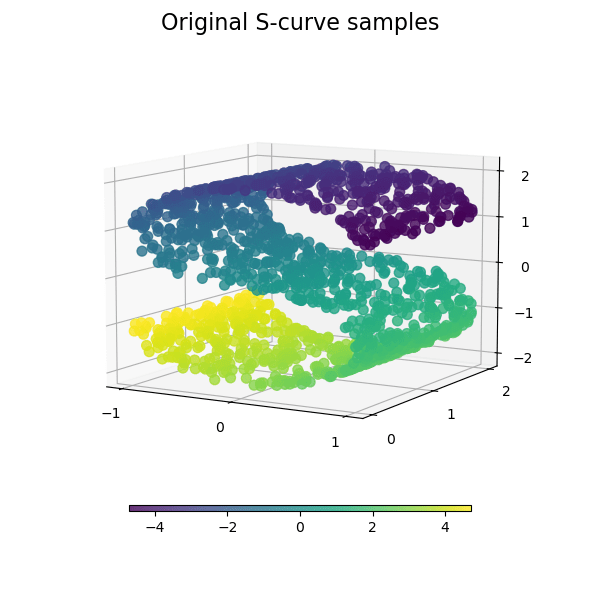
  • Low Dimensional Structure: Data often lies on low-dimensional manifolds despite a high-dimensional \(d\).
  • Question: Images of faces have low dimensional structure. Why?

8. Summary of kNN

  • Simple and effective classifier if distances reliably correspond to meaningful notion of dissimilarity.
  • Provably accurate as \(n\to\infty\), but also becomes slow.
  • For large \(d\), "neighbors" may no longer be similar to each other, so the key assumption breaks down

k-Nearest Neighbors and the Curse of Dimensionality

By Sarah Dean

Private

k-Nearest Neighbors and the Curse of Dimensionality