\text{The logistic map}
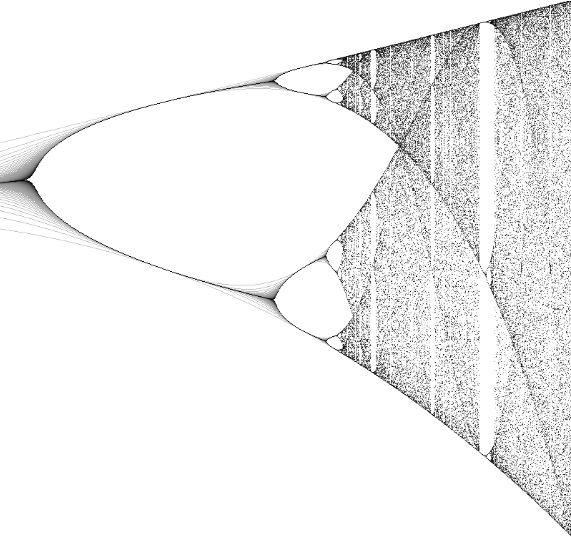
\\
\hspace{2mm}\\
\hspace{2mm}x_{n+1}=r x_n\left(1-x_n\right)\hspace{2mm}\\
\hspace{2mm}\\
\\
\text{Let us define the following recurrence relation}
x_n \text { is the normalized population at generation } n
\textbf{r }\text { is a dimensionless growth rate parameter, controlling how strongly the population grows. }
\text{This simple non-linear reccurence relation is called}
\text{logistic map}
\text{Our goal is to study how deterministic chaos emerges from this equation}
\\
\hspace{2mm}\\
\hspace{2mm}x_{n+1}=r x_n\left(1-x_n\right)\hspace{2mm}\\
\hspace{2mm}\\
\\
\text{Let us define the following recurrence relation}
\text{The term }\textcolor{red}{r x_n} \text{represents the exponential growth}: \text{The normalized population at stage } n+1
\text{This will lead to an exponential growth. }
\text{is directely proportional to the population at the previous stage }n
(1-x_n)\text{ that takes into account the rarety of ressources for continuous growth}
\text{This unrealistic behavious is corrected by the term }
\text{Fixed point}
\text{At equailibrium, we suppose that the normalized population reaches a fixed point } \textcolor{red}{x^*}
\hspace{1mm}\\
\hspace{2mm}x_{n+1}=x_n=x^*\hspace{2mm}\\
\hspace{1mm}\\
\text{so we ca write}
\text{for any reccursive function }f
x^*=f(x*)
\text{If we apply this to our logistic map, we find}
x^*=rx^*(1-x^*)\Rightarrow\begin{cases}
x^*=0\\
x^*=1-\frac{1}{r}
\end{cases}
\text{We need to check if these fixed points are stable or no}
\text{Let us compute the term } x_1
\text{Stability}
x_1=f(x_0)=f(x^*+\delta x_0)\approx \underbrace{f(x^*)}_{\textcolor{red}{x^*}}+f'(x^*)\delta x_0
\text{where we supposed that $x_0$ is $\delta x_0$ far from the fixed point. Using this result, we find}
x_1-x^*=\delta x_1=f'(x^*)\delta x_0
\text{we can continue the process with $x_3$, then $x_4$, $\cdots$ $x_n$ to find}
\text{similarly, we can prove that:}
x_2-x^*=\delta x_2\approx f'(x^*)\delta x_1=\left[f'(x^*)\right]^2 \delta x_0
\hspace{2mm}\delta x_n\approx \left[f'(x^*)\right]^n \delta x_0 \hspace{2mm}
\text{This tells us that the population at stage $n$ can be closer or further from the equilibrium one }
\text{(compared to the initia population) depending on the factor }
\left[f'(x^*)\right]^n
\hspace{2mm}\delta x_n\approx \left[f'(x^*)\right]^n \delta x_0 \hspace{2mm}
\text{The condition to converge to equilibrium is }
\hspace{2mm}\\
\hspace{20mm}
\hspace{2mm}\\
\text{Example}
f(x)=rx(1-x)
f'(x)=r(1-2x)
\text{for $x^*=0$}
\bigg| f'(0) \bigg|<1\Rightarrow r<1
\text{for $r<1$, the population dies and reaches $x^*=0$ at equilibrium.}
\text{for $x^*=1-\frac{1}{r}$}
\bigg| f'(1-r^{-1}) \bigg|<1\Rightarrow \bigg| 2-r\bigg|<1
\Rightarrow 1\lt r\lt3
\text{for these values of $r$, the population converges to the second fixed point.}
\text{for $r>3$, the equation becomes \textcolor{red}{unstable}}
\hspace{2mm}\bigg|f(x*)\bigg|<1 \hspace{2mm}\\
Phys571-The logistic map
By smstry