\text{Chapter 12}
\text{Chapter 12}
\text{Chapter 12}
\text{Chapter 12}
\textit{Dr. Adel Abbout}
\text{Fig. 1 shows a three boxes of masses $m_1, m_2$ and $m_3$ hanging from $a$ ceiling. The crossbars }
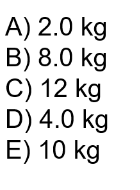
\text{are horizontal and have negligible mass and same length $\mathrm{L}$. If $\mathrm{m}_3=1.0 \mathrm{~kg}$, then $\mathrm{m}_1$ is equal to:}
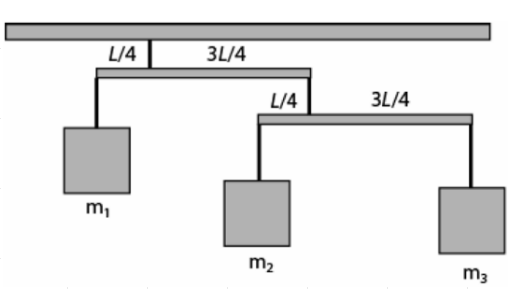
\text{Fig. 1 shows a three boxes of masses $m_1, m_2$ and $m_3$ hanging from $a$ ceiling. The crossbars }
\text{are horizontal and have negligible mass and same length $\mathrm{L}$. If $\mathrm{m}_3=1.0 \mathrm{~kg}$, then $\mathrm{m}_1$ is equal to:}
m_2g \frac{L}{4}-m_3g \frac{3L}{4}=0
\vec{\tau}_\text{net}=0
\Rightarrow
m_2=3m_3=3\hspace{1mm}kg
T=(m_2+m_3)g
m_1g \frac{L}{4}-T \frac{3L}{4}=0
m_1\vec{g}
m_1=\frac{3T}{g}=\frac{3(m_2+m3)g}{g}=3(m_1+m_2)=12\hspace{1mm} kg
\text{Answer C}
(m_2+m_3)\vec{g}
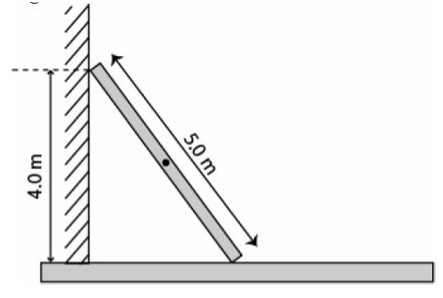
\text{A $5.0 \mathrm{~m}$ long uniform ladder (with mass $\mathrm{m}=12.0 \mathrm{~kg}$ ) leans against a wall at a point $4.0 \mathrm{~m}$ }
\text{above a horizontal floor as shown in Fig 9. Assuming the wall is frictionless (but the floor is not),}
\text{determine the normal force exerted on the ladder by the wall.}
\hspace{-2mm}\text{A) $44 \mathrm{~N}$}\\
\hspace{-2mm}\text{B) $59 \mathrm{~N}$}\\
\text{C) $120 \mathrm{~N}$}\\
\text{D) $160 \mathrm{~N}$}\\
\hspace{-2mm}\text{E) $89 \mathrm{~N}$}
\text{A $5.0 \mathrm{~m}$ long uniform ladder (with mass $\mathrm{m}=12.0 \mathrm{~kg}$ ) leans against a wall at a point $4.0 \mathrm{~m}$ }
\text{above a horizontal floor as shown in Fig 9. Assuming the wall is frictionless (but the floor is not),}
\text{determine the normal force exerted on the ladder by the wall.}
\vec{N}
\vec{F}_1
\vec{F}_2
m\vec{g}
\text{the ladder is in static equilibrium}
\vec{N}+\vec{F}_1+\vec{F}_2+m\vec{g}=0
\text{the projection onto the two axis gives us}
{F}_1=m{g}
{F}_2={N}
\text{ and }
\text{the second equation due to static equilibrium is}
\vec{\tau}_\text{net}=0
\text{let us take the reference point }O\text{ the lowest end of the ladder}
d
-4{N}+0 {F}_1+0 {F}_2+1.5 m{g}=0
\Rightarrow
{N}=\frac{1.5}{4} m{g}=\frac{1.5\times 12\times 9.8}{4}\approx44 N
\text{Answer A}
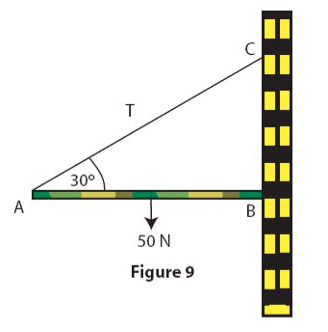
\text{Fig 9 shows a stationary $50 \mathrm{~N}$ uniform rod (AB), $1.2 \mathrm{~m}$ long, held against a wall by a rope $(A C)$ }
\text{and friction between the rod and the wall. Find the force $(T)$ exerted on the rod by the rope.}
\text{A) $87 \mathrm{~N}$}\\
\text{B) $25 \mathrm{~N}$}\\
\hspace{1mm}\text{C) $100 \mathrm{~N}$}\\
\text{D) $50 \mathrm{~N}$}\\
\text{E) $29 \mathrm{~N}$}
\text{Fig 9 shows a stationary $50 \mathrm{~N}$ uniform rod (AB), $1.2 \mathrm{~m}$ long, held against a wall by a rope $(A C)$ }
\text{and friction between the rod and the wall. Find the force $(T)$ exerted on the rod by the rope.}
\vec{f}
\vec{N}
\text{Static equilibrium}
\vec{\tau}_\text{net}=0
\Rightarrow
-T d+mg \frac{L}{2}=0
d
d=L \sin(30^0)
\text{with}
T={mg}=50 N
\text{Answer D}
O
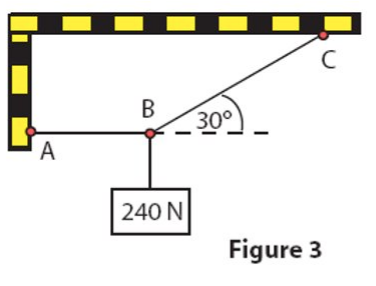
\text{A $240 \mathrm{~N}$ weight is hung from two ropes $A B$ and $B C$ as shown in Fig 3.}
\text{The tension in the horizontal rope $A B$ is:}
\hspace{-3mm}\text{A) $0 \mathrm{~N}$}\\
\text{B) $416 \mathrm{~N}$}\\
\text{C) $656 \mathrm{~N}$}\\
\text{D) $480 \mathrm{~N}$}\\
\text{E) $176 \mathrm{~N}$}
\text{A $240 \mathrm{~N}$ weight is hung from two ropes $A B$ and $B C$ as shown in Fig 3.}
\text{The tension in the horizontal rope $A B$ is:}
\text{Answer B}
m\vec{g}
\vec{T}_1
\vec{T}_2
\vec{T}_1+\vec{T}_2+m\vec{g}=0
\text{static equilibrium}
\text{we project on x-axis}
T_1\cos(\theta)-T_2=0
\text{we project on y-axis}
T_1\sin(\theta)-mg=0
\text{from the two equations, we deduce that}
\displaystyle \frac{mg}{T_2}=\tan(\theta)
\displaystyle T_2=\frac{mg}{\tan{\theta}}=\frac{240}{1/\sqrt{3}}=416 N
\text{The uniform rod in the figure is supported by two strings. The string attached to the wall is }
\text{horizontal, and the string attached to the ceiling makes an angle of $\phi$ with respect to the vertical.}
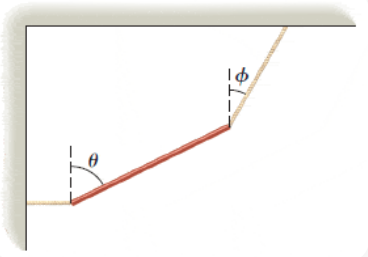
\text{The rod itself is tilted from the vertical by an angle $\theta$. If $\phi=29.9^{\circ}$, what is the value of $\theta$ ?}
\text{The uniform rod in the figure is supported by two strings. The string attached to the wall is }
\text{horizontal, and the string attached to the ceiling makes an angle of $\phi$ with respect to the vertical.}
\text{The rod itself is tilted from the vertical by an angle $\theta$. If $\phi=29.9^{\circ}$, what is the value of $\theta$ ?}
\vec{T}_1
m\vec{g}
\vec{T}_2
\text{static equilibrium}
\vec{T}_1+\vec{T}_2+m\vec{g}=0
\text{}
T_2\sin\phi-T_1=0
\text{we project on the two axis to get:}
T_2\cos\phi-mg=0
\vec{\tau}_\text{net}=0
\theta
d
O
(\text{about the point O})
-T_1 L \cos\theta+mg \frac{L}{2}\sin\theta=0
\theta
\Rightarrow
T_1=mg \tan{\phi}
\displaystyle \tan{\theta}=\frac{2T_1}{mg}=2\tan\phi=1.15
\Rightarrow
\theta=49.0^0
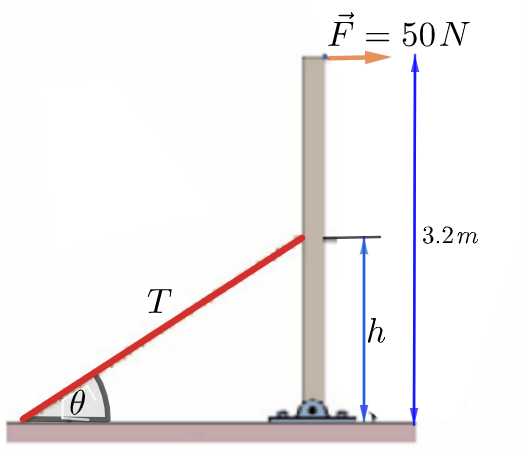
\text{Fig. 2 shows a uniform beam with a weight of $60.0 \mathrm{~N}$ and length of 3.20 $\mathrm{m}$ is hinged at its}
\text{lower end and a horizontal force $\mathrm{F}$ of magnitude $50.0 \mathrm{~N}$ acts at its upper end.}
\text{The beam is held vertical by a cable that makes an angle $\theta=30.0^{\circ}$ with the ground and is}
\text{attached to the beam at a height $h$ $=1.60 \mathrm{~m}$. The tension $(\mathrm{T})$ in the cable is:}
\hspace{1mm}\text{A) $160 \mathrm{~N}$}\\
\hspace{1mm}\text{B) $115 \mathrm{~N}$}\\
\text{C) $46 \mathrm{~N}$}\\
\text{D) $80 \mathrm{~N}$}\\
\text{E) $35 \mathrm{~N}$}
\text{Fig. 2 shows a uniform beam with a weight of $60.0 \mathrm{~N}$ and length of 3.20 $\mathrm{m}$ is hinged at its}
\text{lower end and a horizontal force $\mathrm{F}$ of magnitude $50.0 \mathrm{~N}$ acts at its upper end.}
\text{The beam is held vertical by a cable that makes an angle $\theta=30.0^{\circ}$ with the ground and is}
\text{attached to the beam at a height $h$ $=1.60 \mathrm{~m}$. The tension $(\mathrm{T})$ in the cable is:}
\text{static equilibrium}
m\vec{g}
\vec{N}
\vec{T}
\vec{T}+m\vec{g}+\vec{F}+\vec{N}=0
d
\vec{\tau}_\text{net}=0
\theta
T h\cos\theta-F L=0
\displaystyle T=\frac{FL}{h\cos \theta}=\frac{50\times3.2}{1.6\times \sqrt{3}/2}=115 N
\text{Answer B}
chapter 12
By smstry