Angular JS :)
Angular

- Fullstack Concern
- Includes templating
- Application build using Directives
- 2 Way Data Binding
- Dependency Injection
- Composed of modules
- Providers:
- Services
- Factories
- Values/Constants
- UI-Router for routing.
- Highly Declarative
Directives
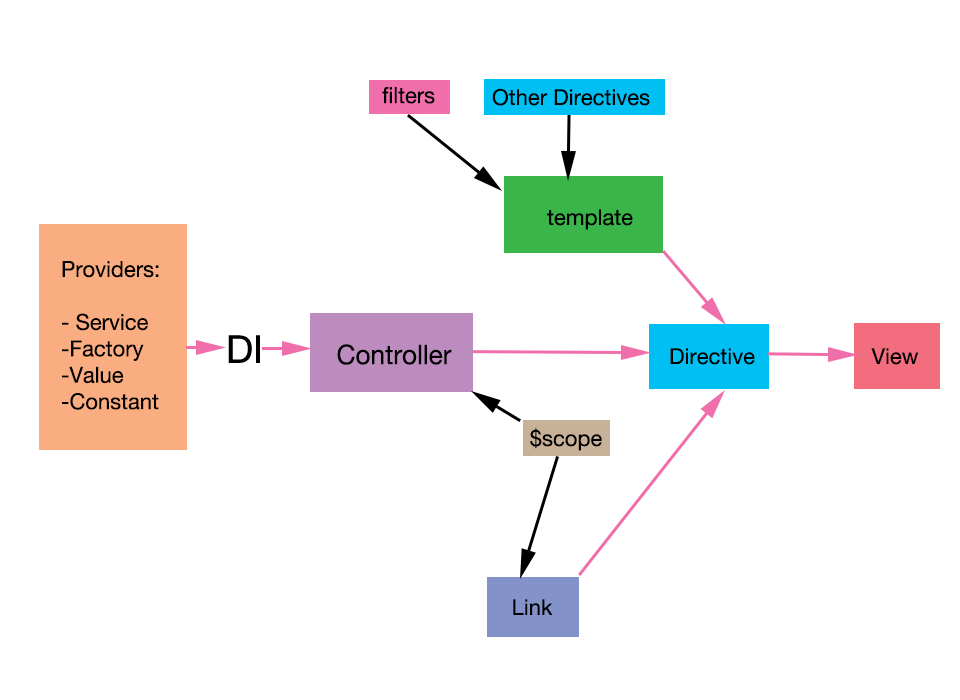
Directives are the lord of the dance. They are essentially a configuration object that takes all the other elements, and via magic and lazers turns them into declarative html.
angular
    .module('angledditApp')
    .directive('subredditMenuItem', function () {
        return {
            templateUrl: './partials/subreddit-menu-item.html',
            restrict: 'E',
            scope: {
                subreddit: '@',
                pages: '@',
                renderer: '@'
            },
            link: function link($scope, $el, $attrs){
                //dom manipulation would be here.
            },
            controller: function ($scope, $state, $stateParams) {
                function navigate(subreddit, pages, renderer) {
                    $stateParams.pages = parseInt(pages);
                    $stateParams.subreddit = subreddit;
                    $state.go('angleddit.' + renderer, $stateParams);
                }

                $scope.navigate = navigate;
            }
        };
    });
angular
.module('angledditApp')
.directive('subredditMenuItem', function () {
return {
templateUrl: './partials/subreddit-menu-item.html',
restrict: 'E',
scope: {
subreddit: '@',
pages: '@',
renderer: '@'
},
link: function link($scope, $el, $attrs){
//dom manipulation would be here.
},
            controller: function ($scope, $state, $stateParams) {
                function navigate(subreddit, pages, renderer) {
                    $stateParams.pages = parseInt(pages);
                    $stateParams.subreddit = subreddit;
                    $state.go('angleddit.' + renderer, $stateParams);
                }
                $scope.navigate = navigate;
            }
};
}); <div ng-repeat="subreddit in subreddits" class=" btn btn-default">
<subreddit-Menu-Item
subreddit="{{subreddit.display_name}}"
pages="{{pages}}"
renderer = "{{renderer}}"
></subreddit-Menu-Item>
</div> controller: function ($scope, $state, $stateParams) {
function navigate(subreddit, pages, renderer) {
$stateParams.pages = parseInt(pages);
$stateParams.subreddit = subreddit;
$state.go('angleddit.' + renderer, $stateParams);
}
$scope.navigate = navigate;
}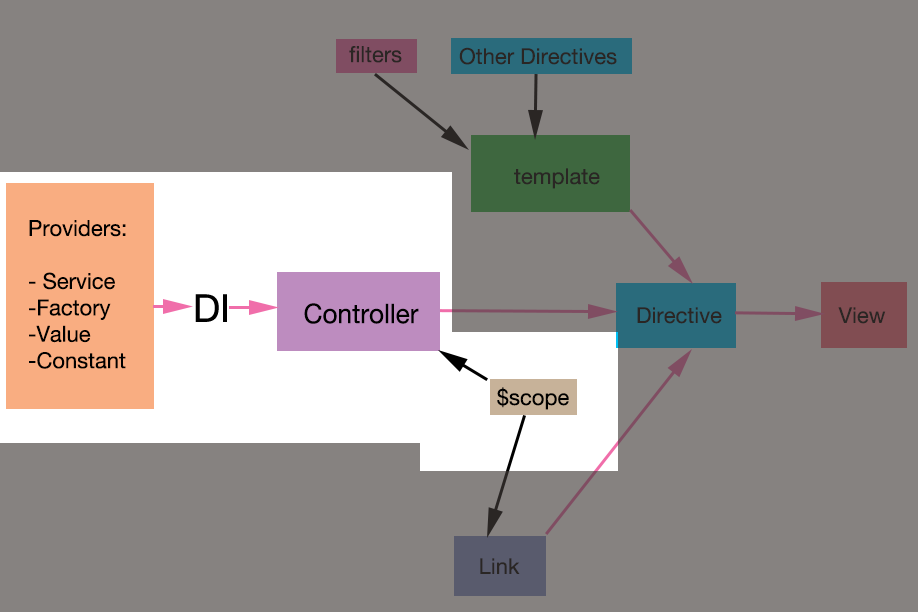
$scope
and
2 providers;
$state
and $stateParams are being injected into the controller
Providers + DI
scope: {
      subreddit: '@',
      pages: '@',
      renderer: '@'
}
<subreddit-Menu-Item
subreddit="{{subreddit.display_name}}"
pages="{{pages}}"
renderer = "{{renderer}}"
></subreddit-Menu-Item>controller: function ($scope, $state, $stateParams) {
function navigate(subreddit, pages, renderer) {
$stateParams.pages = parseInt(pages);
$stateParams.subreddit = subreddit;
$state.go('angleddit.' + renderer, $stateParams);
}
$scope.navigate = navigate;
}$scope
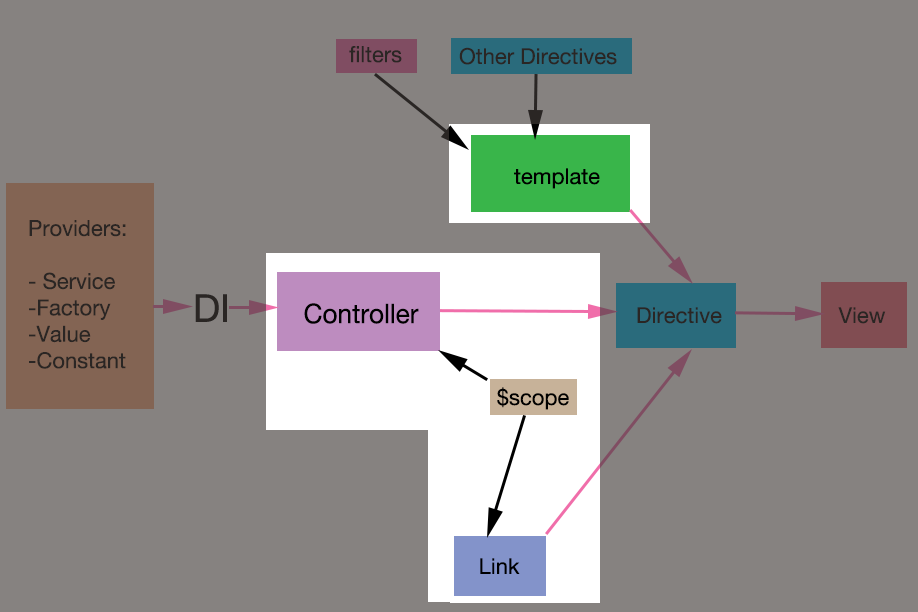
Scope, is essentailly like the public members of a revealing module. Public to the template itself, and modifiable via controller and link
@ DOM attr
= 2-way scope
& expression
The Dream
Create compositable, declarative components you just drop into a page and they work
<my-totallysick-dashboard data="data" />
Many Have Shared this Dream
- Web Components
- Web Forms/ Templated controls
- Html itself

React.js

- Concerned with UI
- (Flux is the full stack solution)
- Implements a Virtual DOM
- One Way Data Binding
- Templating (if you call it that) uses JSX, and basically a preprocessor turns it into react code.
- Component-Driven
- Organizing Principles
- State
- Lifecycle

- Whiz bang feature that basically make react do what it does.
- requires stable unique keys on darn near everything to work well.
- Implements diffing and prevents having to update unnecessary nodes
Implementation-wise what does this mean for you?
Not much, just use React and this happens automatically
The Virtual DOM
Thinking in State and Lifecycle
(isnt new)
;(function ( $, window, document, undefined ) {
    $.widget( "namespace.widgetName" , {
        options: {
            someValue: null
        },
        _create: function () {
            this.element.addStuff();
        },
        destroy: function () {
            $.Widget.prototype.destroy.call(this);
        },
        _privateMethod: function ( event ) {
            console.log("_privateMethodcalled");
        },
        method: function ( event ) {
            this._trigger("dataChanged", event, {
                key: "someValue"
            });
        },
        _setOption: function ( key, value ) {
            switch (key) {
            case "someValue":
                //this.options.someValue = doSomethingWith( value );
                break;
            default:
                //this.options[ key ] = value;
                break;
            }
            $.Widget.prototype._setOption.apply( this, arguments );
        }
    });
})( jQuery, window, document );
State
and
Lifecycle
in
jQuery UI
AnguledditComponents.Test = React.createClass({
    displayName: 'test-component',
    propTypes: {
        optionalArray: React.PropTypes.array,
        optionalBool: React.PropTypes.bool,
        value: React.PropTypes.string.isRequired
    },
    mixins: [someMixin, anotherMixin],
    //lifecyclehooks
    componentWillMount: function(){},
    componentDidMount: function(){},
    componentWillRecieveProps: function(){},
    componentWillUpdate: function(){},
    componentDidUpdate: function(){},
    componentWillUnmount: function(){},
    shouldComponentUpdate: function(){},
    //init
    getDefaultProps: function () {
        return {
            value: 'default value'
        };
    },
    getInitialState: function () {},
    __privateFunction: function(){},
    //main entry point
    render: function render() {

        return React.DOM({
            key: 'uniquekey'
        }, 'contents');
    }
});
State
and
Lifecycle
in
REACT
Real Talk
- React is very fast, and the virtual DOM is cool
- Thinking of the lifecycle of a component is comfortable for high(er) complexity material
- For application assembly, working in React can be more tedius than simply declaring html
- JSX is kind of a drag, and including html strings in your javascript is too. You'll need to set up preprocessors to get work done.
- JSX can feel disconnected to whats actually happening. basically craps out a ton of nested functions.
- Sometimes the Virtual DOM feels like a minor step above string concatination, and below templating.
- One way binding is very easy to predict, and like angular is perfectly testable.
- Some levels of an application are better candidates for this approach than others.
var HelloMessage = React.createClass({
  render: function() {
    return <div>Hello {this.props.name}</div>;
  }
});

Maybe we could use them together to leverage the mutual advantages of each?

They both have strengths.
Now lets look at some fabulous code
(for fabulous people)
git clone git@github.com:the-simian/OKCJS-December-2014-Angular-and-React.git
npm install
bower install
grunt serve
Conclusions
- Ignore the vitriol of the framework debates
- Draw from the wisdom of past frameworks, and map them to what you're using now.
- Think about your usecase
- performance
- personnel
- workflow
- comfort-zone
- Understand The "Worldview" of a Tool (and its limitations)
- Consider the level and cost of any tool or abstraction
I get to pull it all together here.
Thanks ..
Day-04 Angular 1.0.x
By Tarun Sharma
Day-04 Angular 1.0.x
Architecture