Applied Microeconomics
Lecture 2
BE 300
Plan for Today
Electrical Power Purchasing Case
Consumer Surplus
Demand
There are three "levels" of demand for a product:
- Individual demand: how much of a product an individual would like to buy at any given price.
- Market demand: total quantity of a product that can be sold in the market at any given price.
- Firm-level demand: the demand faced by a single firm.
Today we will discuss individual demand.
Demand
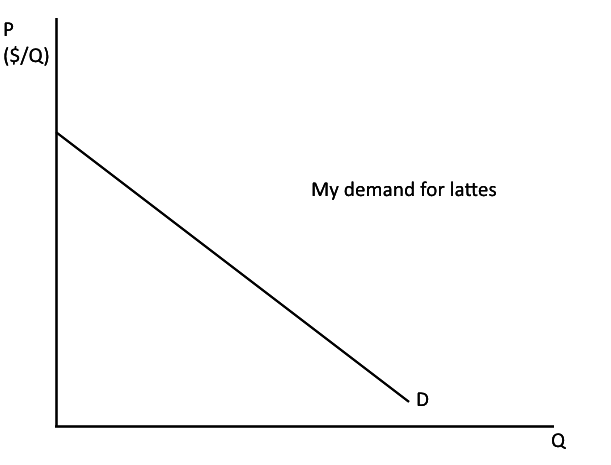
Last time we said:
- demand is downward sloping
- demand holds fixed all other variables except price.
Demand
My consumption of Coca-cola would be zero, no matter what the price was. What would that look like, graphically?
Demand
What would my demand for coffee look like if I consumed 4 cups a day no matter what the price was? Is this realistic?
Willingness to Pay
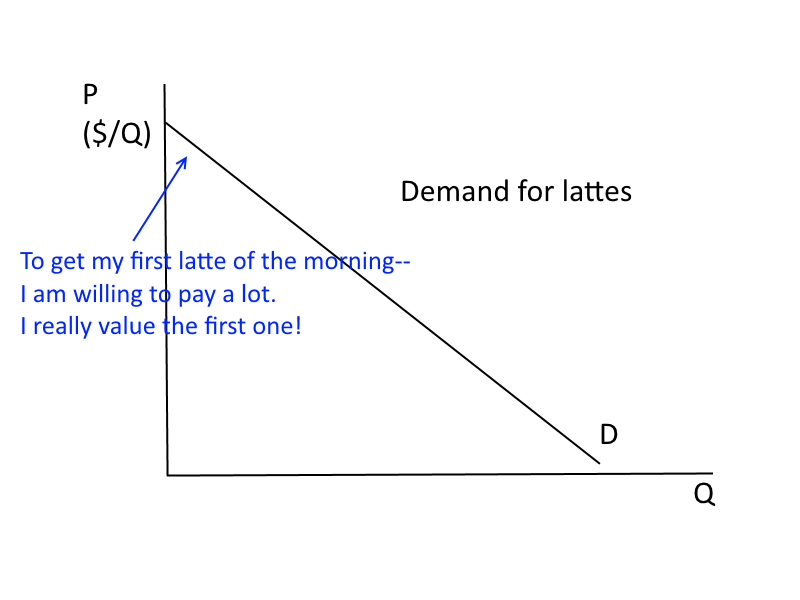
"Willingness to pay" interpretation of the demand curve:
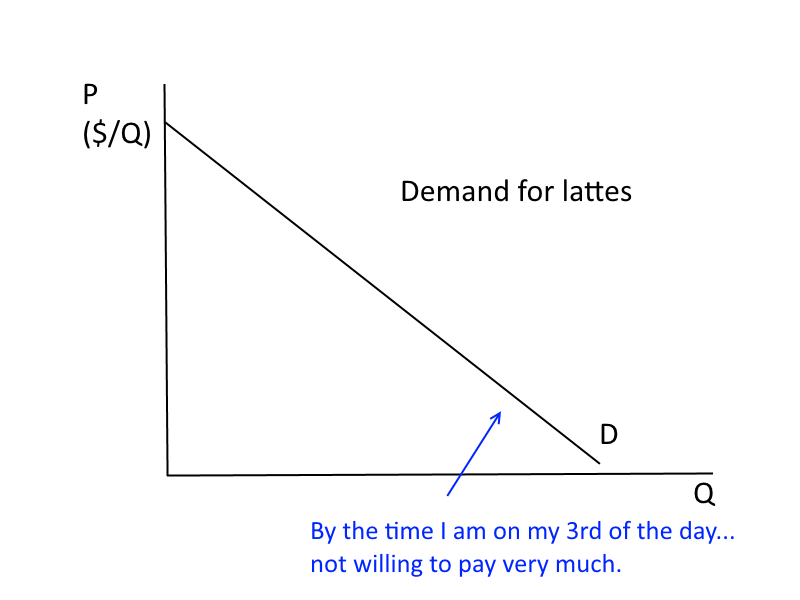
The height of the demand curve shows the maximum amount the consumer is willing (and able) to pay to get one more unit of the good.
Willingness to Pay
Willingness to Pay
Willingness to Pay
Another way to think of it...
Willingness to Pay
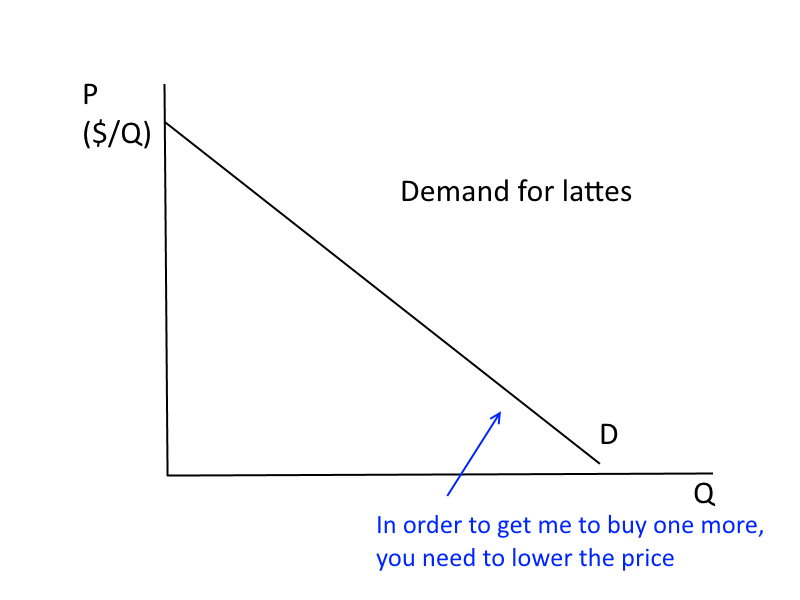
Economists refer to this phenomenon as
Diminishing marginal utility (or diminishing marginal value): principle that as more of a good is consumed, the consumption of additional amounts will yield smaller benefits.
Willingness to Pay
Willingness to Pay
Willingness to Pay
Willingness to Pay
Willingness to Pay
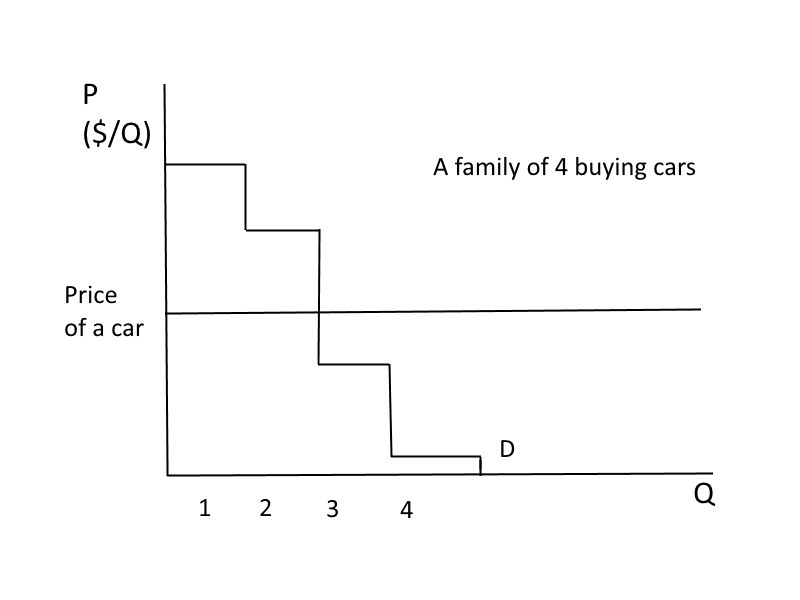
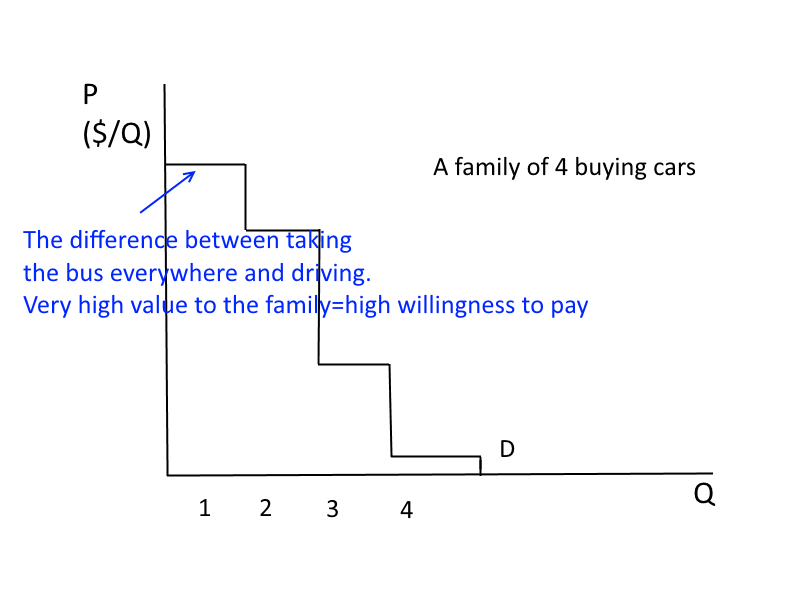
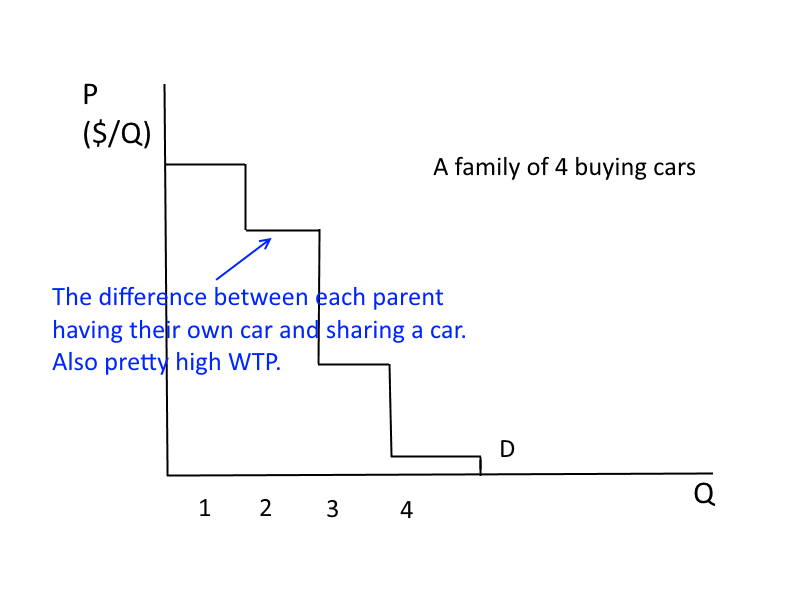
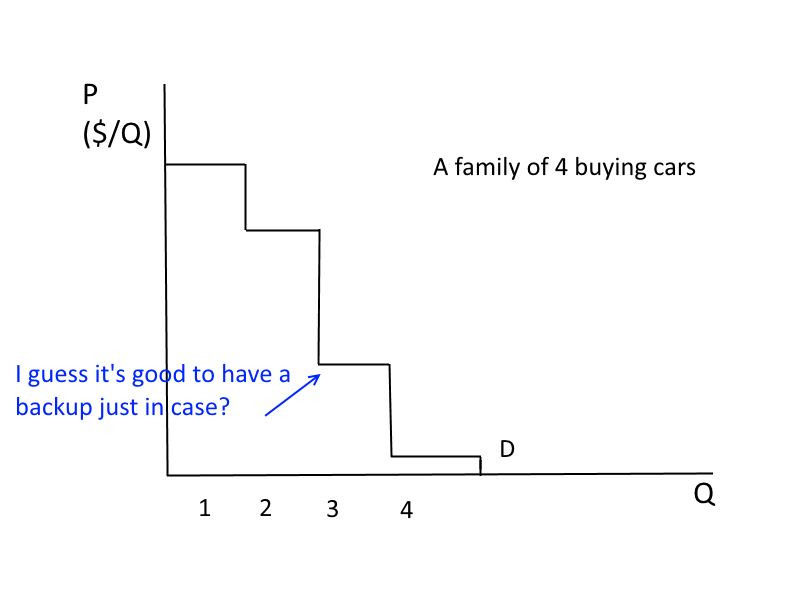
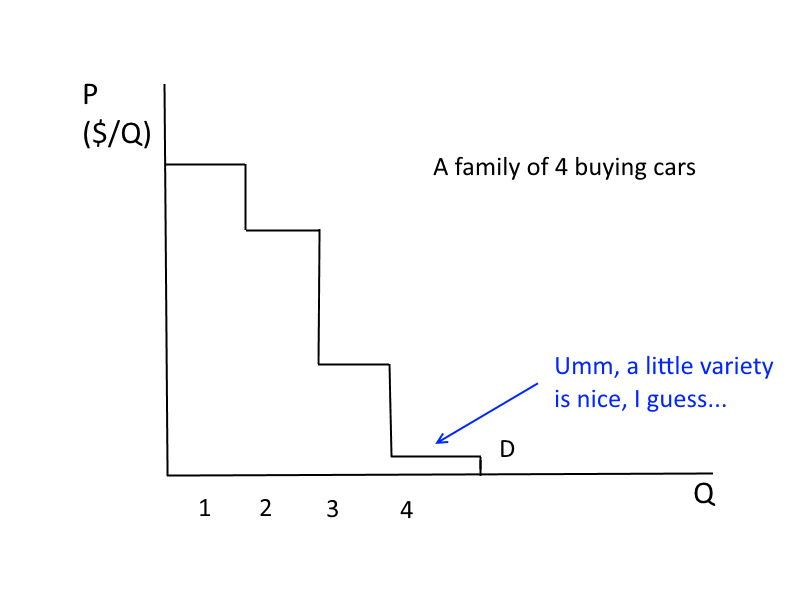
If this is the price--how many cars would the family buy? Why?
Willingness to Pay
The family is making the decision at the margin: do I want to buy one more car?
Electrical Power Purchasing
Electrical Power Purchasing
We have three objectives:
- Applying the concept of “decision making on the margin”
- Calculating how different pricing rules affect the decisions that people make
- Analyzing how to use pricing to extract consumer surplus (increasing producer revenues) – more to come on this in 2nd half of the course
Electrical Power Purchasing
Individual Demand Curve: Q = 1600 – 100P
But remember--we graph price on the y-axis!
Inverse Demand: P = 16 – 0.01Q
Electrical Power Purchasing
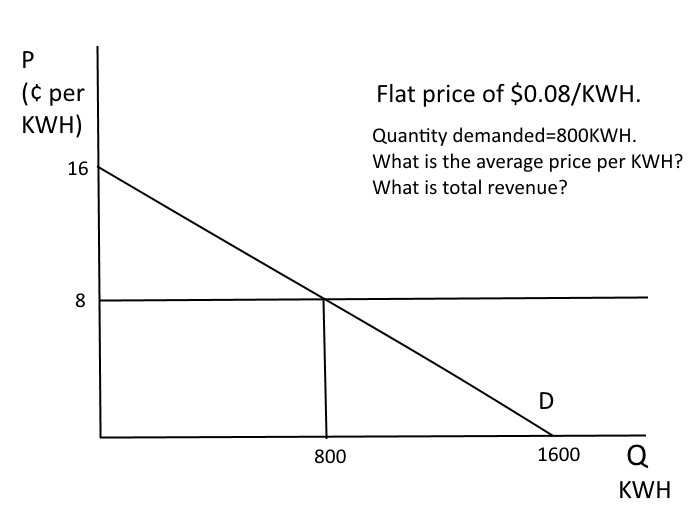
Philadelphia
Electrical Power Purchasing
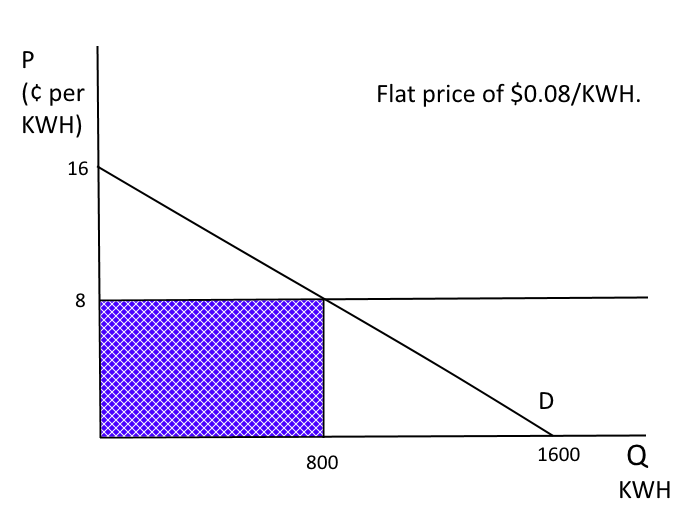
Philadelphia
Electrical Power Purchasing
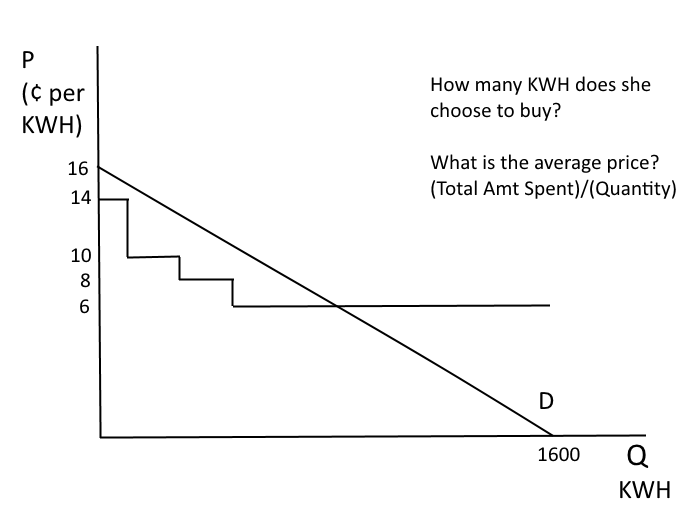
Northern Indiana
Electrical Power Purchasing
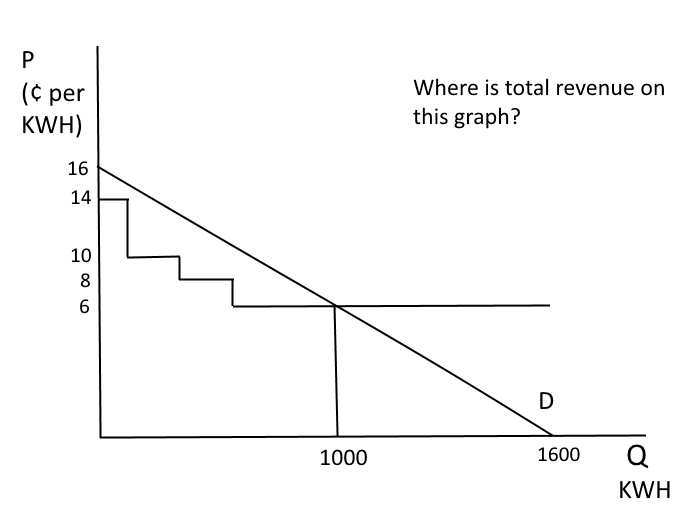
Electrical Power Purchasing
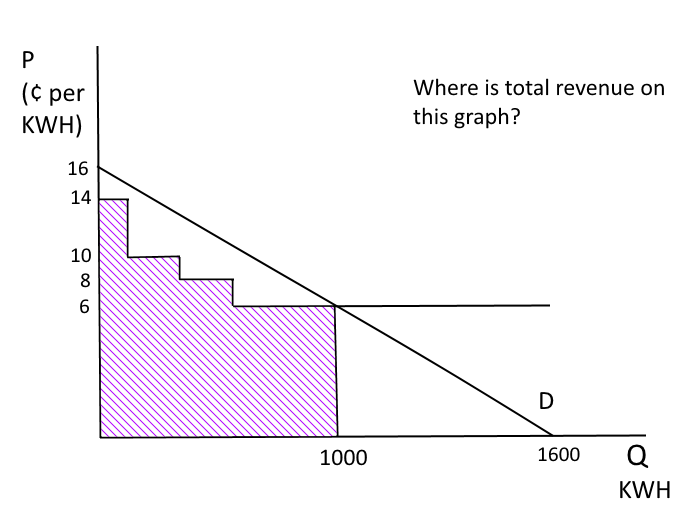
Electrical Power Purchasing
If the average prices are the same, why is she buying more in Indiana?
Where is she better off?
Electrical Power Purchasing
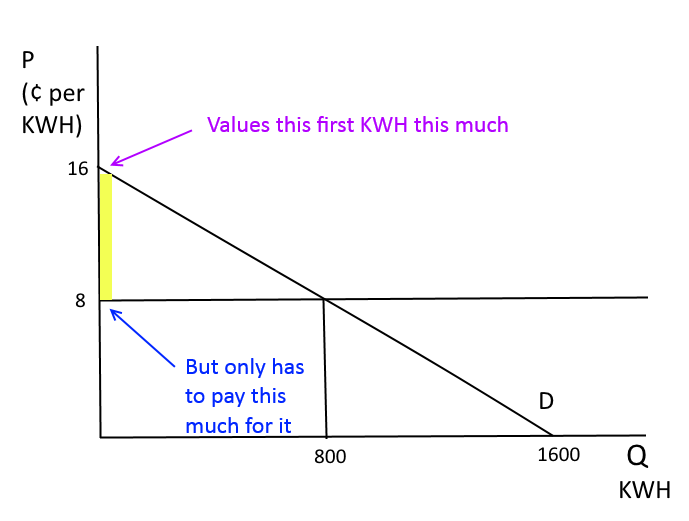
Electrical Power Purchasing
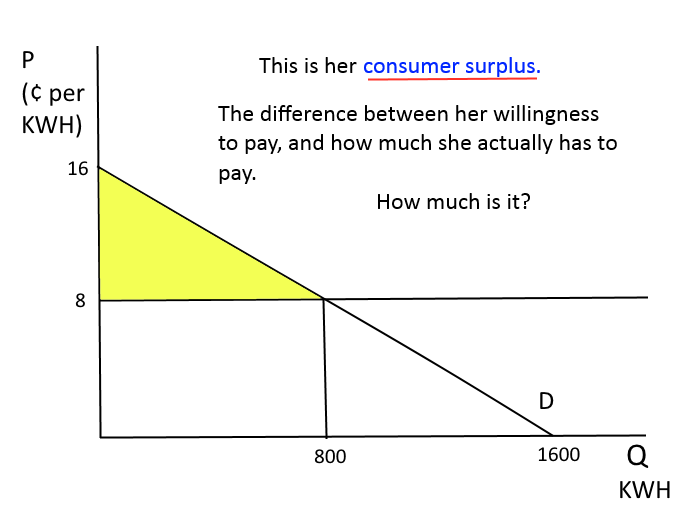
Electrical Power Purchasing
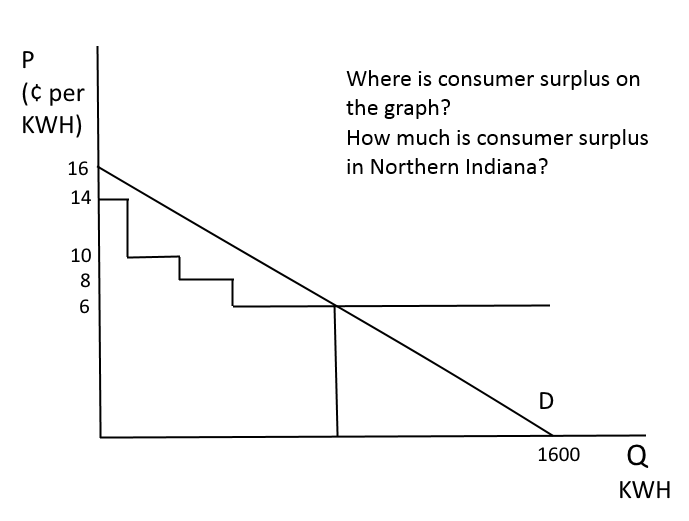
So, where is she better off?
Electrical Power Purchasing
Consumer surplus is how economists measure the value that consumers get out of participating in a market.
Advantages:
-
Quantifies consumer value (what are the units?).
-
Allows us to conduct "normative" analysis (i.e., consumer is "better off" in one situation or another)
Disadvantages:
-
Based on being "willing and able to pay".
- You might really value things you cannot pay for (food, clothes, health)
Electrical Power Purchasing
Decision Making on the Margin Rule:
For the consumer, continue to purchase up to point where Marginal Benefit (measured by WTP)=MC
If MB>MC, ↑Q; if MB<MC, ↓Q
This makes the consumer as well off as possible; this decision rule maximizes her consumer surplus
Electrical Power Purchasing
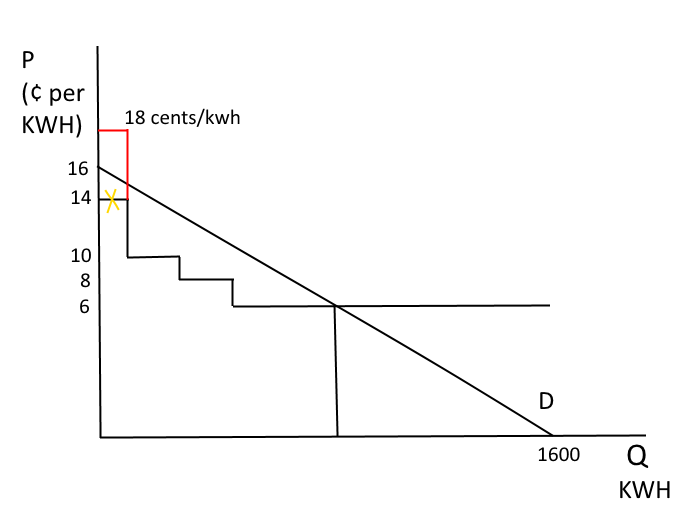
"Thinking on the margin" logic works (most of the time)
Electrical Power Purchasing
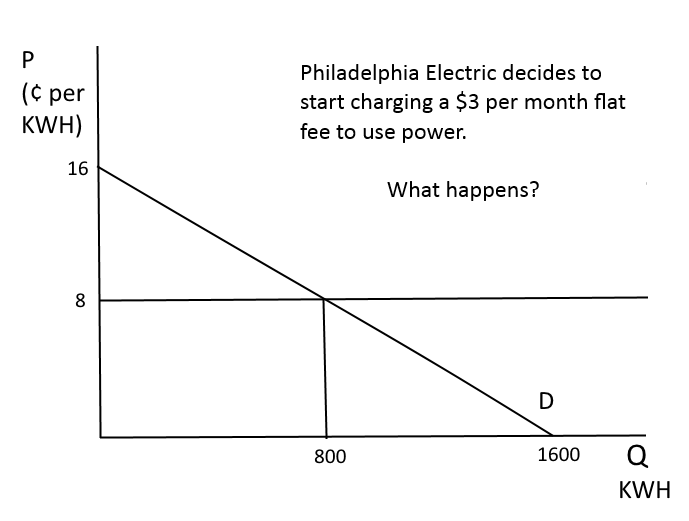
Where else do we see this type of pricing?
Electrical Power Purchasing
So... could you do better?
Electrical Power Purchasing
In Ann Arbor, Detroit Edison has a somewhat strange rate schedule:
First 500 KWH $.07/KWH
Next 300 KWH $.10/KWH
Remaining KWH $.13/KWH
How would we draw this?
Electrical Power Purchasing
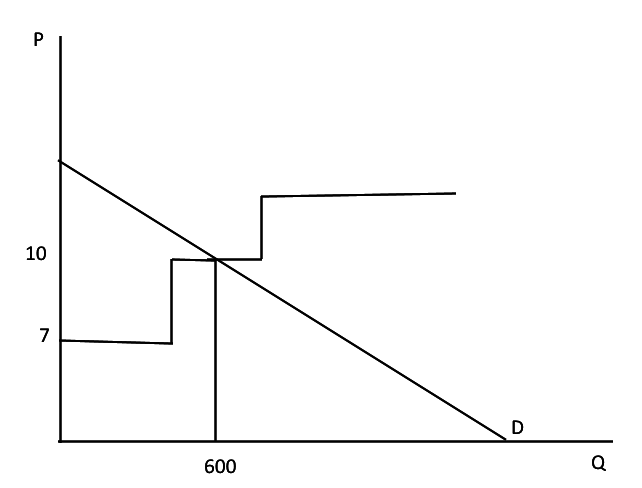
Would she be better off in other cities?
Electrical Power Purchasing
Amount consumed: 600 KWH
Total expenditures: $0.07 * 500 + $0.10*100=$45
Consumer surplus: (Area under Demand Curve, Above Price)=
[(.10*600)+(½*.06*600)= $78] - $45=$33
Individual Demand: Two Interpretations
For each price, an individual’s demand curve shows the amount of the good the consumer is willing to purchase (all else equal)
- A positive role: explains how consumers behave
For each quantity, demand represents the consumer’s willingness to pay
- A normative role: demonstrates why and how much consumers benefit from their purchase
Summary
Rational Consumer’s Decision Rule
A consumer “should” buy additional units up to point where marginal value/benefit just equals marginal cost
If WTP > MC, consume/purchase more
If WTP < MC, consume/purchase less
Optimal consumption/purchase Q:
WTP (the marginal benefit of consumption) = MC
Following this rule “maximizes” CS
Summary
“Inframarginal” charges (e.g, fixed fees):
- Do NOT affect the marginal cost of consumption
- May affect a consumer’s decision of whether to purchase a product at all (if CS became negative)
- May affect a consumer’s willingness to pay (and, hence, her demand) for all goods and services she buys by reducing the consumer’s total disposable income (but often these effects are negligible if the fee is small relative to total income)
Does anyone behave this way?
Is this a good model of consumer behavior?
Does anyone behave this way?
Individual consumers:
Maybe not explicitly or consciously, but … pricing incentives DO make a difference
Example: Renter behavior (e.g., air conditioning use) in “utilities included” apartments v. “utilities separate” apartments.
Does anyone behave this way?
Business customers:
Much more likely to make these calculations explicitly, especially where large amounts of money are at stake (e.g., industrial customers (i) who use a lot of electricity and (ii) for whom self-generation of power is an “economical” alternative).
[The University of Michigan, for instance, generates its own electric power. See http://www.plantops.umich.edu/utilities/utilities/centralpowerplant]
But, some research suggests consumers are confused
Do Consumers Respond to Marginal or Average Price? Evidence from Nonlinear Electricity Pricing, American Economic Review, Koichiro Ito (BU School of Management)
- “…strong evidence that consumers respond to average price rather than marginal or expected marginal price”
- “This sub-optimizing behavior makes nonlinear pricing unsuccessful in achieving its policy goal of energy conservation and critically changes the welfare implications of nonlinear pricing.”
Are average and marginal price different for most products?
The Energy Paradox
American consumers spend a lot on electricity: ~245 billion USD per year. Yet they are very slow to adopt energy-saving products.
- In 2011, only 3% of consumers bought energy efficient (15% return) water heaters
- In 2010, only 28% of American HHs who could use CFLs actually used them
- If they had adopted, Americans would have saved 15 billion USD (per year)!
- Is this lack of info / salience, or do Americans just not like energy-saving bulbs?
What do firms want?
If you were an energy firm, would you want consumers to be highly informed of the marginal cost of your product?
- When would this increase your revenue?
- When would it decrease your revenue?
Next Time: Market Demand
O2, Brute Case
- Tuesday in-class discussion
- Read before class
Concepts Used in O2, Brute Case
- Derive a linear demand curve from data points
- Calculate own-price elasticity of D w/ point formula
- Analyze relationship between elasticity & total revenue
- Analyze movement along vs. shifts of demand curves
Read "Estimates of Own-Price Elasticities"
Ch 3 (intro) & Ch 3.1
Lecture 2
By umich