A Critique of
Formalization and Verification of REST on HTTP using CSP
Overview
- What is REST?
- Why is it good?
- Some problems with REST
- Formalizing the semantics
- Verifying the model
REST
- REpresentational State Transfer
- Proposed by Roy Fielding in 2000
- Description of design principles for an API
- Built & designed around HTTP
- How a "well-designed" web service should behave
REST
- Six architectural constraints:
- Client-Server Architecture
- Statelessness *
- Cacheability
- Layered
- Code Mobility
- Uniform Interface *
- Resource Identification *
- Hypertext-driven (HATEOAS) *
- Uses HTTP methods (GET, POST, PUT, PATCH, DELETE)
REST - Benefits
- Consistent / Uniform
- Portable
- Semantic
- Easy to reason about
REST - Problems
- Often poorly understood or executed
- Incorrectly or incompletely implemented
- In order to be RESTful, a service must comply with ALL architectural constraints
- Many do not
REST - Problems
- Often poorly understood or executed
- Incorrectly or incompletely implemented
- In order to be RESTful, a service must comply with ALL architectural constraints
- Many do not
REST - Problems
- Often poorly understood or executed
- Incorrectly or incompletely implemented
- In order to be RESTful, a service must comply with ALL architectural constraints
- Many do not
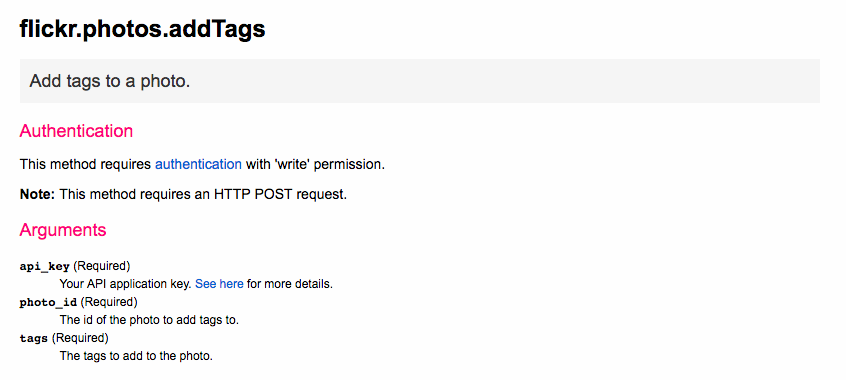
- Very real day-to-day problem in web systems development
- Why I chose this paper
REST - Problems
Formalizing REST - CSP
- The authors use CSP to formalize a model for REST
- First described by Hoare
- Expressive way to model concurrent and sequential communication between processes over channels
- Syntax:
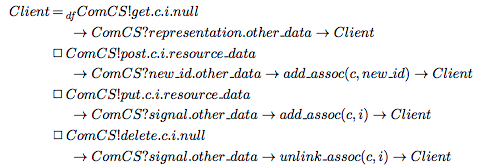
- Define behavior, read messages, write messages, concurrency, synchronization

Formalizing REST - Model
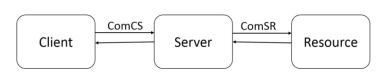
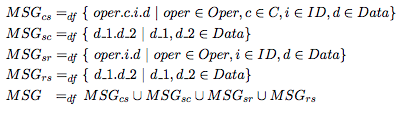
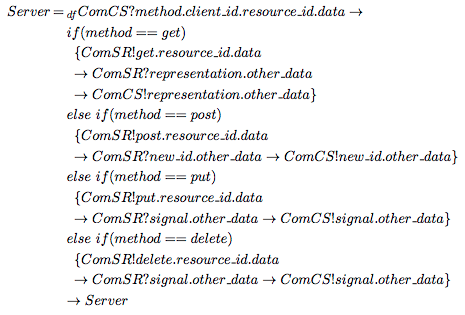
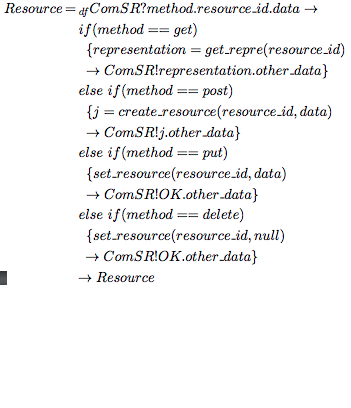
- Model REST using three processes: Client, Server and Resource
- Communication channels between Client/Server, Server/Resource
Formalizing REST - Model
Formalizing REST - Model
Formalizing REST - Model
Formalizing REST - Model
- This is a good model, for the most part
- Very succinct, minimal
- Maps well to real-world implementation
- For the most part, describes the properties they aim to prove well
Formalizing REST - Verification
- Authors choose to verify:
- REST Behavior
- Statelessness
- HATEOAS
- HTTP Methods
- Safety (GET)
- Idempotence (GET, PUT, DELETE)
- REST Behavior
- Why?
- "Most Important"
- "Most Confusing"
- ???
Formalizing REST - Verification
- Authors choose to verify:
- REST Behavior
- Statelessness
- HATEOAS
- HTTP Methods
- Safety (GET)
- Idempotence (GET, PUT, DELETE)
- REST Behavior
Formalizing REST - Verification
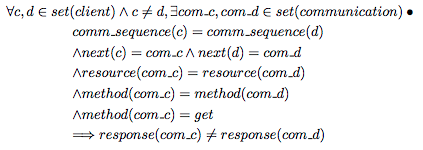
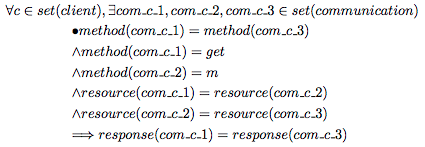
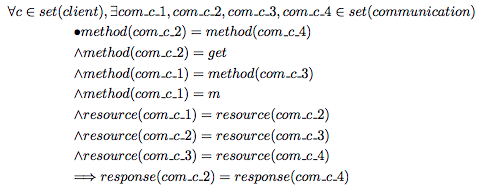
- Use first-order logic to define failure cases and tests to (attempt to) formally define these properties
- Then use PAT (Process Analysis Toolkit) to verify properties
- Automated model checker
- Seems nice, but they don't include all the code
- Angry reacts only
Formalizing REST - Verification
Statelessness

HATEOAS
Formalizing REST - Verification
Method Safety
Method Idempotence
:-( / 10
:-) / 10
SV Critique
By Ada Young


