Koha Librarians Workshop
Alex Buckley and Aleisha Amohia
27 July 2021
Agenda
- Introductions
- What's new in Koha 20.11?
- Customising your OPAC/public interface
- Making Koha data useful to your users
- Customising your staff client
- Resources for writing SQL reports
- Writing SQL reports
- What's new in Koha 21.05?
- Contributing to the Koha Community
- Q&A
Introductions
- Who you are
- How long you have been using Koha
- What you hope to get out of this workshop
Alex Buckley
- Koha Developer at Catalyst since 2015
- Based in Nelson
- Data migrations, new implementations, integrations, training

Aleisha Amohia
- Koha Developer at Catalyst since 2014
- Development, mentoring, communications

Test sites for today's training
Login details:
Username: FirstnameLastname
Password: CatalystTrain1
What's new in Koha 20.11?
Read the blog post
- Group circulation by item type
- Specify a reason when cancelling a hold, send a notice
- Hide chosen fields from the OPAC suggestions form
- Custom destination for failed overdue notices
- Add ability to attach a cover image an item level
- Enhanced high holds
- Default lost item fee refund on return policy
- Holds history for patrons in OPAC
- Accessibility
Customise the OPAC
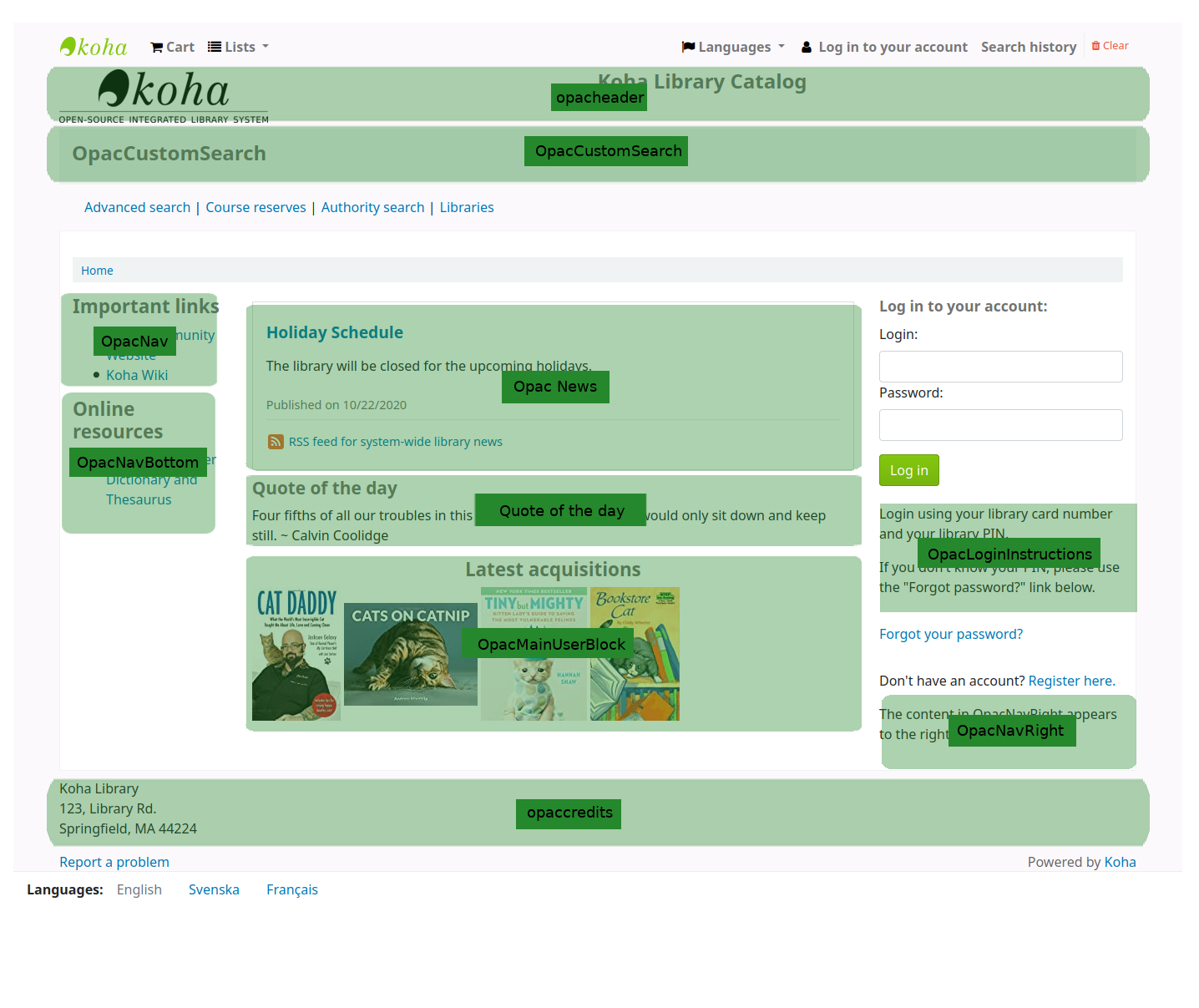
Customise the OPAC
In the News Tool:
- OPAC news
- OpacNavRight
- opacheader
- OpacCustomSearch
- OpacMainUserBlock
- opaccredits
- OpacLoginInstructions
- OpacSuggestionInstructions
These sections are translatable and you do not need to know HTML to modify them.
Still in the system preferences:
- OpacNav
- OpacNavBottom
OPAC system preferences
- OPACAdvSearchOptions - Hide options from the OPAC advanced search page
- OPACSuggestionsUnwantedFields - Hide fields from OPAC suggestion page
- hidelostitems - Hide lost items from search and detail pages
- HighlightOwnItemsOnOPAC & HighlightOwnItemsOnOPACWhich - Move items to the front and increase font size from patrons home library
OPAC system preferences
- OPACHighlightedWords - Choose if patrons search terms are highlighted in result and detail pages
- NotHighlightedWords - Stopwords that should never be highlighted
- OPACMySummaryHTML - Add a column in the tables on the 'My summary' and 'My checkout history' pages for logged in OPAC users
- OPACNoResultsFound - HTML to be displayed when no results are found for an OPAC search
OPAC system preferences
- OPACUserSummary - Show summary of checkouts, overdues, holds and charges on OPAC home page
- OPACReportProblem - Allow patrons submit problems in OPAC to KohaAdminEmailAddress
- OPACHiddenItems - Rules to hide items from OPAC
- OPACHiddenItemsExceptions - Patron categories that can see otherwise hidden items
Style your OPAC
- Additional stylesheets
- OPACUserCSS
/* Hide the no image found image */
.no-image { display: none; }
- OPACUserJS
$("#opacnav").append("<p>This is a test.</p>");
These system preferences require you to know:
CSS: https://www.w3schools.com/css/default.asp
Javscript: https://www.w3schools.com/js/default.asp
Make your OPAC accessible
- Use headings well
- Use the News Tool to show custom content in your installed languages
- Avoid including images of text, just use text
- Images that add information must have alt text
Take a break
Making Koha data useful to your users
Read the blog post
- Use Koha reporting in a creative way
- Put Koha data on other webpages that your users are on
- Collect useful data about patrons using Koha extended attributes
- Exhibit your catalogue
- Social media
Customise the staff client
Using system preferences!
- Hide fields from forms - CollapseFieldsPatronAddForm
- Hide columns in tables - Admin -> Table settings
Or using the News Tool
- IntranetCirculationHomeHTML
- IntranetmainUserblock
- IntranetCatalogSearchPulldown
- IntranetReportsHomeHTML
- IntranetNav
- IntranetUserJS
- IntranetUserCSS
Resources for writing SQL reports
Koha reports wiki
Take a break
Resources for writing SQL reports
Koha Database Schema
- Shows database tables and columns
- Shows relationships between tables
- Every table (set of data) has columns (attributes)
- Each row in a table represents a record
- Sometimes tables are linked by a shared column
Writing SQL reports
Important
Always run your report on your test site before trying it in production.
Do not query the action_logs table, use the Log Viewer Tool instead.
Do not refresh the page while running a report, and do not press Run more than once.
You can only view (not modify) data using Koha reports.
Useful tables
- borrowers, deletedborrowers - patron data
- items, deleteditems - holdings data
- biblio, deletedbiblio - bibliographic data
- auth_header - authority data
- reserves, old_reserves - reserves/holds data
- issues, old_issues - circulation data
- branchtransfers - transfer data
- accountlines - fines and fees data
- statistics
SELECT
SELECT column
FROM table
SELECT count(*)
FROM table
SELECT column1, column2, column3
FROM table
SELECT
SELECT biblionumber
FROM biblio
SELECT count(*)
FROM items
SELECT firstname, surname, email
FROM borrowers
WHERE
SELECT count(*)
FROM table
WHERE column = "value"
SELECT column1, column 2
FROM table
WHERE column IS NULL
SELECT column1
FROM table
WHERE column != "value"
WHERE
SELECT count(*)
FROM statistics
WHERE type = "issue"
SELECT count(*)
FROM items
WHERE barcode IS NULL
SELECT count(*)
FROM items
WHERE barcode IS NOT NULL
AS
SELECT column AS "Column name" FROM table

SELECT column AS ColumnName FROM table
SELECT firstname AS "First name" FROM borrowers

SELECT surname AS Surname FROM borrowers
LIKE + wildcards
SELECT column FROM table
WHERE column LIKE "%middle%";
SELECT column FROM table
WHERE column NOT LIKE "%value%";
SELECT column FROM table
WHERE column LIKE "%end";
SELECT column FROM table
WHERE column LIKE "start%";
LIKE + wildcards
SELECT surname AS Surname,
firstname AS "First Name",
cardnumber AS "Card Number",
email AS Email
FROM borrowers
WHERE email NOT LIKE '%@%.%'
SELECT title FROM biblio
WHERE title LIKE "%dog%";
DISTINCT
SELECT DISTINCT(column)
FROM table
DISTINCT
SELECT DISTINCT(itype)
FROM items
WHERE + AND
SELECT column1, column2
FROM table
WHERE column = 'data'
AND column != 'data'
AND column >= 'number'
WHERE + AND
SELECT itemnumber, barcode
FROM items
WHERE homebranch = 'CPL'
AND ccode = 'FIC'
SELECT * FROM items
WHERE ccode = 'FIC'
AND dateaccessioned > '2021';
WHERE + OR
SELECT column1, column2
FROM table
WHERE column = "data"
OR column IS NOT NULL
WHERE + OR
SELECT biblionumber, itemnumber
FROM items
WHERE itemlost = 1
OR damaged = 1
OR withdrawn = 1
OR notforloan = 1
WHERE + NOT
SELECT column
FROM table
WHERE NOT column = "data"
WHERE + NOT
SELECT DISTINCT(firstname)
FROM borrowers
WHERE NOT firstname LIKE "A%"
RUNTIME PARAMETERS
SELECT column
FROM table
WHERE column = <<Label for free text input>>
SELECT column
FROM table
WHERE column = <<Label for dropdown|dropdown>>
Koha 20.05: Manual documentation
Koha 21.05: Manual documentation
RUNTIME PARAMETERS
SELECT biblionumber, title
FROM biblio
WHERE frameworkcode=<<Please enter the framework code to filter on>>
SELECT itemnumber, barcode
FROM items
WHERE homebranch= <<Select the homebranch|branches>>
ORDER BY
SELECT column
FROM table
WHERE column = "data"
ORDER BY column ASC
SELECT column
FROM table
WHERE column = "data"
ORDER BY column DESC
ORDER BY
SELECT surname, firstname
FROM borrowers
WHERE branchcode = "CPL"
ORDER BY surname ASC
SELECT surname, firstname
FROM borrowers
WHERE branchcode = "CPL"
ORDER BY firstname DESC
LIMIT
SELECT column
FROM table
LIMIT rows
LIMIT
SELECT * FROM biblio
WHERE datecreated > '2020'
LIMIT 5;
SELECT * FROM biblio
WHERE datecreated > '2020'
ORDER BY title ASC
LIMIT 5;
JOIN
SELECT a.column, b.column
FROM table a
JOIN table b USING (sameColumnName)
WHERE a.column = "value"
SELECT a.column, b.column
FROM table a
JOIN table b ON (a.column = b.column)
WHERE c.column = "value"
JOIN
SELECT b.biblionumber, b.title, i.barcode
FROM biblio b
JOIN items i USING (biblionumber)
WHERE b.frameworkcode=<<Framework code>>
SELECT DISTINCT(b.title), i.itype, bi.itemtype
FROM items i
JOIN biblio b USING (biblionumber)
JOIN biblioitems bi ON (i.itype=bi.itemtype)
GROUP BY
SELECT COUNT(column), column
FROM table
GROUP BY column
SELECT SUM(column), column
FROM table
GROUP BY column
GROUP BY
SELECT COUNT(items.itemcallnumber) AS 'Number of Items', items.itemcallnumber
FROM items
GROUP BY items.itemcallnumber
SELECT b.title, SUM(i.issues)
FROM biblio b
LEFT JOIN items i USING (biblionumber)
WHERE i.issues > 0
GROUP BY b.title;
HAVING
WHERE - filter results before grouping
HAVING - filter results after grouping
SELECT COUNT(column1), column2
FROM table
GROUP BY column2
HAVING COUNT(column1) > 'num'
HAVING
SELECT GROUP_CONCAT(biblionumber SEPARATOR ', ') AS 'Duplicate biblionumbers', isbn
FROM biblioitems
GROUP BY isbn
HAVING COUNT(isbn)>1
MARC
SELECT

ExtractValue(metadata,'//datafield[@tag="tag"]/*'),

ExtractValue(metadata,'//datafield[@tag="tag"]/subfield[@code="subfield"]'),

ExtractValue(metadata,'//datafield[@tag="tag"]/subfield[@code>="subfield"]')

FROM table
Table will always be biblio_metadata or auth_header
MARC
SELECT ExtractValue(metadata,
'//datafield[@tag="245"]/*') AS 'Full Title information'
FROM biblio_metadata
WHERE biblionumber=14
SELECT ExtractValue(metadata,
'//datafield[@tag="245"]/subfield[@code="a"]') AS 'Title'
FROM biblio_metadata
WHERE biblionumber=14
Charts for displaying data
SELECT c.description,
COUNT(*) AS 'Number of patrons expiring after this date'
FROM borrowers b
LEFT JOIN categories c
USING (categorycode)
WHERE b.dateexpiry > <<Choose a date|date>>
GROUP BY b.categorycode
Take a break
What's new in Koha 21.05?
Read the blog post
- Automatically link authorities to biblios while cataloguing
- Default order of MARC subfields
- 'Transfers to send' report
- Shibboleth-only mode for single sign-on
- Easy printing of patron check-in slip
- Automatic checkin at end of loan period
- Default hold expiration date
- Preview SQL from list of saved reports
- Take a list parameter in reports
Contributing to Koha
Any questions?
Thank you for coming!
Koha Librarians Workshop 27 July
By aleisha
Koha Librarians Workshop 27 July
Koha Librarians Workshop 27 July