ILLUMINATING LÁSZLÓ MOHOLY-NAGY’S “LIGHT PROP”
AN OBJECT LESSON
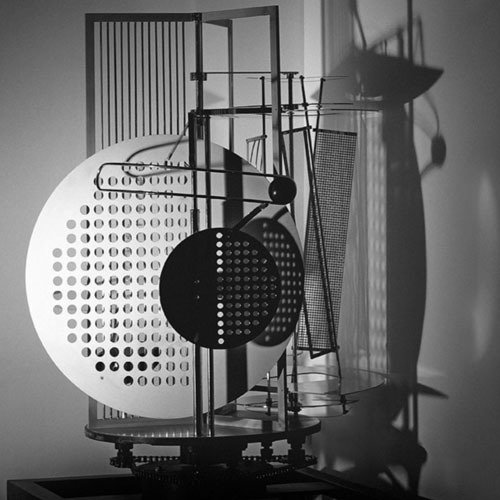
What is "Light Prop for an Electric Stage"?
This object lesson investigates the multi-layered history of László Moholy-Nagy’s “Light Prop for an Electric Stage (Light-Space Modulator).” Learn more about this iconic object, from inception to Instagram, by clicking through the slides.
collage of #moholynagy collected May 14, 2017
"[An] apparatus that generated spectacular projected light and shadow formations by filtering colored and white lights through a range of superimposed moving components."
In addition to Moholy-Nagy’s original "Light Prop," currently on display at the Harvard Art Museums, the museum also owns an identical replica.
How did these two objects come into being? How do their histories intersect and diverge? What are their current resonances?
To answer these questions, we need to start with the artist—László Moholy-Nagy.
LÁSZLÓ
MOHOLY-NAGY
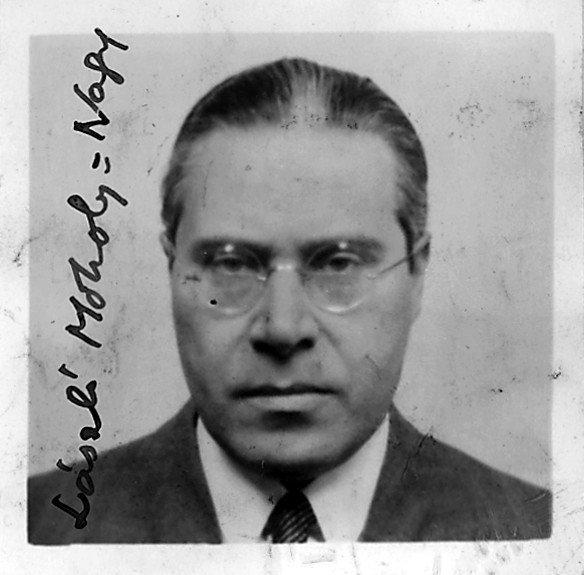
Hungarian artist László Moholy-Nagy (1895-1946) created “Light Prop for an Electric Stage” to explore perceptions of light, material, and machine.
Moholy-Nagy was a key member of the Bauhaus, a 20th-century German school of art, architecture, and design.
Bauhaus founder Walter Gropius described Moholy-Nagy as an artist who “ventured into ever new experiments with the curiosity of a scientist.”
Moholy-Nagy’s worked with film, painting, typography, sculpture, and graphic and stage design.
He was especially curious about light. With refraction and reflection, transparency and shadow, movement and mirrors, he aimed to illuminate and transform the aesthetic experience.
“Light Prop for an Electric Stage” typifies Moholy-Nagy’s intersecting interests of art and technology.
Courtesy of National Archives
Courtesy of University Library of Heidelberg
Courtesy of Bauhaus-Archiv Berlin
First displayed at the 1930 Exposition de la Société des Artistes Décorateurs in Paris, “Light Prop” was gifted to the Harvard Art Museums in 1956 by Moholy-Nagy’s widow.
Courtesy of University Library of Heidelberg
Sixty years later, the Tate Modern commissioned a replica of “Light Prop for an Electric Stage” for an exhibition. Other replicas had been made in the 1970s by Bauhaus Archiv Berlin and Van Abbemuseum, Eindhoven.
The Harvard Art Museums acquired the Tate’s replica in 2007. As part of the agreement with the Tate Modern and Moholy-Nagy’s daughter, the Harvard Art Museums would lend the replica to other institutions as much as possible.
Even though the replica is identical to the original “Light Prop” and would be exhibited alongside other works in art museums, this agreement expressly stipulated that the replica should not be considered a work of art.
Courtesy of Art Resource, New York
The original “Light Prop” has been almost continually on display at the Harvard Art Museums since the 1980s.
Courtesy of Art Resource, New York
Since 2007, the replica has been seen around the world.
EXHIBITION HISTORY
This map follows where the original and replica "Light Prop" have been exhibited.
And both the original and replica “Light Prop” inspire active user engagement on the Harvard Art Museums’ website.
TOTAL PAGE VIEWS
The original "Light Prop" has attracted more online traffic. As of March 2017, the original had 2787 total page views. The replica had 1127.
So does it matter which “Light Prop”—original or replica—viewers experience, either online or in person?
Others comment on how the original “Light Prop” has been altered since 1956 to replace broken parts, stabilize the piece, and maintain its functionality.
They ask: at this point, how “original” is the original artwork?
Some argue that, because of its ability to traverse the globe, the “Light Prop” replica “provides the public a better understanding of the original.”
Courtesy of University Library of Heidelberg
Moholy-Nagy only created one “Light Prop for an Electric Stage (Light-Space Modulator),” and no replica will have what philosopher Walter Benjamin, calls an aura—its unique “presence in time and space.”
Yet replicas, which Benjamin calls reproductions, can also create resonance.
“One might generalize by saying the technique of reproduction detaches the reproduced object from the domain of tradition. By making many reproductions it substitutes a plurality of copies for a unique existence. And in permitting the reproduction to meet the beholder or listener in his own particular situation, it reactivates the object reproduced. These two processes lead to a tremendous shattering of tradition which is the obverse of the contemporary crisis and the renewal of mankind.”
WALTER BENJAMIN
collage of #moholynagy collected May 14, 2017
László Moholy-Nagy’s “Light Prop for an Electric Stage (Light-Space Modulator)” has had a “rich and influential afterlife” through its reproductions.
Moholy-Nagy, somewhat presciently, appreciated the potential for technology, like Instagram, to reproduce artwork.
“The representation of either the object or the human being has been perfected to such a degree [...] The battle between brush and camera becomes ridiculous if one realizes [...] that all representation is interpretation.”
LÁSZLÓ MOHOLY-NAGY
We invite you to explore how this object might resonate with you.
“Light Prop for an Electric Stage (Light-Space Modulator).” Harvard Art Museums. Accessed April 21, 2017. http://www.harvardartmuseums.org/collections/object/299819?q=moholy-nagy+ligh
“Light Prop for an Electric Stage, 1930. Exhibition replica, constructed in 2006, through the courtesy of Hattula Moholy-Nagy.” Harvard Art Museums. Accessed April 21, 2017. http://www.harvardartmuseums.org/collections/object/318198?q=moholy-nagy+light+p
Botar, Oliver A. I., and László Moholy-Nagy. Sensing the Future: Moholy-Nagy, Media and the Arts.
Caton, Joseph Harris. The Utopian Vision of Moholy-Nagy: Technology, Society and the Avant-Garde: an Analysis of the Writings of Moholy-Nagy On the Visual Arts. [S.l.: s.n. ], 1980.
Henry Lie, 'Replicas of László Moholy-Nagy’s Light Prop: Busch-Reisinger Museum and Harvard University Art Museums', Tate Papers, no.8, Autumn 2007, http://www.tate.org.uk/research/publications/tate-papers/08/replicas-of-laszlo-moholy-nagys-light-prop-busch-reisinger-museum-and-harvard-university-art-museums, accessed 14 May 2017.
Witkovsky, Matthew S., Carol S. Eliel, and Karole P. B. Vail. Moholy-Nagy: Future Present. First edition.
Leah Burgin, Andrea Ledesma | May 2017
Illuminating László Moholy-Nagy’s “Light Prop”: An Object Lesson
By Andrea Ledesma
Illuminating László Moholy-Nagy’s “Light Prop”: An Object Lesson
An object lesson by Leah Burgin and Andrea Ledesma, MA in Public Humanities, Brown University (2017)