If you haven't had a chance, take this survey
https://bambamramfan.github.io/ai-compass/

Navigating the
AI Divide
What actions can we take to support faculty, students, and staff while staying true to our personal beliefs and professional expertise?
What policies exist across campus at the university, departments and individual level? How do we, as librarians, navigate these overlapping norms?
What experiences have you had where personal or professional attitudes about AI affected your work?
What is the range of attitudes we've encountered, both in our personal lives and at work, toward generative AI?
Questions for today's discussion
Attitudes
Group
As a full group, we'll assess what terms capture and communicate something helpful. Where do terms cause confusion?
Pairs
Take five minutes to discuss with a partner. Share your attitude (s) with them. If you're in Zoom, you'll be moved to a breakout room.
Individually
Take two minutes to consider these questions on your own.
Consider your own attitute(s) about generative AI. What label would you give yourself? What does the AI compass say you are? Where do these labels help? Where do they get in the way?
Activity
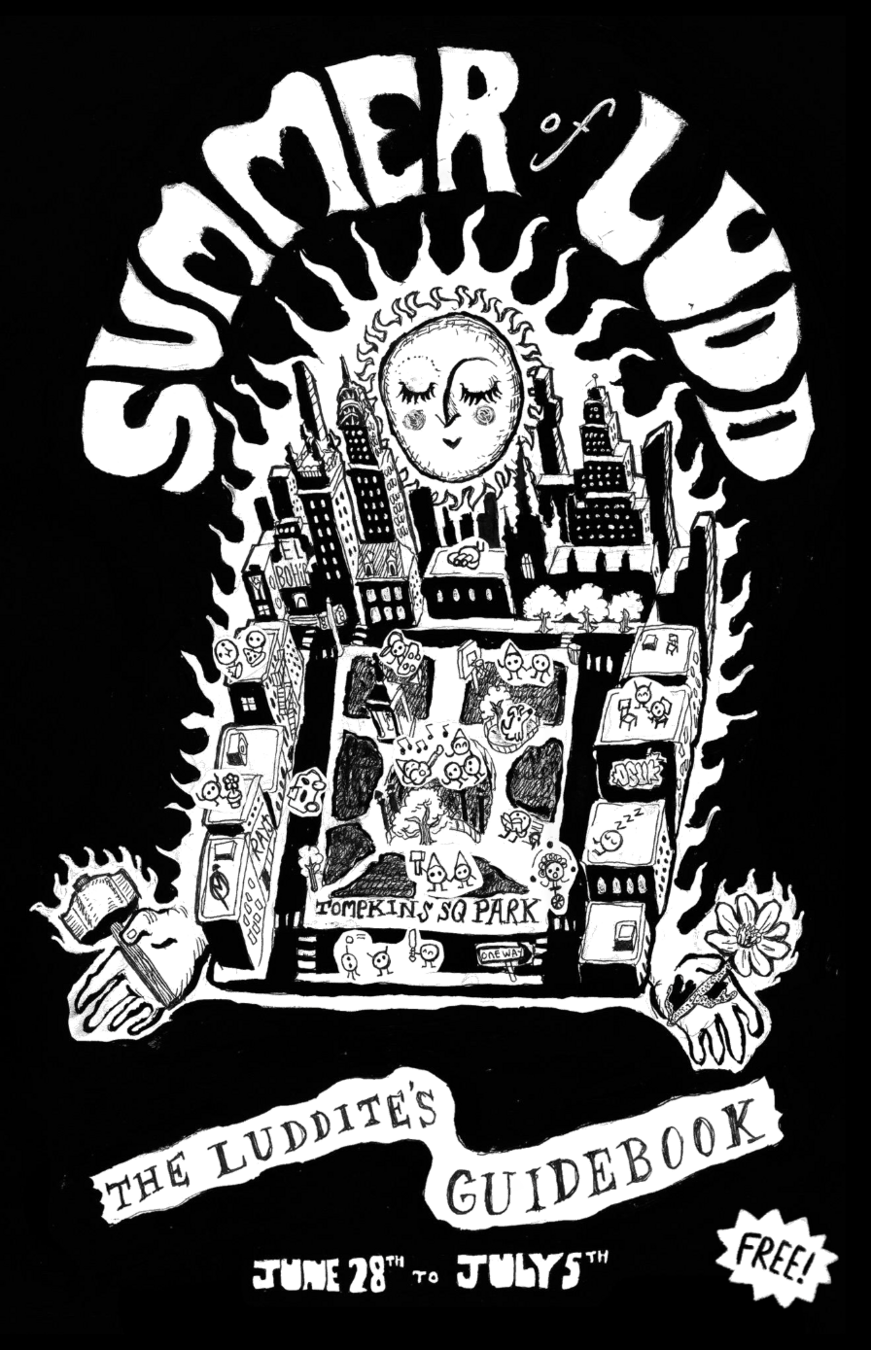
The Luddite (Affectionate)
patron saint: Emily Bender
It doesn't work the way they claim, it's making everything worse, and you'd like your internet back, please. You can explain in precise technical detail why it's a stochastic parrot, and you will, whether or not anyone asked. You're funnier about this than people give you credit for.
The Conscientious Objector
patron saint: Holly Herndon
It doesn't work well, it's doing real harm, and you've opted out on principle. You're not a technophobe — you just think this specific technology is overhyped and corrosive, and you're tired of being told you just don't understand it. You understand it fine. That's the problem.
The Optimist
patron saint: Marc Andreessen
AI cures diseases, teaches children, liberates workers, and democratizes expertise. You see the problems but you believe the trajectory bends toward good, and the only real sin is slowing it down. Your bookshelf has both Pinker and a manifesto you wrote yourself.

The Podcast Bro
patron saint: Lex Fridman
You listened to a three-hour interview with an AI researcher and now you have opinions. Strong ones. You're long on compute and short on regulation, and you've said 'exponential' more times this month than a calculus teacher. Love is the answer, and also AGI.

Experiences
Group
As a full group, we'll share experiences and identify areas where further guidance or action is needed.
Pairs
Take five minutes to discuss with a partner. Share your attitute(s) with them.
Individually
Take two minutes to consider these questions on your own.
What experiences have you (or people you know) had where personal or professional attitudes about AI affected your work?
Activity
Policies
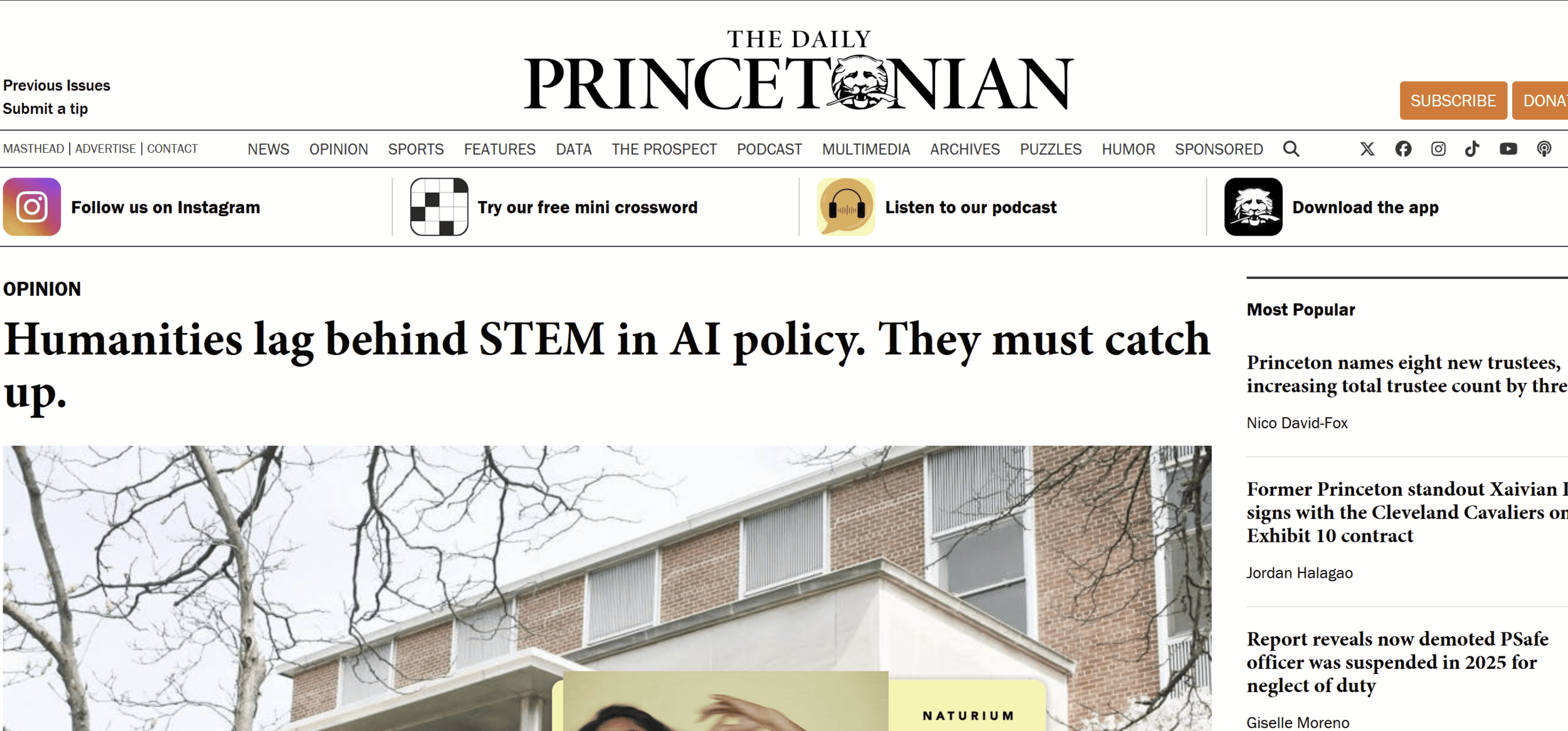
- "...STEM departments thoughtfully adapt their AI policies in response to technological developments.
- "...[some in] the humanities and social sciences have ... hastily rejected all uses of AI.
- "Faculty and departments should revise their AI policies to be more moderate, creating a more honest culture around AI."
-
This proposal’s central problem is that it misunderstands the intrinsic purpose of the humanities, and of a traditional university education.
-
The primary goal of a liberal arts institution, as well as the study of the humanities, should be intellectual maturation in itself.
-
Artificial intelligence threatens the individuality of thought and voice essential to all disciplines, but especially the humanities. Even interacting with LLMs under the guise of “brainstorming” can deter intellectual progress.

University-wide framework
Academic Regulations (RRR §2.4.6 and §2.4.7)
The binding rules treat generative AI as not a source (because its output is not produced by a person). When an instructor permits AI use, students must disclose that use rather than cite it. The regulations define the following as academic-integrity violations:
-
Directly copying AI output
-
Representing AI-generated or AI-derived output as one's own, including reworded or paraphrased output
-
Exceeding the parameters of use specified by the instructor
-
Failing to disclose AI use — including use for rewording, paraphrasing, or editing
Source: Rights, Rules, Responsibilities §2.4 Academic Regulations.
Disclosure of Delegation to Generative AI

The authors declare the use of generative AI in the research and writing process. According to the GAIDeT taxonomy (2025), the following tasks were delegated to GAI tools under full human supervision:

- Defining the research objective
- Feasibility assessment and risk evaluation
- Literature search and systematization
- Writing the literature review
- Text generation
The GAI tool used was: Claude Opus 4.8.
Responsibility for the final manuscript lies entirely with the authors.
GAI tools are not listed as authors and do not bear responsibility for the final outcomes.
Declaration submitted by: Andrew Janco
History Department
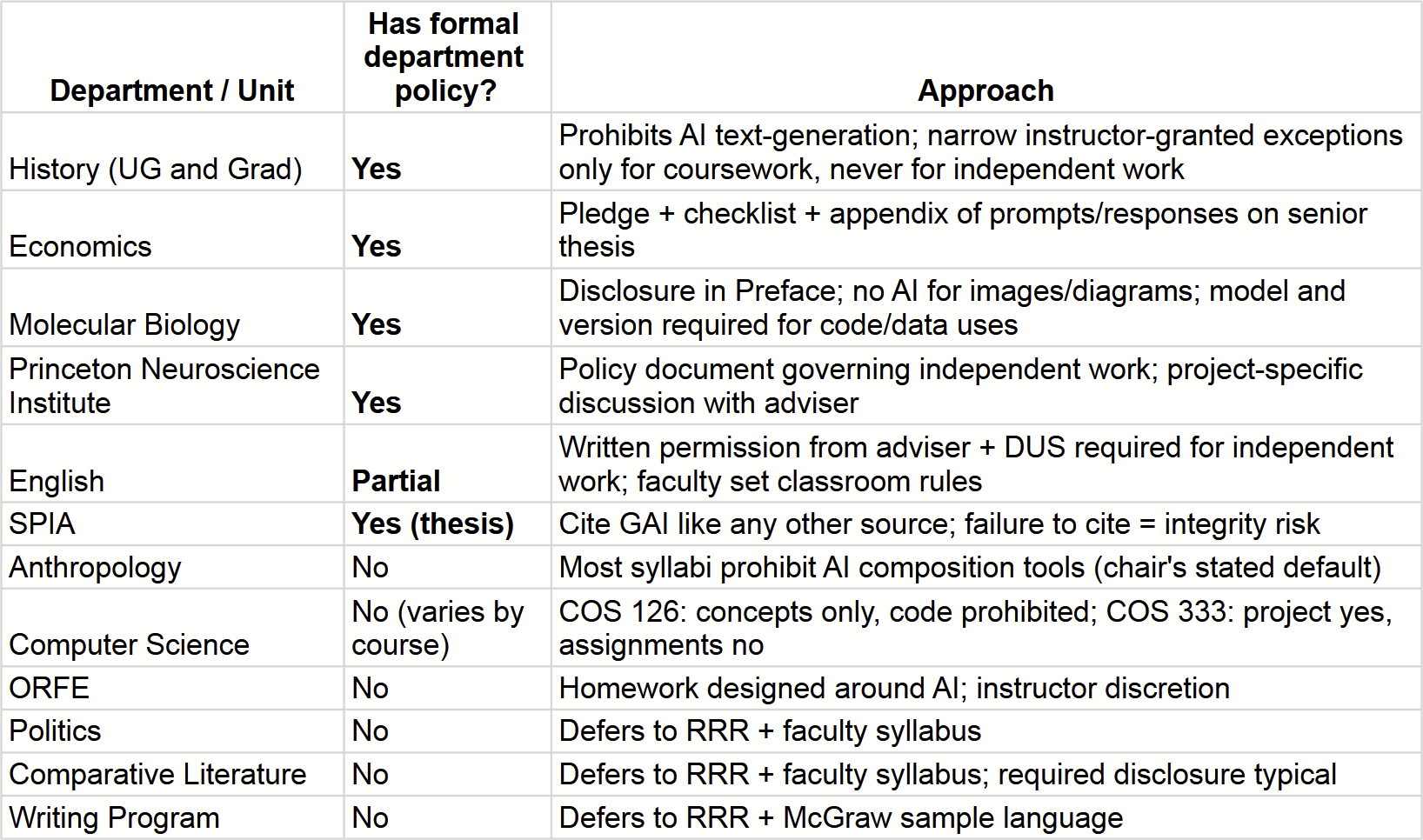
Status: Formal policy for both undergraduates and graduate students.
Undergraduate rule: Generative AI is prohibited as a text-generation tool in coursework, final exams, and independent work (junior papers, senior thesis). Specifically:
-
Students may not submit AI-generated text, in whole or part, as their own.
-
Students may not use AI to produce a rough or partial draft they then modify.
-
Students may not use AI for editing or revising.
Permitted exceptions (only if an instructor explicitly grants them and the student discloses in writing): brainstorming, source location, information retrieval, and in some cases transcribing or translating primary sources (but not analyzing them). No exceptions are ever permitted for the spring junior paper or the senior thesis.
Department of Molecular Biology — formal disclosure with image restriction
Status: Formal department policy posted for junior independent work and senior thesis.
Core rules:
-
Intellectual content, structure, and reasoning of independent work must be the student's own.
-
Any use of generative AI must be disclosed in a Preface describing nature and extent.
-
The student is responsible for accuracy and originality and must be able to explain and defend all aspects of the work without AI assistance.
-
AI may not be used for generating, refining, correcting, editing, or formatting images or diagrams.
-
If AI was used to write code or to generate/analyze data, it must be described in the Preliminary Results (junior paper) or Materials and Methods (senior thesis), with the model name and version number specified (e.g., "ChatGPT 5.2").
Source: MolBio AI Policy for Junior Independent Work and Senior Thesis.
SPIA - cite use of AI
Status: Formal policy embedded in the Class of 2026 Guide to Senior Independent Work.
Core requirement: Generative AI tools (ChatGPT, Copilot, etc.) may be used to generate ideas, summarize articles, develop code, or create images. All thesis work must still be the student's own, and:
-
If GAI is used in aid of the senior thesis, students must cite it like any other source.
-
Failure to cite the use of GAI puts academic integrity at risk.
Note this differs from the RRR framework (which treats AI as "disclosed" rather than "cited") — SPIA's wording is explicitly a citation requirement.
Source: SPIA Class of 2026 Guide to Senior Independent Work (PDF), p. 24.
Department of English - permission-and-defense
Status: No department-wide classroom policy (faculty set their own); a department rule for independent work.
Rule for independent work (junior paper, senior thesis): Students must obtain written permission from both their adviser and the Department of Undergraduate Studies before using any generative AI tool, and must include a brief defense of their AI usage.
Source: English Independent Work Handbook; summary in Daily Princetonian, Oct. 2025.
Actions
Group
As a full group, we'll assess what actions we can and should not take.
Pairs
Take five minutes to discuss with a partner. Share your ideas with them.
Individually
Take two minutes to consider this question on your own.
What actions can we take to support faculty, students, and staff with generative AI while staying true to our personal beliefs and professional expertise?
Activity
Manoel Horta Ribeiro (Princeton CS), The Anti-AI Trap
Arvind Narayanan and Sayash Kapoor, AI as Normal Technology
Karen Hao et al., The AI Resist List
Emily Bender and Alex Hanna, The AI Con
Pope Leo XIV, Mangifica Humanitas
MLA, AI and the Humanities: A Framework for Language and Literary Scholarship
Further Reading
These Slides
https://slides.com/andrewjanco/ai-attitudes
AI Attitudes
By Andrew Janco