
WINDSHEAR RECOVERY
CHAPTER 04
Windshear Recovery
If windshear is encountered during take off roll or during initial climb, the following actions should be taken without delay:
Before V1 :
The take off should be rejected if unacceptable airspeed variations occur (not exceeding the target V1) and if there is insufficient runway remaining to stop the airplane
After V1 :
- Disconnect autothrottles (A/THR), if availbale, and maintain or set the throttlr levers to maximum take off thrust;
- Rotate normallt at VR; and
- Follow the FD pitch command if the FD pitch command provides wind shear recovery guidance, or set the required pitch attitude (as recommended in the AOM/QRH)
Cont. . .
During initial Climb:
- Disconnect A/TRH (if available), and maintain or set the throttle levers to maximum take off thrust;
- If the Autopilot (AP) is engaged and if the FD provides windshear recovery guidance, keep the AP engaged; or follow the FD pitch command, if the FD windshear recovery guidance; or
- Set the required pitch attitude (as recommended in the AOM/QRH);
- Level the wings to maximize the climb gradient, unless a turn is required for obstacle clearance;
- Closely monitor the airspeed, airspeed trend and flight-path angle (as available)
- Allow airspeed to decrease to stick shaker onset (intermittent stick shaker activation) while monitoring airspeed trend;
- Do NOT change the flaps or landing-gear configuartions until out of the windshear condition; and
- When out of the windshear condition, increase airspeed when a positive climb is confirmed, retract the landing gear, flaps and slats, then establish a normal climb profile
Cont. . .
Windshear is associated usually with the following weather conditions:
- Jet streams
- Mountain waves
- Frontal surfaces
- Thunderstorms and convective clouds, and
- Microburst
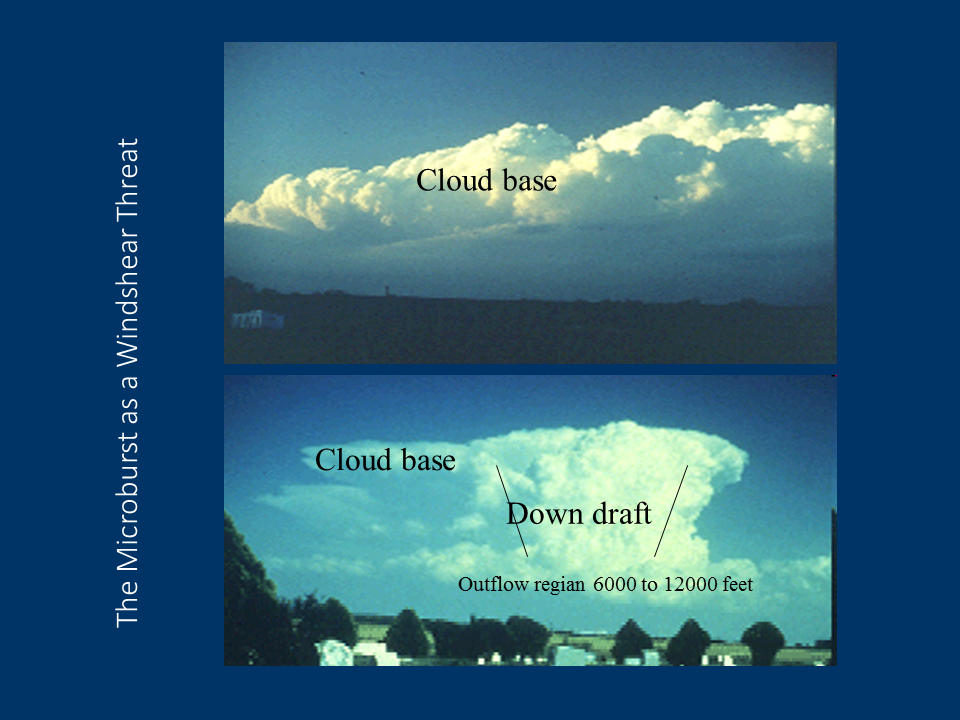
Microburst present two distinct threats to aviation safety:
A downburst that results in strong downdrafts (reaching 40 knots vertical velocity) A down
An outburst that results in strong horizontal wind shear and wind-component reversal (with horizontal winds reaching 100 knots)

SUMMARY
Definition of windshear, is a sudden change of wind velocity/direction.
Type of windshear:
- Vertical windshear (vertical variations of the horizontal wind component, resulting in turbulence and affecting aircraft speed when climbing or decending through the shear layer), and
- Horizontal wind shear (horizontal variations of the wind component (eg. Decreasing headwind or increasing tailwind, or shift from a headwind to a tail wind), affecting the aircraft in level flight, climb or descent)
Take-off Precautions
- Use maximum rated take-off thrust
- Use longest suitable runway
- Consider using recommended flap setting
- Consider using increased rotation airspeed
- Do NOT use speed referenced flight director
summary.....
Approach Precautions:
- Stabilize approach no later than 1000 ft AGL
- Minimize thrust reductions
- Use most suitable runway
- Consider using increased approach speed
- Use autoflight systems during approach
summary.....
- Advisory Circular, AC 00-54, Pilot Windshear Guide
- ALAR Toolkit, FSA ALAR Briefing Note, 5.4 – Windshear
- General Aviation Pilot's Guide to Preflight Weather Planning
- Weather self briefing, and weather decision making, FAA
bibliography.....
End of Chapter 04
Recovery(Chapter 04)-TRAVIRA
By arifmarzuki