Spring Framework
What we're gonna learn?
- Motivation
- Basics → advanced aspects
- Good practice
- Workshops
- How do we test it?
Spring Framework
- EJB alternative
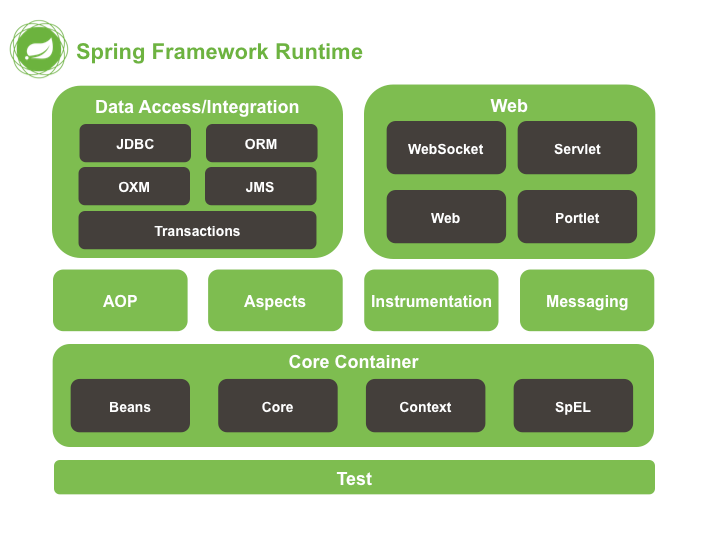
- Umbrella project (Beans, AOP, Data, Boot, Cloud, Integration ...)

Components
../
amqp/
android/
aws/
batch/
beandoc/
boot/
build/
cloud/
commons/
data/
flex/
hateoas/
integration/
javaconfig/
ldap/
maven/
mobile/
osgi/
plugin/
restdocs/
retry/
roo/
security/
session/
shell/
social/
spring/
spring-agent/
spring-aop/
spring-asm/
spring-aspects/
spring-beandoc/
spring-beans/
spring-binding/
spring-context/
spring-context-support/
spring-core/
spring-dao/
spring-expression/
spring-framework-bom/
spring-full/
spring-hibernate/
spring-hibernate2/
spring-hibernate3/
spring-ibatis/
spring-instrument/
spring-instrument-tomcat/
spring-jca/
spring-jdbc/
spring-jdo/
spring-jms/
spring-jmx/
spring-jpa/
spring-ldap/
springloaded/
spring-messaging/
spring-mock/
spring-ojb/
spring-orm/
spring-oxm/
spring-parent/
spring-portlet/
spring-remoting/
spring-struts/
spring-support/
spring-test/
spring-tomcat-weaver/
spring-toplink/
spring-tx/
spring-web/
spring-webflow/
spring-webmvc/
spring-webmvc-portlet/
spring-webmvc-struts/
spring-websocket/
statemachine/
various/
webflow/
ws/
xd/
Maven repository
Repositories
<repositories>
    <repository>
        <id>io.spring.repo.maven.release</id>
        <url>http://repo.spring.io/release/</url>
        <snapshots><enabled>false</enabled></snapshots>
    </repository>
</repositories>

<repositories>
    <repository>
        <id>io.spring.repo.maven.milestone</id>
        <url>http://repo.spring.io/milestone/</url>
        <snapshots><enabled>false</enabled></snapshots>
    </repository>
</repositories>

<repositories>
    <repository>
        <id>io.spring.repo.maven.snapshot</id>
        <url>http://repo.spring.io/snapshot/</url>
        <snapshots><enabled>true</enabled></snapshots>
    </repository>
</repositories>
Bill of Materials
<dependencyManagement>
    <dependencies>
        <dependency>
            <groupId>org.springframework</groupId>
            <artifactId>spring-framework-bom</artifactId>
            <version>4.2.4.RELEASE</version>
            <type>pom</type>
            <scope>import</scope>
        </dependency>
    </dependencies>
</dependencyManagement>

<dependencies>
    <dependency>
        <groupId>org.springframework</groupId>
        <artifactId>spring-context</artifactId>
    </dependency>
    <dependency>
        <groupId>org.springframework</groupId>
        <artifactId>spring-web</artifactId>
    </dependency>
<dependencies>
Gradle
repositories {
    mavenCentral()
    // and optionally...
    maven { url "http://repo.spring.io/release" }
}

dependencies {
    compile("org.springframework:spring-context:4.2.4.RELEASE")
    testCompile("org.springframework:spring-test:4.2.4.RELEASE")
}
Dependency Injection and Inversion of Control
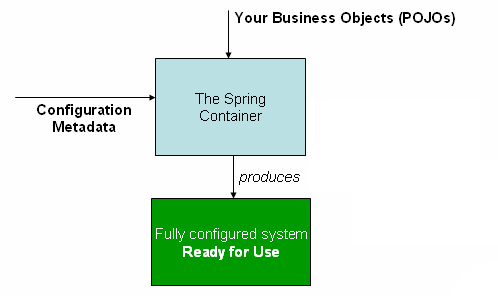
- IoC - moving some aspects of component outside (solving dependencies, GUI callbacks, EJB passivation)
- IoC is what makes framework different from library
- Dependency Injection - moving dependency aspect outside of component
ApplicationContext
- ClassPathXmlApplicationContext, FileSystemXmlApplicationContext
XML Configuration
ApplicationContext context =
    new ClassPathXmlApplicationContext(new String[] {"services.xml", "daos.xml"});

// retrieve configured instance
PetStoreService service = context.getBean("petStore", PetStoreService.class);
services.xml
<?xml version="1.0" encoding="UTF-8"?>
<beans xmlns="http://www.springframework.org/schema/beans"
    xmlns:xsi="http://www.w3.org/2001/XMLSchema-instance"
    xsi:schemaLocation="http://www.springframework.org/schema/beans
        http://www.springframework.org/schema/beans/spring-beans.xsd">

    <!-- services -->

    <bean id="petStore" class="org.springframework.samples.jpetstore.services.PetStoreServiceImpl">
        <property name="accountDao" ref="accountDao"/>
        <property name="itemDao" ref="itemDao"/>
        <!-- additional collaborators and configuration for this bean go here -->
    </bean>

    <!-- more bean definitions for services go here -->

</beans>
daos.xml
<?xml version="1.0" encoding="UTF-8"?>
<beans xmlns="http://www.springframework.org/schema/beans"
    xmlns:xsi="http://www.w3.org/2001/XMLSchema-instance"
    xsi:schemaLocation="http://www.springframework.org/schema/beans
        http://www.springframework.org/schema/beans/spring-beans.xsd">

    <bean id="accountDao"
        class="org.springframework.samples.jpetstore.dao.jpa.JpaAccountDao">
        <!-- additional collaborators and configuration for this bean go here -->
    </bean>

    <bean id="itemDao" class="org.springframework.samples.jpetstore.dao.jpa.JpaItemDao">
        <!-- additional collaborators and configuration for this bean go here -->
    </bean>

    <!-- more bean definitions for data access objects go here -->

</beans>
id vs name
- id - only one
- name - multiple
- are not required
- namingConventions
Composing contexts
<beans>
    <import resource="services.xml"/>
    <import resource="resources/messageSource.xml"/>
    <import resource="/resources/themeSource.xml"/>

    <bean id="bean1" class="..."/>
    <bean id="bean2" class="..."/>
</beans>
Constructor arguments
package x.y;

public class Foo {

    public Foo(Bar bar, Baz baz) {
        // ...
    }

}
<beans>
<bean id="foo" class="x.y.Foo">
<constructor-arg ref="bar"/>
<constructor-arg ref="baz"/>
</bean>
<bean id="bar" class="x.y.Bar"/>
<bean id="baz" class="x.y.Baz"/>
</beans>Resolving constructor conflicts
public class ExampleBean {
    private int years;
    private String ultimateAnswer;

    public ExampleBean(int years, String ultimateAnswer) {
        this.years = years;
        this.ultimateAnswer = ultimateAnswer;
    }
}
<bean id="exampleBean" class="examples.ExampleBean">
<constructor-arg type="int" value="7500000"/>
<constructor-arg type="java.lang.String" value="42"/>
</bean><bean id="exampleBean" class="examples.ExampleBean">
<constructor-arg index="0" value="7500000"/>
<constructor-arg index="1" value="42"/>
</bean><bean id="exampleBean" class="examples.ExampleBean">
<constructor-arg name="years" value="7500000"/>
<constructor-arg name="ultimateAnswer" value="42"/>
</bean>Static factory method
public class ClientService {
    private static ClientService clientService = new ClientService();
    private ClientService() {}

    public static ClientService createInstance() {
        return clientService;
    }
}
<bean id="clientService"
class="examples.ClientService"
factory-method="createInstance"/>Instance factory method
public class DefaultServiceLocator {

    private static ClientService clientService = new ClientServiceImpl();
    private DefaultServiceLocator() {}

    public ClientService createClientServiceInstance() {
        return clientService;
    }
}
<!-- the factory bean, which contains a method called createInstance() -->
<bean id="serviceLocator" class="examples.DefaultServiceLocator">
<!-- inject any dependencies required by this locator bean -->
</bean>
<!-- the bean to be created via the factory bean -->
<bean id="clientService"
factory-bean="serviceLocator"
factory-method="createClientServiceInstance"/>P namspace
<bean id="myDataSource" class="org.apache.commons.dbcp.BasicDataSource" destroy-method="close">
    <!-- results in a setDriverClassName(String) call -->
    <property name="driverClassName" value="com.mysql.jdbc.Driver"/>
    <property name="url" value="jdbc:mysql://localhost:3306/mydb"/>
    <property name="username" value="root"/>
    <property name="password" value="masterkaoli"/>
</bean>
<beans xmlns="http://www.springframework.org/schema/beans"
xmlns:xsi="http://www.w3.org/2001/XMLSchema-instance"
xmlns:p="http://www.springframework.org/schema/p"
xsi:schemaLocation="http://www.springframework.org/schema/beans
http://www.springframework.org/schema/beans/spring-beans.xsd">
<bean id="myDataSource" class="org.apache.commons.dbcp.BasicDataSource"
destroy-method="close"
p:driverClassName="com.mysql.jdbc.Driver"
p:url="jdbc:mysql://localhost:3306/mydb"
p:username="root"
p:password="masterkaoli"/>
</beans>C namspace
<beans xmlns="http://www.springframework.org/schema/beans"
    xmlns:xsi="http://www.w3.org/2001/XMLSchema-instance"
    xmlns:c="http://www.springframework.org/schema/c"
    xsi:schemaLocation="http://www.springframework.org/schema/beans
        http://www.springframework.org/schema/beans/spring-beans.xsd">

    <bean id="bar" class="x.y.Bar"/>
    <bean id="baz" class="x.y.Baz"/>

    <!-- traditional declaration -->
    <bean id="foo" class="x.y.Foo">
        <constructor-arg ref="bar"/>
        <constructor-arg ref="baz"/>
        <constructor-arg value="foo@bar.com"/>
    </bean>

    <!-- c-namespace declaration -->
    <bean id="foo" class="x.y.Foo" c:bar-ref="bar" c:baz-ref="baz" c:email="foo@bar.com"/>

</beans>
Injecting collections
<bean id="moreComplexObject" class="example.ComplexObject">
    <!-- results in a setAdminEmails(java.util.Properties) call -->
    <property name="adminEmails">
        <props>
            <prop key="administrator">administrator@example.org</prop>
            <prop key="support">support@example.org</prop>
            <prop key="development">development@example.org</prop>
        </props>
    </property>
    <!-- results in a setSomeList(java.util.List) call -->
    <property name="someList">
        <list>
            <value>a list element followed by a reference</value>
            <ref bean="myDataSource" />
        </list>
    </property>
    <!-- results in a setSomeMap(java.util.Map) call -->
    <property name="someMap">
        <map>
            <entry key="an entry" value="just some string"/>
            <entry key ="a ref" value-ref="myDataSource"/>
        </map>
    </property>
    <!-- results in a setSomeSet(java.util.Set) call -->
    <property name="someSet">
        <set>
            <value>just some string</value>
            <ref bean="myDataSource" />
        </set>
    </property>
</bean>
Inner beans
<bean id="outer" class="...">
    <!-- instead of using a reference to a target bean, simply define the target bean inline -->
    <property name="target">
        <bean class="com.example.Person"> <!-- this is the inner bean -->
            <property name="name" value="Fiona Apple"/>
            <property name="age" value="25"/>
        </bean>
    </property>
</bean>
Autowiring
- no
- byName
- byType
- constructor
Autowiring
- autowire-candidate: true/false
- default-autowire-candidates on <beans>
- takes comma-separated patterns: *Repository
Scopes
- singleton
- prototype
- ...
singleton
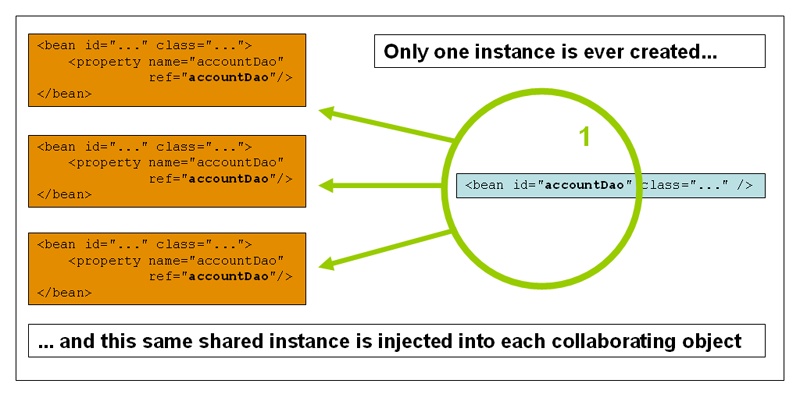
<bean id="accountService" class="com.foo.DefaultAccountService"/>

<!-- the following is equivalent, though redundant (singleton scope is the default) -->
<bean id="accountService" class="com.foo.DefaultAccountService" scope="singleton"/>
prototype
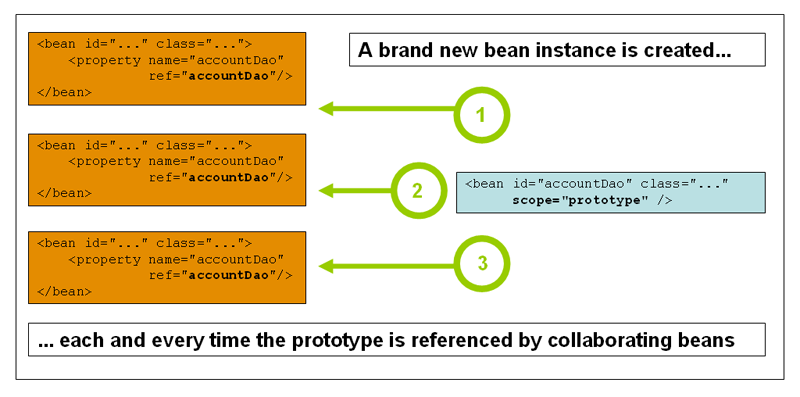
Scopes
- singleton
- prototype
- request
- session
- application (single ServletContext)
- custom
Liecycle
- InitializingBean, DisposeableBean
- @PostConstruct and @PreDestroy
- init-method and destroy-method
- (inferred) for java.lang.AutoCloseable and java.io.Closeable as destroy-method
- default-init-method and deault-destroy-method on <beans>
InitializingBean and DisposeableBean
public class AnotherExampleBean implements InitializingBean {
    public void afterPropertiesSet() {
        // do some initialization work
    }
}
<bean id="exampleInitBean" class="examples.AnotherExampleBean"/>public class AnotherExampleBean implements DisposableBean {
public void destroy() {
// do some destruction work (like releasing pooled connections)
}
}<bean id="exampleInitBean" class="examples.AnotherExampleBean"/>@PostConstruct and @PreDestroy
public class AnotherExampleBean {
    @PostConstruct
    public void afterPropertiesSet() {
        // do some initialization work
    }
}
<bean id="exampleInitBean" class="examples.AnotherExampleBean"/>public class AnotherExampleBean {
@PreDestroy
public void destroy() {
// do some destruction work (like releasing pooled connections)
}
}<bean id="exampleInitBean" class="examples.AnotherExampleBean"/>init-method and destroy-method
public class AnotherExampleBean {
    public void afterPropertiesSet() {
        // do some initialization work
    }
}
<bean id="exampleInitBean" class="examples.AnotherExampleBean"
init-method="afterPropertiesSet" />public class AnotherExampleBean {
public void destroy() {
// do some destruction work (like releasing pooled connections)
}
}<bean id="exampleInitBean" class="examples.AnotherExampleBean"
destroy-method="destroy" />init-method and destroy-method
<beans default-init-method="init" default-destroy-method="destroy" >

    <bean id="someService" class="com.foo.MyService" />

</beans>
shutdown hook
ConfigurableApplicationContext ctx =
    new ClassPathXmlApplicationContext("spring-context.xml");

ctx.registerShutdownHook();
ApplicationContext context =
new ClassPathXmlApplicationContext("classpath:spring-context.xml");
((ConfigurableApplicationContext)context).registerShutdownHook();Task
- What's the order o initialization and destroy methods?
Annotation configuration
annotation-config
<?xml version="1.0" encoding="UTF-8"?>
<beans xmlns="http://www.springframework.org/schema/beans"
    xmlns:xsi="http://www.w3.org/2001/XMLSchema-instance"
    xmlns:context="http://www.springframework.org/schema/context"
    xsi:schemaLocation="http://www.springframework.org/schema/beans
        http://www.springframework.org/schema/beans/spring-beans.xsd
        http://www.springframework.org/schema/context
        http://www.springframework.org/schema/context/spring-context.xsd">

    <context:annotation-config/>
    ...

</beans>
@Autowired
public class MovieRecommender {

    @Autowired
    private MovieCatalog movieCatalog;

    private CustomerPreferenceDao customerPreferenceDao;

    @Autowired
    public MovieRecommender(CustomerPreferenceDao customerPreferenceDao) {
        this.customerPreferenceDao = customerPreferenceDao;
    }
}
@Autowired
// All instance of MovieCatalog
@Autowired
private MovieCatalog[] movieCatalogs;

// The same for sets
@Autowired
public void setMovieCatalogs(Set<MovieCatalog> movieCatalogs) {
    this.movieCatalogs = movieCatalogs;
}

// All beans with their names
@Autowired
public void setMovieCatalogs(Map<String, MovieCatalog> movieCatalogs) {
    this.movieCatalogs = movieCatalogs;
}

@Autowired(required=false)
public void setMovieFinder(MovieFinder movieFinder) {
    this.movieFinder = movieFinder;
}
Conflicts
<bean class="example.SimpleMovieCatalog">
    <qualifier value="main"/>
</bean>

<bean class="example.SimpleMovieCatalog">
    <qualifier value="action"/>
</bean>
@Autowired
public void prepare(@Qualifier("main") MovieCatalog movieCatalog,
CustomerPreferenceDao customerPreferenceDao) {
this.movieCatalog = movieCatalog;
this.customerPreferenceDao = customerPreferenceDao;
}Alternatives
@Resource(name="myMovieFinder")
public void setMovieFinder(MovieFinder movieFinder) {
    this.movieFinder = movieFinder;
}

@Resource
public void setMovieFinder(MovieFinder movieFinder) {
    this.movieFinder = movieFinder;
}

@Inject
public void setMovieFinder(MovieFinder movieFinder) {
    this.movieFinder = movieFinder;
}
component-scan
<?xml version="1.0" encoding="UTF-8"?>
<beans xmlns="http://www.springframework.org/schema/beans"
    xmlns:xsi="http://www.w3.org/2001/XMLSchema-instance"
    xmlns:context="http://www.springframework.org/schema/context"
    xsi:schemaLocation="http://www.springframework.org/schema/beans
        http://www.springframework.org/schema/beans/spring-beans.xsd
        http://www.springframework.org/schema/context
        http://www.springframework.org/schema/context/spring-context.xsd">

    <context:component-scan base-package="org.example"/>

</beans>
@Service
@Service
public class MovieRecommender {

    @Autowired
    private MovieCatalog movieCatalog;

    private CustomerPreferenceDao customerPreferenceDao;

    @Autowired
    public MovieRecommender(CustomerPreferenceDao customerPreferenceDao) {
        this.customerPreferenceDao = customerPreferenceDao;
    }
}
Other annotations
- @Component
- @Service
- @Repository
- @Configuration
Java-based configuration
- @Configuration
- @Bean
<beans>
    <bean id="myService" class="com.acme.services.MyServiceImpl"/>
</beans>
@Configuration
public class AppConfig {
@Bean
public MyService myService() {
return new MyServiceImpl();
}
}Creating context
public static void main(String[] args) {
    ApplicationContext ctx = new AnnotationConfigApplicationContext(AppConfig.class);
    MyService myService = ctx.getBean(MyService.class);
    myService.doStuff();
}
@Configuration
public class AppConfig {
@Bean
public MyService myService() {
return new MyServiceImpl();
}
}public static void main(String[] args) {
AnnotationConfigApplicationContext ctx = new AnnotationConfigApplicationContext();
ctx.register(AppConfig.class, OtherConfig.class);
ctx.register(AdditionalConfig.class);
ctx.refresh();
MyService myService = ctx.getBean(MyService.class);
myService.doStuff();
}Coponent scanning
@Configuration
@ComponentScan(basePackages = "com.acme")
public class AppConfig  {
    ...
}
<beans>
<context:component-scan base-package="com.acme"/>
</beans>public static void main(String[] args) {
AnnotationConfigApplicationContext ctx = new AnnotationConfigApplicationContext();
ctx.scan("com.acme");
ctx.refresh();
MyService myService = ctx.getBean(MyService.class);
}Beans dependencies
@Configuration
public class AppConfig {

    @Bean
    public TransferService transferService(AccountRepository accountRepository) {
        return new TransferServiceImpl(accountRepository);
    }

}
@Configuration
public class AppConfig {
@Bean(autowire = Autowire.BY_TYPE)
public TransferService transferService() {
return new TransferServiceImpl();
}
}@Bean annotation
@Target({ElementType.METHOD, ElementType.ANNOTATION_TYPE})
@Retention(RetentionPolicy.RUNTIME)
@Documented
public @interface Bean {
	String[] name() default {};
	Autowire autowire() default Autowire.NO;
	String initMethod() default "";
	String destroyMethod() default AbstractBeanDefinition.INFER_METHOD;
}
Importing
@Configuration
@Import({ConfigA.class, ConfigC.clas})
public class ConfigB {
}
@Configuration
@ImportResource("classpath:spring-context.xml")
public class AppConfig {
}IntelliJ Diagrams
Property placeholder
<bean class="org.springframework.beans.factory.config.PropertyPlaceholderConfigurer">
    <property name="locations" value="classpath:com/foo/jdbc.properties"/>
</bean>

<bean id="dataSource" destroy-method="close"
        class="org.apache.commons.dbcp.BasicDataSource">
    <property name="driverClassName" value="${jdbc.driverClassName}"/>
    <property name="url" value="${jdbc.url}"/>
    <property name="username" value="${jdbc.username}"/>
    <property name="password" value="${jdbc.password}"/>
</bean>
<context:property-placeholder location="classpath:com/foo/jdbc.properties"/>Property placeholder
@Configuration
@ImportResource("classpath:/com/acme/properties-config.xml")
public class AppConfig {

    @Value("${jdbc.url}")
    private String url;

    @Value("${jdbc.username}")
    private String username;

    @Value("${jdbc.password}")
    private String password;

    @Bean
    public DataSource dataSource() {
        return new DriverManagerDataSource(url, username, password);
    }

}
Property Sources Placeholder
@Configuration
@PropertySource("classpath:root/test.props")
public class SampleConfig {
 @Value("${test.prop}")
 private String attr;

 @Bean
 public SampleService sampleService() {
  return new SampleService(attr);
 }

 @Bean
 public PropertySourcesPlaceholderConfigurer placeHolderConfigurer() {
  return new PropertySourcesPlaceholderConfigurer();
 }
}
Profiles
@Configuration
@Profile("dev")
public class StandaloneDataConfig {

    @Bean
    public DataSource dataSource() {
        return new EmbeddedDatabaseBuilder()
            .setType(EmbeddedDatabaseType.HSQL)
            .addScript("classpath:com/bank/config/sql/schema.sql")
            .addScript("classpath:com/bank/config/sql/test-data.sql")
            .build();
    }
}
@Configuration
@Profile("production")
public class JndiDataConfig {
@Bean(destroyMethod="")
public DataSource dataSource() throws Exception {
Context ctx = new InitialContext();
return (DataSource) ctx.lookup("java:comp/env/jdbc/datasource");
}
}Activating profile
AnnotationConfigApplicationContext ctx = new AnnotationConfigApplicationContext();
ctx.getEnvironment().setActiveProfiles("dev");
ctx.register(SomeConfig.class, StandaloneDataConfig.class, JndiDataConfig.class);
ctx.refresh();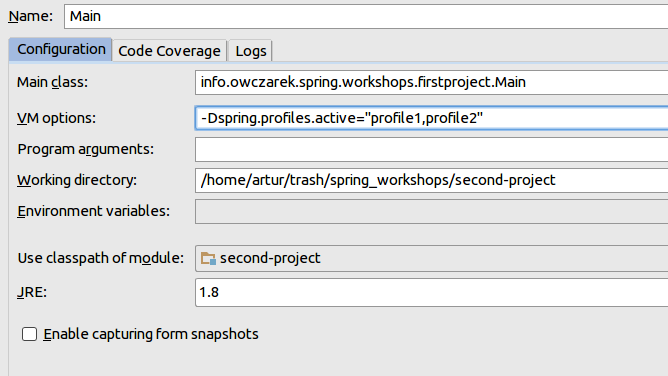
Profiles
@Target(ElementType.TYPE)
@Retention(RetentionPolicy.RUNTIME)
@Profile("production")
public @interface Production {
}
@Configuration
@Profile("production")
public class JndiDataConfig {
@Bean(destroyMethod="")
public DataSource dataSource() throws Exception {
Context ctx = new InitialContext();
return (DataSource) ctx.lookup("java:comp/env/jdbc/datasource");
}
}@Configuration
@Production
public class JndiDataConfig {
@Bean(destroyMethod="")
public DataSource dataSource() throws Exception {
Context ctx = new InitialContext();
return (DataSource) ctx.lookup("java:comp/env/jdbc/datasource");
}
}Profiles
<beans profile="dev"
    xmlns="http://www.springframework.org/schema/beans"
    xmlns:xsi="http://www.w3.org/2001/XMLSchema-instance"
    xmlns:jdbc="http://www.springframework.org/schema/jdbc"
    xsi:schemaLocation="...">

    <jdbc:embedded-database id="dataSource">
        <jdbc:script location="classpath:com/bank/config/sql/schema.sql"/>
        <jdbc:script location="classpath:com/bank/config/sql/test-data.sql"/>
    </jdbc:embedded-database>
</beans>
<beans xmlns="http://www.springframework.org/schema/beans"
xmlns:xsi="http://www.w3.org/2001/XMLSchema-instance"
xmlns:jdbc="http://www.springframework.org/schema/jdbc"
xmlns:jee="http://www.springframework.org/schema/jee"
xsi:schemaLocation="...">
<beans profile="dev">
<jdbc:embedded-database id="dataSource">
<jdbc:script location="classpath:com/bank/config/sql/schema.sql"/>
<jdbc:script location="classpath:com/bank/config/sql/test-data.sql"/>
</jdbc:embedded-database>
</beans>
<beans profile="production">
<jee:jndi-lookup id="dataSource" jndi-name="java:comp/env/jdbc/datasource"/>
</beans>
</beans>Events (Event class)
public class BlackListEvent extends ApplicationEvent {

    private final String address;
    private final String test;

    public BlackListEvent(Object source, String address, String test) {
        super(source);
        this.address = address;
        this.test = test;
    }

    // accessor and other methods...

}
Events (Publisher)
public class EmailService implements ApplicationEventPublisherAware {

    private List<String> blackList;
    private ApplicationEventPublisher publisher;

    public void setBlackList(List<String> blackList) {
        this.blackList = blackList;
    }

    public void setApplicationEventPublisher(ApplicationEventPublisher publisher) {
        this.publisher = publisher;
    }

    public void sendEmail(String address, String text) {
        if (blackList.contains(address)) {
            BlackListEvent event = new BlackListEvent(this, address, text);
            publisher.publishEvent(event);
            return;
        }
        // send email...
    }

}
Events (Listener)
public class BlackListNotifier implements ApplicationListener<BlackListEvent> {

    private String notificationAddress;

    public void setNotificationAddress(String notificationAddress) {
        this.notificationAddress = notificationAddress;
    }

    public void onApplicationEvent(BlackListEvent event) {
        // notify appropriate parties via notificationAddress...
    }

}
public class BlackListNotifier {
private String notificationAddress;
public void setNotificationAddress(String notificationAddress) {
this.notificationAddress = notificationAddress;
}
@EventListener
public void processBlackListEvent(BlackListEvent event) {
// notify appropriate parties via notificationAddress...
}
}Events (Listener)
@EventListener({ContextStartedEvent.class, ContextRefreshedEvent.class})
public void handleContextStart() {

}
@EventListener(condition = "#event.test == 'foo'")
public void processBlackListEvent(BlackListEvent event) {
// notify appropriate parties via notificationAddress...
}Resources
public interface Resource extends InputStreamSource {

    boolean exists();

    boolean isOpen();

    URL getURL() throws IOException;

    File getFile() throws IOException;

    Resource createRelative(String relativePath) throws IOException;

    String getFilename();

    String getDescription();

}
public interface InputStreamSource {
InputStream getInputStream() throws IOException;
}Resource types
- UrlResource
- ClassPathResource
- FileSystemResource
- ServletContextResource
- InputStreamResource
- ByteArrayResource
ResourceLoader
Resource template = ctx.getResource("some/resource/path/myTemplate.txt"); // depends on the context type
Resource template = ctx.getResource("classpath:some/resource/path/myTemplate.txt");

Resource template = ctx.getResource("file:///some/resource/path/myTemplate.txt");
Resource template = ctx.getResource("http://myhost.com/resource/path/myTemplate.txt");
classpath*:
ConfigurableApplicationContext context =
                new ClassPathXmlApplicationContext("classpath*:*-context.xml");
Spring Framework
By Artur Owczarek