Serialization

In PHP world
by m1r1k
Serialization?
Serialization is the process of translating data structures or object state into a format that can be stored (for example, in a file or memory buffer, or transmitted across a network connection link) and reconstructed later in the same or another computer environment.

What could be easier?
$obj = (object) [
  'id' => 15,
  'label' => 'Serialize me!',
  'tags' => [
    'Tag1', 'Tag2', 'Tag3'
  ],
];

// Let's represent it as a string.
serialize()/deserialize()
echo serialize($obj);

// 'O:8:"stdClass":3:{
//    s:2:"id";i:15;
//    s:5:"label";s:13:"Serialize me!";
//    s:4:"tags";a:2:{
//       i:0;s:4:"Tag1";
//       i:1;s:4:"Tag2";
//    }
// }'
json_encode()/json_decode()
echo json_encode($obj);

// {
//  "id": 15,
//  "label": "Serialize me!",
//  "tags": [
//    "Tag1",
//    "Tag2"
//  ]
// }
SimpleXML
$xml = simplexml_load_string("<?xml version='1.0'><document />");
foreach ((array) $obj as $key => $value) {
  $xml->addChild($key, $value);
}
echo $xml->asXML();

// <?xml version="1.0"?>
//  <object>
//      <id>15</id>
//      <label>Serialize me!</label>
//      <empty/>
//  </object>
But we have other formats
- YAML
- HAL
- Xliff
- Custom formated XML
- ect
But usually we have a bit more complex data structures
Have you seen externals of ContentEntity instance?
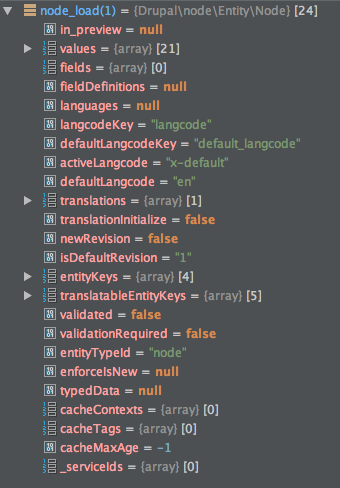
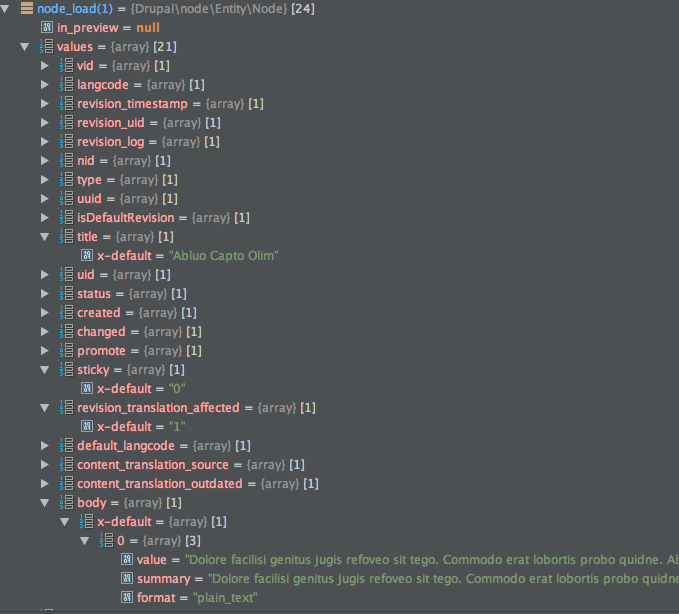
echo strlen(serialize(node_load(1)));

// 9846

echo json_encode(node_load(1));

// {"in_preview":null}

echo \Drupal::service('serializer')->serialize(node_load(1), 'json');

// { "nid": [ { "value": "1" } ], "uuid": [ { "value": "3bc88030-1ebb-457b-9e00-db67c90efd17" } ],
// "vid": [ { "value": "1" } ], "type": [ { "target_id": "page" } ], "langcode": [ { "value": "en" } ],
// "title": [ { "value": "Abluo Capto Olim" } ], "uid": [ { "target_id": "0", "url": "\/user\/0" } ],
// "status": [ { "value": "1" } ], "created": [ { "value": "1447807663" } ], "changed": [ { "value":
//  "1448367583" } ], "promote": [ { "value": "0" } ], "sticky": [ { "value": "0" } ],
// "revision_timestamp": [ { "value": "1448367583" } ], "revision_uid": [ { "target_id": "0",
// "url": "\/user\/0" } ], "revision_log": [], "revision_translation_affected": [ { "value": "1" } ],
// "default_langcode": [ { "value": "1" } ], "content_translation_source": [],
// "content_translation_outdated": [], "path": [], "body": [ { "value": "VALUE",
// "format": "plain_text", "summary": "VALUE" } ] }
What is serializer?
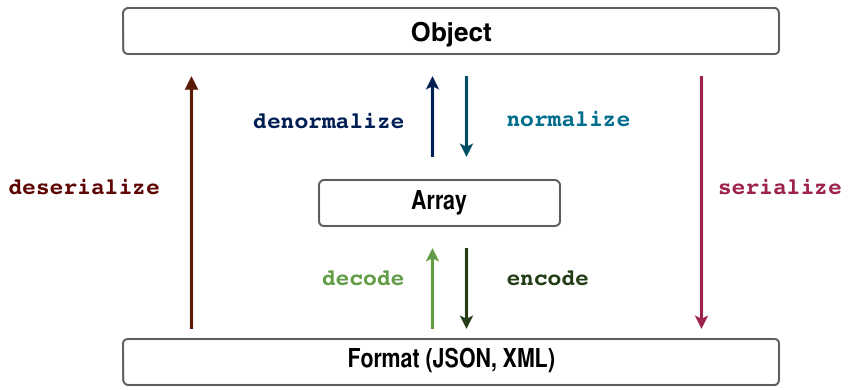
Serializer public API
class Serializer {

    final public function serialize($data, $format, array $context = array())

    final public function deserialize($data, $type, $format, array $context = array())

    public function normalize($data, $format = null, array $context = array())

    public function denormalize($data, $type, $format = null, array $context = array())

    public function supportsNormalization($data, $format = null)

    public function supportsDenormalization($data, $type, $format = null)

}
Basic usage
use Symfony\Component\Serializer\Serializer;
use Symfony\Component\Serializer\Encoder\XmlEncoder;
use Symfony\Component\Serializer\Encoder\JsonEncoder;
use Symfony\Component\Serializer\Normalizer\ObjectNormalizer;

$encoders = array(new XmlEncoder(), new JsonEncoder());
$normalizers = array(new ObjectNormalizer());

$serializer = new Serializer($normalizers, $encoders);

$serializer->serialize($obj, 'json');
Serialization in Drupal 8
- Symfony components
- Main Serializer API
- Basic Encoders
- Serialization module
- Normalizers
- Services resolver
- Hal module
- Normalizers for HAL
- Encoder for HAL
Basic usage
$serializer = \Drupal::service('serializer');

$json_output = $serializer->serialize($node, 'json');

$deserialized_node = $serializer->deserialize($json_output,
    'Drupal\Core\Entity\ContentEntityInterface', 'json', ['entity_type' => 'node']);
Drupal Normalizers
| Normalizer | Goal |
|---|---|
| ComplexDataNormalizer | Top level normalizer for all objects in drupal |
| ConfigEntityNormalizer | Normalizer to deal with config entities only |
| ContentEntityNormalizer | Normalizer to deal with content entities |
| ListNormalizer | Normalizer for iterable objects |
| TypedDataNormalizer | Normalizer for low level pieces of data |
Metadata definition
services:
  serializer.normalizer.config_entity:
    class: Drupal\serialization\Normalizer\ConfigEntityNormalizer
    tags:
      - { name: normalizer }
    arguments: ['@entity.manager']
  serializer.normalizer.content_entity:
      class: Drupal\serialization\Normalizer\ContentEntityNormalizer
      tags:
        - { name: normalizer }
      arguments: ['@entity.manager']
  serializer.normalizer.password_field_item:
      class: Drupal\serialization\Normalizer\NullNormalizer
      arguments: ['Drupal\Core\Field\Plugin\Field\FieldType\PasswordItem']
      tags:
        - { name: normalizer, priority: 20 }
  serializer.encoder.hal:
    class: Drupal\hal\Encoder\JsonEncoder
    tags:
      - { name: encoder, priority: 10, format: hal_json }
Let's create our own format
Technical description:
- Custom formated XML
- XML comments
- Show only translatable data
http://cgit.drupalcode.org/smartling/tree/?h=8.x-1.x
Symfony and JMS Serializer
The same serializer with the same public API but...
With some adjustments :)
Flexible configuration
$serializer =
    JMS\Serializer\SerializerBuilder::create()
    // Set directory to store cached and compiled
    // version of classes with metadata.
    ->setCacheDir($someWritableDir)
    // Additional check if cached data is still valid.
    ->setDebug($trueOrFalse)
    // Custom logic injection into the serialization process
    ->configureHandlers(function(JMS\Serializer\Handler\HandlerRegistry $registry) {
            $registry->registerHandler('serialization', 'MyObject', 'json',
                function($visitor, MyObject $obj, array $type) {
                    return $obj->getName();
                }
            );
        })
    ->build();
Events
use JMS\Serializer\EventDispatcher\EventSubscriberInterface;
use JMS\Serializer\EventDispatcher\PreSerializeEvent;

class MyEventSubscriber implements EventSubscriberInterface
{
    public static function getSubscribedEvents()
    {
        return array(
            array('event' => 'serializer.pre_serialize', 'method' => 'onPreSerialize'),
        );
    }

    public function onPreSerialize(PreSerializeEvent $event)
    {
        // do something
    }
}
Events
use JMS\Serializer\EventDispatcher\EventSubscriberInterface;
use JMS\Serializer\EventDispatcher\PreSerializeEvent;

class MyEventSubscriber implements EventSubscriberInterface
{
    public static function getSubscribedEvents()
    {
        return array(
            array('event' => 'serializer.pre_serialize', 'method' => 'onPreSerialize'),
        );
    }

    public function onPreSerialize(PreSerializeEvent $event)
    {
        // do something
    }
}
And the most delicious
ANNOTATIONS!
http://jmsyst.com/libs/serializer/master/reference/annotations
Thank you
Questions?
Serialization in Symfony and Drupal 8
By Artyom Miroshnik