Schnyder Woods for Higher Genus Triangulated Surfaces
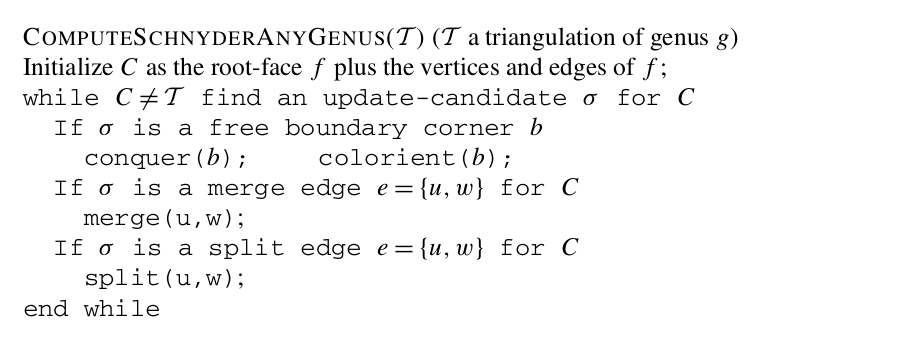
Input: a triangulation of genus g
Output: g-Schnyder wood
Implementation of the algorithm
1. 2g merge/split operations-> 2g+1 periods when executing
2. The implementation of each period
- Half-edge data structure
- each brin has several pointers: to the incident vertex, to the incident face, to the opposite brin, to tje following brin, to the dual brin
- T & its dual T* are fixed structures
- C and its complementary dual D evolves over time
- a brin of D has an additional pointer to the corresponding boundary corner of C
- Free boundary corners are stored in a list: the first one is selected each time
- after conquering the corner, a sequence of update is needed -> O(|E|) = O(n + g)
Encoding and Decoding
G2 is the cut-graph of the Schnyder wood, i.e., G2 is T2
plus the 2g special edges.
-> G2 can be encoded by a word W of length 2n − 2 + O(g log(n)).
W' is obtained from a clockwise walk along the (unique) face of G2
the pair of words (W, W') is of total length 4n + O(g log(n))
reconstruction of the Schnyder wood from (W, W') takes time
O((n + g)g), since it just consists in building the cut-graph
G2 and walking clockwise along G2 .
Schnyder Woods for higher genus
By austinlaurice