
The Role of Monolithic Chromatography in Next-Generation Drug Manufacturing — BCI
By Biochromatographix
The Role of Monolithic Chromatography in Next-Generation Drug Manufacturing — BCI
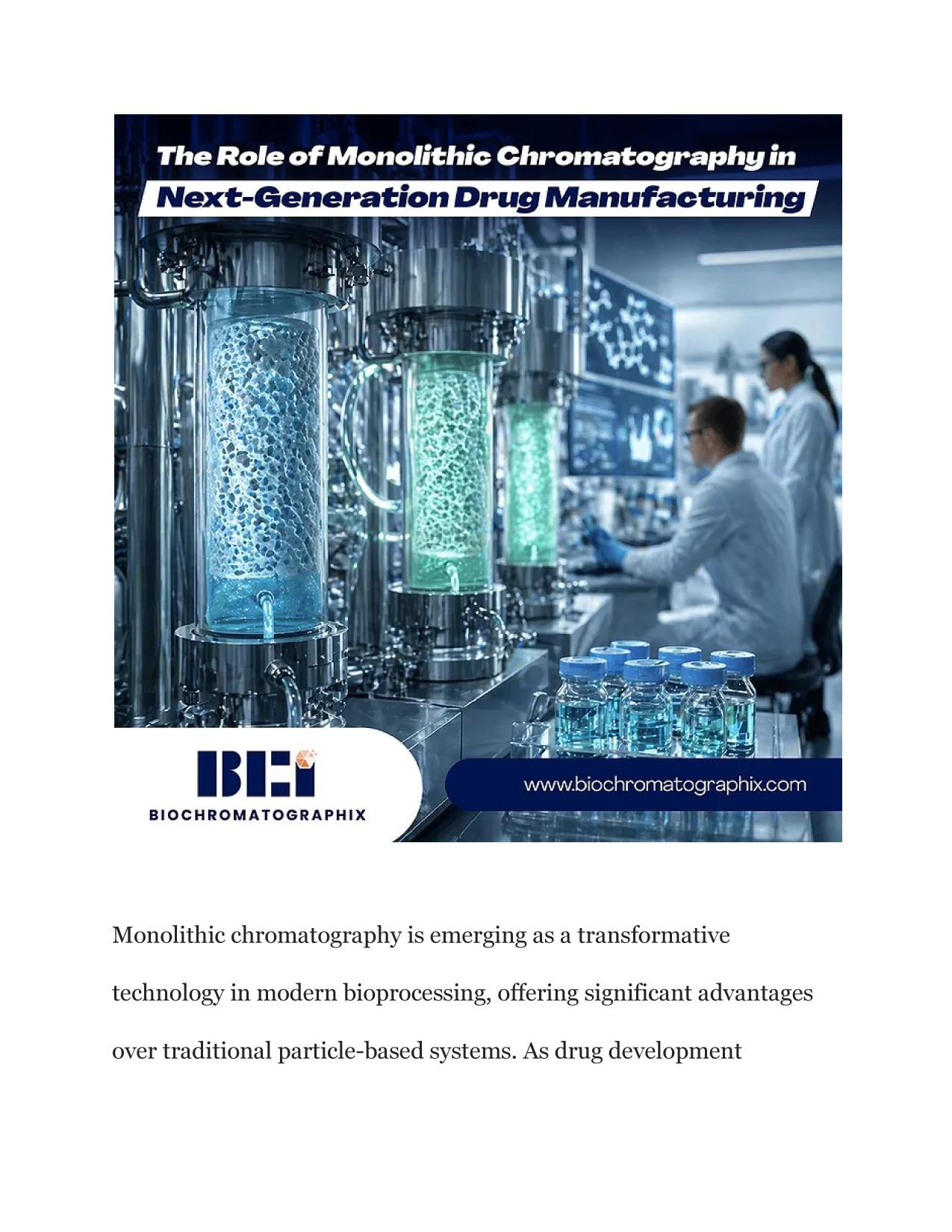
Monolithic chromatography is emerging as a transformative technology in modern bioprocessing, offering significant advantages over traditional particle-based systems. As drug development increasingly focuses on complex biologics, the need for efficient, scalable, and reliable purification methods has become critical. This is where monolithic chromatography plays a key role, especially for pharma manufacturing companies Singapore aiming to enhance productivity and maintain consistent product quality. Unlike conventional chromatography columns packed with porous particles, monolithic columns consist of a single continuous structure with interconnected channels. This unique architecture allows for convective flow rather than relying solely on diffusion, which is often a limiting factor in traditional systems. As a result, monolithic chromatography significantly improves flow efficiency, enabling faster processing without compromising separation performance. One of the primary advantages of monolithic chromatography is its ability to handle high flow rates while maintaining resolution. In traditional systems, increasing the flow rate can reduce separation efficiency due to insufficient interaction time between the target molecules and the stationary phase. Visit us : https://biochromatographix.com/