Design and Targeting of Transfers
Brandon Williams
Development Economics
November 12, 2024
Design and Targeting of Transfers
Development Economics
November 12, 2024
Food vs. Food Stamps (2021)
- Published 2023 as "Electronic Food Vouchers: Evidence from an At-Scale Experiment in Indonesia"
- Two common food programs:
- Directly provide food
- Provide vouchers or credits for purchase of food
- How do these differ?
- More flexibility for beneficiaries and different consumption choices
- Sourcing of food in limited areas, e.g. if government provides
- In-kind may self-select for those that most benefit
- Administration and logistical challenges
- Cheaper to give credit than move food, but administration of payment scheme is nontrivial
- Control over distribution and monitoring for fraud
Design and Targeting of Transfers
Development Economics
November 12, 2024
Food vs. Food Stamps (2021)
- Indonesia reform to in-kind food delivery replaced with voucher BPNT for rice or eggs (equal in value)
- Conditional on receiving benefits, voucher provided 85% more subsidy/worth
- Fewer households received benefit
- Poor households 16% less likely
- Wealthier households 49% less likely
Design and Targeting of Transfers
Development Economics
November 12, 2024
Food vs. Food Stamps (2021)
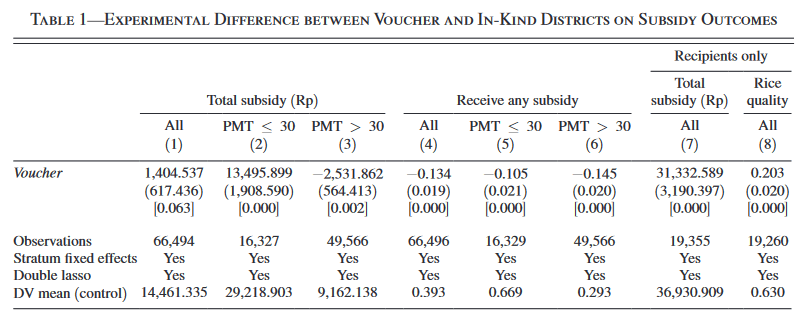
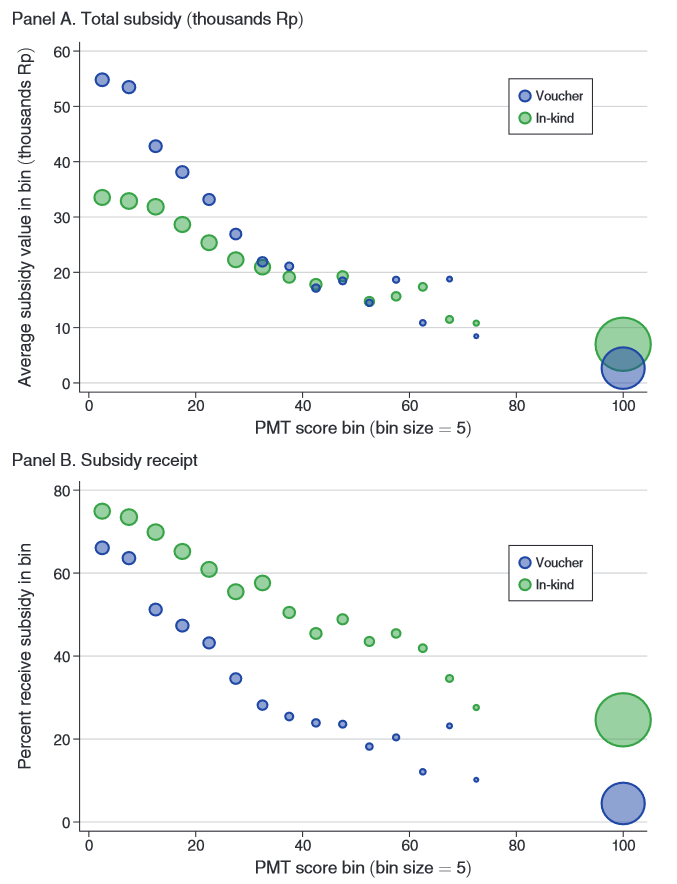
Fewer receive subsidy overall
More aid to those who need it
PMT = Proxy-means test, index of poverty
Design and Targeting of Transfers
Development Economics
November 12, 2024
Food vs. Food Stamps (2021)
Design and Targeting of Transfers
Development Economics
November 12, 2024
Food vs. Food Stamps (2021)
Combined, these results show a clear pattern. In in-kind districts, assistance is subdivided into much smaller amounts, so that the typical beneficiary receives only about a third of the intended transfer size. The additional funds are used to give many more households assistance, despite the fact that this is explicitly against the stated rules. In voucher areas, this practice is substantially less prevalent. Somewhat fewer households receive assistance, but those that receive assistance receive substantially more, and usually the full amount they were entitled to.
Design and Targeting of Transfers
Development Economics
November 12, 2024
Food vs. Food Stamps (2021)
- Indonesia reform to in-kind food delivery replaced with voucher BPNT for rice or eggs (equal in value)
- Conditional on receiving benefits, voucher provided 85% more subsidy/worth
- Fewer households received benefit
- Poor households 16% less likely
- Wealthier households 49% less likely
- Combined: more aid to poorer households. What are the ramifications?
- For households in the bottom 15 percent, the share of households in poverty fell by 20 percent
Design and Targeting of Transfers
Development Economics
November 12, 2024
Food vs. Food Stamps (2021)
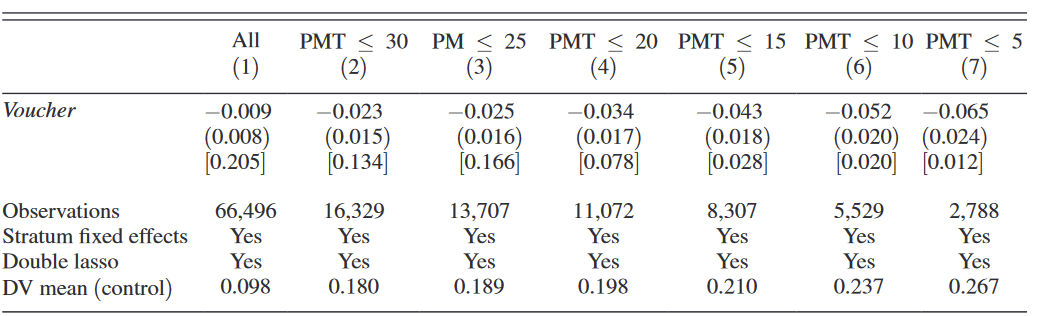
Corresponds to bottom 15%
4.3 pp reduction = 20% reduction from the mean
Design and Targeting of Transfers
Development Economics
November 12, 2024
Food vs. Food Stamps (2021)
- Indonesia reform to in-kind food delivery replaced with voucher BPNT for rice or eggs (equal in value)
- Conditional on receiving benefits, voucher provided 85% more subsidy/worth
- Fewer households received benefit
- Poor households 16% less likely
- Wealthier households 49% less likely
- Poor households 16% less likely
- Combined: more aid to poorer households. What are the ramifications?
- For households in the bottom 15 percent, the share of households in poverty fell by 20 percent
- Little change in local prices (and offset when arise)
- Also cheaper to administer
Dev.Slides.11.12
By bjw95