Veto Power, Delegation and Mechanism Design
Brandon Williams
Alistair Wilson
Richard Van Weelden
ESA North America
October 11, 2025
Setup
Setup
- Many "bargaining" contexts exist in which a less-informed (about preferences) party must decide what to offer to a more-informed party, who hold veto power
Setup
- Many "bargaining" contexts exist in which a less-informed (about preferences) party must decide what to offer to a more-informed party, who hold veto power




Setup
-
Constrained delegation can improve efficiency:
- Kartik, Kleiner, and Van Weelden (2021) show this mechanism is particularly useful in veto bargaining
- The proposer can offer a menu of options to the informed party, conceding some of their agenda-setting power in exchange for fewer bargaining breakdowns
- The responders can then choose from the menu, or veto
- Experimentally, we find:
- Constrained delegation does increase efficiency
- Responders get most of the benefit
- Proposers fail to optimize over the menu design and generally provide more latitude to responders
Theory
Theory
Theory
0
1
Theory

Proposer
0
1
Theory
Proposer
0
1
- Proposer has:
- Increasing payoff \( \pi (z) \) over the outcome \( z \) (for simplicity, we'll assume this is linear)
- Will make an offer to the vetoer
Theory

Vetoer
0
1
Proposer
\( \theta \)
- Veteor has:
- Ideal point \( \theta \) which is private information, \( \theta \sim F(\theta) \)
Theory
???
0
1
\( \theta \)
- Veteor has:
- Ideal point \( \theta \) which is private information, \( \theta \sim F(\theta) \)
Theory
???
0
1
- Veteor has:
- Ideal point \( \theta \) which is private information, \( \theta \sim F(\theta) \)
- A choice \( z \in \{0,Y\} \), either the veto threat point (here 0) or in the offer
\( \theta \)
Theory
- Veteor has:
- Ideal point \( \theta \) which is private information, \( \theta \sim F(\theta) \)
- A choice \( z \in \{0,Y\} \), either the veto threat point (here 0) or in the offer
0
1
Theory: Take it or Leave It
0
1
Proposer
Offer \( y \)
\( \frac{ y}{2} \)
These \( \theta \)-types veto
These \( \theta \)-types choose offer
\( z = 0 \)
\( z = y \)
Theory: Take it or Leave It
0
1
Proposer
Offer \( y \)
\( \frac{ y}{2} \)
Suboptimal:
inefficient as \( \theta > y \)
preferred by both
Breakdown:
inefficient as \( \theta > 0 \)
Theory: Delegation
0
\( \theta \)
1
Vetoer
Proposer
- Proposer:
- Offers set of options \(Y\)
- Vetoer has:
- Chooses \(z\in\left\{0\right\}\cup Y\), either the veto threat point (here \(0\)) or some offer in delegation set
Theory: Delegation
0
1
\( \frac{ y}{2} \)
These \( \theta \)-types veto
These \( \theta \)-types
choose minimum offer
\( z = 0 \)
\( z = y \)
Offer \( [y,1] \)
\( y \)
These \( \theta \)-types
choose their preferred
\( z = \theta \)
Theory: Delegation
0
1
\( \frac{ y}{2} \)
Offer \( [y,1] \)
\( y \)
No suboptimality:
The delegation mechanism ensures
these options are available
Breakdown:
inefficient as \( \theta > 0 \)
Theory: Summary
- Delegation should capture a meaningful proportion of alignment failures, and therefore have more efficient outcomes than take it or leave it offers
- In both cases, proposers should change their offer according to ex-ante alignment (i.e. bargaining power)
- Theory informs the optimal offer, including when no delegation and full delegation are optimal
- We test if these predictions hold and assess behavioral deviations (e.g. other regarding behavior, optimization failures, etc.)
Experiment
Experimental Design
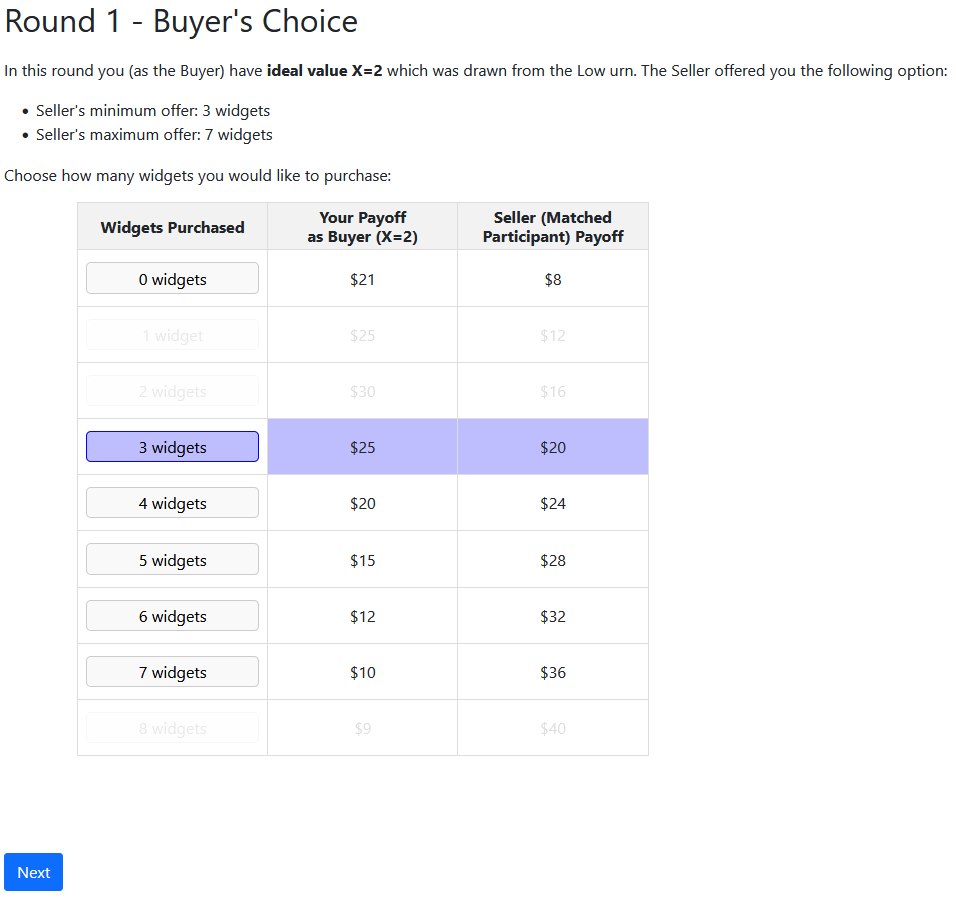
- Constructed environment that models the veto bargaining framework
- One challenge: how to bring this abstract environment to a participants in a way that is easier to understand?
Experimental Design
- Constructed environment that models the veto bargaining framework
- One challenge: how to bring this abstract environment to a participants in a way that is easier to understand?
Experimental Design
- Constructed environment that models the veto bargaining framework
- One challenge: how to bring this abstract environment to a participants in a way that is easier to understand?
Experimental Design
Proposer
Seller
Vetoer
Buyer
State
Ideal Demand
Offer
Widgets
Delegation
Widget Menu
Types
Urn Draws
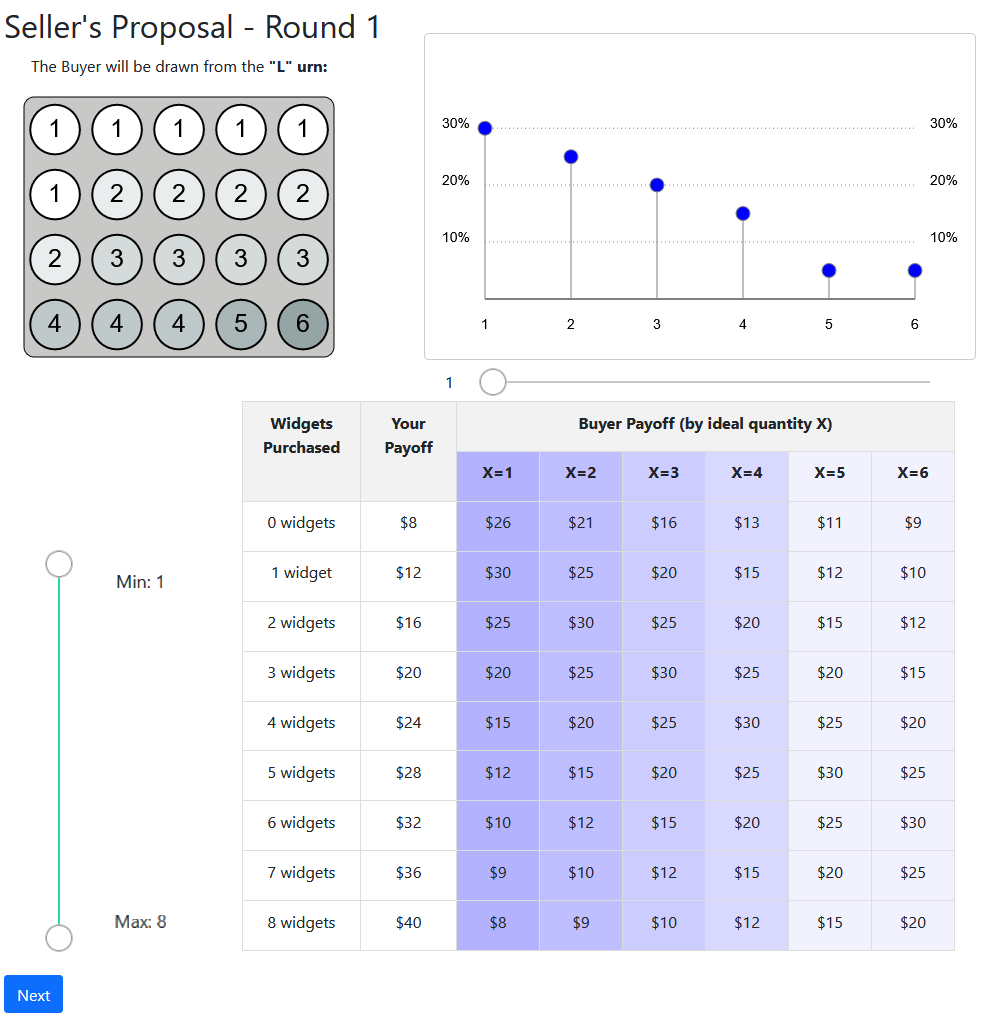
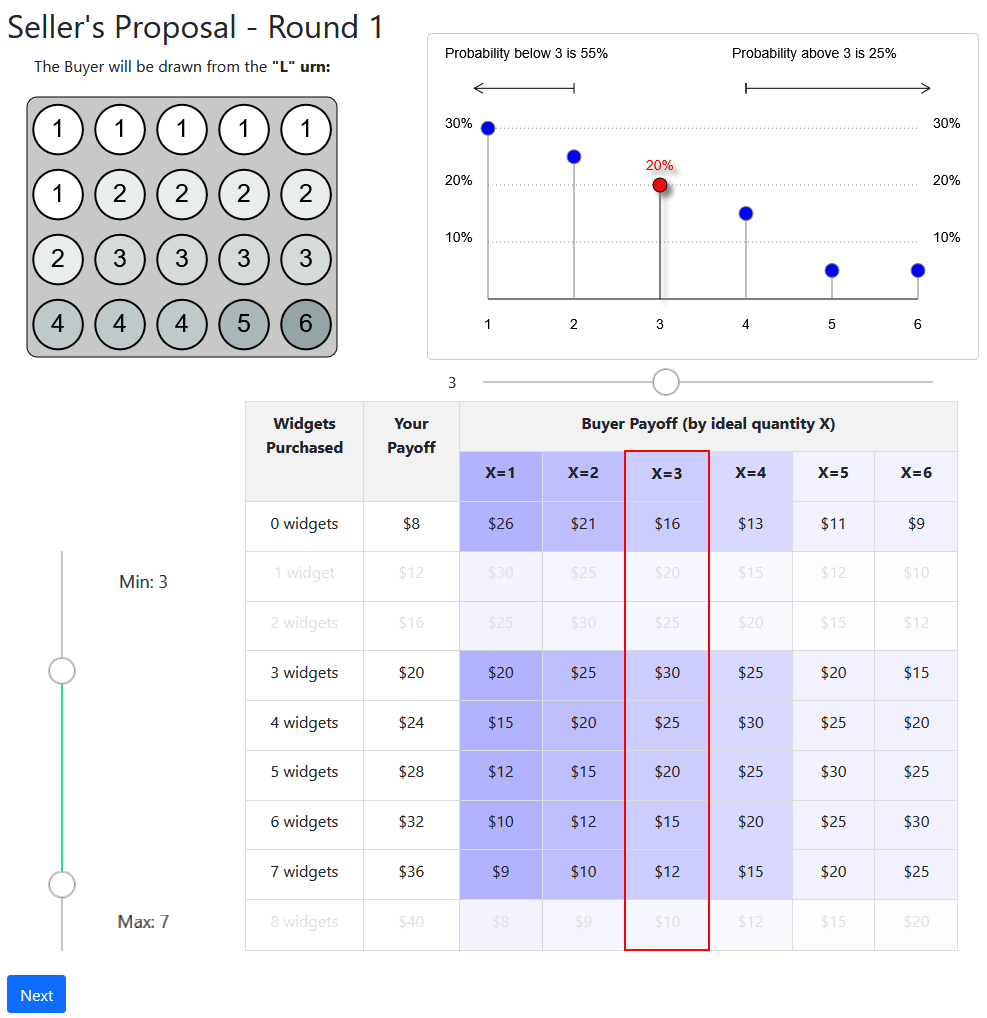
Delegation treatment:
offer a range
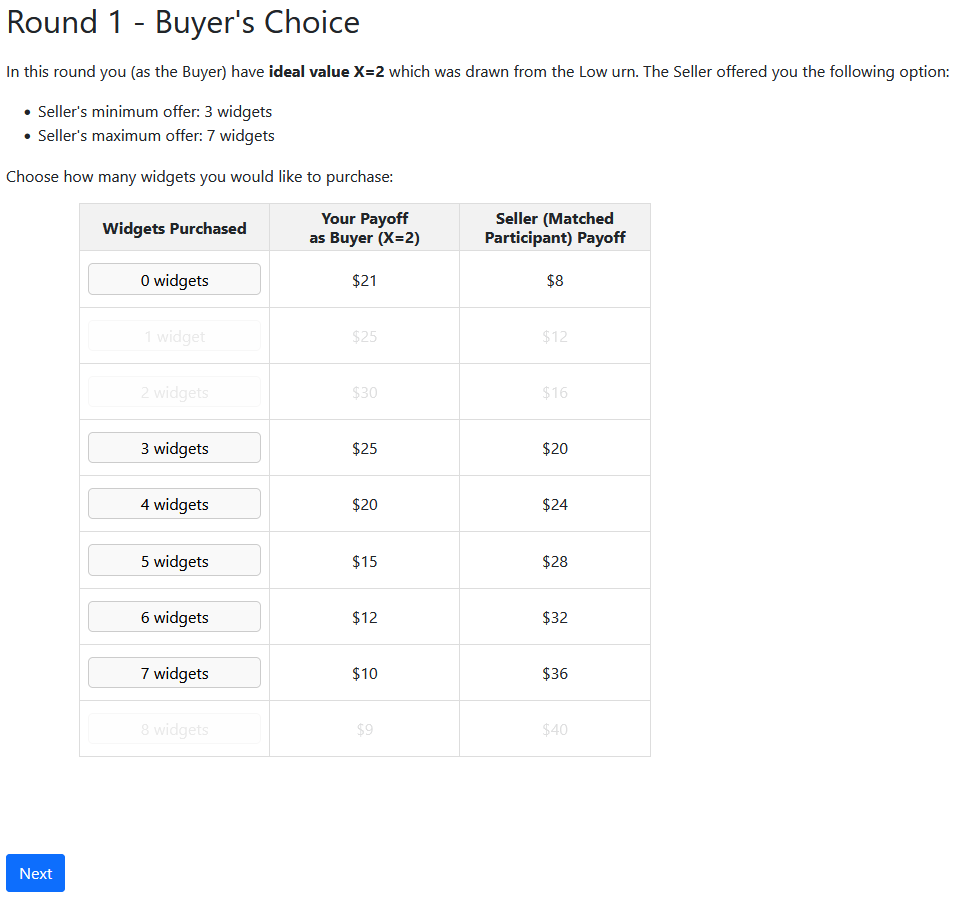
Take it or leave it:
single offer
Experimental Design
- Within-subject variation:
- Varying distributions (high, middle, low) for the Buyer
- Changing roles: 5 rounds in one role, 5 rounds in the other, and back to first role for 5 more rounds
- Between subject 2x2
| No Chat | Chat | |
| Take-it-or-leave-it | N=66 | N=60 |
| Delegation | N=64 | N=66 |
Experimental Design
- Within-subject variation:
- Varying distributions (high, middle, low) for the Buyer
- Changing roles: 5 rounds in one role, 5 rounds in the other, and back to first role for 5 more rounds
- Between subject 2x2
- Collect other behavioral variables (identification through subtraction):
- Remove player: Optimizing ability while playing against a robot Buyer
- Remove mechanism complexity: Preferences over pure lotteries
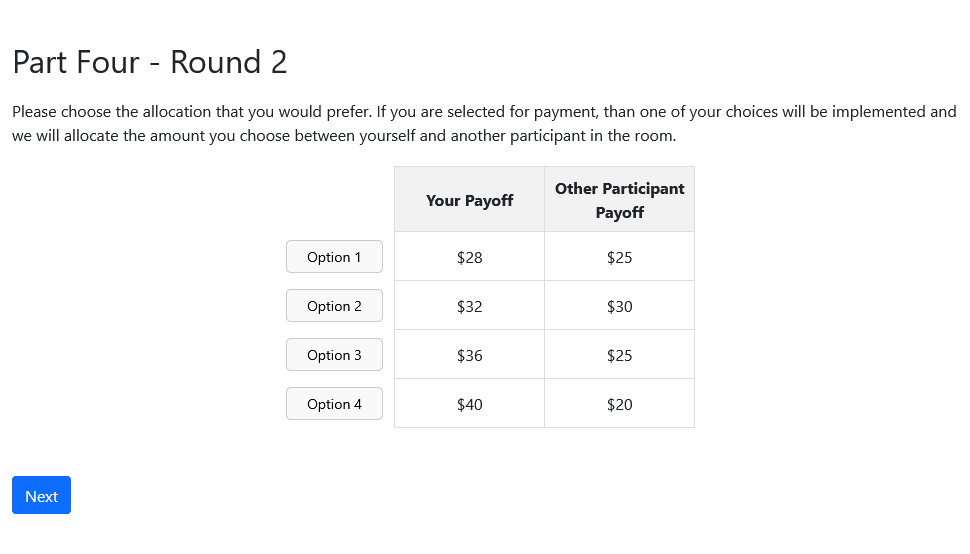
- Remove uncertainty over both player payoffs: Pure allocation decisions
Results
Sanity check: Sellers respond to alignment
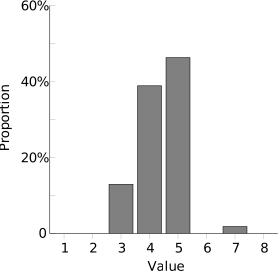
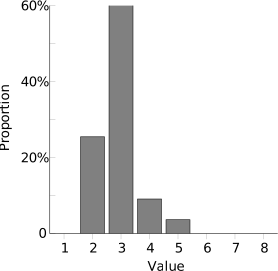
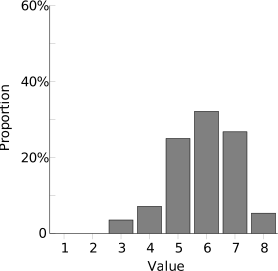
Low
Middle
High
Low
Middle
High
Sanity check: Sellers respond to alignment
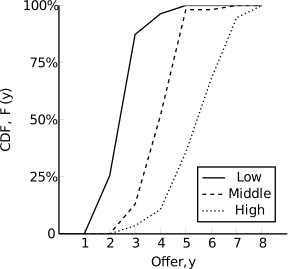
Sanity check: Sellers respond to alignment
Sanity check: Sellers respond to alignment
Low
Middle
High
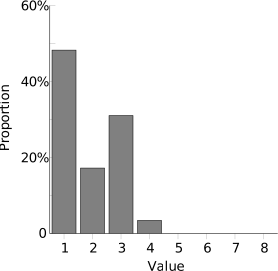
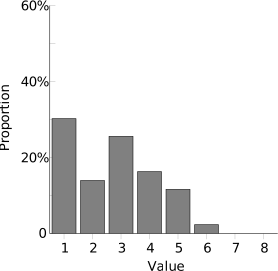
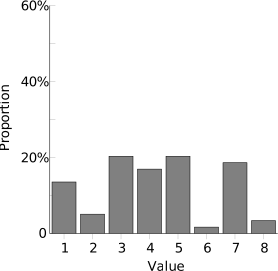
Minimal offer in interval:
Sanity check: Sellers respond to alignment
Low
Middle
High
Minimal offer in interval:
Sanity check: Sellers respond to alignment
Other quick results
- Buyers overwhelmingly pick the best option available
- They pick the best number of widgets from the menu, and take the outside option when better
- Sellers (mostly) keep offers higher than the minimum
- They do not constrain the upper bound of the delegation set
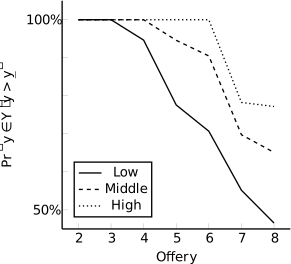
Sellers offer more latitude under delegation
Low
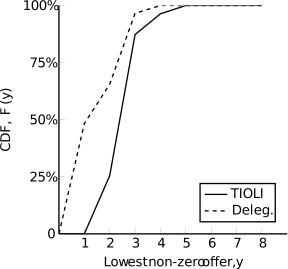
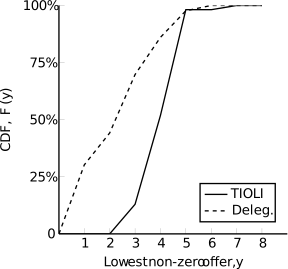
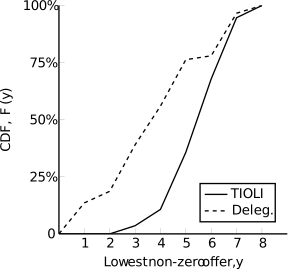
Middle
High
Low
Middle
High
Sellers offer more latitude under delegation
Delegation should increase efficiency
Take it or Leave It
Delegation
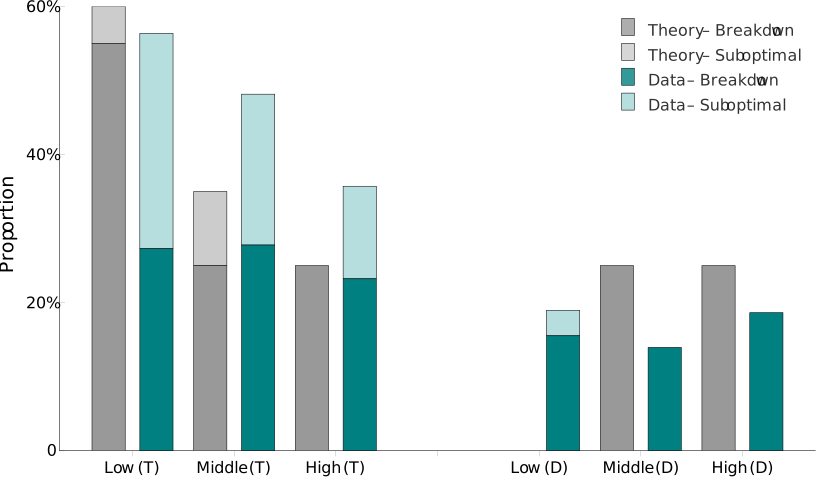
Delegation should increase efficiency
Take it or Leave It
Delegation
Take it or Leave It is inefficient
Take it or Leave It
Delegation
Inefficiency not eliminated under delegation
Take it or Leave It
Delegation
Delegation does increase efficiency
Take it or Leave It
Delegation
Take it or Leave It
Delegation
Delegation does increase efficiency
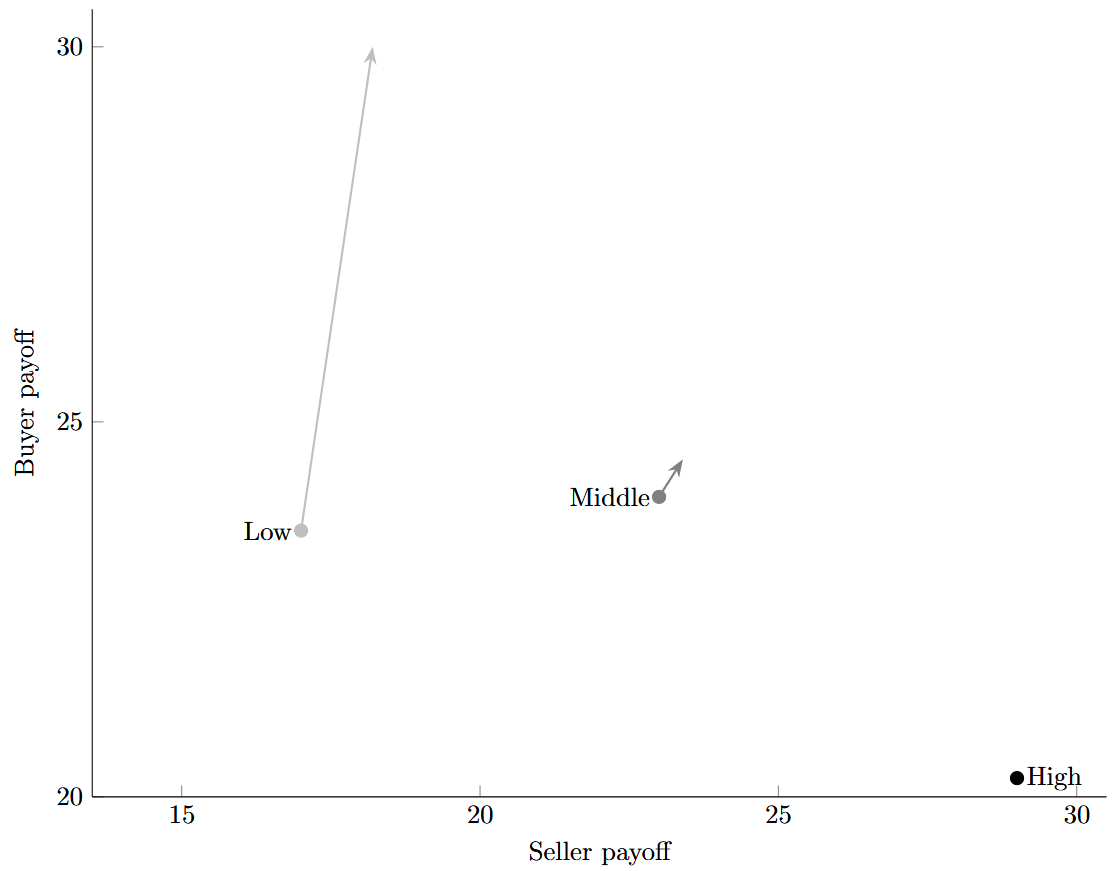
Who benefits from delegation?
Who benefits from delegation?
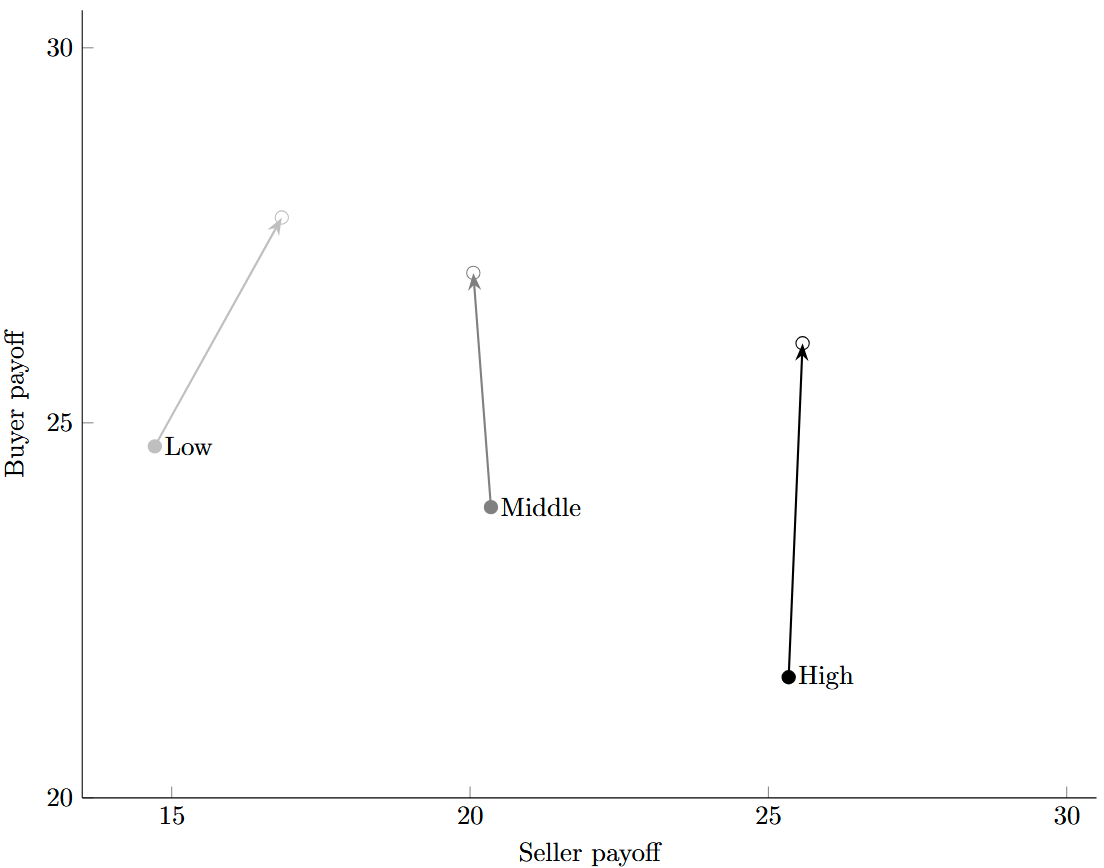
Buyers mostly benefit from delegation
What explains behavioral deviations?
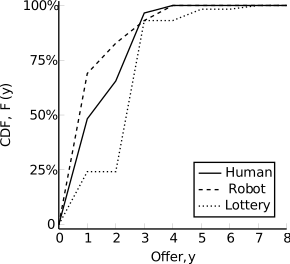
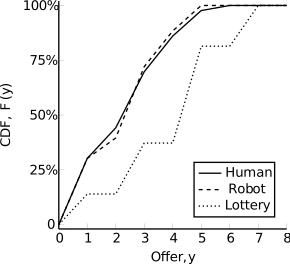

Main reason sellers don't extract more of the delegation gain is optimization failure:
What explains behavioral deviations?
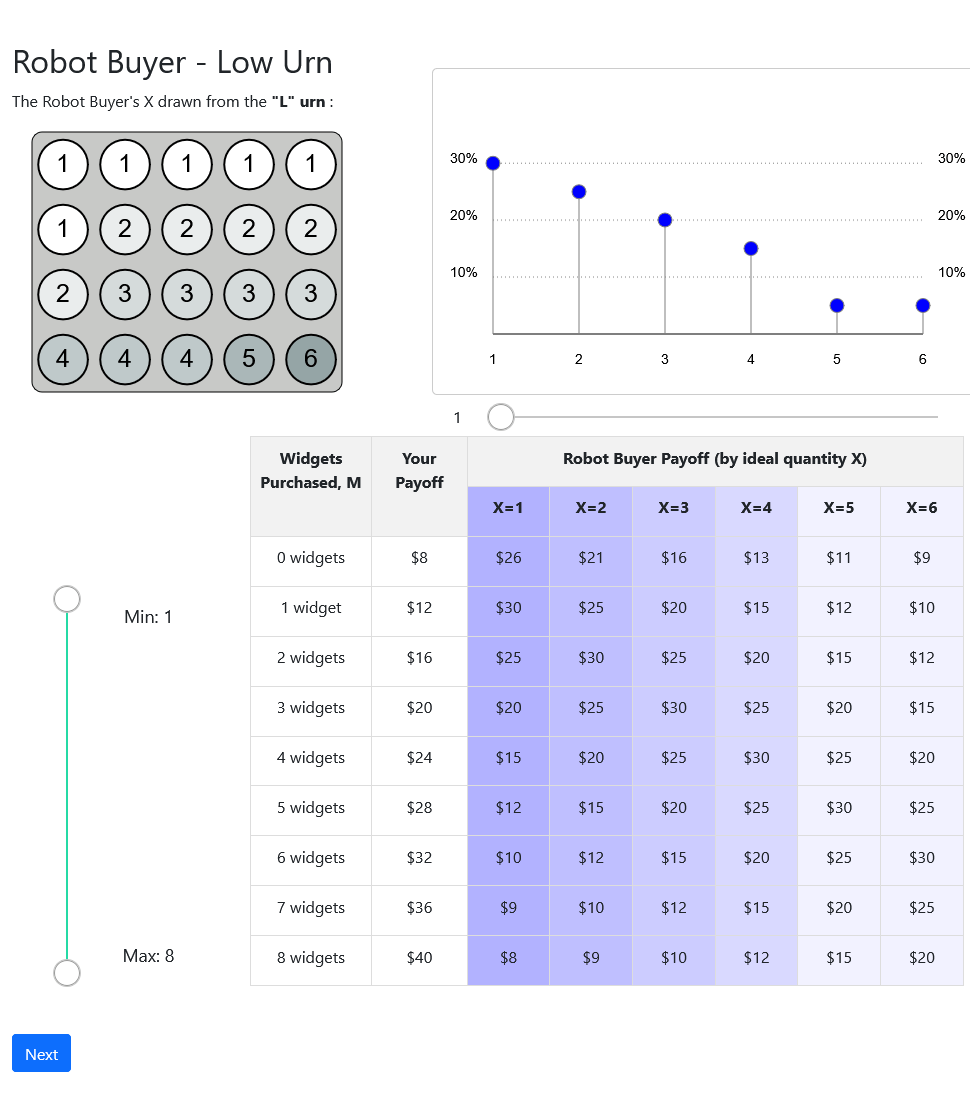
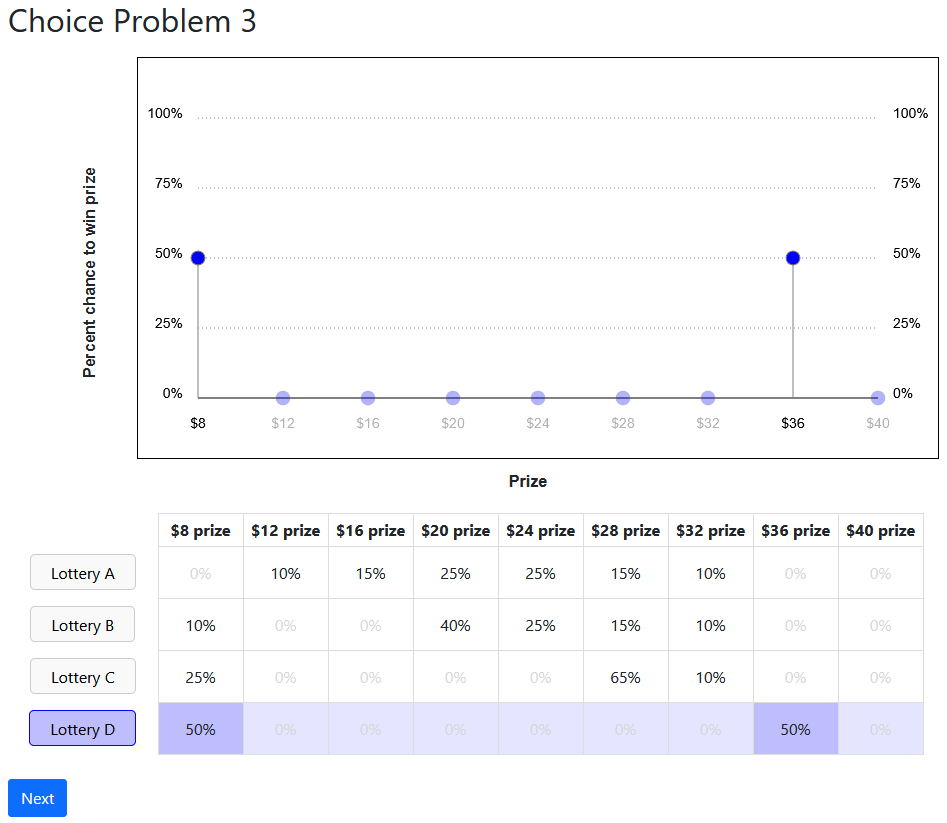
Main reason sellers don't extract more of the delegation gain is optimization failure:
- Remove player: Robot choices closely match delegation choices
What explains behavioral deviations?
Main reason sellers don't extract more of the delegation gain is optimization failure:
- Remove player: Robot choices closely match delegation choices
- Remove mechanism complexity: Lottery choices indicate less delegation
Results: Key Points
- Offers respond to the bargaining alignment of the types in a well-ordered manner
- Sellers offer more latitude than perfectly-optimized predictions
- Sellers in delegation offer more latitude
- Delegation mechanism is more efficient than take it or leave it
- Most of the "cost" of the mechanism falls on the Seller:
- More of the efficiency gains are captured by the Buyer
- Best improvements for the Seller is when alignment is low
- Data suggest that the optimization failures are the main reason for overly-permissive Sellers
- Addendum: pre-play communication is just as efficient as delegation
Conclusion
- Test delegation bargaining with veto power in a lab setting
- Proposers respond to key distribution parameters and change their offers accordingly
- Clear efficiency gains from the delegation mechanism over take-it-or-leave-it offers
- But more of the surplus goes to the responder
- Optimization failures in understanding the mechanism action space explain some of the proposer's failure to extract more
- However, this doesn't lead to inefficiency as they over-delegate
Thank you!
Questions or Comments?
Diagnosing the Failures: Pure Optimization
Diagnosing the Failures: Lotteries
Diagnosing the Failures: Distribution
Results: Inefficiency (Data with No Comm)
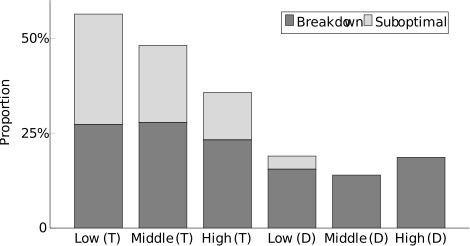
TIOLI
Delegation
Results: Inefficiency (Data with Comm)
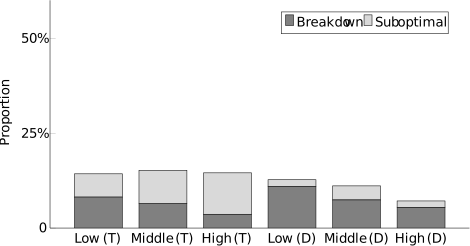
TIOLI
Delegation
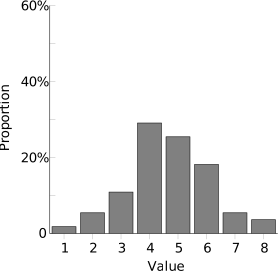
Results: Communication Offers (TIOLI)
Low
Middle
High
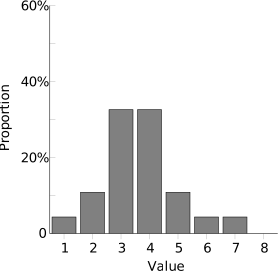
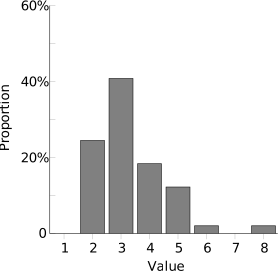
Chat
No Chat
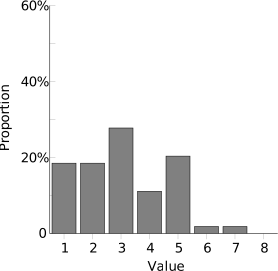
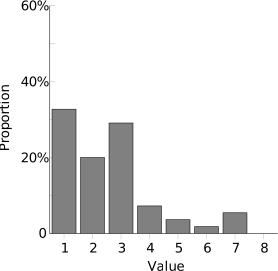
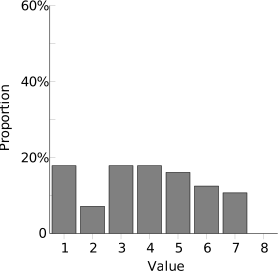
Results: Offers (Delegation)
Low
Middle
High
Chat
No Chat
ESA Delegation
By bjw95