Spending on Education
Brandon Williams
Development Economics
November 19, 2024
Spending on Education
Development Economics
November 19, 2024
Inputs, Incentives, and Complementarities (2019)
- Education may be constrained by low effort (e.g. absenteeism)
- Or it may be constrained by resources (but does "throwing money" at the problem solve it?)
- Complementarity: the impact of jointly increasing both may be greater than the sum of doing each individually
- 350 schools in Tanzania, sorted into 3 treatments:
- Unconditional grants
- Teacher incentives from student performance
- Both
- Context: country with promising enrollment in schools but poor performance (less than 12% of grade 3 students reading at level)
Incentives of State Personnel
Development Economics
Inputs, Incentives, and Complementarities (2019)

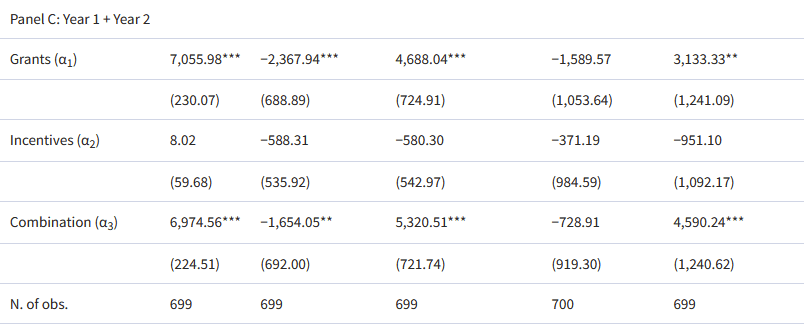
Schools are spending more
But (correctly) not in the incentives treatment
Household spending drops but not enough to offset
November 19, 2024
Incentives of State Personnel
Development Economics
Inputs, Incentives, and Complementarities (2019)
Evidence of complementarities in grant and teacher incentives
\max_e U_i (e) = W + \lambda_i \Delta L - c_i(e)
Choose effort
Wage
Intrinsic benefit from a change in learning
s.t.
W = S + b \Delta L \\
\Delta L = f(e,I) \\
\Delta L \geq \underline{\Delta L} \geq 0
Base pay plus possible incentives
Production of effort and other inputs
Wth normal and reasonable assumptions about the shape of these, including:
f_{ei} > 0
November 19, 2024
Bare minimum effort to not be fired
Incentives of State Personnel
Development Economics
Inputs, Incentives, and Complementarities (2019)
Evidence of complementarities in grant and teacher incentives
\max_e U_i (e) = W + \lambda_i \Delta L - c_i(e)
Choose effort
Wage
Intrinsic benefit from a change in learning
s.t.
W = S + b \Delta L \\
\Delta L = f(e,I) \\
\Delta L \geq \underline{\Delta L} \geq 0
If no incentives and motivation is low:
b + \lambda_i \approx 0
Inputs increase, but teachers can re-optimize and achieve the required minimum change in learning by decreasing effort
This equation binds
November 19, 2024
Incentives of State Personnel
Development Economics
Inputs, Incentives, and Complementarities (2019)
Evidence of complementarities in grant and teacher incentives
\max_e U_i (e) = W + \lambda_i \Delta L - c_i(e)
Choose effort
Wage
Intrinsic benefit from a change in learning
s.t.
W = S + b \Delta L \\
\Delta L = f(e,I) \\
\Delta L \geq \underline{\Delta L} \geq 0
If no incentives and motivation is low:
b + \lambda_i >> 0
One channel is that intrinsic motivation is far from 0, and then inputs will generate a change
November 19, 2024
Incentives of State Personnel
Development Economics
Inputs, Incentives, and Complementarities (2019)
Evidence of complementarities in grant and teacher incentives
\max_e U_i (e) = W + \lambda_i \Delta L - c_i(e)
Choose effort
Wage
Intrinsic benefit from a change in learning
s.t.
W = S + b \Delta L \\
\Delta L = f(e,I) \\
\Delta L \geq \underline{\Delta L} \geq 0
If no incentives and motivation is low:
b + \lambda_i >> 0
The other channel is to force this higher with change in incentives and then increase outputs, to take advantage of
f_{ei} > 0
November 19, 2024
Incentives of State Personnel
Development Economics
Inputs, Incentives, and Complementarities (2019)
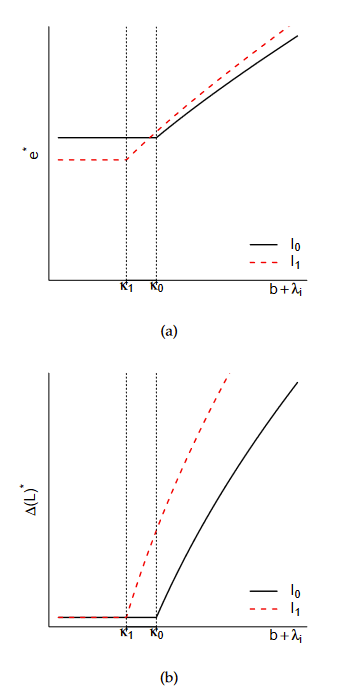
We need to clear this
Or, effort drops
And we see no gains
Even as inputs increase
November 19, 2024
Incentives of State Personnel
Development Economics
Inputs, Incentives, and Complementarities (2019)
Schools see little result from increasing funding
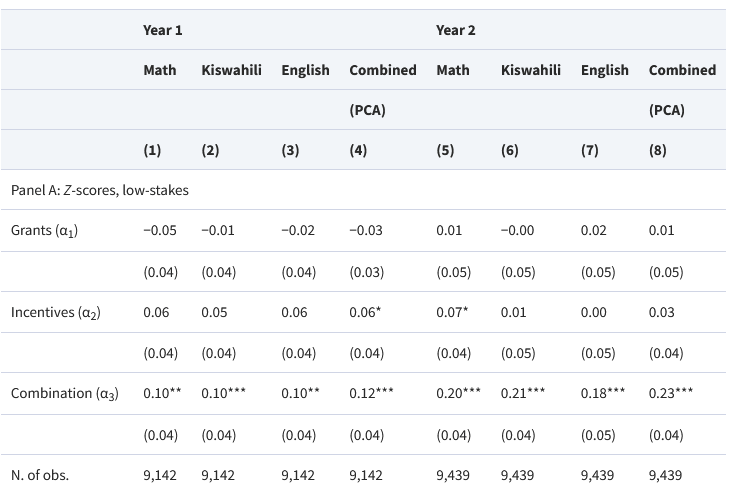
Overall, our results are consistent with and add to a large body of research that finds that merely increasing school resources rarely improves student learning outcomes in developing countries
November 19, 2024
Incentives of State Personnel
Development Economics
Inputs, Incentives, and Complementarities (2019)
Schools see little result from increasing funding
Teacher incentives seem to have little benefit on "low stakes" results
Evidence of complementarities in grant and teacher incentives
November 19, 2024
Spending on Education
Development Economics
November 19, 2024
Inputs, Incentives, and Complementarities (2019)
- Education may be constrained by low effort (e.g. absenteeism)
- "Even well motivated staff may not be able to deliver services effectively if they lack the resources to do so."
- Or it may be constrained by resources (but does "throwing money" at the problem solve it?)
- "Large and growing body of evidence on the limited impact on learning outcomes of simply providing more resources"
- Complementarity: the impact of jointly increasing both may be greater than the sum of doing each individually
- " Our results show that the marginal returns of introducing reforms to better reward improved effort of frontline service providers may be particularly high in settings where inputs are being expanded."
Dev.Slides.11.19
By bjw95