Productivity and Society
Brandon Williams
Development Economics
September 10, 2024
Ethnic Divisions & Production in Firms (2014)
- Longstanding political and social divides along tribes in Kenya, examined in the context of a flower plant with random teams
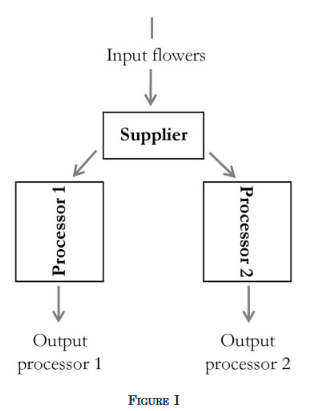
Ethnic Divisions & Production in Firms (2014)
- Longstanding political and social divides along tribes in Kenya, examined in the context of a flower plant with random teams
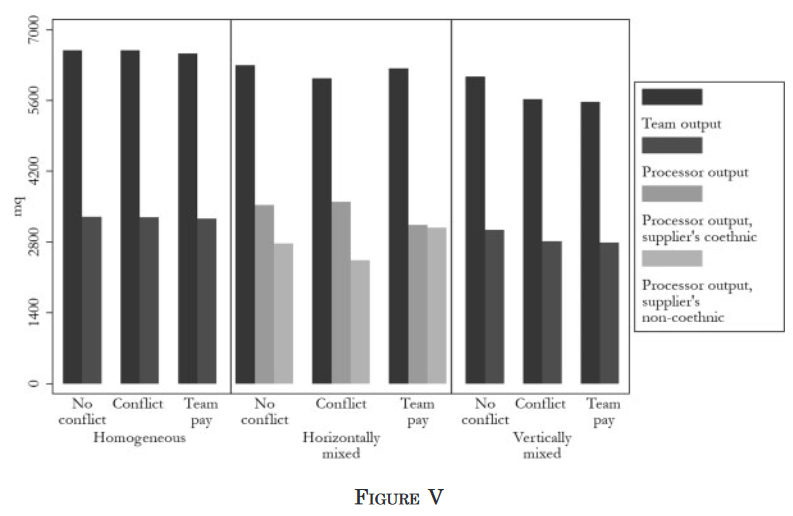
- Three big results:
- Vertical discrimination led to less productive mixed teams (both vertically and horizontally)
- Output gap nearly doubled when political conflict caused tensions to rise between groups
- Introducing team pay eliminated most of the output gap in horizontally mixed teams
Ethnic Divisions & Production in Firms (2014)
Ethnic Divisions & Production in Firms (2014)
\max_{e_{s1},e_{s2}} w(f(e_{s1},\alpha_s,e1,\alpha_1)+f(e_{s2},\alpha_s,e2,\alpha_2))-d(e_{s1}+e_{s2}) + \\
\theta_1(2wf(e_{s1},\alpha_s,e1,\alpha_1)-d(e_1))+\theta_2(2wf(e_{s2},\alpha_s,e2,\alpha_2)-d(e_2))
production based on
effort and ability
supplier cost
of effort
weight on processor type
- Importance of theory: Very hard to distinguish between taste-based and statistical discrimination
Ethnic Divisions & Production in Firms (2014)
- Importance of theory: Very hard to distinguish between taste-based and statistical discrimination
- Non-taste-based explanations can't simultaneously rationalize:
- drop in mixed teams' output under conflict
- equalization of down-stream output under team pay
\max_{e_{s1},e_{s2}} w(f(e_{s1},\alpha_s,e1,\alpha_1)+f(e_{s2},\alpha_s,e2,\alpha_2))-d(e_{s1}+e_{s2}) + \\
(\theta_1+\theta_2)w(f(e_{s1},\alpha_s,e1,\alpha_1)+f(e_{s2},\alpha_s,e2,\alpha_2))-\theta_1d(e_1))-\theta_2d(e_2)
production remains the same
average weight
of processor types
now paid on joint work
Religious Divisions & Production Technology
- Processed food plant in West Bengal, employs both Hindus (majority group) and Muslims (minority), with a history of conflict.
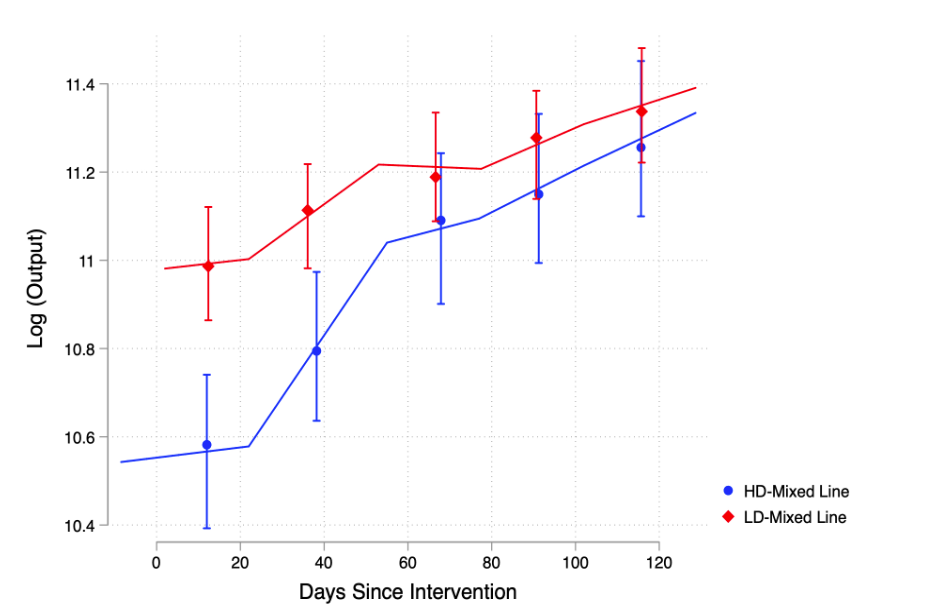
- Group composition randomly assigned (with some limitations), with high- and low-dependency tasks (quasi-randomly assigned)
- Key findings:
- Religious diversity negatively affects team output, but only in HD tasks
- The difference in output attenuates over time (20% gap to 1%), driven by gains in mixed HD teams
- Reduction in negative out-group attitudes in HD mixed groups
Religious Divisions & Production Technology
Religious Divisions & Production Technology
- "It is insightful and non-obvious that the largest positive effects of treatment on attitudes occurred in teams that also suffered the largest negative output shocks."
- Some thoughts:
- It might have been better to collect more information about beliefs and attitudes before endline
- Does the best possible to reconcile design limitations (e.g. no Muslim only teams) with robustness checks using observables, but wouldn't have to do this in a perfect world
- Full model gets relegated to the appendix
Dev.Slides.9.10
By bjw95