Corruption
Brandon Williams
Development Economics
September 17, 2024
Eight Questions (2005)
- Corruption in models:
- As taxes
- As lobbying
- As rent-seeking
- Measuring is extremely difficult, for obvious reasons
Eight Questions (2005)
- Corruption in models:
- Measuring is extremely difficult, for obvious reasons
- Complementary explanations of corruption:
- Institutional:
- Economic factors/human capital => institutions => corruption
- Colonization => legal institutions/regulation/religion => corruption
- Markets and competition
- Open trade policies
- Free press
- Voting
- Institutional:
Eight Questions (2005)
- Corruption in models:
- Measuring is extremely difficult, for obvious reasons
- Complementary explanations of corruption:
- Evidence? Mixed, noisy and not causal
- Can higher public service wages reduce corruption?
- Can competition reduce corruption?
- Why isn't there a clear-cut answer?
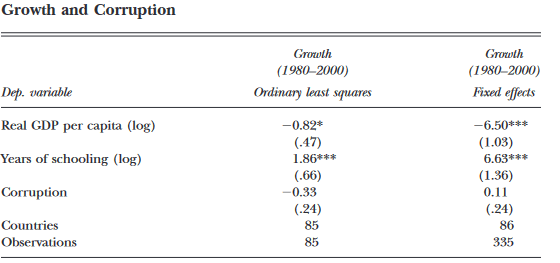
- Does it actually hurt growth?
Eight Questions (2005)
- Does it actually hurt growth?
Simple Economics of Extortion (2009)
- AKA, corrupt officials are profit maximizers, too
- Level of corruption depends on the market, demand, and coordination
- 304 trucking trips in Indonesia, with 6000 payments (13% of total cost of a trip is spent on bribes)
- Market structure change: 30,000 officials withdrawn from Aceh (but not North Sumatra)
- Average bribe in North Sumatra increases in response to the reduction in checkpoints in Aceh
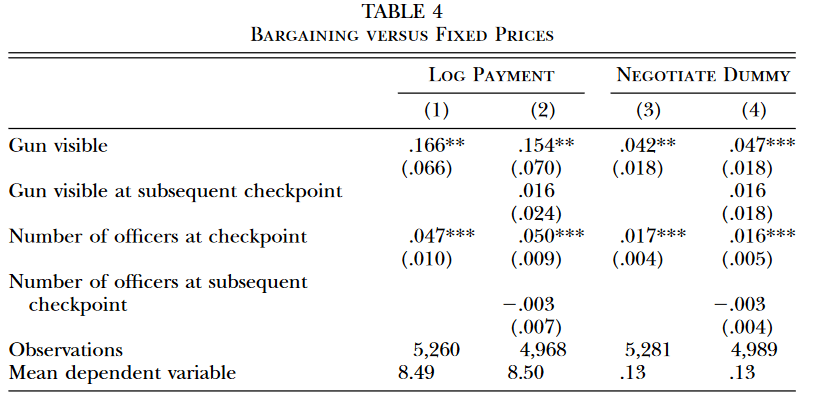
- Bargaining power: Downstream checkpoints have higher bribes than those at the beginning of the route
- Price discrimination: bribe charges change on observables
Simple Economics of Extortion (2009)
- Model(s) predict:
- The price per checkpoint is decreasing in the number of checkpoints
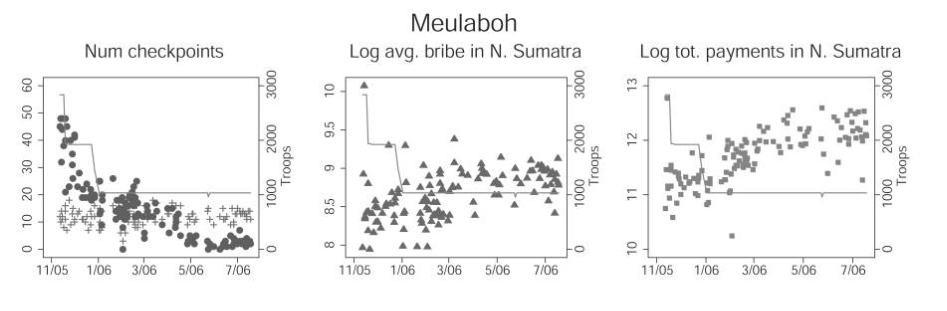
Stable checkpoints in N. Sumatra
Decreasing checkpoints in Aceh
Increasing bribes in N. Sumatra
Simple Economics of Extortion (2009)
- Model(s) predict:
- The price per checkpoint is decreasing in the number of checkpoints
- More bargaining power means higher bribe
Simple Economics of Extortion (2009)
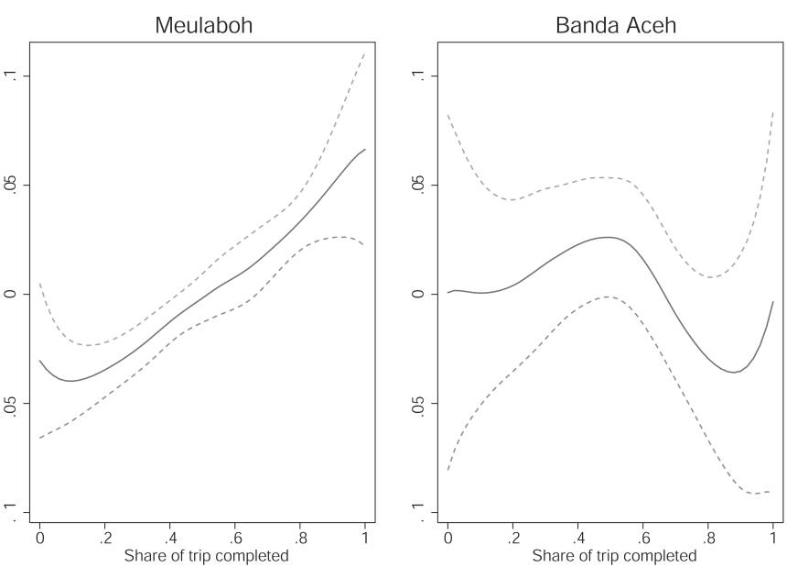
Clear bargaining
Less clear,
for a number of reasons
Monitoring Corruption (2007)
- Can formal or informal monitoring reduce corruption?
- Increasing government audits reduced missing expenditures by 8 percentage points
- Increasing grassroots participation had little impact
- RCT in Indonesian villages, where a new road was being constructed
- Treatment 1 is 100% chance of audit (vs. baseline 4%)
- Treatment A is accountability meetings invite
- Treatment B is accountability meetings invite with a chance to share an anonymous comment
- You could receive Treatment 1 and A or B
- Constructed estimates of real cost of construction to compare to reported cost (super cool!)
Monitoring Corruption (2007)
- Increasing government audits reduced missing expenditures by 8 percentage points
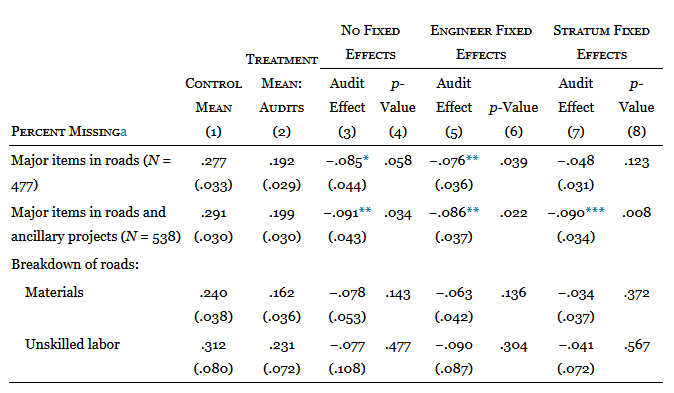
Monitoring Corruption (2007)
- Increasing government audits reduced missing expenditures by 8 percentage points
- Increasing grassroots participation had little impact
- Evidence of substitution into nepotism (a "legitimate" expense)
...a 100 percent audit probability does not imply that village officials face a 100 percent probability of detecting corruption and imposing a punishment.
Dev.Slides.9.17
By bjw95