Corruption II
Brandon Williams
Development Economics
September 19, 2024
Corruption in Developing Countries (2012)
- To recap the literature:
- The magnitude of corruption is still unknown--estimating is hard
- Corrupt behavior has considerable negative consequences for efficiency and equity outcomes
- Corrupt officials respond to monitoring and punishment, as well as market forces
Corruption in Developing Countries (2012)
- To recap the literature:
- The magnitude of corruption is still unknown--estimating is hard
- Perceptions
- Direct observation (the rare person who takes notes on their illicit activities)
- Estimate by subtraction (Indonesian road project)
- Market inference
- Corrupt behavior has considerable negative consequences for efficiency and equity outcomes
- Corrupt officials respond to monitoring and punishment, as well as market forces
- The magnitude of corruption is still unknown--estimating is hard
Corruption in Developing Countries (2012)
- To recap the literature:
- The magnitude of corruption is still unknown--estimating is hard
- Corrupt behavior has considerable negative consequences for efficiency and equity outcomes
- Bribes with worse efficiency results than a tax
- Increase cost of government activity
- Underprovision of services
- Failure to correct externalities
- Corrupt officials respond to monitoring and punishment, as well as market forces
Corruption in Developing Countries (2012)
- To recap the literature:
- The magnitude of corruption is still unknown--estimating is hard
- Corrupt behavior has considerable negative consequences for efficiency and equity outcomes
- Corrupt officials respond to monitoring and punishment, as well as market forces
- We've seen examples of responses to monitoring and market forces
- Transparency itself possibly not sufficient
- Limited evidence on compensation and incentives
Corruption in Developing Countries (2012)
If we were asked by a politician seeking to make his or her country eligible for Millennium Challenge aid or the head of an anti-corruption agency what guidance the economic literature could give them about how to tackle the problem, we realized that, beyond a few core economic principles, we had more questions to pose than
concrete answers.
The Real State in DRC (2022)
- DRC traffic enforcement agents can charge violations and escort violators to a station for fee enforcement
- Unofficially station managers had a daily target (quota) of violators brought to station, then solicited bribes to get out of a charge and return their vehicle
- Descriptive results:
- Real revenue (from unofficial sources) was 5.2 times larger than from fines
- Drivers without connections paid 2.2 more in bribes
- 82% of pull-overs had no visible infraction
- Quota treatment results:
- A quota weakens both traffic management and deterrence
- The level of the quota does not affect fine revenue (it is about corruption)
The Real State in DRC (2022)
- Quota treatment results:
- A quota weakens both traffic management and deterrence
- The level of the quota does not affect fine revenue (it is about corruption)
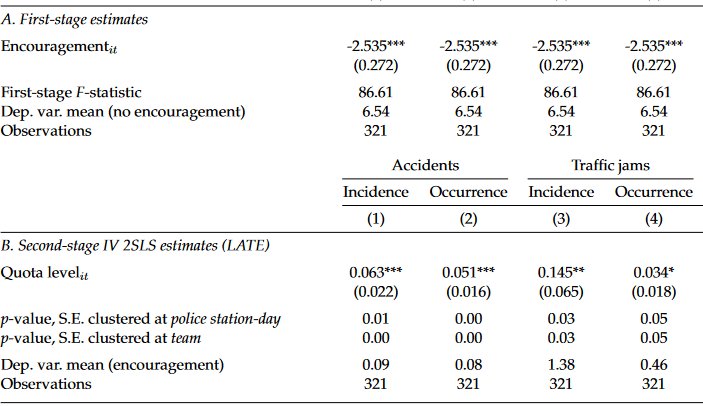
Assignment works
to reduce quota
Increase in quota
means an increase
in traffic problems
Obtaining a License in India (2007)
- Treatments:
- Bonus: paid a sum of cash if they get the license quickly
- Lesson: free driving lessons
- Comparison: control group
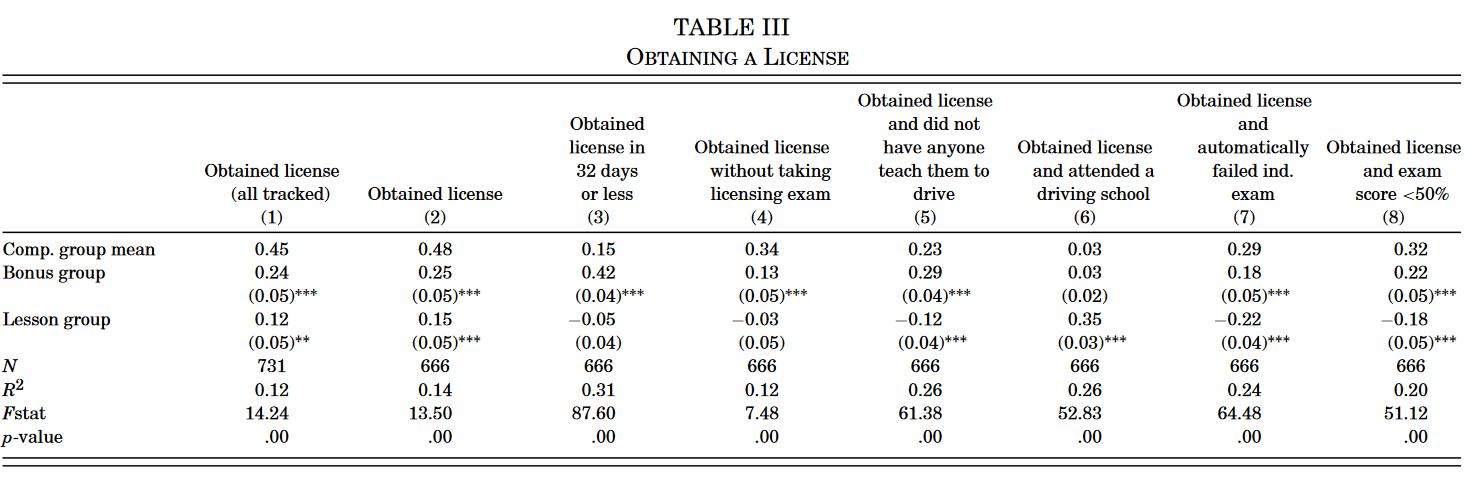
- Control group: 71% of license getters did not take exam, 62% unqualified, paid 2.5x the official fee
- Bonus group were 24 pp more likely to obtain a license, 18 pp more likely to get license while unqualified, pay more in extralegal fees
- Lesson group are 12pp more likely to get and also still pay bribes--why?
- Evidence of "endogenous red tape" that causes bureaucrats to arbitrarily fail some to push them towards agents who can be bribed
Obtaining a License in India (2007)
Obtaining a License in India (2007)
Treatment leads to
getting a license
...and moving quickly
...and getting around the exam
...but its true for everyone
Obtaining a License in India (2007)
More bad drivers!
The increase comes at a cost of:
Obtaining a License in India (2007)
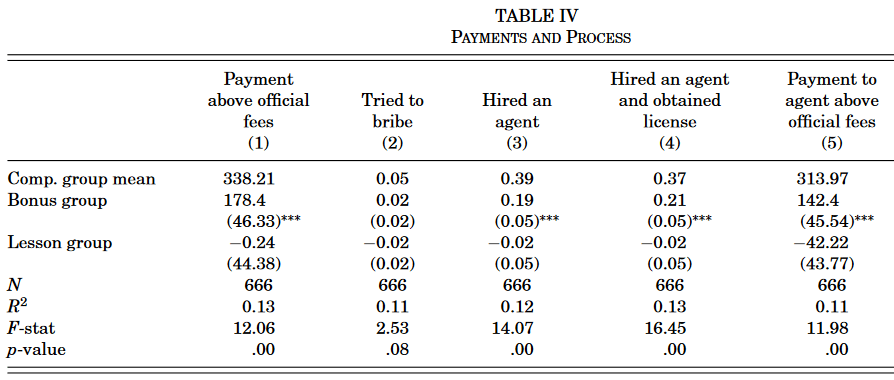
They are paying more
...but not in bribes
...rather to agents
Endogenous Red Tape!
Obtaining a License in India (2007)
Had we run a survey simply asking individuals who had obtained licenses whether they paid bribes, we might have concluded that there was no corruption in this bureaucratic system. Instead, the detailed questions on payments and the process of obtaining a license allowed us to isolate the central role agents play in this system.
Copy of Dev.Slides.9.19
By bjw95