Incentives of State Personnel
Brandon Williams
Development Economics
September 26, 2024
Incentives of State Personnel
Development Economics
September 26, 2024
Incentives and Organizations (2002)
-
We can model incentives in the public sector in traditional principal-agent problems
- Moral Hazard: incentives for effort when not easily observable
- Adverse Selection: incentives for information when the agent has some private information
- Costly Verification: principal can accept information about some outcome from agent or subject it to a costly audit
-
But these are complicated in reality by:
- Inter-temporal elements
- Multiple dimensions
- Multiple agents and teams
-
And further by the nature of the public sector:
- Multiple principals in bureaucracy
- Agencies with multiple agendas
- Limited competition
Incentives of State Personnel
Development Economics
September 26, 2024
Incentives and Organizations (2002)
Sometimes it may be desirable to split an agency, and privatize or open to competition those of its activities that have clear simple tasks and easily measured outputs with little risk of degradation of unobservable quality, and few or minor conflicting political stakes.
Incentives of State Personnel
Development Economics
September 26, 2024
Tax Farming Redux (2016)
- Developing countries rely on tax officials to collect tax funds
- These might be poorly compensated, considered corrupt, and have little administrative or third-party oversight
- What is the tradeoff between increasing tax revenues through incentives and political costs from disgruntled citizenry?
- Randomize property tax "circle" in Pakistan into three incentive treatments:
- Revenue: incentives for anything over benchmark
- Revenue plus: same as revenue except also includes incentives based on taxpayer satisfaction and tax accuracy
- Flexible: rewards for much wider set of criteria and overall performance at period end
Incentives of State Personnel
Development Economics
September 26, 2024
Tax Farming Redux (2016)
- Randomize into three incentive treatments:
- Revenue: 17% increase
- Revenue plus: 9.5% increase
- Flexible: 4.2% increase (insignificant)
- Overall increase of 8 percent, mostly through the tax base
- No impact on taxpayer perceptions of quality of service or in accuracy of tax assessments
- Evidence of tradeoffs:
- Results driven by properties that are re-assessed and then switch to paying higher taxes but lower bribes
Incentives of State Personnel
Development Economics
September 26, 2024
Tax Farming Redux (2016)
On net, the results suggest that tax inspectors focus on a small number of high-value properties to increase revenue, thus potentially raising revenue while minimizing political costs.
Incentives of State Personnel
Development Economics
September 26, 2024
Inputs, Incentives, and Complementarities (2019)
- 350 schools in Tanzania, sorted into 3 treatments:
- Unconditional grants
- Teacher incentives from student performance
- Both
- Context: country with promising enrollment in schools but poor performance (less than 12% of grade 3 students reading at level)
Incentives of State Personnel
Development Economics
September 26, 2024
Inputs, Incentives, and Complementarities (2019)

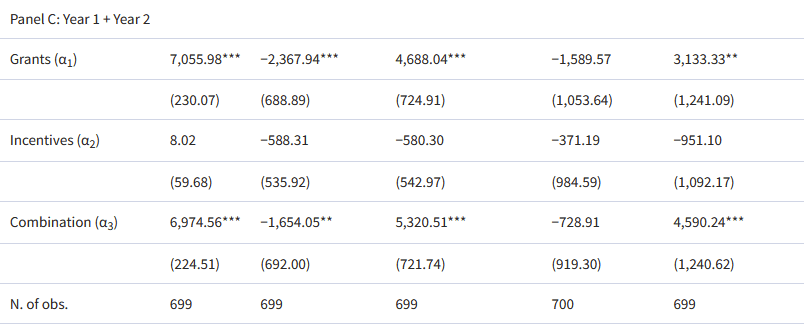
Schools are spending more
But (correctly) not in the incentives treatment
Household spending drops but not enough to offset
Incentives of State Personnel
Development Economics
September 26, 2024
Inputs, Incentives, and Complementarities (2019)
Schools see little result from increasing funding
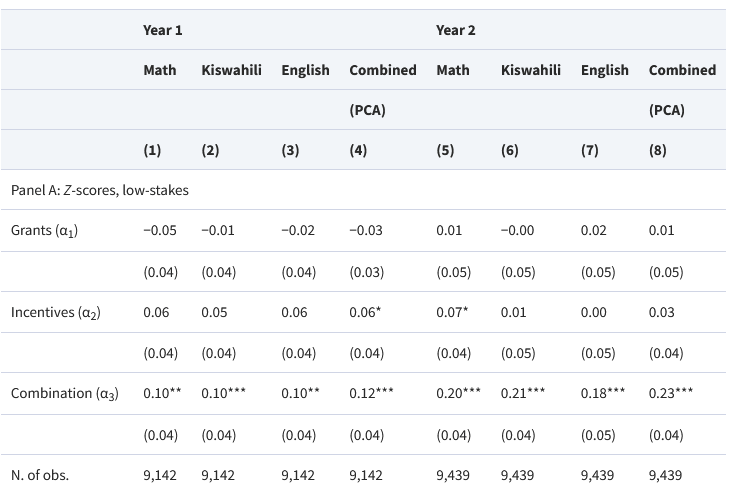
Overall, our results are consistent with and add to a large body of research that finds that merely increasing school resources rarely improves student learning outcomes in developing countries
Incentives of State Personnel
Development Economics
September 26, 2024
Inputs, Incentives, and Complementarities (2019)
Schools see little result from increasing funding
Teacher incentives seem to have little benefit on "low stakes" results
Evidence of complementarities in grant and teacher incentives
Incentives of State Personnel
Development Economics
September 26, 2024
Inputs, Incentives, and Complementarities (2019)
Evidence of complementarities in grant and teacher incentives
\max_e U_i (e) = W + \lambda_i \Delta L - c_i(e)
Choose effort
Wage
Intrinsic benefit from a change in learning
s.t.
W = S + b \Delta L \\
\Delta L = f(e,I) \\
\Delta L \geq \underline{\Delta L} \geq 0
Base pay plus possible incentives
Production of effort and other inputs
Max normal and reasonable assumptions about the shape of these, including:
f_{ei} > 0
Incentives of State Personnel
Development Economics
September 26, 2024
Inputs, Incentives, and Complementarities (2019)
Evidence of complementarities in grant and teacher incentives
\max_e U_i (e) = W + \lambda_i \Delta L - c_i(e)
Choose effort
Wage
Intrinsic benefit from a change in learning
s.t.
W = S + b \Delta L \\
\Delta L = f(e,I) \\
\Delta L \geq \underline{\Delta L} \geq 0
If no incentives and motivation is low:
b + \lambda_i \approx 0
Inputs increase, but teachers can re-optimize and achieve the required minimum change in learning by decreasing effort
This equation binds
Incentives of State Personnel
Development Economics
September 26, 2024
Inputs, Incentives, and Complementarities (2019)
Evidence of complementarities in grant and teacher incentives
\max_e U_i (e) = W + \lambda_i \Delta L - c_i(e)
Choose effort
Wage
Intrinsic benefit from a change in learning
s.t.
W = S + b \Delta L \\
\Delta L = f(e,I) \\
\Delta L \geq \underline{\Delta L} \geq 0
If no incentives and motivation is low:
b + \lambda_i >> 0
One channel is that intrinsic motivation is is far from 0, and then inputs will generate a change
Incentives of State Personnel
Development Economics
September 26, 2024
Inputs, Incentives, and Complementarities (2019)
Evidence of complementarities in grant and teacher incentives
\max_e U_i (e) = W + \lambda_i \Delta L - c_i(e)
Choose effort
Wage
Intrinsic benefit from a change in learning
s.t.
W = S + b \Delta L \\
\Delta L = f(e,I) \\
\Delta L \geq \underline{\Delta L} \geq 0
If no incentives and motivation is low:
b + \lambda_i >> 0
The other channel is to force this higher with change in incentives and then increase outputs, to take advantage of
f_{ei} > 0
Incentives of State Personnel
Development Economics
September 26, 2024
Inputs, Incentives, and Complementarities (2019)
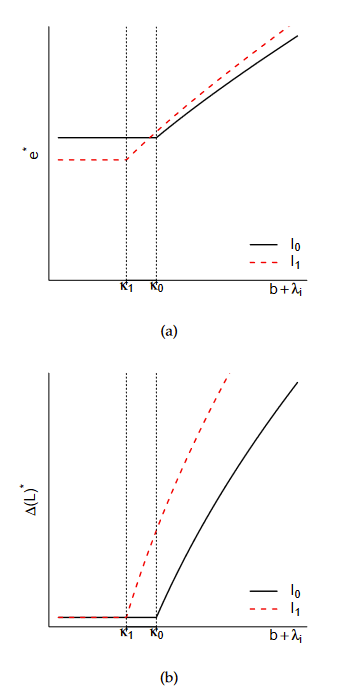
We need to clear this
Or, effort drops
And we see no gains
Even as inputs increase
Dev.Slides.9.26
By bjw95