Motivated Meritocracy:
An Experiment in the Stability of Inequality Preferences
Brandon Williams
Development Economics
November 21, 2024
Motivated Meritocracy
Development Economics
November 21, 2024
Motivation
Inequality threatens long-term social and economic development, harms poverty reduction and destroys people’s sense of fulfillment and self-worth."
- United Nations Millennium Development Goals
Motivated Meritocracy
Development Economics
November 21, 2024
Motivation: Some Facts
- 71% of the population live in country where inequality has risen since 1990
- The source of inequality matters for preferences about redistribution:
- Some accept all forms of inequality (libertarians)
- Some accept inequality only if it is earned (meritocrats)
- Some do not accept any form of inequality (egalitarians)
- A considerable amount of literature has worked to study the share of these types across country, political views, and gender
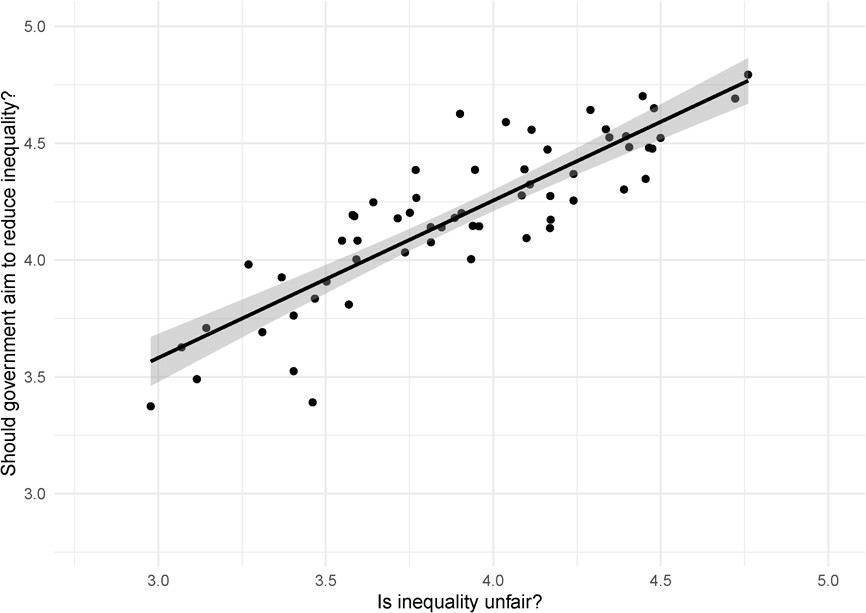
- Preferences about inequality are important because they strongly correlate with beliefs about policy
Motivated Meritocracy
Development Economics
November 21, 2024
Motivation
Motivated Meritocracy
Development Economics
November 21, 2024
Motivation: Some More Facts
- Discrimination and in-group bias are real phenomena
- Social desirability bias can lead to attenuated estimates of discriminatory intent in experiments
- Evidence of discrimination tends to emerge when it can be hidden by other possible explanations
- Choice of flowers to allocate to downstream workers
- Effectiveness of mixed-team efforts in a factory
Motivated Meritocracy
Development Economics
November 21, 2024
Research Question
- Are preferences about inequality stable? Or do they change depending on who benefits from redistribution?
- Stable preferences would indicate that they are in some sense fundamental
- Policymakers need to under their constituent base
- Social and redistribution policies should reflect those views
- Context-dependent preferences would indicate that these preferences could be used for veiled discrimination
- Policymakers need to overcome some motivated preferences to develop cohesive policies
- Economic or social power structures that claim to reduce inequality may in fact make it worse
- Stable preferences would indicate that they are in some sense fundamental
Motivated Meritocracy
Development Economics
November 21, 2024
Objectives Today
- Explain experimental paradigm used to determine inequality preferences
- Provide a model of context-dependent inequality preferences that could bias true preferences and disguise discrimination
- Offer a unique context to explore this "motivated meritocracy" in the country of Fiji
- Outline experimental procedure to test hypotheses about the stability of inequality preferences
Collect feedback!
Motivated Meritocracy
Development Economics
November 21, 2024
Experimental Procedure
- Two Types of Participants:
- Workers - complete task for possible payment
- Spectators - can decide on possible redistribution of payment


Motivated Meritocracy
Development Economics
November 21, 2024
- The task requires little skill but real effort (e.g. ball-catching task, counting zeros)
Experimental Procedure
Motivated Meritocracy
Development Economics
November 21, 2024
- One worker gets initial allocation according to treatment
- Luck - a fair coin determines who is paid the whole amount
- Merit - the more productive worker is paid the whole amount
$
$
$
$
$
$
Experimental Procedure
Motivated Meritocracy
Development Economics
November 21, 2024
- Spectators know the source of the allocation
- Workers are not informed of the initial distribution, but are aware a spectator will have final say
$
$
$
$
$
$
Experimental Procedure
Motivated Meritocracy
Development Economics
November 21, 2024
- Before the workers are paid, the spectator can choose to redistribute: none
$
$
$
$
$
$
Experimental Procedure
Motivated Meritocracy
Development Economics
November 21, 2024
- Before the workers are paid, the spectator can choose to redistribute: none, some,
$
$
$
$
$
$
Experimental Procedure
Motivated Meritocracy
Development Economics
November 21, 2024
- Before the workers are paid, the spectator can choose to redistribute: none, some, or all
$
$
$
$
$
$
Experimental Procedure
Motivated Meritocracy
Development Economics
November 21, 2024
- Spectators can be classified by their choices over redistribution depending on treatment
$
$
$
$
$
$
Experimental Procedure
Motivated Meritocracy
Development Economics
November 21, 2024
- Spectators can be classified by their choices over redistribution depending on treatment
$
$
$
$
$
$
Experimental Procedure
Motivated Meritocracy
Development Economics
November 21, 2024
- Spectators can be classified by their choices over redistribution depending on treatment
$
$
$
$
$
$
Experimental Procedure
Motivated Meritocracy
Development Economics
November 21, 2024
- Spectators can be classified by their choices over redistribution depending on treatment
$
$
$
$
$
$
Meritocrat*
Experimental Procedure
Motivated Meritocracy
Development Economics
November 21, 2024
- Spectators can be classified by their choices over redistribution depending on treatment
$
$
$
$
$
$
Experimental Procedure
Motivated Meritocracy
Development Economics
November 21, 2024
- Spectators can be classified by their choices over redistribution depending on treatment
$
$
$
$
$
$
Egalitarian
Experimental Procedure
Motivated Meritocracy
Development Economics
November 21, 2024
- Spectators can be classified by their choices over redistribution depending on treatment
$
$
$
$
$
$
Experimental Procedure
Motivated Meritocracy
Development Economics
November 21, 2024
- Spectators can be classified by their choices over redistribution depending on treatment
$
$
$
$
$
$
Experimental Procedure
Motivated Meritocracy
Development Economics
November 21, 2024
- Spectators can be classified by their choices over redistribution depending on treatment
$
$
$
$
$
$
Libertarian
Experimental Procedure
Motivated Meritocracy
Development Economics
November 21, 2024
- Spectators can be classified by their choices over redistribution depending on treatment
$
$
$
$
$
$
Experimental Procedure
Motivated Meritocracy
Development Economics
November 21, 2024
- Spectators can be classified by their choices over redistribution depending on treatment
$
$
$
$
$
$
Egalitarian*
Experimental Procedure
Motivated Meritocracy
Development Economics
November 21, 2024
- Spectators can be classified by their choices over redistribution depending on treatment
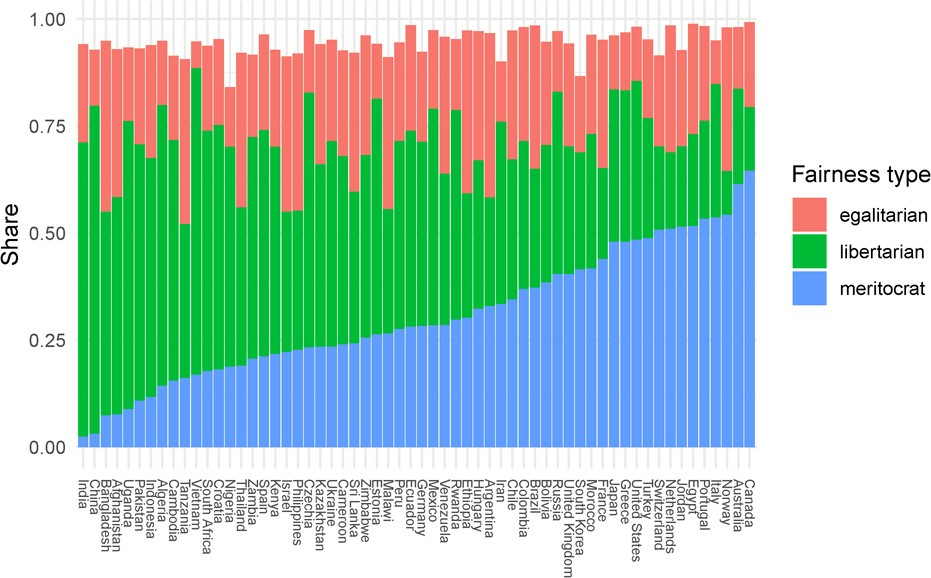
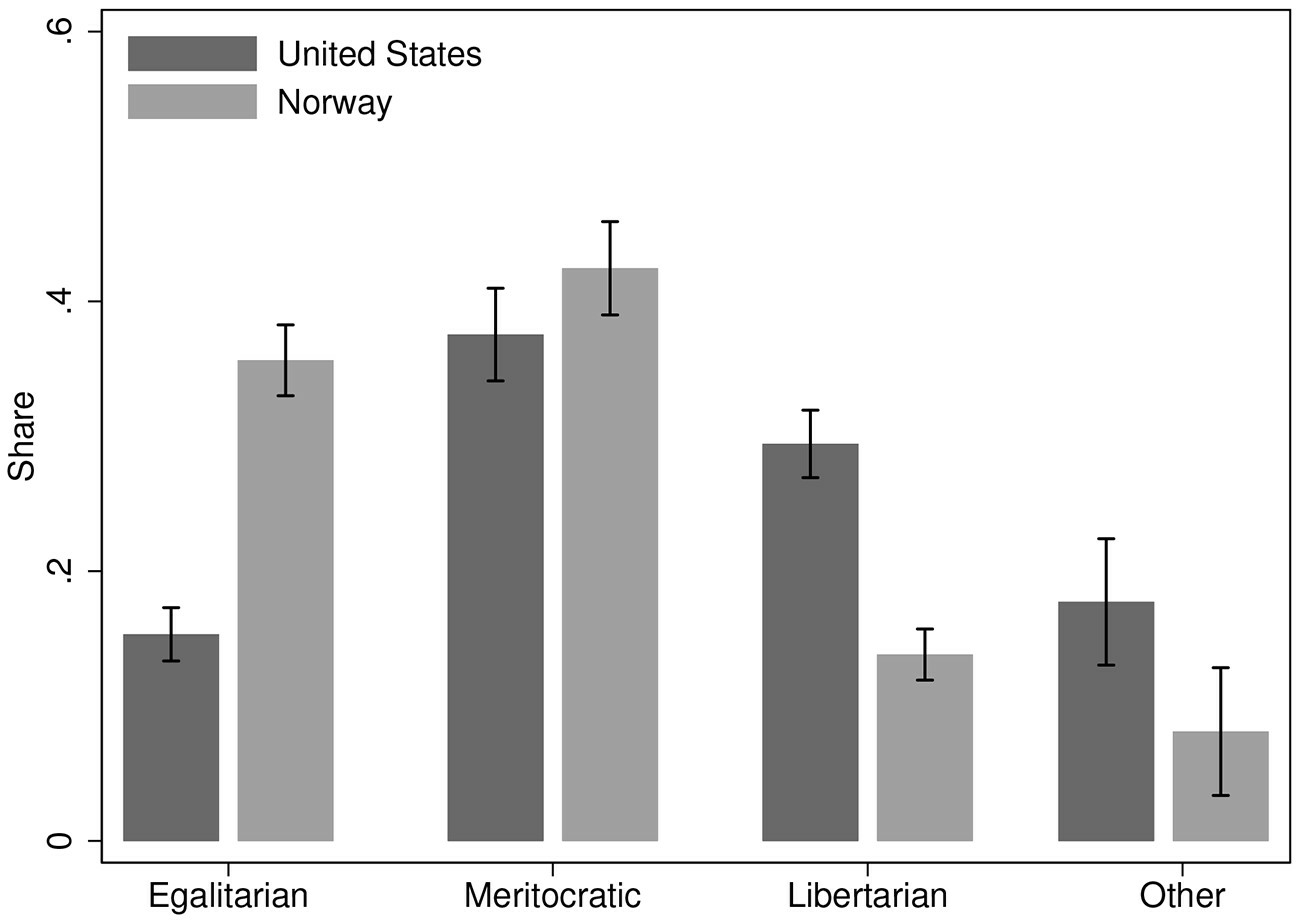
- Egalitarians - the share dividing equally in the merit treatment
- Libertarians - the share allocating everything to the lucky worker in the luck treatment
- Meritocrats - the difference between the share of participants allocating more to the productive worker in the merit treatment and the share allocating more to the lucky worker in the luck treatment
- Other - share redistributing in other ways
Experimental Procedure
Motivated Meritocracy
Development Economics
November 21, 2024
Some Results From Around the World
Motivated Meritocracy
Development Economics
November 21, 2024
A Model of (Context-Dependent) Inequality
\max_{y_1, y_2} V_i^{k(i)} = \theta_1 y_1 + \theta_2 y_2 - \beta_i \frac{(y_1 - m^{k(i)})^2}{2}
The spectator seeks to maximize their utility from the distribution of resources:
Weight to worker 1
Allocation to worker 1
Strength of inequality preferences
Inequality preferences
Motivated Meritocracy
Development Economics
November 21, 2024
A Model of (Context-Dependent) Inequality
\max_{y_1, y_2} V_i^{k(i)} = \theta_1 y_1 + \theta_2 y_2 - \beta_i \frac{(y_1 - m^{k(i)})^2}{2}
The spectator seeks to maximize their utility from the distribution of resources:
Since the overall pot is fixed, we can rewrite this as:
\max_{y_1} V_i^{k(i)} = X \theta_2 + y_1(\theta_1 - \theta_2) - \beta_i \frac{(y_1 - m^{k(i)})^2}{2}
Motivated Meritocracy
Development Economics
November 21, 2024
A Model of (Context-Dependent) Inequality
The spectator seeks to maximize their utility from the distribution of resources:
\max_{y_1} V_i^{k(i)} = X \theta_2 + y_1(\theta_1 - \theta_2) - \beta_i \frac{(y_1 - m^{k(i)})^2}{2}
Motivated Meritocracy
Development Economics
November 21, 2024
A Model of (Context-Dependent) Inequality
The spectator seeks to maximize their utility from the distribution of resources:
\max_{y_1} V_i^{k(i)} = X \theta_2 + y_1\underbrace{(\theta_1 - \theta_2)} - \beta_i \frac{(y_1 - m^{k(i)})^2}{2}
Difference in weights on two types of workers
Discrimination
Motivated Meritocracy
Development Economics
November 21, 2024
A Model of (Context-Dependent) Inequality
The spectator seeks to maximize their utility from the distribution of resources:
\max_{y_1} V_i^{k(i)} = X \theta_2 + y_1\underbrace{(\theta_1 - \theta_2)} - \beta_i \frac{(y_1 - m^{k(i)})^2}{2}
Motivated Meritocracy
Development Economics
November 21, 2024
A Model of (Context-Dependent) Inequality
The spectator seeks to maximize their utility from the distribution of resources:
If we assume there is no benefit from giving to a particular worker:
\max_{y_1} V_i^{k(i)} = X \theta_2 + y_1(\theta_1 - \theta_2) - \beta_i \frac{(y_1 - m^{k(i)})^2}{2}
Motivated Meritocracy
Development Economics
November 21, 2024
A Model of (Context-Dependent) Inequality
The spectator seeks to maximize their utility from the distribution of resources:
If we assume there is no benefit from giving to a particular worker:
\max_{y_1} V_i^{k(i)} =- \beta_i \frac{(y_1 - m^{k(i)})^2}{2}
This is the traditional model, solved by FOC:
0 =- \beta_i (y_1 - m^{k(i)}) \Rightarrow y_1 = m^{k(i)}
Motivated Meritocracy
Development Economics
November 21, 2024
A Model of (Context-Dependent) Inequality
This is the traditional model, solved by FOC:
0 =- \beta_i (y_1 - m^{k(i)}) \Rightarrow y_1 = m^{k(i)}
We can classify people by type given their redistribution choice:
m^{E(i)}=\frac{X}{2} \\
m^{M(i)}=\frac{a_1}{a_1+a_2}X
m^{L(i)}=\frac{a_1 p_1}{a_1 p_1+a_2 p_2}X
Egalitarian
Meritocrat
Libertarian
Motivated Meritocracy
Development Economics
November 21, 2024
A Model of (Context-Dependent) Inequality
The spectator seeks to maximize their utility from the distribution of resources:
\max_{y_1} V_i^{k(i)} = X \theta_2 + y_1(\theta_1 - \theta_2) - \beta_i \frac{(y_1 - m^{k(i)})^2}{2}
If we allow for some preference over who gets redistribution:
\theta_1 >0 \text{ and/or } \theta_2 >0 \text{ and } \theta_1 \neq \theta_2
Which yields FOC:
y_1^* = \frac{X(\theta_1 - \theta_2)}{\beta_i} + m^{k(i)}
Motivated Meritocracy
Development Economics
November 21, 2024
A Model of (Context-Dependent) Inequality
Which yields FOC:
y_1^* = \frac{X(\theta_1 - \theta_2)}{\beta_i} + m^{k(i)}
Then only allocate according to inequality preferences if spectator really cares about inequality preferences
\beta_i >> 0
Otherwise, bias towards one participant causes misrepresentation as a different type, which disguises the discrimination
Motivated Meritocracy
Development Economics
November 21, 2024
A Model of (Context-Dependent) Inequality
We need not allow for direct discrimination by providing the identity of the workers; it can be probabilistic:
y_1^* = \frac{X(\pi \theta_1 - (1-\pi)\theta_2)}{\beta_i} + m^{k(i)}
Potentially, the probability attenuates the bias based on inference.
However, it behaviorally provides more "cover" for discrimination under an inequality preference
Motivated Meritocracy
Development Economics
November 21, 2024
A Model of (Context-Dependent) Inequality
- Key takeaways:
- Under "blind" elicitations, spectator should always choose their personal optimal preference for inequality
- Introducing any information about workers may bias the redistributive choice
- Suddenly egalitarians look like meritocrats (or vice versa) when their choice benefits a certain type of worker
- My argument henceforth
- "Real" preferences (in the sense of policy) are made with knowledge and inference about who will benefit from redistribution schemes
- It is vital to know if inequality preferences are stable or subject to the context of who benefits
Motivated Meritocracy
Development Economics
November 21, 2024
A Unique Context: Fiji
- Island country in Melanesia north of New Zealand
- Consists of 330 islands, with about 100 inhabited, most of the population (87%) lives on one of two islands

Motivated Meritocracy
Development Economics
November 21, 2024
A Unique Context: Fiji
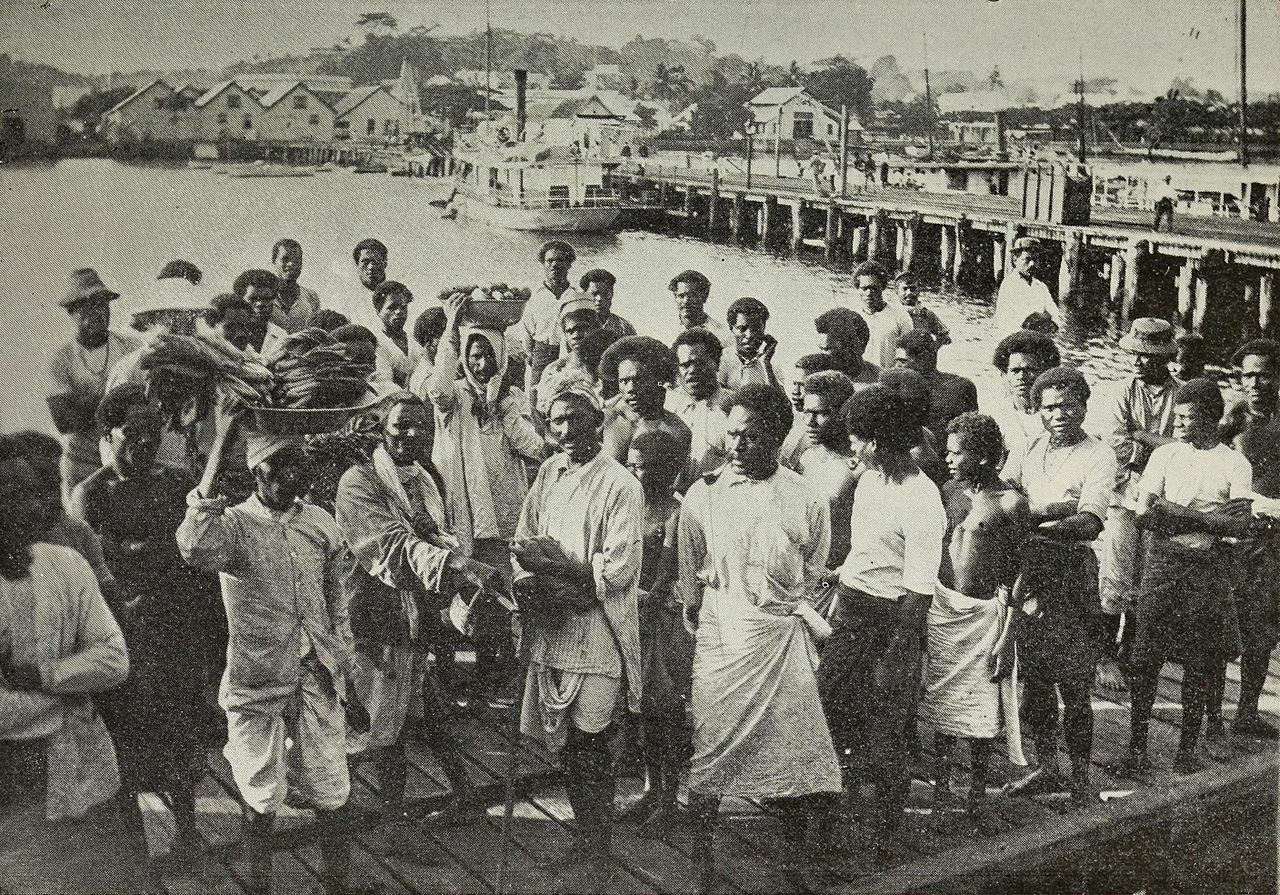
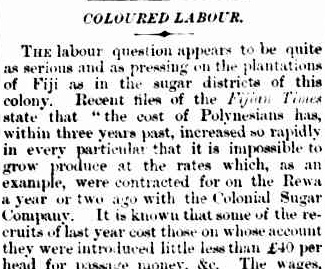
- 1874: Fiji as a British colony
- A catastrophic measles outbreak (mortality rate of 540 out of 1000 workers) and rebellion led to limited labor force
- Beginning in 1878, the UK began bringing indentured "laborers" from India to work, eventually over 60,000
- Today, 35% of the population is Indo-Fijian, with 60% indigenous iTaukei
Motivated Meritocracy
Development Economics
November 21, 2024
A Unique Context: Fiji
- Meanwhile "Fiji is for the Fijians" was adopted as official land ownership policy
- Traditional chiefs granted control over governing
- Most land could not be sold, only leased
- Today, this land agreement remains in place: 90% of land belongs to iTaukei communal land-owning units
- The majority of land is leased to farmers for agriculture
- The rents are distributed hierarchically to iTaukei communities, though until 2023 they were uniformly paid
Motivated Meritocracy
Development Economics
November 21, 2024
A Unique Context: Fiji
- Since independence in 1970, "Two Fijis" is the norm
- iTaukei own land rights and receive rent payments
- Redistributive scheme until last year was equal payments to the entire tribe
- Now hierarchical, with only 70% evenly split
- Often iTaukei do not work the land they own, or only subsistence farm on small percentages of it
- Indo-Fijians largely comprise the cash crop production and urban business development
- Not allowed to own land; pay rents to iTaukei
- Generate considerable economic activity through land use
- Lower poverty rate (20% vs 36%)
- iTaukei own land rights and receive rent payments
Motivated Meritocracy
Development Economics
November 21, 2024
A Unique Context: Fiji
- Cultural differences are extremely prevalent (and salient):
- iTaukei have a stronger social identity, in-group identification, and are more collectivistic than Indo-Fijians
- Indo-Fijians have a much higher perceived socio-economic status than iTaukei
- iTaukei more likely to be Christians, while Indo-Fijians more likely to be Hindus or Muslims
- Geographic differences are also clearly defined:
- iTaukei: native land under traditional clan structure
- Indo-Fijian: urban centers and towns
- The population share of Indo-Fijians is decreasing in distance from largest city, Suva
- Political strength largely vested in iTaukei (esp. following 2000 coup), but economic strength with Indo-Fijians
Motivated Meritocracy
Development Economics
November 21, 2024
Hypotheses and Experimental Procedure
- Standard spectator game (as in Almas, et al 2020)
- Two experimental treatments:
- Blind treatment - no information about the workers provided to the spectator
- Geographical - location information about each worker, such that ethnic group of worker is readily inferred
- Each with two sub-treatments for determining types:
- Luck
- Merit
Motivated Meritocracy
Development Economics
November 21, 2024
Hypotheses and Experimental Procedure
- There are two key measures from the spectator game:
- The share of each type (as defined before)
- Implemented inequality:
e_i = \alpha + \alpha_M M_i + \delta T_i +\delta_M M_i T_i + \gamma X_i + \epsilon_i
where the outcome is equivalent to the GINI coefficient:
e_i = \frac{|\text{income } A_i - \text{income } B_i|}{\text{total income}}
Motivated Meritocracy
Development Economics
November 21, 2024
Hypothesis 1: the collectivist tradition of the iTaukei and the redistribution scheme for rents will lead to more egalitarian views
- Hypothesis 1a: there is more inequality implementation by Indo-Fijian spectators than iTaukei spectators in blind treatments
- Hypothesis 1b: there are fewer Indo-Fijian egalitarians than iTaukei egalitarians
Hypotheses and Experimental Procedure
(\delta > 0)
While not causal, this would provide further suggestive evidence along the lines of the differences observed between the United States and Norway
Motivated Meritocracy
Development Economics
November 21, 2024
Hypothesis 2: there are systematic shifts in inequality preferences towards the in-group in geographic treatment
- Hypothesis 2a: when the in-group benefits from the initial payment scheme, fewer people choose to redistribute
- Hypothesis 2b: when the in-group does not benefit from the initial payment scheme, more people choose to redistribute
- Hypothesis 2c: conditioning on in-group performance, the distribution of types is not the same
Hypotheses and Experimental Procedure
e^b > e^g \Rightarrow \alpha_M^b > \alpha_M^g
Given blind (b) versus geographical (g) conditioning on in-group performing worse:
Motivated Meritocracy
Development Economics
November 21, 2024
Hypotheses and Experimental Procedure
Conditioning on in-group receiving initial payment
Motivated Meritocracy
Development Economics
November 21, 2024
Hypotheses and Experimental Procedure
Conditioning on in-group NOT receiving initial payment
Motivated Meritocracy
Development Economics
November 21, 2024
Hypotheses and Experimental Procedure
Conditioning on in-group NOT receiving initial payment
Motivated Meritocracy
Development Economics
November 21, 2024
Hypotheses and Experimental Procedure
Conditioning on in-group NOT receiving initial payment
Motivated Meritocracy
Development Economics
November 21, 2024
Additional Things I'm Thinking About
- Adding a treatment with specific details about the workers to test direct pathway to in-group preference
- Repeating the task within-subject to determine if spectators attenuate the bias shift in order to stay consistent
- For example, going blind in first rounds to geographic in later rounds
- Or, seeing the immediate beneficiaries of payment switch from in-group to out-group
Motivated Meritocracy
Development Economics
November 21, 2024
Conclusion
- Understanding the stability of inequality preferences is important for a cohesive policy agenda
- Redistributive policies can be an effective way to favor a group under veiled discrimination
- Experimental procedure that uses an established paradigm and introduces an in- and out-group dimension with testable implications
- Fiji offers a unique context in which to study:
- History of different groups enjoying differing levels of political and economic power
- Clear inference about worker type can be drawn with little exact revealed details
motivated.meritocracy.dev
By bjw95