The 4 act storyline
Dramatic question
The underlying message
Act 1
Introduction
Act 1: Introduction
The main character is introduced along with their ordinary life and setting.
A catalyst event (action driver) disrupts their ordinary life and sets the story in motion.
The main character faces a challenge or opportunity that propels them into a new situation.
Act 1: Introduction con't
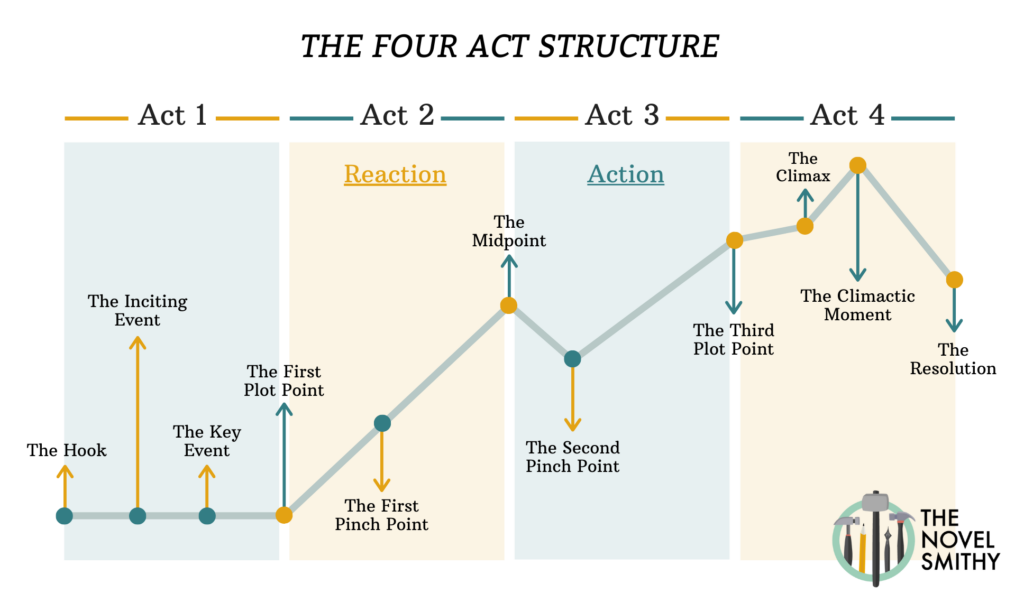
The hook: This plot point introduces some conflict or question that grabs your reader’s attention and “hooks” them into your story.
The inciting event: Sets your story's conflict into motion. Often your protagonist will be present here, though not always. Either way, this is the spark that triggers your plot.
The key event: Where your protagonist becomes personally involved in your plot. Some event will suck them into your story's conflict, though they’ll likely resist this pull at first.
The first plot point: Act One comes to a close with the first plot point, where your protagonist will make the choice to engage with your plot. From now on, there’s no turning back.
Act 2
Conflict
Act 2: Conflict
The main character embarks on a journey or mission to achieve their goal.
They encounter obstacles, conflicts, and meet new characters who aid or hinder their progress.
The main character undergoes personal growth and development as they face various trials and tribulations.
Act 2: Conflict con't
The first pinch point: Part of a pair, this pinch point is where your antagonist will get their first chance to demonstrate their power. Use this plot point to reinforce the stakes of your plot and remind readers (and your protagonist) why this story matters.
The midpoint: The end of act two, the midpoint is a major turning point where your protagonist will face their biggest trial yet. If they succeed, this will shift their story from reaction to action. They’ll feel confident in their skills and ready to tackle the challenges ahead.
Act 3
Climax
Act 3: Climax
The main character faces the biggest obstacle or conflict that pushes them to the brink of failure.
They confront their fears or limitations and make a crucial decision that determines their fate.
The tension builds to a climactic moment where success or failure hangs in the balance.
Act 3: Climax con't
The second pinch point: With the midpoint behind them, your protagonist is feeling confident—meaning they need a reminder of what’s at stake. The second pinch point serves as that reminder, showcasing your antagonist’s power and why your hero can’t relax just yet.
The third plot point: This is your protagonist’s darkest moment, as well as the end of act three. Here they’ll experience a painful defeat, causing them to question both their journey thus far and what comes next. This sets the stage for your finale.
Act 4
Resolution
Act 4: Resolution
The main character's decision leads to a final confrontation or resolution of the story's conflict.
Loose ends are tied up, and the main character learns important lessons or experiences a significant change.
The story concludes with a sense of closure, leaving the audience with a satisfying resolution.
Act 4: Resolution
The main character's decision leads to a final confrontation or resolution of the story's conflict.
Loose ends are tied up, and the main character learns important lessons or experiences a significant change.
The story concludes with a sense of closure, leaving the audience with a satisfying resolution.
Act 4: Resolution con't
The climax: The beginning of your story’s finale, where your protagonist and antagonist can no longer avoid each other. Your protagonist makes the choice to confront your core conflict head on.
The climactic moment: This culminates in a key scene, called the climactic moment. This is where your protagonist will make the final decision that determines whether they succeed or fail, resolving their story once and for all.
The resolution: Finally, the last plot point of the four act structure is the resolution, where you’ll show the aftermath of your plot. Your core conflict has been resolved, and now your protagonist will have to figure out where their life goes from here. Whether joyful or bittersweet, this marks the end of your story.
More detail: bit.ly/cst24acts
Decision driven
vs
action driven
- Storyline type - bit.ly/cst25storyline
- Character archetypes - bit.ly/cst25characters
- Decision vs action
- Underlying message
- bit.ly/cst25acts
4 act storyline
By camberwellshowtime