i = \text{Player }i
-i = \text{Player(s) other than }i
\text{Example 1: Consider a strategy profile for four players }s = (s_1, s_2, s_3, s_4)
\text{If we consider player 2, then }s_i = s_2 \text{ and } s_{-i}=(s_1, s_3, s_4)
\text{Example 2: }BR_i(\theta_{-i})\text{ is read:}
\text{“Player $i$'s best response to their beliefs about other players' strategies"}
u_i(s_i,s_{-i}) = \text{Player $i$'s utility from playing $s_i$ when others play $s_{-i}$}

Last time we analyzed this game.
Dominance and Rationalizability
Today's Agenda
Dominant and Dominated Strategies
Best Responses
Rationalizability (aka Iterated Deletion of Dominated Strategies)
Dominant and Dominated Strategies


Which strategies are dominated?
How to search for a dominated strategy:
1. Look to see if it's dominated by another pure strategy
2. Look for candidate mixed strategies, especially different strategies with alternating large payoffs
3. Remember: you only need to find one strategy that dominates a strategy for strategy to be dominated.

Formal Definition
Strict vs. Weak Dominance
U strictly dominates D for player 1
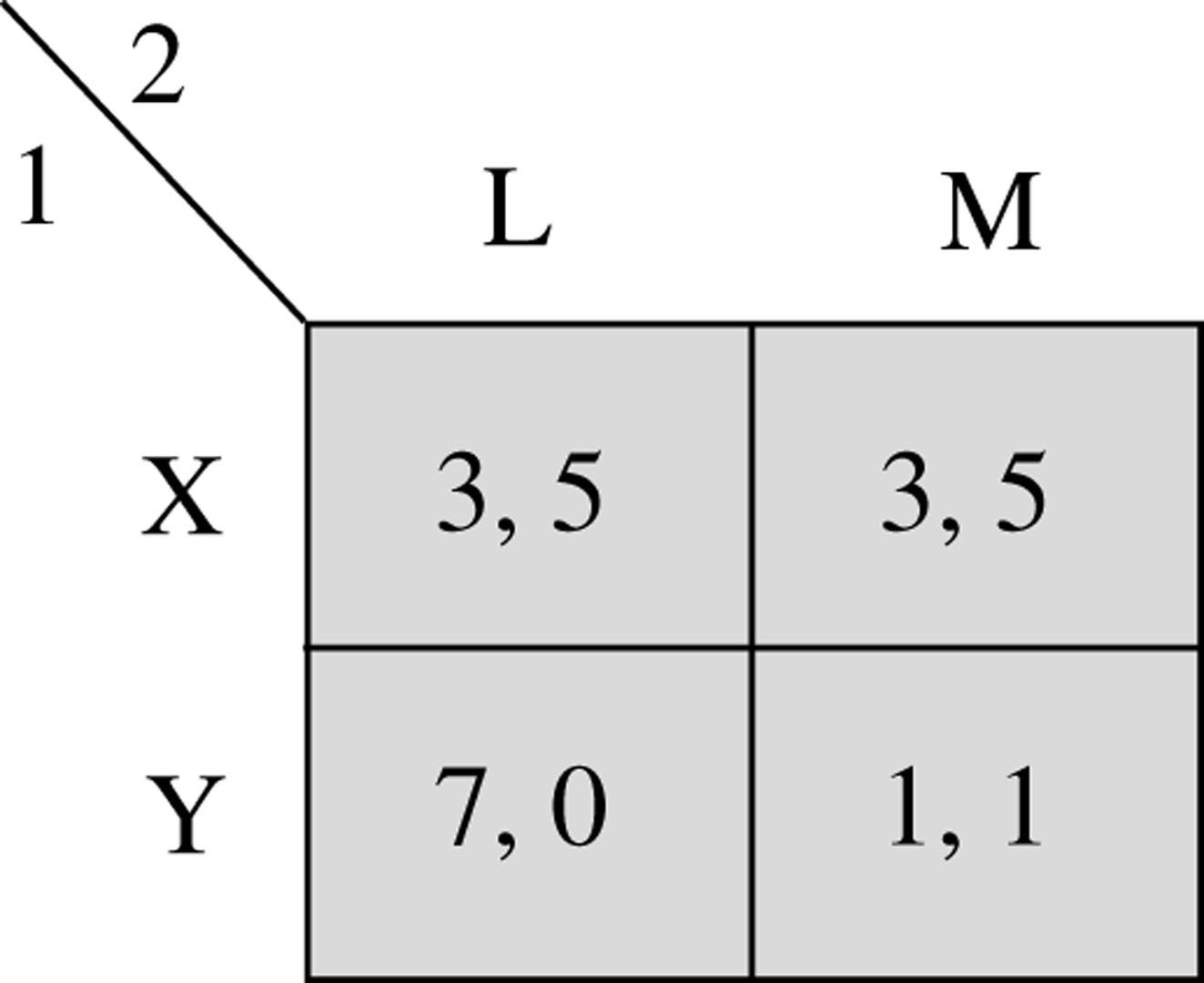
M weakly dominates L for player 2
Dominant Strategy Equilibrium
If each player has a single dominant strategy, then the dominant strategy equilibrium is the outcome of the game in which they each play their dominant strategy.
Dominant Strategy
If a player has a strategy which dominates all other strategies, it is called a dominant strategy.
First Strategic Tension:
Prisoner's Dilemma
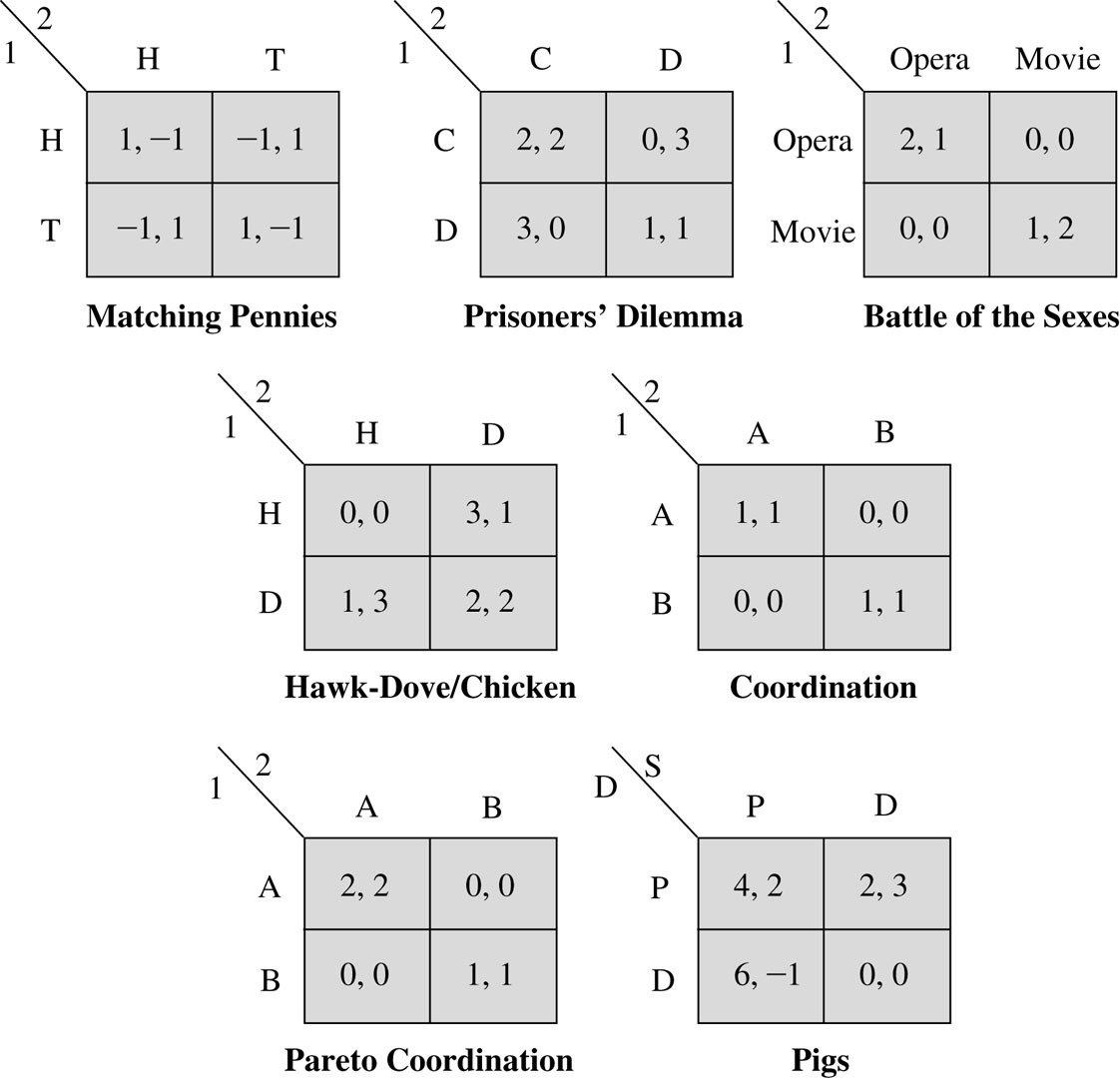
(C,C) pareto dominates (D,D)
(D,D) is a dominant strategy equilibrium
The First Strategic Dilemma:
Everyone doing what's best for themselves can lead to a group loss.
Best Responses

Best Responses
Informally: a thought exercise that says:
"If I believe the other player(s) are going to play some way, what should I do?"
Formally:

\theta_2 = (\frac{1}{3}, \frac{1}{2}, \frac{1}{6})
u_1(U, \theta_2) =
u_1(M, \theta_2) =
u_1(D, \theta_2) =
BR_1(\theta_2) =
\theta_2 = (\frac{1}{2}, \frac{1}{4}, \frac{1}{4})
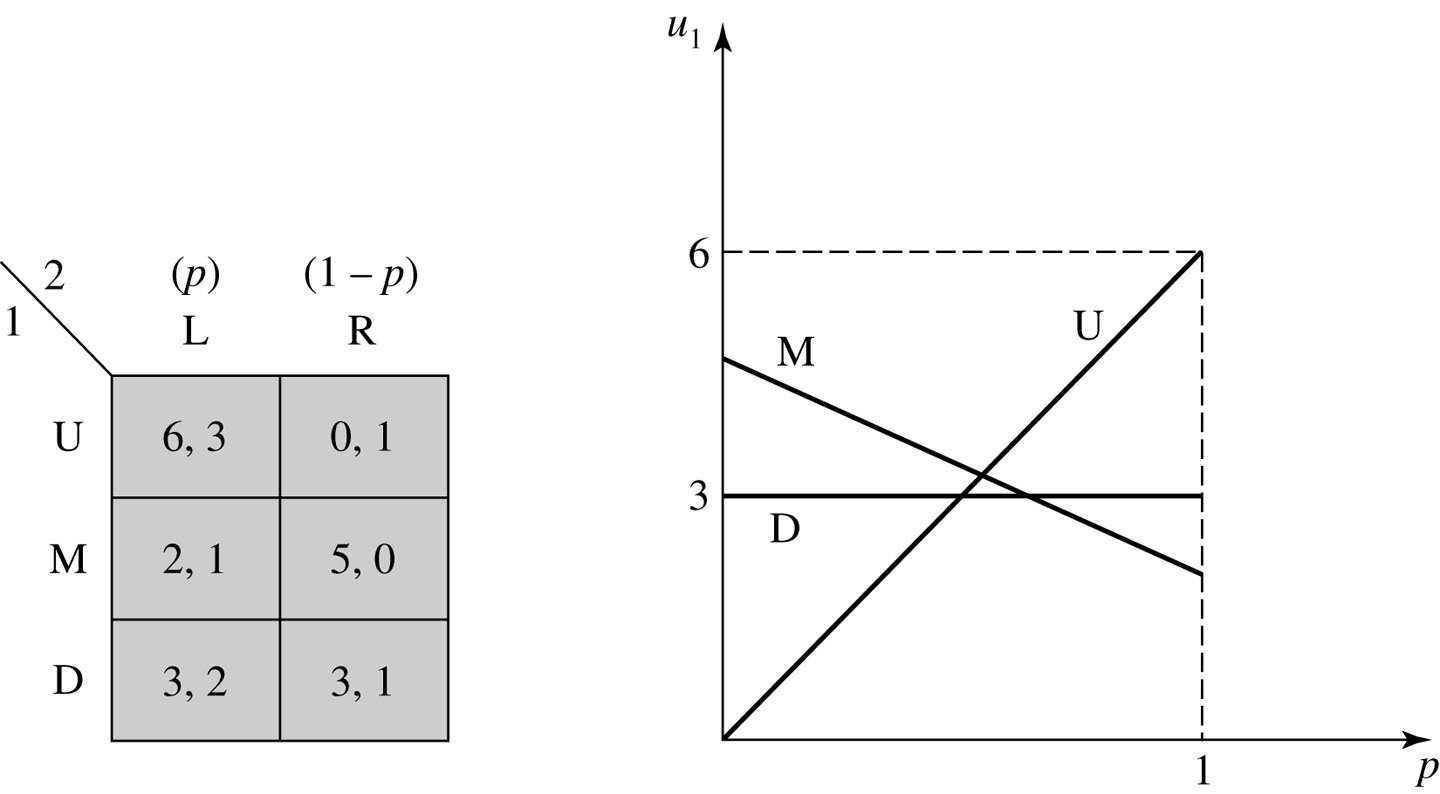
What is player 1's best response if they believe player 2 will play L?
What is player 1's best response
if they believe player 2 will play R?
What if they believe player 2 will play L with probability p?
B_i(\theta_j): \text{Best response for belief }\theta_j
B_i: \text{Set of strategies which are a BR for some belief}
Note: In a finite two-player game, \(B_i\) is also the set of strategies which are not dominated.
Rationalizability
(a.k.a. Iterated Deletion of Dominated Strategies)
Ra・tion・a・liz・a・bil・i・ty
(a.k.a. Iterated Deletion of Dominated Strategies)

Iterated Dominance
The process of eliminating strategies that are dominated, until no remaining strategies are dominated.
Rationalizable Strategies
The set of strategies that survive iterated dominance.
70% Game
Go to the link in your email to play.
Everyone guesses a number between 0 and 100. The closest guess to 70% of the class average will win 5 homework points!

Two hot dog carts on a beach; 9 possible locations.
Customers are evenly distributed along the beach and go to closest location.
What is the set of rationalizable strategies?
Second Strategic Tension:
Strategic Uncertainty


Conclusions and Next Steps
So far we've mainly talked about what people won't do,
and we have a good predictor of what they will do --
but only if they have a single dominant strategy.
Next time: look for Nash Equilibrium
in which everyone is best responding to everyone else.
Econ 51 | 10 | Dominance and Rationalizability
By Chris Makler
Econ 51 | 10 | Dominance and Rationalizability
The first steps to understanding strategic behavior: what will you NOT do? What, based on your beliefs about the other players' strategies, might you do?