Price Discrimination
and a review of the past 20 weeks
Christopher Makler
Stanford University Department of Economics
Econ 51: Lecture 19
I'm just another player in your game for two.
Both of these are models of asymmetric information: an uninformed party is trying to extract behavior or information from an informed party.
Last time:
The Principal-Agent Model
Today:
Price Discrimination
- Buyers differ as to their valuation of quality: some value it a lot, others not so much
- A seller cannot observe how much the buyer values quality
- Offers a menu of options: a "budget" product at a low price point, and a "premium" product at a higher price point
- Goal: have buyers sort themselves
- A "principal" wants an "agent" to do something for them
- The principal cannot observe how much effort the agent puts forward, but can observe if the agent is successful
- Offers a wage contract with two values: one if the agent fails, the other if they succeed
- Goal: encourage effort
Price Discrimination
- Neoclassical model: perfect competition, single price, price-taking
- Real world: firms with market power engage in lots of interesting kinds of pricing strategies
- Transportation: single tickets vs. monthly passes
- Cell phone plans: pre-paid vs. unlimited
- Airline tickets
- College tuition
- Asymmetric information problem: the firm doesn't know how much its customers value its product. How can it design different options that encourage customers to self-select based on their preferences?
Different Options for Different Customers
- The firm is going to have different "offerings" aimed at different customers.
- One possibility: bundles of quantities
- Another possibilities: quality choice
Quantity Options



Quality Options


Quality Options




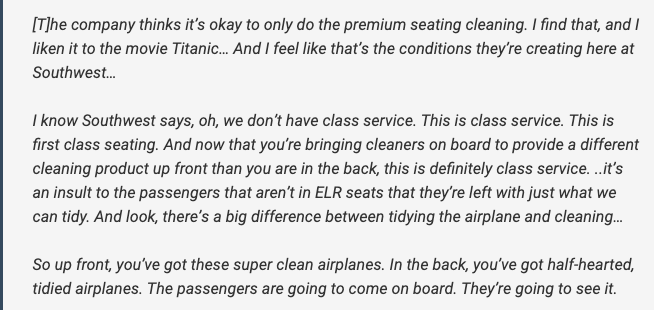
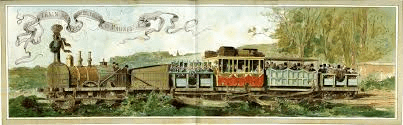
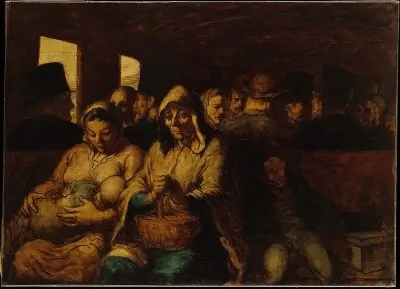
Only too often does the sight of third-class passengers travelling in open or poorly sprung carriages,
and always badly seated, raise an outcry against the barbarity of the railway companies.
It wouldn't cost much, people say, to put down a few yards of leather and a few pounds of horsehair, and it is worse than avarice not to do so...
It is not because of the few thousand francs which would have to be spent to put a roof over the third-class carriages or to upholster the third class seats that some company or other has open carriages with wooden benches; it would be a small sacrifice for popularity.
What the company is trying to do is to prevent the passengers who can pay the second-class fare from traveling third class; it hits the poor, not because it wants to hurt them, but to frighten the rich.
- Emile Dupuit, 19th century French railroad engineer
Model Setup
Firm chooses to produce goods with quality \(q\)
Type 1 (low value)
There are two types of consumers, who value quality differently.
Type 2 (high value)
TB_1(q) = 20q - {1 \over 2}q^2
TB_2(q) = 30q - {1 \over 2}q^2
Assume (for now) equal numbers in each group
Assume the firm has no costs; they are just trying to maximize their revenue.
First-Degree Price Discrimination
Type 1 (low value)
Type 2 (high value)
TB_1(q) = 20q - {1 \over 2}q^2
TB_2(q) = 30q - {1 \over 2}q^2
Suppose the firm can observe the type of each customer, and offer them a quality just suited to them — and charge them their total willingness to pay.
p_1(q_1) = TB_1(q_1)
p_2(q_2) = TB_2(q_2)
What qualities will it produce?
What will it charge?
"Budget offering"
"Premium offering"
What would happen if the consumer's type was unobservable to the seller?
Second-Degree Price Discrimination
Type 1 (low value)
Type 2 (high value)
TB_1(q) = 20q - {1 \over 2}q^2
TB_2(q) = 30q - {1 \over 2}q^2
Now suppose the firm cannot observe the type of the consumer.
Each consumer will buy the good which gives them the most surplus (benefit minus cost)
p_1(q_1) = TB_1(q_1)
p_2(q_2) = ?
We don't have to worry about the Type-1 consumers buying the premium product
Might the Type-2 consumers want to buy the budget product, though...?
Second-Degree Price Discrimination
Type 1 (low value)
Type 2 (high value)
TB_1(q) = 20q - {1 \over 2}q^2
TB_2(q) = 30q - {1 \over 2}q^2
p_1(q_1) = TB_1(q_1)
TB_2(q_2) - p_2 \ge TB_2(q_1) - p_1
Charge low-value types their maximum willingness to pay:
Constraint for high-value types: prefer to buy \(q_2\) at price \(p_2\) than \(q_1\) at price \(p_1\):
450 - p_2 \ge [30q_1 - {1 \over 2}q_1^2] - [20q_1 - {1 \over 2}q_1^2]
p_1(q_1) = 20q_1 - {1 \over 2}q_1^2
p_2(q_1) = 450 - 10q_1
450 \ge p_2 + 10q_1
Notice: the price you can charge for the premium product depends on how nice the budget product is. The crappier the budget version, the more you can charge for premium...
Second-Degree Price Discrimination
Type 1 (low value)
Type 2 (high value)
p_1(q_1) = 20q_1 - {1 \over 2}q_1^2
p_2(q_1) = 450 - 10q_1
Notice: the price you can charge for the premium product depends on how nice the budget product is. The crappier the budget version, the more you can charge for premium...
Second-Degree Price Discrimination
Type 1 (low value)
Type 2 (high value)
TB_1(q) = 20q - {1 \over 2}q^2
TB_2(q) = 30q - {1 \over 2}q^2
p_1(q_1) = 20q_1 - {1 \over 2}q_1^2
p_2(q_1) = 450 - 10q_1
Expected revenue if equal numbers of each type:
\mathbb{E}[p(q_1)] = {1 \over 2}[20q_1 - {1 \over 2}q_1^2] + {1 \over 2}[450 - 10q_1]
Take the derivative and set equal to zero:
{1 \over 2}[20 - q_1] + {1 \over 2}[- 10] = 0
\Rightarrow q_1^* = 10
q_1^* = 10
Mechanisms: A Review
- In each of the models we saw this week, one of the players designs a choice for the other player
- Principal-agent: incentivize the other player to behave in a certain way, even though behavior can't be monitored
- Price discrimination: incentivize the other player to reveal their preferences by giving them a menu of options
- How many games in the real world are designed...and by whom...and for what (profit-making) purpose...?
What have we learned in our 20 weeks together?
Ways to Think about Learning
Strategic:
"knowing when" - given an unstructured problem, which model/framework is most relevant?
Schematic:
Procedural:
Declarative:
"knowing why" - how do different concepts/models relate to one other?
"knowing how" - given a well-defined problem, ability to follow correct procedure to solve it
"knowing that" - facts and figures, vocabulary
Goals of the Course
Strategic:
Develop rigorous approach to economic modeling; understand how assumptions map into conclusions.
Schematic:
Procedural:
Declarative:
Understand the relationships between
words, math, and graphs.
Learn the techniques of
optimization, equilibrium, and comparative statics.
Know the definitions of key economic terms.
At the core of everything is the concept of choice.
Tradeoffs between two goods
Optimal quantity of one good
Model 1: Consumer Choice
Model 2: Theory of the Firm
WEEK 1
WEEK 2
WEEK 3
Modeling preferences with multivariable calculus
Constrained optimization when calculus works
Constrained optimization when calculus doesn't work
WEEK 4
WEEK 5
Consumer Demand
Applications to Finance
WEEK 6
WEEK 7
WEEK 8
Production and Costs for a Firm
Profit Maximization
Competitive Equilibrium
WEEK 9
WEEK 10
Taxes and Externalities
Public Economics; Market Power
Model 3: Market Equilibrium
Two Kinds of Optimization
Tradeoffs between two goods
Optimal quantity of one good
🍎
(not feasible)
(feasible)
🍌
Optimal choice
🙂
😀
😁
😢
🙁
🍎
benefit and cost per unit
Marginal Cost
Marginal Benefit
Optimal choice
Part I: Trading Interactions
Exchange Economies
Production Economies
Static Games of Complete Information
Dynamic Games of Complete Information
Static Games of Incomplete Information
Dynamic Games of Incomplete Information
Getting people to do what you want
Getting people to reveal information
Part III: Mechanisms
Different Types of Interactions
Part II: Strategic Interactions
Individual agents make choices.
Systems result in outcomes as a result of the collective choices being made within them.
Consumers
Firms
Governments
Markets
Games
Mechanisms
From Bundles to Allocations

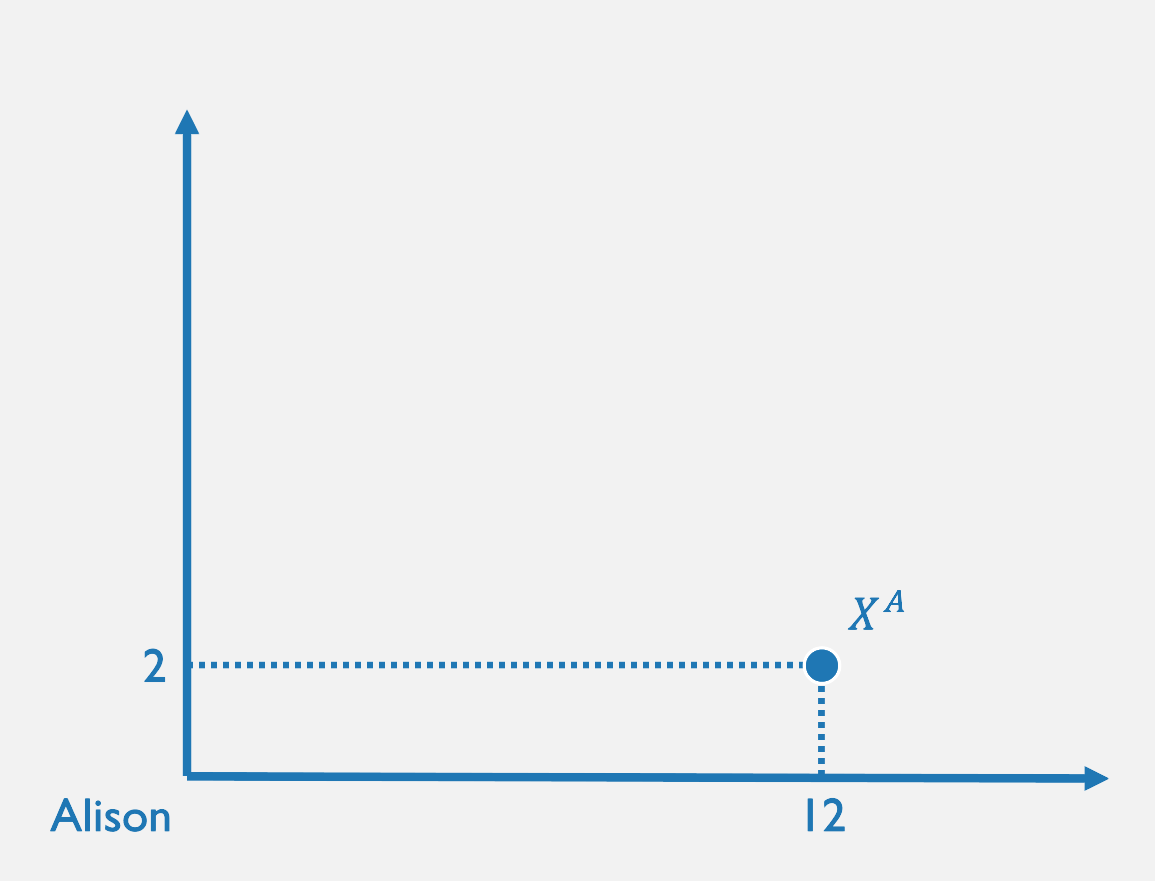
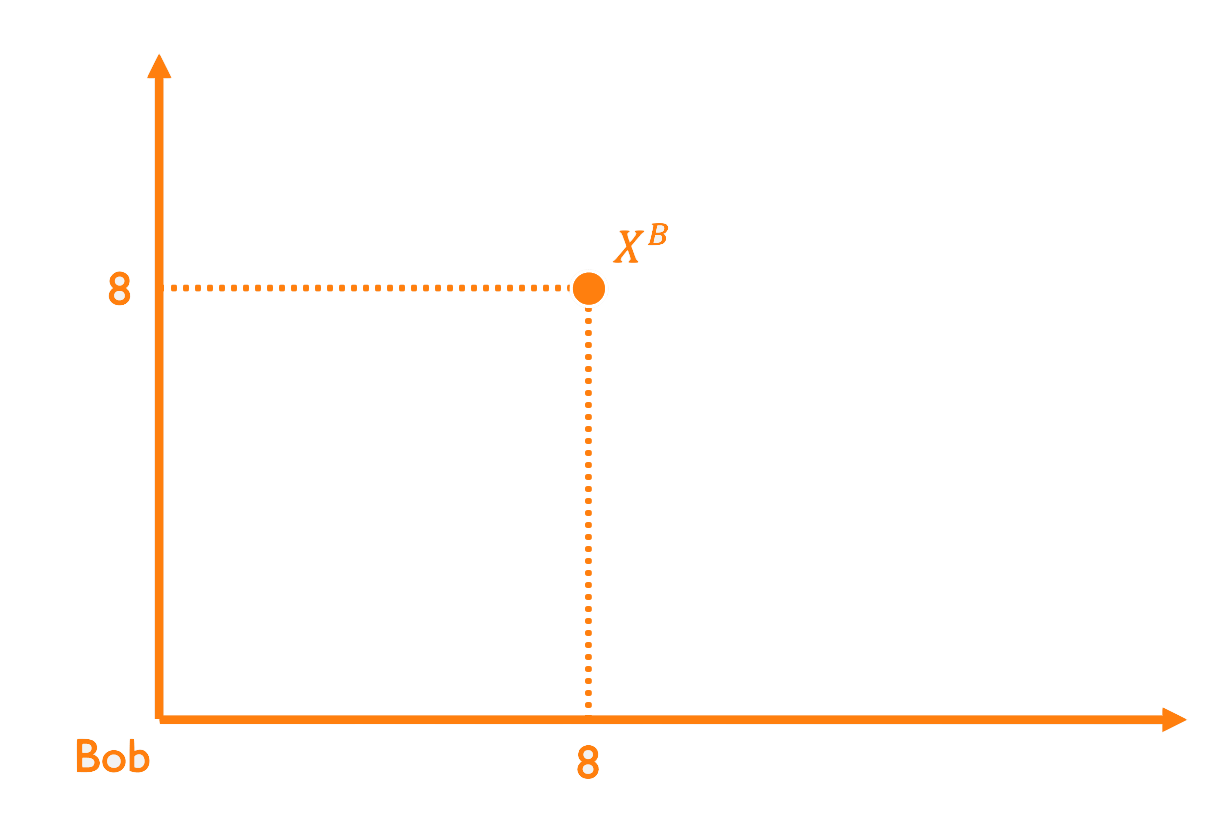
From Bundles to Allocations
From Bundles to Allocations
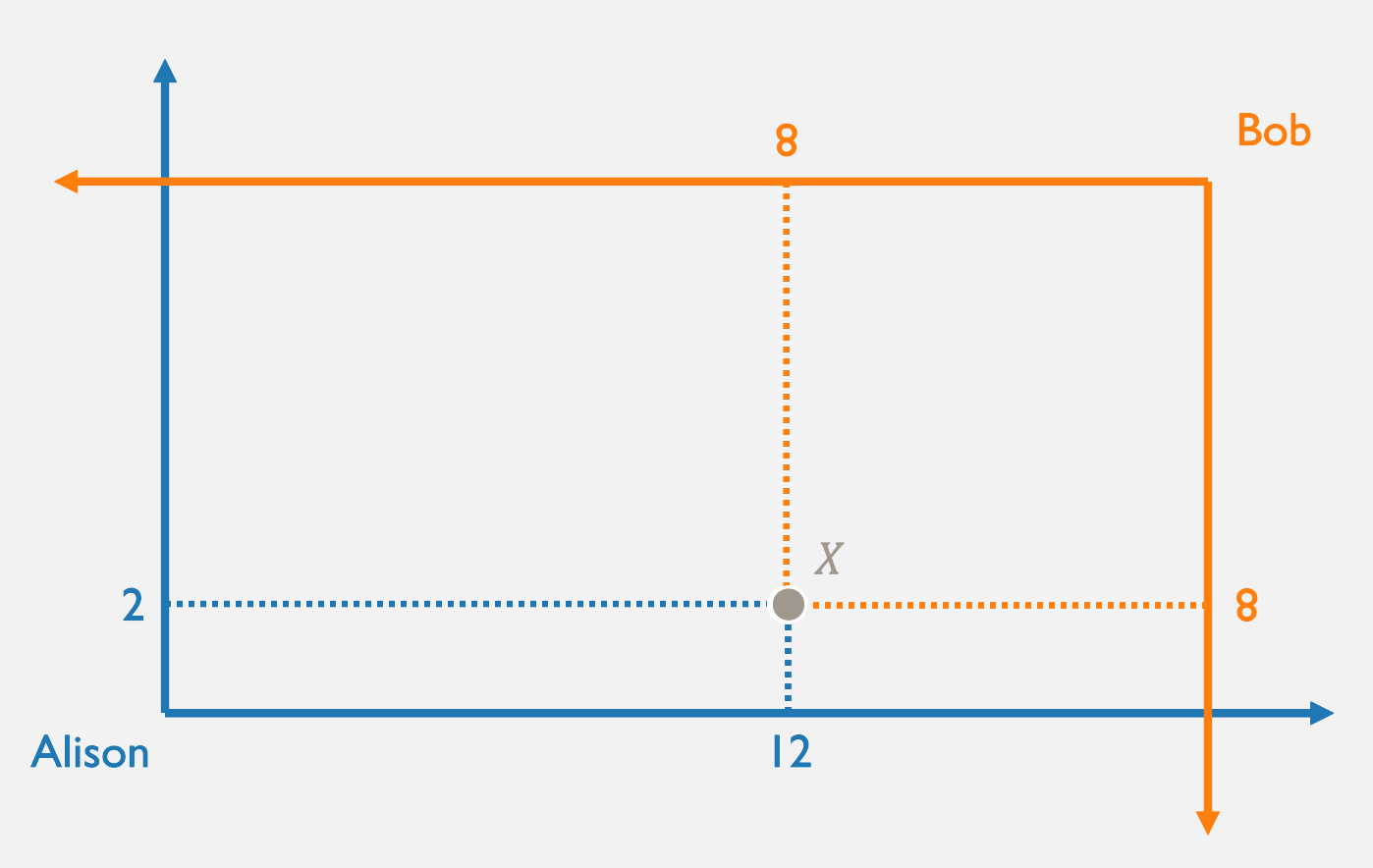
Preferences in the Edgeworth Box
What does the "lens" of overlap represent?
How is the existence of this lens related to
the agents' marginal rate of substitution (MRS) at point \(X\)?
Pareto Improvements and Pareto Efficiency
A reallocation that makes at least one person strictly better off and makes nobody strictly worse off is called a Pareto improvement.
An allocation from which
there is a possible Pareto improvement is called a
Pareto inefficient allocation.
An allocation from which
there is no possible Pareto improvement is called a
Pareto efficient allocation.
Pareto Efficiency and the Contract Curve
u^A(x_1^A,x_2^A) = a \ln x_1^A + (1-a) \ln x_2^A
u^B(x_1^B,x_2^B) = b \ln x_1^B + (1-b) \ln x_2^B
The parameters \(a\) and \(b\) represent how much A and B like good 1, respectively:
At each price of good 1, we can say how much good 1 each will supply at that price
Given any price ratio, Alison and Bob will choose some amounts to produce; this determines the dimensions of the Edgeworth Box, as well as their endowment in it.
They will then choose how much they want to sell of the goods they produced, in order to buy the other good from the other person, at that price ratio.
Competitive equilibrium occurs at the price ratio for which they end up wanting to trade to the same bundle.
Strategic Interactions
- Players: who is playing the game?
- Actions: what can the players do at different points in the game?
- Information: what do the players know when they act?
- Outcomes: what happens, as a function of all players' choices?
- Payoffs: what are players' preferences over outcomes?
Components of a Game
Strategies and Strategy Spaces
A strategy is a complete, contingent plan of action for a player in a game.
This means that every player
must specify what action to take
at every decision node in the game tree!
A strategy space is the set of all strategies available to a player.
Time
Information
Static
(Simultaneous)
Dynamic
(Sequential)
Complete
Incomplete
WEEK 5
WEEK 6
LAST TIME
TODAY
Prisoners' Dilemma
Cournot
Entry Deterrence
Stackelberg
Auctions
Job Market Signaling
Collusion
Cournot with Private Information
Poker
Time
Information
Static
(Simultaneous)
Dynamic
(Sequential)
Complete
Incomplete
Strategy: an action
Equilbirium: Nash Equilibrium
Strategy: a mapping from the history of the game onto an action.
Equilibrium: Subgame Perfect NE
Strategy: a plan of action that
specifies what to do after every possible history of the game, based on one's own private information and (updating) beliefs about other players' private information.
Equilibrium: Perfect Bayesian Equilibrium
Strategy: a mapping from one's private information onto an action.
Equilibrium: Bayesian NE
WEEK 5
WEEK 6
LAST TIME
TODAY
Prisoners' Dilemma
Cournot
Entry Deterrence
Stackelberg
Auctions
Job Market Signaling
Collusion
Cournot with Private Information
Poker
Definition: Best Response (Nash) Equilibrium
\text{A strategy profile }s^* = s_1^*,s_2^*,...,s^*_n\text{ is a \textbf{Nash Equilibrium} if}
u_i(s^*) \ge u_i(s'_i,s^*_{-i})
\text{ for every available strategy }s'_i \in S_i \text{, for all players } i=1,2,...,n
In plain English: in a Nash Equilibrium, every player is playing a best response to the strategies played by the other players.
\text{ player }i\text{'s equilibrium payoff}
\text{ player }i\text{'s payoff from some deviation }s'_i
In other words: there is no profitable unilateral deviation
given the other players' equilibrium strategies.
1
2
1
2
,
4
3
,
1
4
,
1
1
,
T
M
L
C
B
R
3
0
,
2
1
,
3
2
,
8
0
,
8
0
,
Nash equilibrium occurs when every player is choosing strategy which is a
best response to the strategies chosen by the other player(s)
BR_1(L) =
BR_1(C) =
BR_1(R) =
\{M\}
\{B\}
\{T,B\}
BR_2(T) =
BR_2(M) =
BR_1(B) =
\{L\}
\{C\}
\{C\}
Definition: Subgame Perfect Nash Equilibrium
In an extensive-form game of complete and perfect information,
a subgame in consists of a decision node and all subsequent nodes.
A Nash equilibrium is subgame perfect if the players' strategies
constitute a Nash equilibrium in every subgame.
(We call such an equilibrium a Subgame Perfect Nash Equilibrium, or SPNE.)
Informally: a SPNE doesn't involve any non-credible threats or promises.
1
2
X
Y
X
Y
A
B
3
2
1
0
2
0
1
3
C
D
1
2
2
AC
AD
BC
BD
3
2
1
0
2
0
1
3
3
2
1
3
2
1
0
0
What are the Nash equilibria of this normal-form game?
1
2
X
Y
X
Y
A
B
3
2
1
0
2
0
1
3
C
D
1
2
2
AC
AD
BC
BD
3
2
1
0
2
0
1
3
3
2
1
3
2
1
0
0
Think about this: after player 1 makes her move, we are in one of two subgames.
What should player 2 do in each subgame?
1
2
X
Y
X
Y
A
B
3
2
1
0
2
0
1
3
C
D
1
2
2
AC
AD
BC
BD
Think about this: after player 1 makes her move, we are in one of two subgames.
3
2
1
0
2
0
1
3
3
2
1
3
2
1
0
0
What should player 2 do in each subgame?
Anticipating how player 2 will react, therefore, what will player 1 choose?
Definition: Bayes Nash Equilibrium
A strategy in a simultaneous game of incomplete information is a mapping from each agent's private information onto their actions.
A Bayes Nash Equilibrium is the Nash equilibrium of the game with such strategies.
Games of
Incomplete Information
A
B
X
Y
1
2
2
0
2
0
0
4
0
4
A
B
X
Y
1
2
0
4
2
0
2
0
0
4
Suppose one of these
two games is being played.
Both players know there is an equal probability of each game.
Only player 1 knows which game is being played right now.
What is player 1's strategy space?
Player 2's?
Nature
Heads
(1/2)
Tails
(1/2)
Both players know there is an equal probability of each game.
Only player 1 knows which game is being played right now.
We can model this "as if" there is a nonstrategic player called Nature who moves first,
2
1
2
1
X
Y
2
0
2
0
0
4
0
4
X
Y
0
4
2
0
2
0
0
4
X
Y
X
Y
\(A^H\)
\(B^H\)
\(A^T\)
\(B^T\)
flips a coin, and picks which game is being played based on the coin flip.
Player 1 observes Nature's move, so they have to choose what to do if Nature flips Heads (\(A^H\) or \(B^H\)) and if Nature flips Tails (\(A^T\) or \(B^T\)).
Player 2 does not, so their information set spans the entire game: they are only choosing X or Y.
Nature
Heads
(1/2)
Tails
(1/2)
2
1
2
1
\(A^H\)
\(B^H\)
X
Y
1
2
2
0
2
0
0
4
0
4
\(A^T\)
\(B^T\)
X
Y
0
4
2
0
2
0
0
4
X
Y
X
Y
The Bayesian Normal Form representation of the game shows the expected payoffs for each of the strategies the players could play:
\(A^HA^T\)
\(A^HB^T\)
\(B^HA^T\)
\(B^HB^T\)
X
Y
1
2
1
0
3
1
0
2
0
1
3
2
2
0
2
4
Bayes Nash Equilibrium is the NE of this game. It maps private information onto (simultaneously taken) actions.
Definition: Perfect Bayesian Equilibrium
Consider a strategy profile for the players, as well as beliefs over the nodes at all information sets.
These are called a perfect Bayesian Equilibrium (PBE) if:
- Each player’s strategy is optimal to them at each infoset, given beliefs at this infoset and opponents’ strategies (“Sequential Rationality”)
- The beliefs are obtained from strategies using Bayes’ Rule wherever possible (i.e. at each infoset that is reached with a positive probability) (“consistency of beliefs”)
Job Market Signaling
Nature determines each worker's type; \({1 \over 3}\) are H, \({2 \over 3}\) are L.
NATURE
Type-H Worker
Type-L Worker
The worker realizes their own type,
and chooses whether to go to college
or stick with a high school degree.
Firms cannot observe the worker's type;
they can only observe whether
they chose High School or College.
The firm has beliefs about the worker's type based on that choice:
p = \Pr\{H\ |\ \text{High School}\}
q = \Pr\{H\ |\ \text{College}\}
Job Market Signaling
NATURE
Type-H Worker
Type-L Worker
Consider a separating equilibrium in which type-H workers choose College, and type-L workers choose High School:
What are the firm's beliefs?
p = \Pr\{H\ |\ \text{High School}\} =
q = \Pr\{H\ |\ \text{College}\} =
s_1 = C,HS'
0
1
Reason: if all type-H's choose College,
and all type-L's choose High School,
then observing the worker's choice conveys all relevant information to the firm.
Job Market Signaling
NATURE
Type-H Worker
Type-L Worker
Consider a separating equilibrium in which type-H workers choose College, and type-L workers choose High School:
What are the firm's beliefs?
p = \Pr\{H\ |\ \text{High School}\} =
q = \Pr\{H\ |\ \text{College}\} =
s_1 = C,HS'
0
1
What is the firm's best response to workers' strategies and this set of beliefs?
s_2 = C', M
Job Market Signaling
NATURE
Type-H Worker
Type-L Worker
Candidate separating equilibrium:
p = \Pr\{H\ |\ \text{High School}\} =
q = \Pr\{H\ |\ \text{College}\} =
s_1 = C,HS'
0
1
s_2 = C', M
Important! A PBE must specify
both strategies and beliefs.
Also...we're not done!!!
We need to check that workers don't want to deviate given the strategies of firms.
Mechanism Design
Game
Players
Strategies
Payoffs
Mechanism
Players with Hidden Information
Actions
Outcomes
Given this game,
what outcome do we predict will happen?
Given a desired outcome,
what game can we design to achieve it?
"Reverse Game Theory"
If people have hidden information,
(e.g. the quality of a used car for sale)
what mechanism can a designer establish
to get them to reveal that information?
If people can take hidden actions,
what mechanism can a designer establish
to get them to choose the action the designer wants them to take?
ADVERSE SELECTION
MORAL HAZARD
Big Ideas
- At the core of every model are people making decisions.
- To "solve" a problem, you have to start by understanding what makes those people tick.
- You then have to analyze the ways in which people are interacting with one another
- Time and information are the key determinants of how people will interact with one another.
- Your boss will never ask you to set up a Lagrangian or solve for the off-the-equilibrium-path beliefs which will sustain a pooling perfect Bayes equilibrium
- But hopefully, these courses will help you make better choices, and give you frameworks for productive interactions in your life and your work.
Thank you.
Econ 51 | 19 | Price Discrimination
By Chris Makler
Econ 51 | 19 | Price Discrimination
Designing mechanisms to reveal preferences