







Content ITV PRO
This is Itvedant Content department
Learning Outcome
5
Apply concepts to real-world market scenarios.
4
Analyze investor choices and financial impact.
3
Understand key dates and response deadlines.
2
Learn major types of voluntary corporate actions.
1
Understand voluntary corporate actions.
What is a Voluntary Corporate Action?
A Voluntary Corporate Action is an event initiated by a company in which shareholders are given the opportunity but not the obligation to participate. Eligible shareholders must actively respond within a specified timeframe to receive the benefit. Shareholders who do not respond by the deadline are typically deemed to have chosen not to participate.
What is a Voluntary Corporate Action?
Key Distinction
Mandatory actions apply automatically to all eligible shareholders.
Voluntary actions require shareholders to actively participate.
No response means no benefit in voluntary actions.
Participation depends on the offer period and deadline.
Investors can choose to accept, reject, or ignore the offer.
Types of Voluntary Corporate Actions
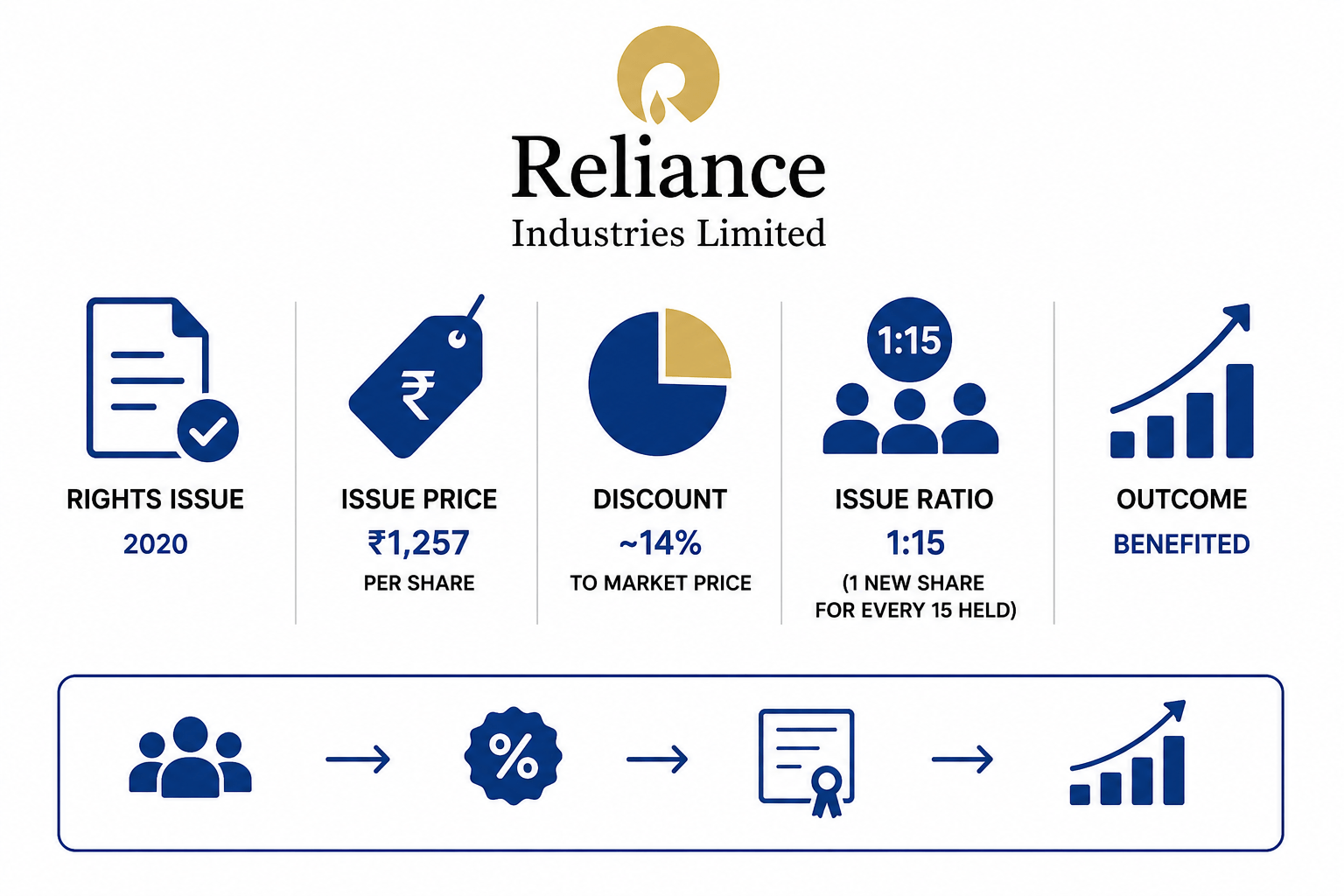
Rights Issue
| Who can participate? | Only existing shareholders as on the Record Date. |
| Price | Offered at a discount to current market price, making it attractive. |
| Proportion | Offered in a fixed ratio e.g., 1:4 means 1 new share for every 4 held. |
| Shareholder Choices | Subscribe in full, subscribe in part, sell or renounce the rights or let rights lapse (do nothing). |
| Purpose | The company raises fresh capital for expansion, debt reduction, or working capital. |
| Risk of non-participation | Dilution shareholding percentage decreases if others subscribe and you don't. |
Example
Open Offer (Takeover Offer)
| Who initiates it? | An acquirer (individual, company, or group) who has acquired or seeks to acquire a substantial stake. |
| Price | Offered at a discount to current market price, making it attractive. |
| Proportion | Offered in a fixed ratio e.g., 1:4 means 1 new share for every 4 held. |
| Shareholder Choices | Subscribe in full, subscribe in part, sell or renounce the rights or let rights lapse (do nothing). |
| Purpose | The company raises fresh capital for expansion, debt reduction, or working capital. |
| Risk of non-participation | Dilution shareholding percentage decreases if others subscribe and you don't. |
Summary
5
Missing the deadline triggers the default option.
4
DPs process investor choices.
3
Record Date decides eligibility.
2
Default option applies if no response is given.
1
Investors get a choice in the action.
Quiz
Which intermediary collects investor elections in a Mandatory with Choice action?
A. RBI
B. Stock Exchange
C. Depository Participant (DP)
D. Credit Rating Agency
Quiz-Answer
Which intermediary collects investor elections in a Mandatory with Choice action?
A. RBI
B. Stock Exchange
C. Depository Participant (DP)
D. Credit Rating Agency
By Content ITV