















Content ITV PRO
This is Itvedant Content department
Learning Outcome(Slide2)
6
Basics of branding and messaging
5
Target audience and segmentation
4
Different marketing channels
3
Creating value for customers
2
Understanding customer needs
1
What marketing means ?
Choose cool, soft colors instead of vibrant colors
Max 6 Points for Summary & Min 4
Topic Name-Recall(Slide3)
Hook/Story/Analogy(Slide 4)
Transition from Analogy to Technical Concept(Slide 5)
The entry point of a Spring Boot application
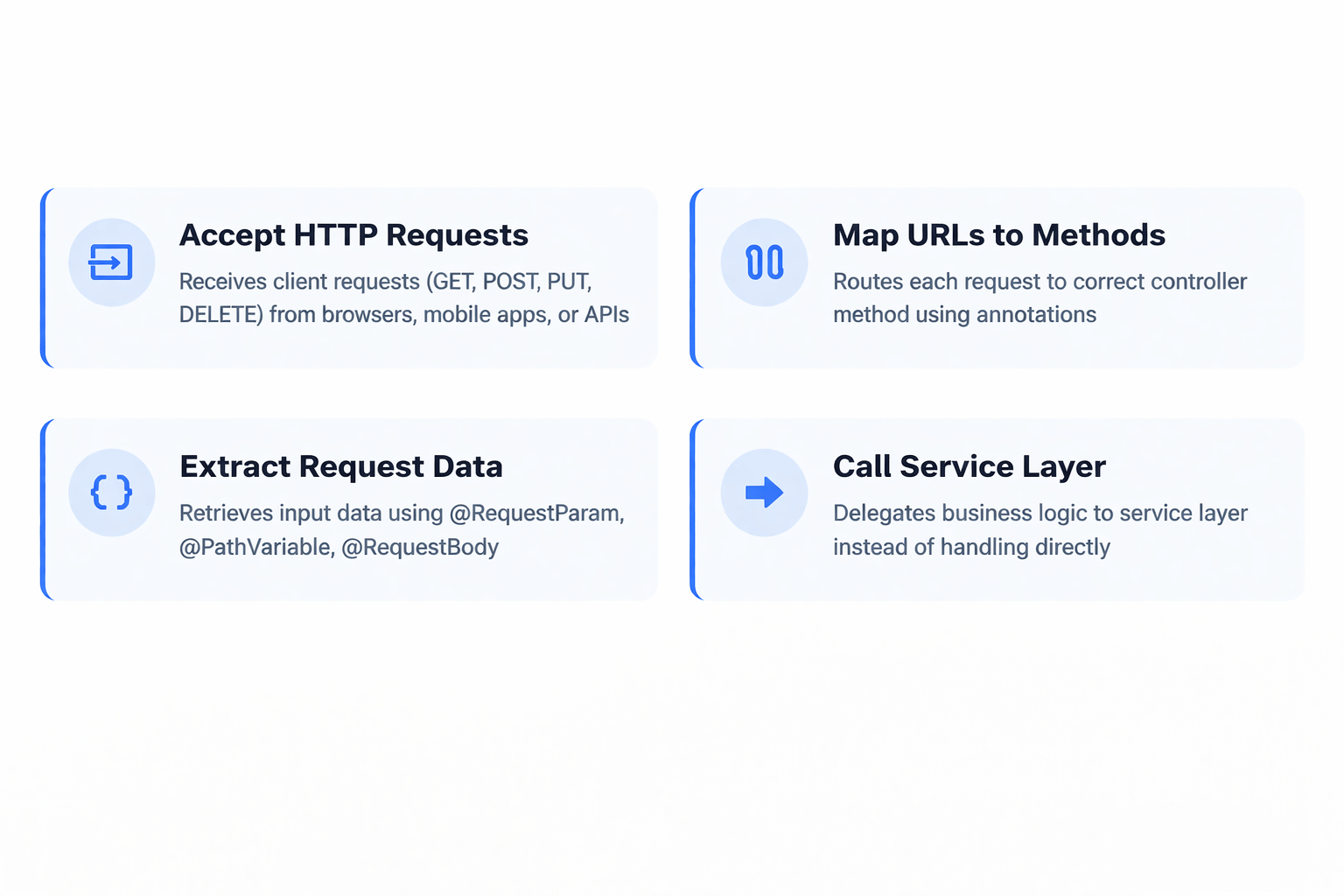
Handles incoming HTTP requests from clients, processes them, and returns appropriate responses
Receives Requests
From browsers, mobile apps, or API clients like Postman
Processes Requests
Validates input, delegates to service layer, applies business logic
Returns Responses
Sends back JSON, XML, or HTTP status codes to the client
Primary Response Format: JSON (JavaScript Object Notation)
Bridge Between Client & Service
Connects external clients to internal business logic
Handles HTTP Requests & Responses
Manages communication protocol between client and server
Delegates to Service Layer
Forwards business logic processing to service components
Maintains Separation of Concerns
Keeps architecture clean and maintainable
Key Principle: Controllers handle HTTP communication, not business logic
@Controller
@RestController
Returns view pages (HTML/JSP) for web applications
Used in Spring MVC applications
Requires @ResponseBody to return JSON/XML
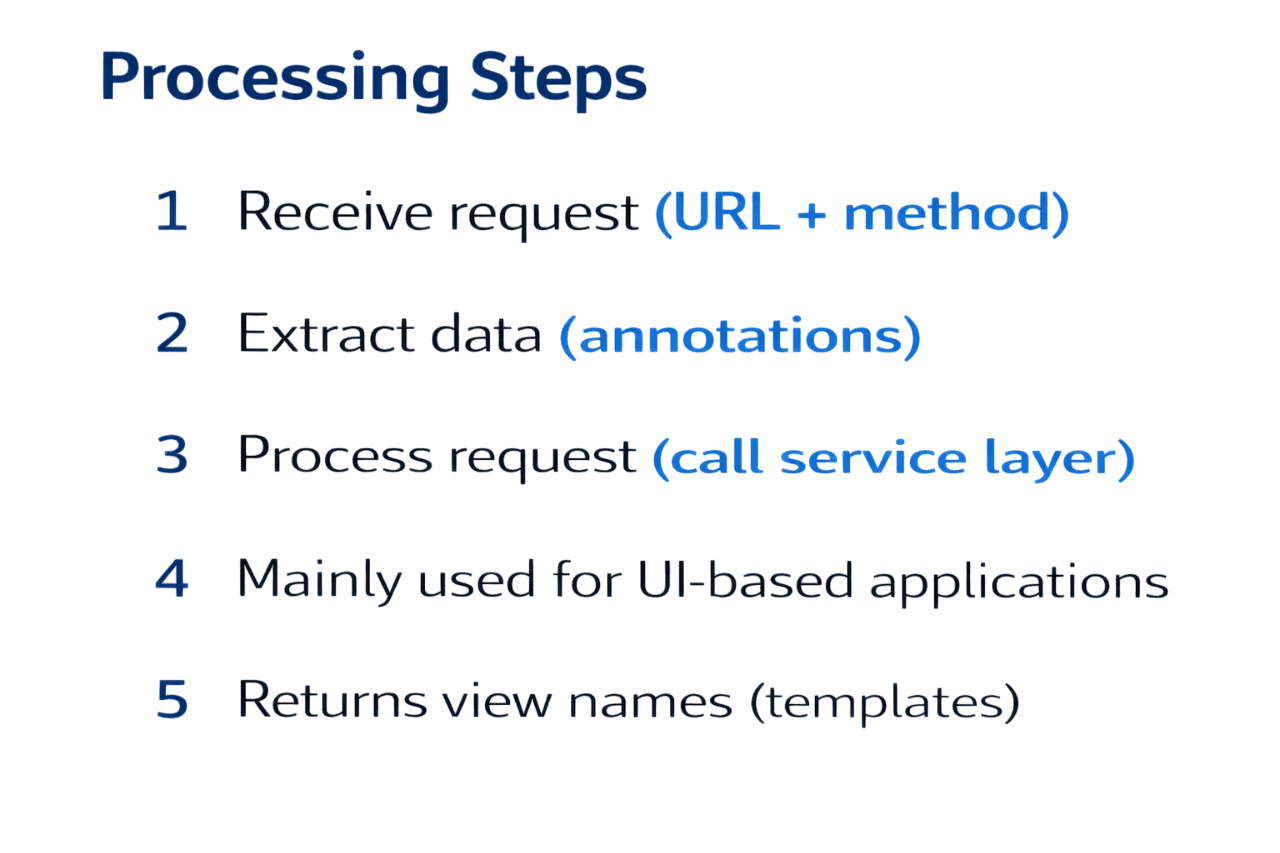
Mainly used for UI-based applications
Returns view names (templates)
Returns JSON/XML data directly
Used for building RESTful web services
@ResponseBody is applied automatically
Mainly used for backend APIs
Returns data instead of views
HTTP requests are messages sent by a client (like a browser or app) to a server to ask for data or perform an action.
Retrieve data from server without modification
Send new data and create a new resource
Replace entire existing resource completely
Remove a resource from the server
Update only specific fields of existing resource
Request Mapping Annotations in Spring are used to map HTTP requests (URLs) to specific controller methods.
@RequestMapping
Maps any HTTP method (GET, POST, PUT, DELETE)
@GetMapping
Handles GET requests (fetch data)
@PostMapping
Handles POST requests (create data)
@PutMapping
Handles PUT requests (update full data)
@DeleteMapping
Handles DELETE requests (remove data)
@PatchMapping
Handles PATCH requests (partial update)
Request Handling is the process of receiving an HTTP request, processing it, and sending back a response.
@RequestParam
Extract data from URL query string
@PathVariable
Extract values from URL path
@RequestBody
Extract JSON data from request body
Core Concepts (Slide 7)
Core Concepts (.....Slide N-3)
Summary
5
Build strong branding
4
Use different marketing channels
3
Target the right audience
2
Create and communicate value
1
Understand customer needs
Choose cool, soft colors instead of vibrant colors
Max 5 Points for Summary & Min 2
Quiz
Which platform is mainly used for professional networking and B2B marketing ?
A. Facebook
B. Instagram
C. LinkedIn
D. Snapchat
Quiz-Answer
Which platform is mainly used for professional networking and B2B marketing ?
A. Facebook
B. Instagram
C. LinkedIn
D. Snapchat
By Content ITV