{week 3}
W18A
What will we cover today?
- Design By Contract
- Domain Modelling
- Debugging
- Exceptions
Programming Approaches
Defensive Programming
- Proactively identify and handle problematic situations to prevent software failures.
- In practice, this means having a lot of checks before the actual logic is executed (Eg. input checks, null checks etc)
- Trust no one! 😤
Pros: higher safety
Cons: redundant checks, more complex, harder to spot errors due to unclear responsbilities
1.
2.
Design By Contract
- Establish clear responsibilities via a contract (eg. expected input, expected output) at design time. All parties abide by the contract to guarantee correct behaviour.
- In practice, this means clearly documenting preconditions, postconditions and class invariants.
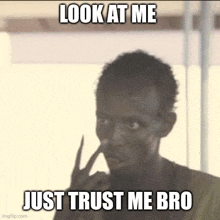
- Trust me bro🗿
Pros: cleaner, reduces redundant checks, faster
Cons: code crashes if contract is broken
Design by Contract (DbC) 📑
Providing an interface for others to use with clear preconditions, postconditions and invariants which, when adhered to, guarantees correct and expected behaviour.
T&C : Terms and Conditions 📝
A contract generally consists of these 3 components:
- Class Invariant: Something that is true for all instances of a class.
- Precondition: Something that must be true before an operation is invoked (to guarantee that it will work correctly). Users need should meet such conditions before calling an operation
- Postcondition: Something that must be true after an operation is invoked. Condition is to be met by the implementor.
Liskov Substitution Principle 🔄
- LSP is a way to ensure DbC in terms of OOP.
- I know I used way too many abbreviations here. Alas, I am lazy and the slide is small.
The main logic of LSP:
- Every subclass should be a substitute for its parent class
- This substitution should never result in unexpected errors

LSP Rules🗽
- Preconditions cannot be strengthened in a subtype.
- Postconditions cannot be weakened in a subtype.
- Invariants of the supertype — conditions that must remain true — must be preserved in a subtype.
Breaking LSP 🐣
-
Give an example of a real-life subclass that would violate the given contract:
public class Bird {
/**
 * Make the bird fly to the given height
 * @precondition given height must be >= 0
 *(birds cannot burrow into the ground)
**/
   public void fly(float height) {}
}
Note: by real-life subclass, I mean some kind of creature that is a type of Bird.
A suggestion 🐧
interface Flying {
 /**
 * Make the creature fly to the given height
 * @precondition given height must be >= 0
*/
 public void fly(float height);
}

// Not all birds can fly
class Bird {}
// We implement it directly for the birds that can
class Hummingbird extends Bird implements Flying {}
// And don't implement it otherwise
class Penguin extends Bird {}
// And we can apply the interface to other creatures,
// even if they're not birds
class Pterosaur extends Reptile implements Flying {}
Exceptions 👀
Exceptions in Java fall under 2 categories:
- Checked Exceptions: These exceptions are caught at compile time and need to be handled (using a try-catch block). Eg: IOException, ServletException
- Unchecked Exceptions: These exceptions are caught at run-time and do not need to be handled. Eg: NullPointerException, IllegalArgumentException
Errors 🤯
There's a third category to represent serious and usually irrecoverable conditions like a library incompatibility, infinite recursion, or memory leaks. These are called Errors.
- Even though they don’t extend RuntimeException, they are also unchecked.
- In most cases, it’d be weird for us to handle, instantiate or extend Errors. Usually, we want these to propagate all the way up.
- Eg: StackOverflowError, OutOfMemoryError
Exceptions and Errors
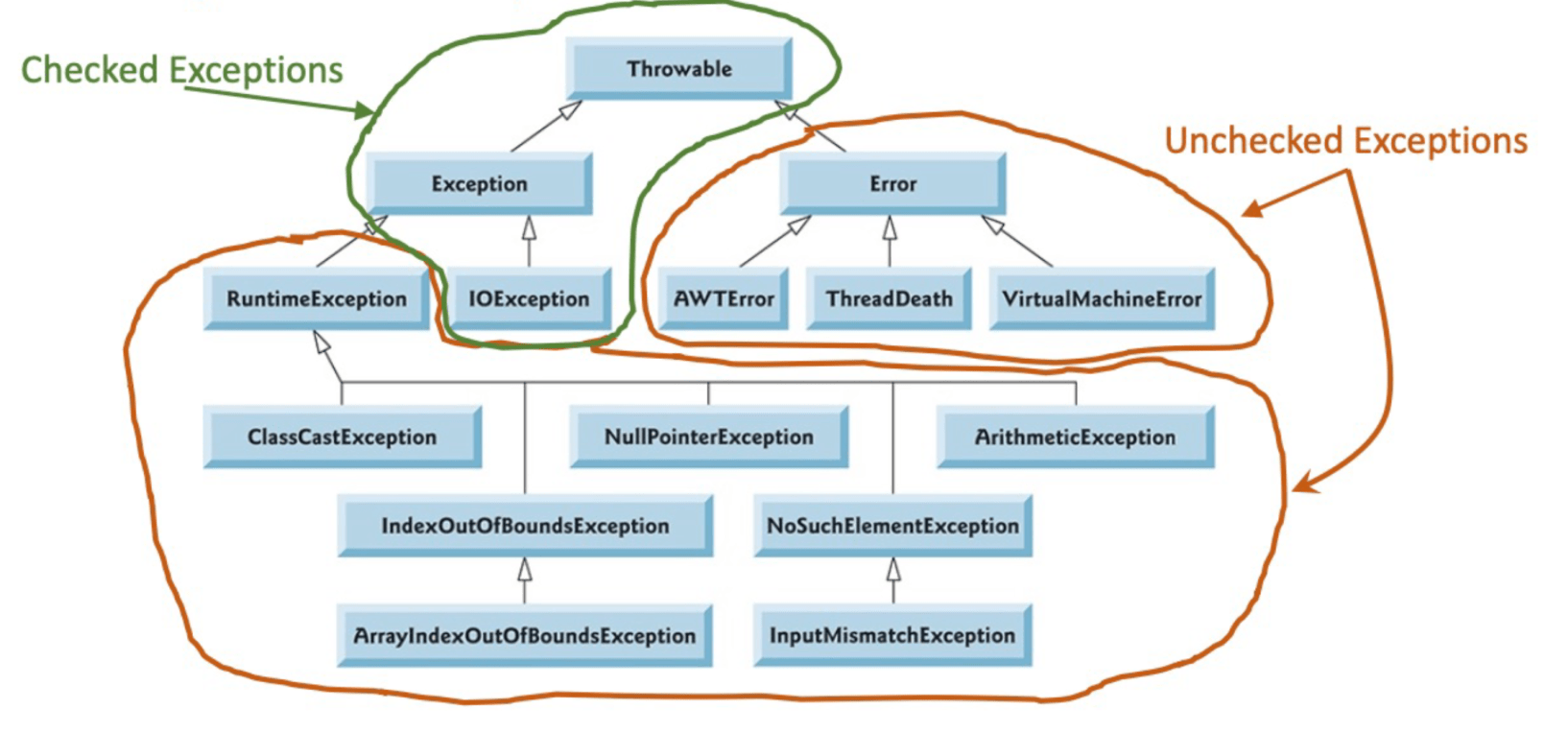
All exceptions and errors in Java extend Throwable.
{The End}
Thank you for attending!
Code
By esha tripathi