Committee Meeting #1

Fortin Lab

Sep. 23, 2020

Peter R.

Monitoring biodiversity and ecosystem services in production landscapes

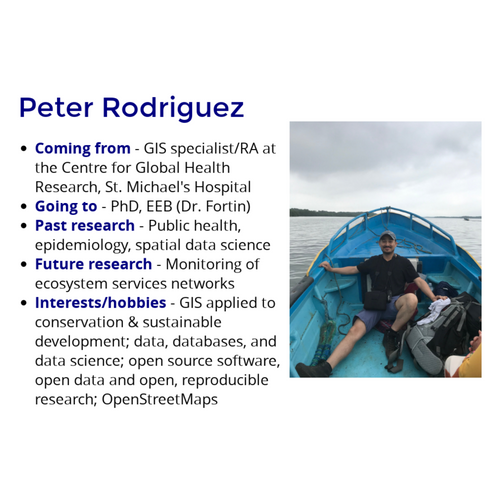
Where do I come from

  • Academic background
    • degrees
    • papers
  • Professional background
    • CGHR (CFI grants)
    • Consulting gigs
    • Ecotourism company

Who am I

Time

Where do I come from

Where am I going to

Who am I

  • Back at UofT after 20 years
  • Interests
  • Goals, why a PhD

Who am I

Time

Where do I come from

Where am I going to

Where am I going to?

  • Goals
  • Why a PhD?
    • I like to learn
    • Next logical step for more & better research
    • NGO
    • Biological conservation Ecuador/Latin America
    • Become a bridge Canada & Ecuador conservation scientist
      • ResNet is an ideal project

Who am I

Time

Where do I come from

Where am I going to

ResNet

  • L1-L6
  • Theme 1- 3
  •  

Theme 3 deliverables

  • Advance theory, stats & code/tools for ES science
  • Develop spatially explicit decision-support systems for ES management
  • Develop a network framework to monitor ES & determine high risk areas in terms of ES loss
    • Account for uncertainty
  • Develop a prototype dashboard for national ES monitoring
  • Create ES monitoring guidelines/protocols, papers
\mu , \sigma, \Delta
for (i in 1:10) {...}

Key concepts

  • Spatial Ecological Network (SEN) Models
    • Patches as nodes, flows as links/relationships
    • SEN structure & dynamics
  • Socio-Economic (SE) context
    • SE spatial data including admin boundaries
  • Multi-scale analyses
    • across time, space and L1-L6
    • sensitivity analyses

Thesis

  • Spatial Ecological Network (SEN) Models
    • Patches as nodes, flows as links/relationships
    • SEN structure & dynamics
  • Socio-Economic (SE) context
    • SE spatial data including admin boundaries
  • Multi-scale analyses
    • across time, space and L1-L6
    • sensitivity analyses

Methods

  • Spatial Ecological Network (SEN) Models
    • Patches as nodes, flows as links/relationships
    • SEN structure & dynamics
  • Socio-Economic (SE) context
    • SE spatial data including admin boundaries
  • Multi-scale analyses
    • across time, space and L1-L6
    • sensitivity analyses

Expected results

  • Spatial Ecological Network (SEN) Models
    • Patches as nodes, flows as links/relationships
    • SEN structure & dynamics
  • Socio-Economic (SE) context
    • SE spatial data including admin boundaries
  • Multi-scale analyses
    • across time, space and L1-L6
    • sensitivity analyses

Research questions - I

  • How & how often to measure EESV and biodiversity indicators (BI?
    • Criteria, guidelines, protocol for choosing relevant EESV, BI?
    • Criteria for defining landscape nodes & links
    • Criteria for how to model ES feedbacks, trade-offs
  • How to define a ES? (literature)
  • How to define and detect ES changes?

Notes & questions - II

  • Each landscape modeled as a SEN, with its own nodes & links
  • Are we also working on attribution stats, causal network models?
  • Are we managing data as part of Theme 3?
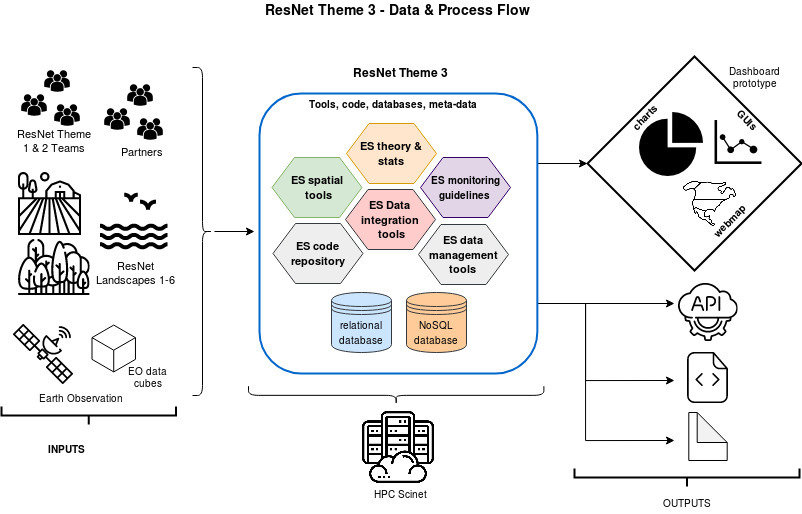
  • Theme 3 Data/process flow considerations (see fig.)
  • Methods need to be general enough to apply to all landscapes but specific enough to be useful at each landscape

Icons by FlatIcon (

Committee Meeting 1

By Peter Rodriguez

Committee Meeting 1

ResNet Theme 3 short overview

  • 49