DahLIAS 🌼: Discrete Logarithm-based Interactive Aggregate Signatures


Yannick Seurin, Tim Ruffing, Jonas Nick
Signature Schemes
- "single" signature
- \(\mathsf{Verify}(pk, msg, sig) \rightarrow \{0, 1\}\)
- multi-signature
- \(\mathsf{Verify}((pk_1, \ldots, pk_n), msg, sig)\rightarrow \{0, 1\}\)
- aggregate signature
- \(\mathsf{Verify}(((pk_1, msg_1), \ldots, (pk_n, msg_n)), sig)\rightarrow \{0, 1\}\)
- Trivial Example:
(s_1, ..., s_n) := sig
for i in 1..n:
	if Verify(m_i, pk_i, s_i) == 0:
    	return 0
return 1
DahLIAS 🌼
DahLIAS is the first aggregate signature scheme
- with constant-size signatures (64 bytes in practice)
- verification time is not constant (linear in \(n\))
- directly based on discrete discrete logarithms in pairing-free groups.
- we can continue using the curve secp256k1 we're familiar with
Application: Bitcoin transactions
-
Today: every transaction input typically contains a signature of a message (the "sighash")
-
With DahLIAS: every transaction could have only a single aggregate signature
Downside of DahLIAS, it is interactive
aggregate signature
Signer 1
Signer 2
(This is pretty much the same communication as in MuSig2)
(First two half round trips can be preprocessed)
Alternative: Schnorr Signature Half-aggregation
-
Signature is not constant-size but half the size of the individual Schnorr signatures (32 + n*32 bytes).
- Non-interactive!
- Public algorithm: \(\mathsf{Aggregate}((sig_1, \ldots, sig_n)) \rightarrow aggsig \)
Alternative: Aggsigs from multisignatures
def VerifyAgg(((m_1, pk_1), ..., (m_n, pk_n)), s):
    return VerifyMulti(m_1 || ... || m_n,
                       (pk_1, ..., pk_n),
s)- Actually this is broken due to "Russell's [O'Connor] attack".
- Easy fix: Let VerifyAgg abort when there are duplicate public keys.
- We prove the security of this in the paper.
- So we could just use MuSig2 (also interactive), why need a new scheme like DahLIAS?
Key Tweaking
- Assume we have some function \(\mathsf{PubKey}(sk) \rightarrow pk\)
- Key Tweaking
- \(\mathsf{TweakSK}(sk, t) \rightarrow sk\)
- \(\mathsf{TweakPK}(pk, t) \rightarrow pk\)
- Property
- \(PubKey(TweakSK(sk, t)) = TweakPK(PubKey(sk), t)\)
- BIP 32 key derivation and Taproot commitments are examples of key tweaking.
- We use it quite a lot in Bitcoin
- Want our aggregate signature scheme to be secure even if signers tweak their keys (it's not obvious that this is secure)
ATTACK!
The translation multisig->aggsig is not secure if the signer is doing key tweaking!
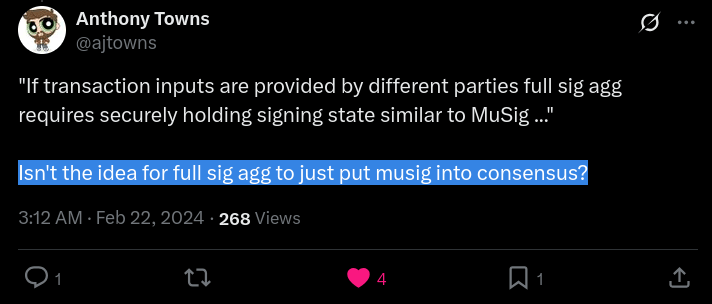
If we had done that it would have been broken!
In other words:
(I believe this validates our slow-and-steady approach to cryptography)

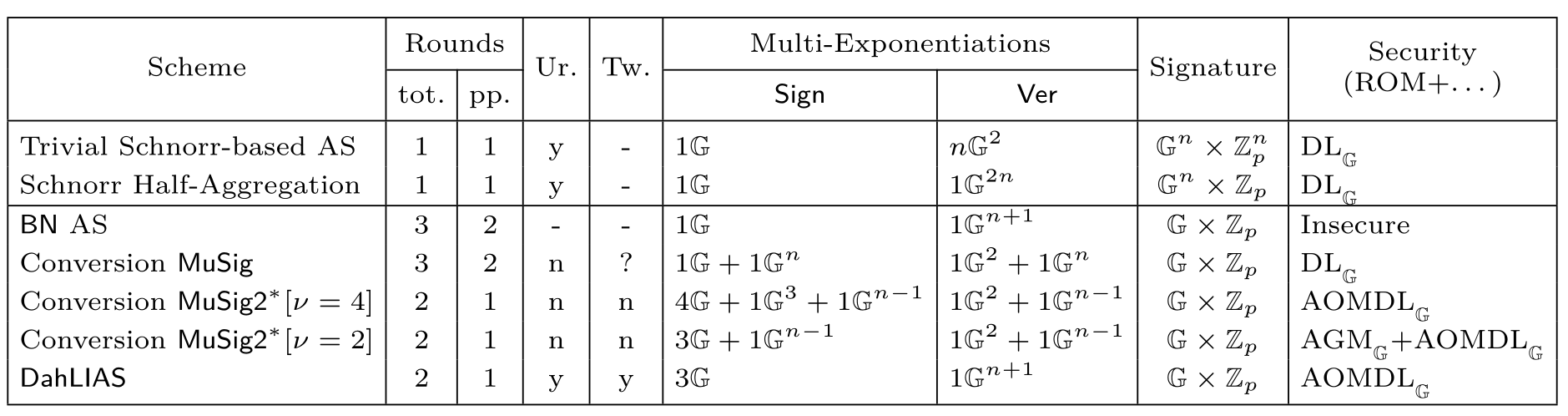
Comparison with other Discrete Log-based schemes
DahLIAS 🌼
DahLIAS is the first aggregate signature scheme
- with constant-size signatures (64 bytes in practice)
- verification time is not constant (linear in \(n\))
- directly based on discrete discrete logarithms in pairing-free groups.
- we can continue using the curve secp256k1 we're familiar with
DahLIAS (blockstream)
By iamjon