Presentation Overview
- History of EC
- What is IEC
- Motivation for human component
- Overview of IEC field
- Towards a Theory of IGA
- Problems in IEC
- Solutions?
- Applications and Results of IEC
History of EC
What is IEC?
Interactive Evolutionary Computation
Human user is involved in evolutionary computation in some way
Two definitions:
Narrow -
User aids fitness function
Broad -
User aids entire search
What is IEC?
Human input can also be benficial in
- Evolution Strategies (IES)
- Genetic Programming (IGP)
- Human-Based Genetic Algorithms (HBGA)
"Human in the loop" is not restricted only to interactive GA (IGA)
IGA vs HBGA
IGA comes in narrow and broad flavors as defined
- Fitness
- Search
HBGA has human involvement at every step
- Fitness
- Search (Selection)
- Initialization of Population
- Recombinant Crossover
- Mutation
Motivation
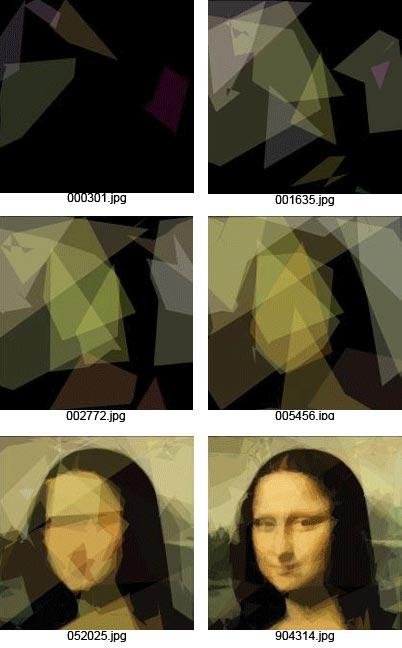
We know how to do this with non-interactive GA
Note - Stochastic hill climber used here
http://rogeralsing.com/2008/12/07/genetic-programming-evolution-of-mona-lisa/
Motivation
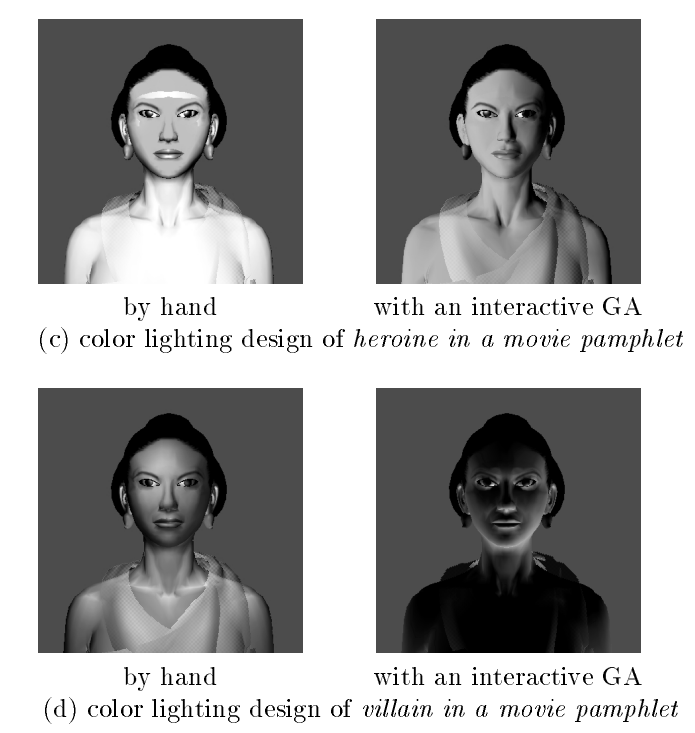
What if we don't know the target?
Maybe we're not
great artists?
Aoki, K. and Tagaki, H.: 3D CG Lighting with Interactive GA
Motivation
IEC can assist in human creativity
Used in many creative domains:
- Visual art
- 3D lighting
- 3D/2D image creation
- Music
- Melody generation
- Rhythm Generation
- Synthesizer optimization
- Industrial design
- etc
Overview of Field
Towards a Theory
One major attempt to create theoretical model of IEC
Rudolph:
- Can IEC be modeled in a probabilistic framework?
- If so, is there any utility?
Towards a Theory
Classic EAs can be modeled by Markov Chains
Too restricted for IEA
Rudolph attempts to model IEA using stochastic automata
Towards a Theory
Stochastic Automata
\langle{S, X, Y, P(s', y|s, x)}\rangle
⟨S,X,Y,P(s′,y∣s,x)⟩
S=States
S=States
Y=Output\ Symbols
Y=Output Symbols
X = Input\ Symbols
X=Input Symbols
P:S \times Y \times S \times X \to [0,1]
P:S×Y×S×X→[0,1]
\displaystyle\sum_{(s^{\prime} ,y)\in S\times Y} P(s^{\prime}, y|s, x)=1, forall\ (s,x)\in S\times X
(s′,y)∈S×Y∑P(s′,y∣s,x)=1,forall (s,x)∈S×X
Towards a Theory
Special Cases of stochastic automata
Markov Chains:
\langle{S, \emptyset, \emptyset, P(s'|s x)}\rangle
⟨S,∅,∅,P(s′∣sx)⟩
Towards a Theory
Special Cases of stochastic automata
Stochastic Mealy Automata:
\langle{S, X, Y, P(s', y|s, x)}\rangle
⟨S,X,Y,P(s′,y∣s,x)⟩
P(s', y | s, x) = P(s' | s, x) \cdot P(y | s, x)
P(s′,y∣s,x)=P(s′∣s,x)⋅P(y∣s,x)
P(s'|s,x)= \displaystyle\sum_{y \in Y}P(s', y|s, x)
P(s′∣s,x)=y∈Y∑P(s′,y∣s,x)
P(y|s,x)= \displaystyle\sum_{s^{\prime} \in S} P(s', y|s, x)
P(y∣s,x)=s′∈S∑P(s′,y∣s,x)
Where,
Towards a Theory
Special Cases of stochastic automata
Stochastic Automata with Deterministic Output:
\langle{S, X, Y, P(s', y|s, x)}\rangle
⟨S,X,Y,P(s′,y∣s,x)⟩
TODO
Towards a Theory
To model IEC as SMA, need:
- State space
- Input set
- Output set
- Transition matrices
\langle{S, X, Y, P(s', y|s, x)}\rangle
⟨S,X,Y,P(s′,y∣s,x)⟩
S = Set of all possible populations
Y = Function of current state - can be ignored
X = User selection
A(x) = transition matrices
{N(2N-1)}\over (N!)^2
(N!)2N(2N−1)
#selection operations =
Problems...
Solutions?
Applications and Results
deck
By igorii