





Michael Martinez
Sr. Software Engineer in Test at Tinder
[
            "Name": "Michael Martinez",
"Current Employer": "Tinder 🔥", "Previous Employers": [ "Eventbrite", "Bigcommerce" ], "Twitter": "twitter.com/mychaelmartinez", "LinkedIn": "linkedin.com/in/iMichael", "Disclaimer": "Opinions herein do not represent my employers view" ]
"A paradigm of programming that requires emphasizes using pure functions and immutable data."
"Functional programming is programming without assignment statements" - Robert C. Martin [0]
"Functional Programming languages use functions as first class citizens" - Erik Meijer [1]
"In the Functional Kingdoms, Nouns and Verbs are generally considered equal-caste citizens. However, the Nouns, being, well, nouns, mostly sit around doing nothing at all. They don't see much point in running or executing anything, because the Verbs are quite active.." - Steve Yegge [3]
"Functional programming is when functions, not objects or procedures, are used as the fundamental building blocks of a program" - Ward Cunningham [2]
"Congress meets in the US Capital"
means the same thing as
"Congress meets in Washington D.C"
Abstract
Concrete
func incrementArray(a: [Int]) -> [Int] {
    return a.map {$0 + 1}
}

/*
Imagine a program has "incrementArray([1,2,3])" somewhere deep in the codebase. That we can replace this function with the value "[2,3,4]" without
changing the output of the program makes this function "Referentially Transparent"
*/
Code with side effects
class Dog{
  var age = 0
  var ageInHumanYears = 0
  func haveBirthday() {
    age += 1
    ageInHumanYears += 7
  }
}
Code without side effects
func humanBirthday(age: Int) -> Int {
  return age + 1
}

func getDogAge(ageInHumanYears: Int) -> Int {
  return ageInHumanYears * 7
}
Mutable Data
Immutable Data
func squareMutable(a: [Int]) -> [Int] {
  var result = [Int]()
  for i in a {
    result.append( i * i )
  }
  return result
}
func squareImmutable(a: [Int]) -> [Int] {
  return a.map {$0 * $0}
}
let squares = squareImmutable([1,2,3])
let a = [1,2,3]
let d = ["age": 28]
struct Contact {
    let name: String
    let age: Int
}
let sqr = {(n: Int) -> Int in
    return n * n
}

// ==

func sqr(n: Int) -> Int {
    return n * n
}
Swift Closures
≈
Lamba in Python
≈
Blocks in Ruby
≈
Anonymous Functions in Javascript
Functions == Named Closures
Takes a function as an argument
func getEvens(a: [Int]) -> [Int] {
    func isEven(i: Int) -> Bool {
        return (i % 2 == 0) ?  true : false
    }
    return a.filter(isEven)
}
or ...
Returns a function
func aggregateFunctionFactory(operation: String) -> ([Int] -> Int) {
  // Slightly contrived
  func sum(a: [Int]) -> Int {
    return a.reduce(0) { $0 + $1 }
  }
  func avg(a: [Int]) -> Int {
    return (a.reduce(0) { $0 + $1 } / a.count)
  }
  func max(a: [Int]) -> Int {
    return a.reduce(0) {$1 < $0 ? $0 : $1}
  }
  switch operation {
    case "sum":
      return sum
    case "avg":
      return avg
    case "max":
      return max
    default:
     return sum
  }
}
Flat Map (New in Beta 3)
// Flatten a multi-dimensional array
let a = [[1,2,3],[4,5,6]]
let aFlattened = a.flatMap({$0})
// => [1,2,3,4,5,6]
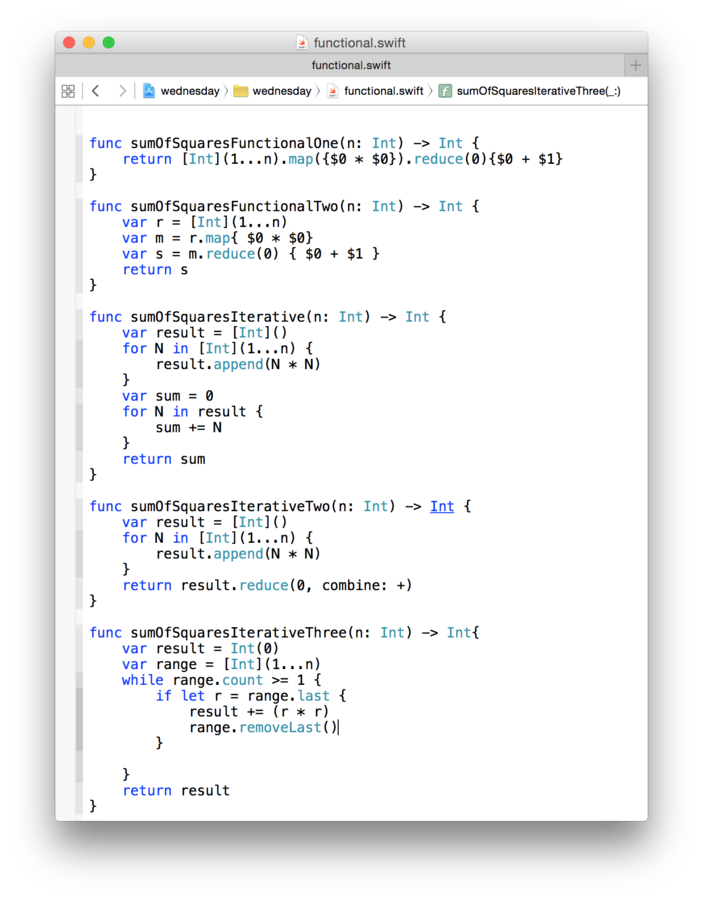
func sumOfSquares(n: Int) -> Int {
    if n == 0 {
        return n
    }
    else {
        return (sumOfSquares(n-1) + (n * n))
    }
}
(kinda)
$ cat monday_orders.csv |awk -f, '{print $NF }'| round_up.py | sum.py > monday_revenue.txt
(sometimes)
^ Great Book ^
SICP
By Michael Martinez

