D3.js
What
- JavaScript library
- Data Driven Documents
What
- DOM manipulation (does not "draw")
- interpolates position values (does not move elements)
Basic SVG Shapes
- circle
- ellipse
- line
- text (x: left edge of text, y: vertical position of type's baseline)
- path (everything else)
SVG properties
- fill: can also use alpha transparencies
- stroke
- stroke-width
- opacity: 0 => 1
Text Styling
- font-family
- font-size
- color
- etc
Layering & Drawing Order
- SVG does not support z-index (CSS)
- order in which elements are coded determine their depth order
Methods
select/selectAll
- similar to jQuery's $()
- save references to selections in variables to save time later
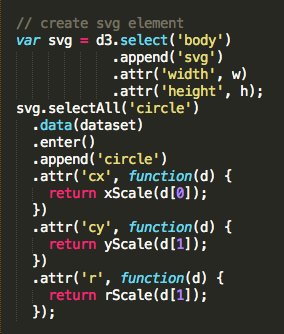
select/selectAll
- create elements by selecting them
- you can select elements that don't exist yet
.text()
- takes string
- inserts it between opening and closing tags of selection
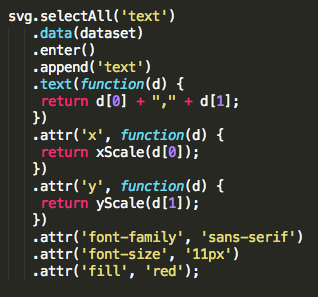
.append()
- attaches thing to end of the selection
- goes inside selection, as last child.
D3 anonymous functions
function(d, i) {}
- d: value in data set for that index (if d is an array, you can access that value using bracket notation)
- e.g. d = [[1,2]]; // d[1] = 2
- i: index of the current element
Binding Data
What is binding?
- "attaching" or associating data to specific elements
- allows us to apply mapping rules
- data input in
- visual properties out
- examples:
- bigger numbers => taller bars
- special categories => brighter colors
selection.data(dataset)
- select Dom elements to manipulate
- pass in the data
- e.g.
var dataset = [5, 10, 15, 20, 25];
- e.g.
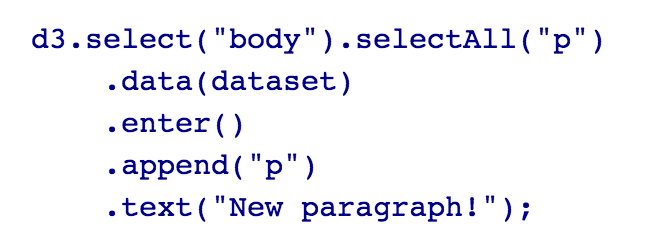
.enter()
- creates new, data-bound elements
- looks at DOM, then looks at data being handed to it
- creates new placeholder elements for each data value that is missing a corresponding DOM element
.exit()
- contains the "leftover" elements for which there is no corresponding data
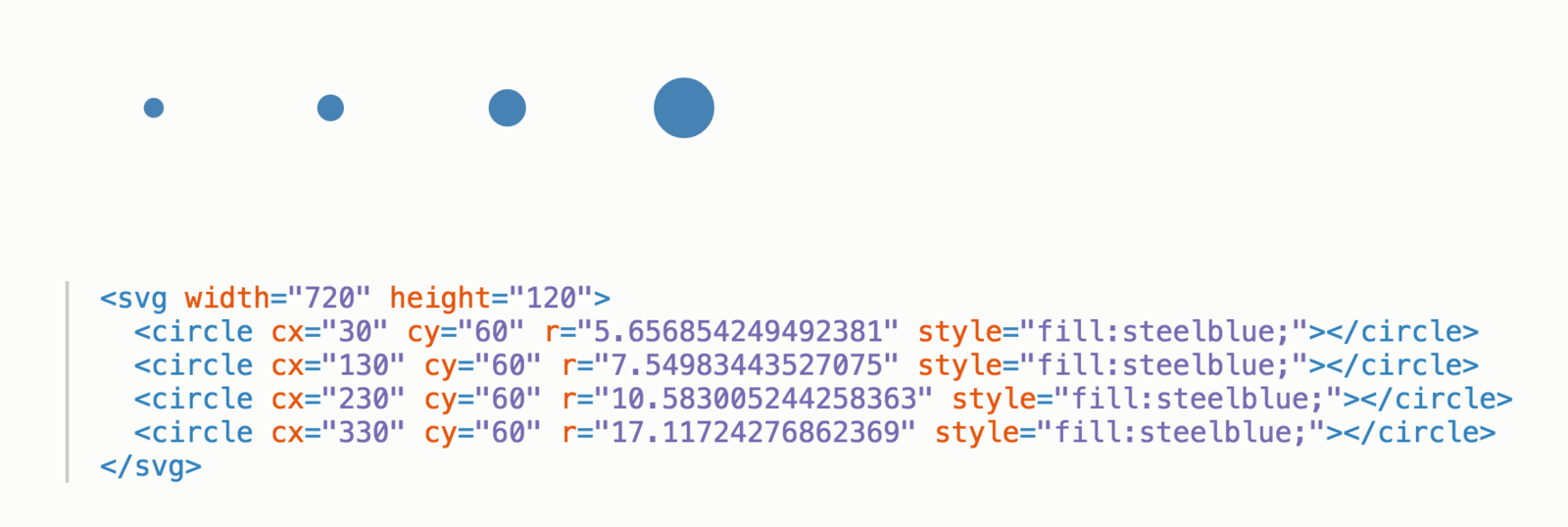
- var circle = svg.selectAll('circle')
.data([32, 57, 112, 293]);
var circleEnter = circle.enter().append('circle');
.exit()
- contains the "leftover" elements for which there is no corresponding data
- var circle = svg.selectAll('circle')
.data([32, 57]);
// removing last 2 data points circle.exit().remove()
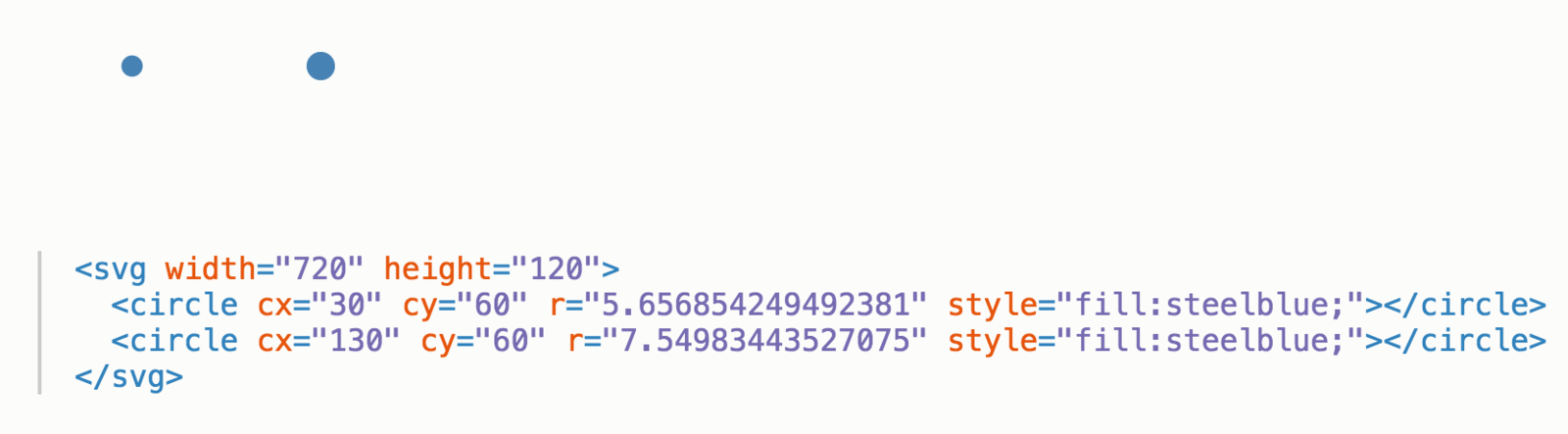
.transition()
- default duration (transition speed): 250ms (.25 seconds)
- multiple attribute transitions OK
- .attr("fill", "steelblue")
- .attr("cy", "50%")
.delay(waitTime)
- wait before doing a transition
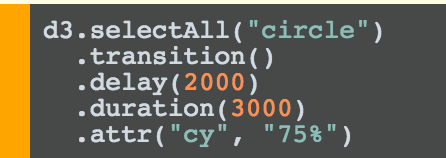
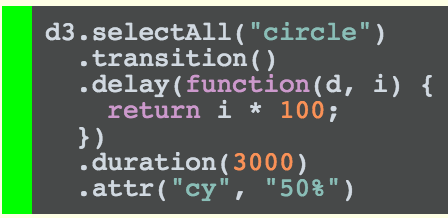
.delay(waitTime)
- anonymous functions using values passed in by D3
- per-element delay technique
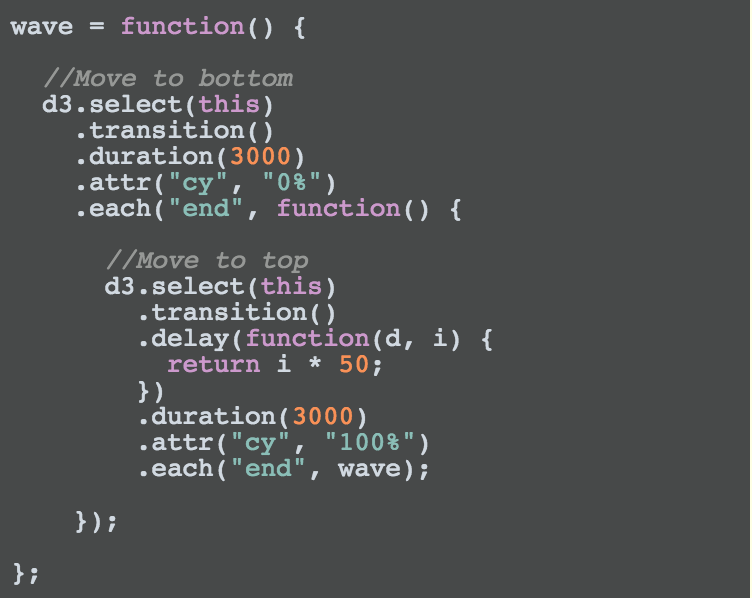
Looping Transitions
.each('end', transitionFunc)
- .each: tells D3 to perform an action as soon as initial transition ends
- could go on forever-- RECURSION!!

.each('end', transitionFunc)
- wrap your transition in a function
- call .each, and pass in the the same function
- call the function (e.g. 'recolor();')
consecutive (non-looping) transitions
-
this: element that just finished its initial transition
- e.g. 'circle'
- .each('end', function() {...})
- initiates 2nd transition as soon 1st transition ends
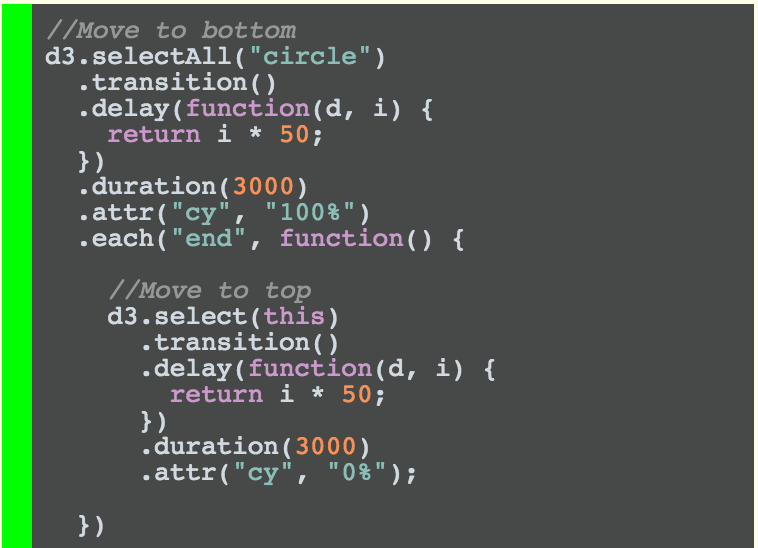
make it loop!
- recursive function call in .each('end', yourFunction)
Axes
Scales
- functions that map from an input domain to an output range
- normalizes input values, then scales to output range
D3
By Jacqueline Wijaya