jaredblumer
Of few words
Jared Blumer (he/him)
Moralistic judgments imply wrongness or badness on the part of people who don’t act in harmony with our values. Such judgments are reflected in language:
“The problem with you is that you’re too selfish.”
“They’re prejudiced.”
“It’s inappropriate.”
Comparisons are a form of judgment that block compassion for oneself and for others.
Comparisons to others prevents seeing each person as a unique individual with their own strengths and weaknesses and with their own needs and feelings.
The phrase “makes one feel” as in “you make me feel guilty,” is an example of how language facilities denial of personal responsibility for one’s own feelings and thoughts.
We deny responsibility for our actions when we attribute their cause to factors outside ourselves:
A demand explicitly or implicitly threatens listeners with blame or punishment if they fail to comply.
It is a common form of communication in our culture, especially among those who hold positions of authority.
When we combine observation with evaluation, we decrease the likelihood that others will hear our intended message.
Instead, they are apt to hear criticism and thus resist whatever we are saying.
1. "John was angry with me yesterday for no reason."
2. "Yesterday evening Nancy bit her fingernails while watching television."
3. "Sam didn't ask for my opinion during the meeting."
4. "Janice works too much."
Our repertoire of words for calling people names is often larger than our vocabulary of words to clearly describe our emotional states.
Expressing our vulnerability can help resolve conflicts.
A common confusion, generated by the English language, is our use of the word feel without actually expressing a feeling. "I feel" could often be more accurately replaced with "I think."
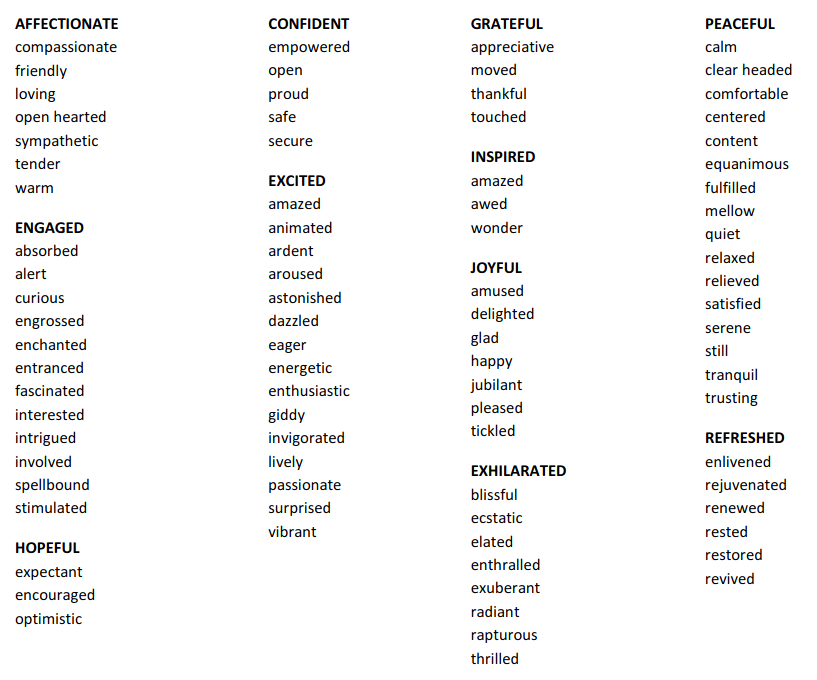
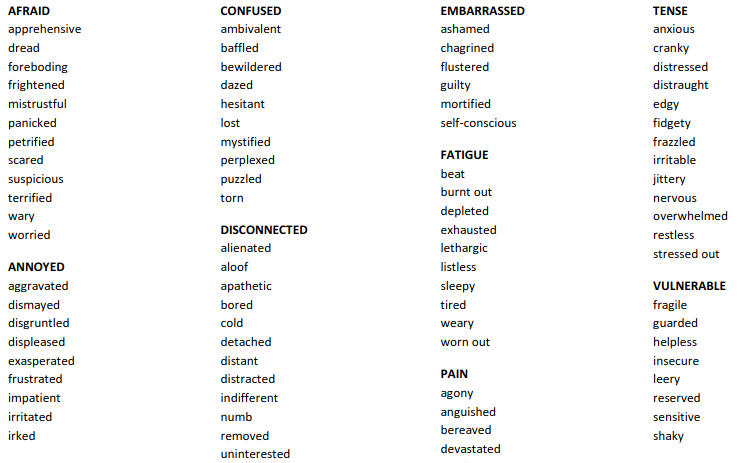
In NVC, we distinguish between words that express actual feelings and those that describe what we think we are.
“I feel like I’m terrible at playing guitar.”
I feel disappointed in myself as a guitarist.
I feel impatient with myself as a guitarist.
I feel frustrated with myself as a guitarist.
“I feel ignored.”
abandoned
attacked
betrayed
bullied
cheated
rejected
unheard
unseen
unsupported
used
In expressing our feelings, it helps to use words that refer to specific emotions, rather than words that are vague or general.
Which of the following statements expresses feelings, rather than evaluations or interpreting others?
1. "I feel you don't love me."
2. "I'm sad that you're leaving."
3. "I feel scared when you say that."
4. "I feel misunderstood."
When someone gives us a negative message, whether verbally or non-verbally, we have four options as to how we receive it:
1. blame ourselves
2. blame others
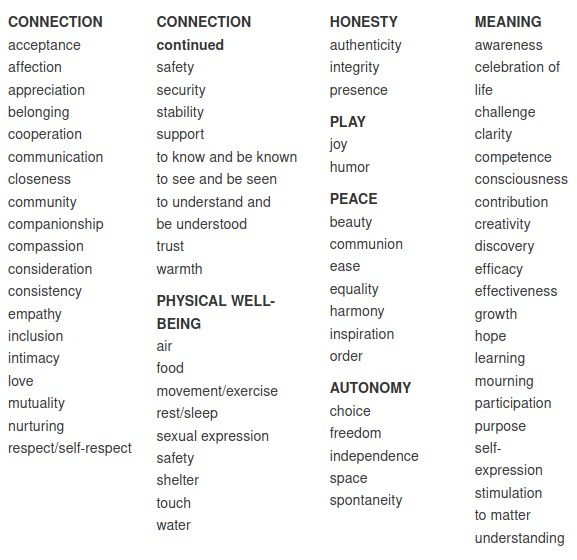
3. sense our own feelings and needs
4. sense others’ feelings and needs
We can deepen our own awareness of our own responsibility for our feelings and needs by using the phrase:
I feel… because I need…
Judgments, criticisms, diagnoses, and interpretations of others are all alienated expressions of our needs. When we express our needs indirectly through the use of evaluations and interpretations, others are likely to hear criticism.
And when people hear anything that sounds like criticism, they tend to invest their energy in self-defense or counterattack.
The more directly we can connect our feelings to our own needs, the easier it is for others to respond to us compassionately, and if we express our needs directly, we have a better chance of getting them met.
The more that individuals and groups begin talking about what they need rather than what’s wrong with one another, the possibility of finding ways to meet everybody’s needs is greatly increased.
1. "You irritate me when you leave company documents on the conference room floor."
2. "I feel angry when you say that, because I am wanting respect and I hear your words as an insult."
3. "I feel scared when you raise your voice."
4. "I feel grateful that you offered me a rise because I was needing to get home before my children arrive."
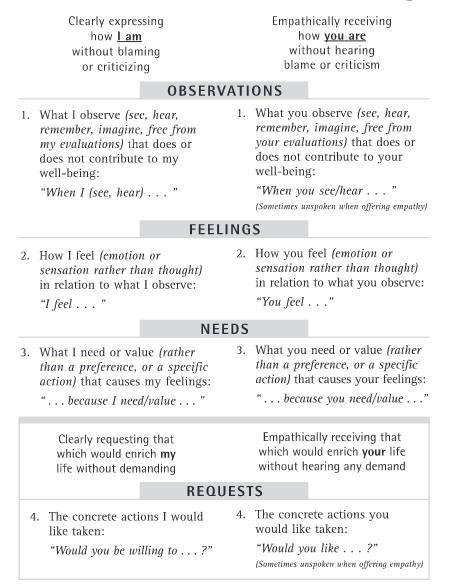
We have now covered the first three components of NVC, which address what we are observing, feeling, and needing. We have learned to do this without criticizing, analyzing, blaming, or diagnosing others, and in a way likely to inspire compassion.
The fourth and final component of this process addresses what we would like to request of others in order to enrich life for us. When our needs are not being fulfilled, we follow the expression of what we are observing, feeling, and needing with a specific request: we ask for actions that might fulfill our needs.
Use positive language when making requests. Instead of speaking to what you don’t want, request what you do want. The clearer we are about what we want, the more likely it is that we’ll get it.
When we simply express our feelings, it may not be clear to the listener what we want them to do.
Therefore, make requests in clear, positive, concrete action language.
With that said, the message we send is not always the message that’s received.
To make sure the message we sent is the message that’s received, ask the listener to reflect it back.
Instead of asserting “That’s not what I said” or “You didn’t hear me,” express appreciation when your listener tries to meet your request for a reflection.
Because asking others to reflect back what they hear us say, we can explain to people before difficult conversations why we may sometimes ask them to reflect back our words.
We make clear that we’re not testing their listening skills, but checking out whether we’ve expressed ourselves clearly.
However, should the listener retort, “I heard what you said, I’m not stupid!” we have the option to focus on the listener’s feelings and needs and ask:
”Are you saying you’re feeling annoyed because you want respect for your ability to understand things?”
Our requests are received as demands when others believe they will be blamed or punished if they do not comply.
When people hear a demand, they see only two options: submission or rebellion.
To tell if it’s a demand or a request, observe what the speaker does if the request is not complied with. It’s a demand if the speaker then criticizes or judges.
We can help other trust that we are requesting, not demanding, by indicating that we would only want them to comply if they can do so willingly.
Thus we might ask, “Would you be willing to set the table?” rather than “I would like you to set the table.”
However, the most powerful to communicate that we are making a genuine request is to empathize with people when they don’t agree to the request.
The objective of NVC is to establish a relationship based on honesty and empathy.
When others trust that our primary commitment is to the quality of the relationship, and that we expect this process to fulfill everyone’s needs, then they can trust that our requests and not camouflaged demands.
It is especially important when we are addressing a group to be clear about the kind of understanding or honesty we want back after we’ve expressed themselves.
When we are not clear about the response we’d like, we may initiate unproductive conversations that end up satisfying no one’s needs.
When addressing a group, we need to express our request in the same clear, positive, concrete action language as when speaking to an individual.
1. "I want you to understand me."
2. "I would like you to show respect for my privacy."
3. "I'd like to get to know you better."
4. "I would like you to drive at or below the speed limit."
The concrete actions we observe that affect our well-being
How we feel in relation to what we observe
The needs, values, desires, etc. that create our feelings
The concrete actions we request in order to enrich our lives
Expressing honestly through the four components
Receiving empathically through the four components
By jaredblumer
A Presentation on Nonviolent Communication, developed by Marshall B. Rosenberg, Ph.D.