COMP1701-004
fall 2023
lec-03

Down the Road
any A1 questions?
speaking of questions
continuing to speak of questions
onlinequestions.org
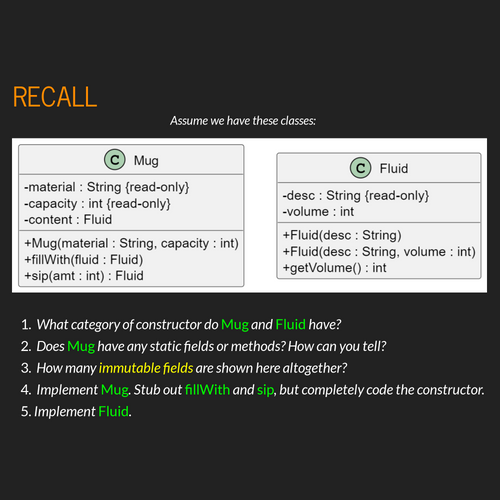
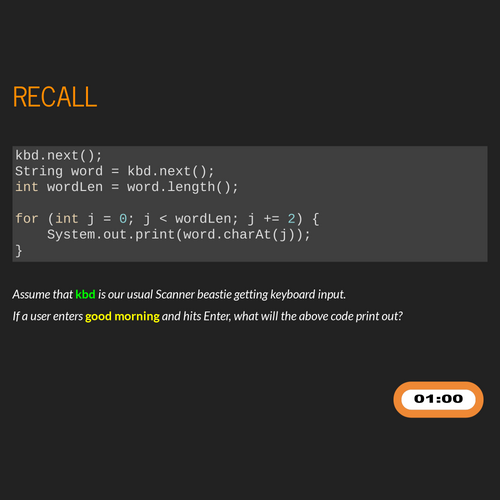
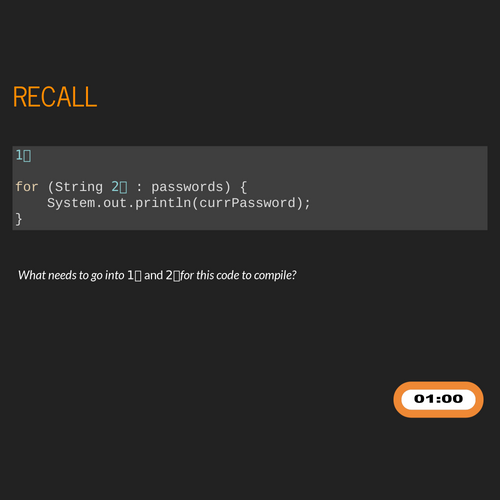
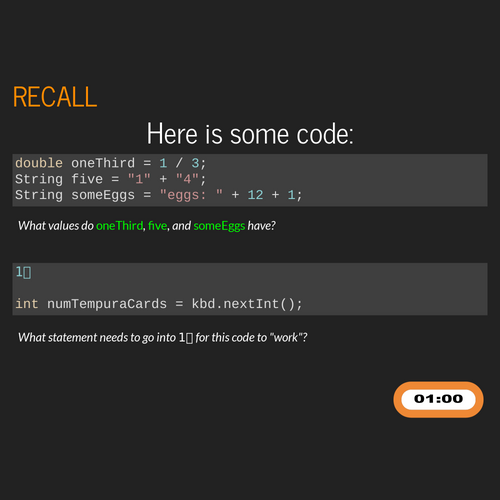
202304170103RECALL

Let's do a brain dump: write down everything you can remember - words, phrases, pictures, whatever - about things we covered in lecture and lab last week.
You've got 1 minute.
let's talk about these things today:
⦾ hardware & the measly 7 things
⦾ software
⦾ Hello, Python (on a Codespace)
⦾ printing stuffs
⦾ variables
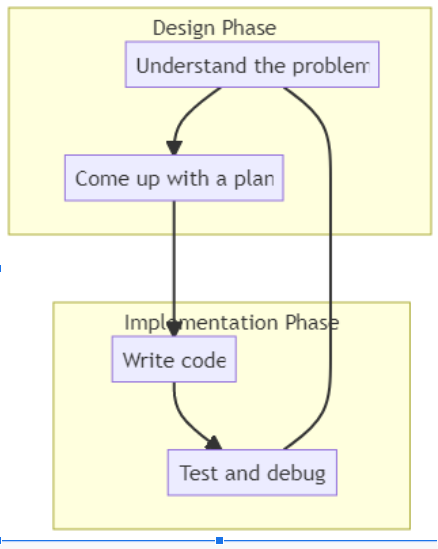
Last week, we spent some time up here, solving simple problems by making algorithms for people to follow.
This week, we'll spend time down here, learning how to write algorithms in Python, a language that a computer's hardware can understand (with some help).
let's talk hardware
c. curtis
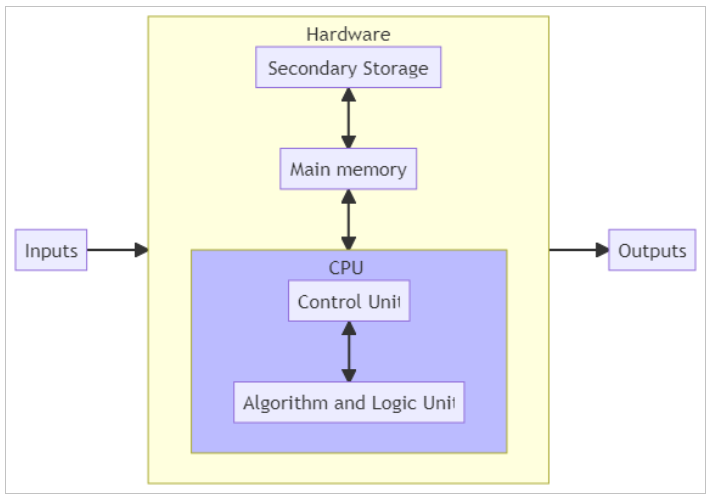
This is a very high level view of hardware, from a programmer's point of view
hardware
c. curtis
Inputs
c. curtis
Outputs
hardware
c. curtis
Main Memory
hardware
c. curtis
Secondary Storage
hardware
c. curtis
CPU
CPU
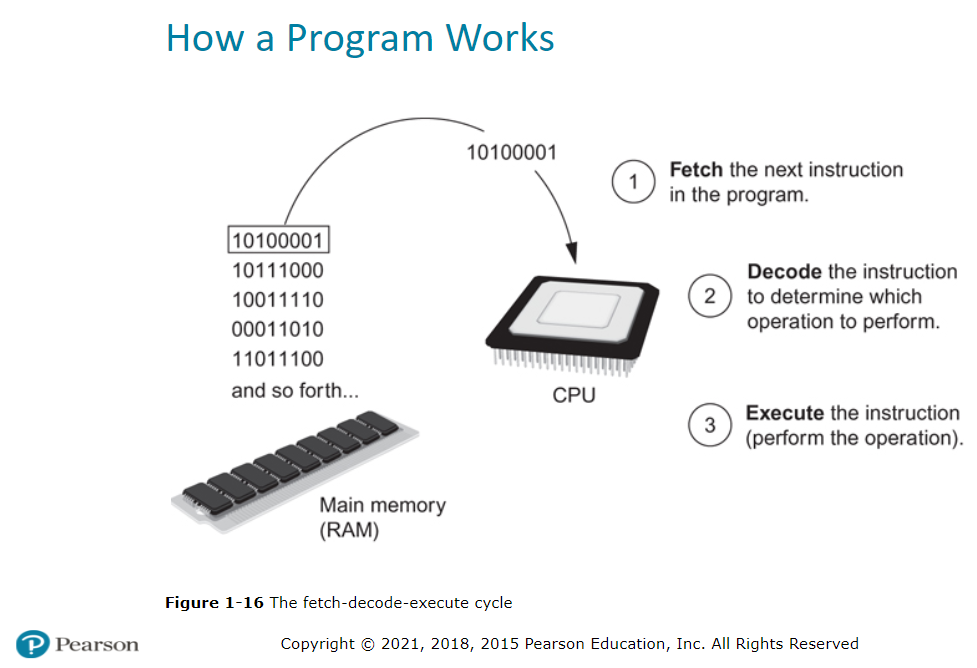
What can a CPU actually do?
7 measly things!
-
read from an input device
-
write to an output device
-
read a value from storage
-
write a value to storage
-
"do math"
-
branch
-
loop (i.e. repeated branching)
WAIT...REALLY???




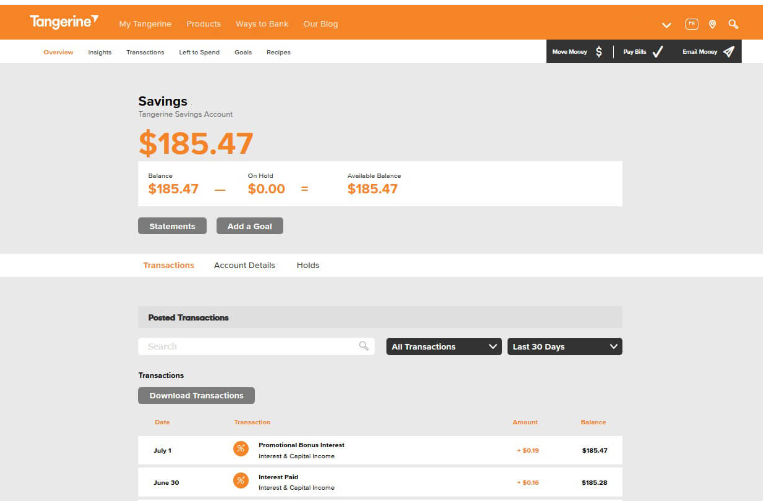
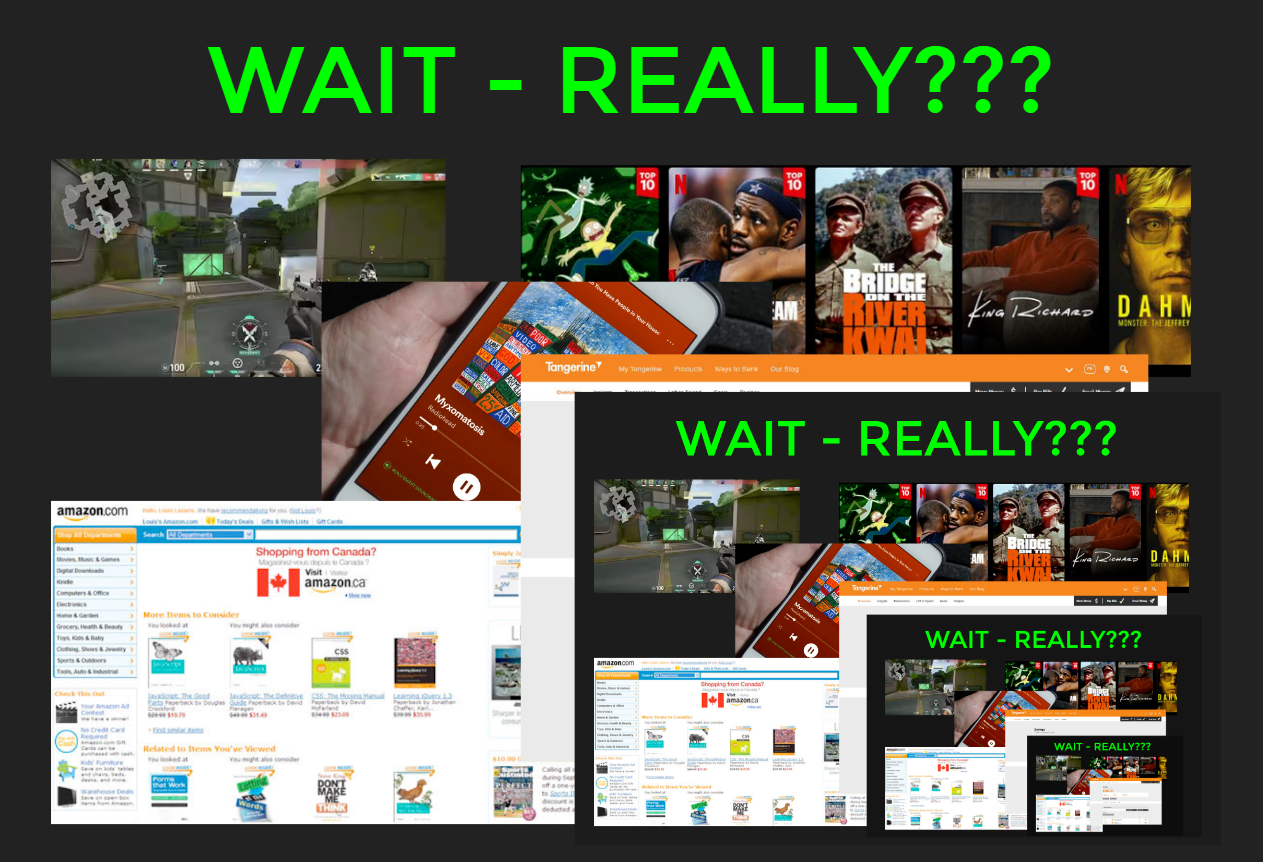
all possible because of 7 measly operations

we tell the hardware to do these 7 things by writing software
the code that we write doesn't "talk" to the CPU directly
software
a wee problem
// Hey there - I'm written in C++

#include <iostream>
using namespace std;

int main() {
	cout << "Greetings, citizen." << endl;
}
// Hey there - I'm written in Java
class Greeting {
public static void main (String[] args) {
System.out.println("Greetings, citizen.");
}
}# Hey there - I'm written in Python
print("Greetings, citizen.")high-level languages
# Hey there - I'm written in Python

print("Greetings, citizen.")source code
various tools & processes


get ready to code
I'll be using this for lecture code demos...
new kid in town on our GitHub org page
...but IMO, during lecture you should just pay attention and predict
getting ready to code
the REPL
- go to the Terminal
- enter python
- do the Python incantations you wish
- exit() or Ctrl + d when done
Demo dat, Pratt.
running a source file
- make a new script file (w/ .py extension)
- open that file in the editor
- enter the Python incantations you wish
- run the script (there's at least 3 different ways to do this!)
Demo dat, Pratt.
getting ready to code
Should we use the REPL or run scripts?
Yup.
RECALL
Are these Python instructions being directly interpreted by the computer's CPU?
let's print() some stuffs
What can a CPU do again?
-
read from an input device
-
write to an output device
-
read a value from storage
-
write a value to storage
-
"do math"
-
branch
-
loop (repeated branching)
let's do some of this
printing stuffs
In Python, we tell the CPU we want to output to the terminal by using
print()Demo dat, Pratt.
(Yes, it's weird that we use "print", because no paper is involved. Sigh.)
printing stuffs
let's RT(f)M a bit
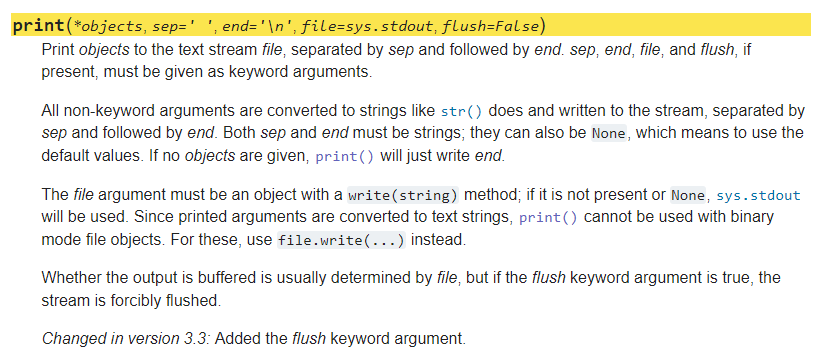
ouch
printing stuffs
print('this','that')

print('this','that' sep='*')

print()

print('this')

print('that')

print('this',end='...')

print('that')
Demo dat, Pratt.
predict!
printing stuffs
what's up with that funky \n?
printing stuffs
\n is an example - probably the most commonly used example - of an escape sequence
print("foo\nfoo")

print("foo\tfoo")

print("foo\bfoo")

print("\u2639")

print("\u26FA")
printing stuffs
You can totally print numbers, too
print(3)

print(3.14) # yes to decimals

print(-400) # negs are ok

print(02)  # !! nope

print($120.12) # not really a number
printing stuffs
try this challenge
4825 Mount Royal Gate
Calgary, AB
T3E 4K2
Write the following address 2 ways:
- with multiple prints
- with one print

printing stuffs
try this challenge
Name Nickname
Jordan "JP"
Cassie 50¢
Write the following table.
anyone have some time after lecture today?
RECALL

lec-03
By Jordan Pratt
lec-03
hardware | software | Python plunge | print()