Agile mindset
The Rules of The Game
- We will work in pairs
- One person will be The Customer, and will be responsible for communicating their product vision
- The other will be the The Developer, and is responsible for translating that product vision into reality
- You may pair with somebody who speaks your native language, and then work in that language
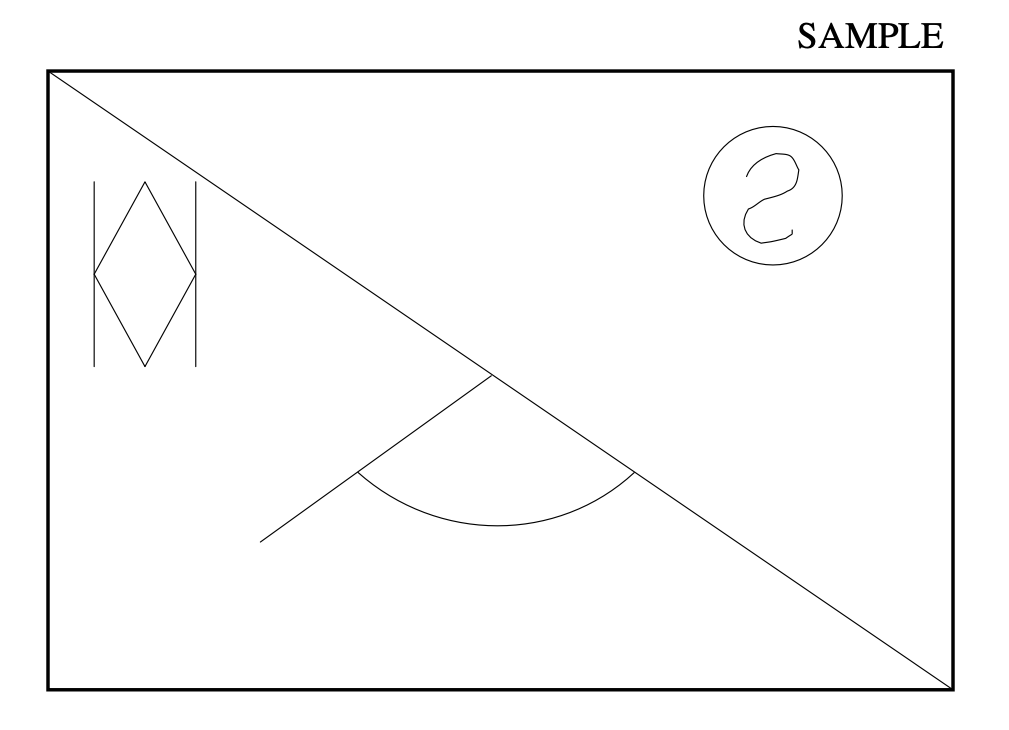
- This is what a product vision looks like
-
The Customer and Developer must reproduce a drawing exactly as it was originally depicted
-
There are three straight line elements, and two curved elements
-
In order to survive as a company, you must correctly draw the straight line elements
-
In order to dominate the market, you should also correctly draw the curved elements
- You do not have to reproduce the border around the drawing. Just use the edge of the paper as a border
Round 1A
-
The Developers will go get a coffee
-
The Customer will be given a printout of a drawing to reproduce.
- It will not be the sample that you've already seen.
- They have ten minutes to write "in words" how to reproduce that drawing
- No sketching, no clever positioning. If you cheat, you only cheat yourself
Round 1B
-
The Customers will go get a coffee
-
The Developer will take the description that The Customer wrote down and try to reproduce the original drawing from the description
- They will not have access to the original drawing
- They have ten minutes to draw it
- No asking questions of The Customer
Round 2
-
The Customers and The Developers sit together
- The Customer must describe, in spoken words, how to reproduce the drawing, without The Developer seeing the original drawing
- They have ten minutes to reproduce the drawing
- The two may speak to each other and ask questions
- The Customer may not "air draw," make gestures, or point to any location on The Developer's drawing
Agile mindset
Okay, so what just happened?
Efficiency vs Effectiveness
A Retrospective
-
Round 1a - Customer worked very efficiently, to write down as much detail as possible before the time ran out. All the available time was used.
-
Round 1b - The Developer worked very efficiently, but alone, to draw based on the description. All the available time was used.
- The end result was that neither of these approaches was effective. Lots of activity, very poor outcome
Time
Risk
high
low
10 min
10 min
Risk over Time
Rounds 1a and 1b
peak risk
Rework
Efficiency vs Effectiveness
A Retrospective
-
Round 2 - The Customer and Developer worked very closely and iterated toward an outcome
- It got loud because real-time feedback, iterations, and communication were driving the work, but many people finished early
- At the end, the Customer was almost assured to get exactly what they wanted, and in half the time. Very effective work, very good outcome
Time
Risk
high
low
10 min
10 min
Risk over Time
Round 2
peak risk
Agile mindset
How do we take these observations and channel them into a value-focused way of working?
The Agile Mindset
Empirical Process Control. Agile practitioners rely on data-driven decision making and experimentation. We utilize feedback loops to validate assumptions, improve processes, and make informed adjustments to our plans.
Customer-Centricity. Agile practitioners focus on understanding and satisfying customer needs through continuous feedback and iteration. All practices employed in agile processes are ultimately in service of improving our ability to do this.
Embrace change. Agile practitioners work in a way that welcomes changes to priorities, requirements, and even processes. We do this to deliver value effectively and in a way that is capable of quickly adapting to market changes and emerging customer needs.
The Agile Mindset
Incremental Value. Agile practitioners break projects down into small, manageable chunks of valuable and verifiable outcomes. This ensures frequent delivery and opportunities for customer feedback, and de-risks our work.
The Agile Mindset
Self-Organized Cross-Functional Teams. Agile practitioners employ cross-functional teams to self-organize, make decisions, and take ownership of our work and customer-centric valuable outcomes. This fosters creativity, innovation, and accountability.
Transparency and Visibility. Agile practitioners maintain open communication channels and provide clear visibility into progress, impediments, and goals to foster alignment within the team, as well as with stakeholders and customers.
The Agile Mindset
This has nothing to do with software development. The agile mindset originates in Lean Manufacturing and the Toyota Production System, which attempt to eliminate as much waste as possible from processes
The agile mindset can be applied to nearly every value-creating activity, and often should be
In fact, it's impossible to realize a maximum return on investment when introducing agile methods unless everyone in the organization works in an agile way
THANKS!
Any more questions?
Agile Mindset
By Thomas Bradford