Dissertation Meeting
26/01/2026
Luisa Cutillo,
School of Mathematics, University of Leeds
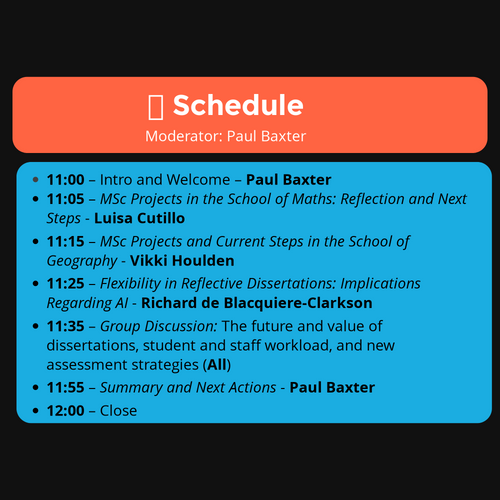
🕚 Schedule
- 13:00 – Intro and Welcome
-
13:05 – EAP Lecture - Deak Kirkham
-
13:15 – Assessment Components & Supervision
-
13:25 – Academic Integrity & Good Practice
-
13:35 – Projects Selection & Career Seminars
-
13:45 – Q&A
-
14:00 – Close
Dissertation Modules
- MATH5871 (MSc Statistics/ Statistics with applications to Finance)
- MATH5872 (MSc Data Science and Analytics)
x
Process-Based Assessment
Evaluating students' engagement, understanding, and progress throughout the duration of their project, rather than focusing solely on the final product.
Assessment Components
Project Portfolio
3 Milestones
Viva (Oral Examination)
30 Minutes
Manuscript
Assessment
Supervision and milestones
Project Portfolio
The portfolio will include regular updates, reflections, and evidence of engagement and progress.
Phase 1: Preparation & Skills Building
(Late February – March, expert led)
Phase 2: Dissertation Work (April/May–August, 6 meetings)
Lecture 1 (late February): critically read and summarise academic work
Supervision meeting 0: once dissertations are assigned, informal meeting with supervisors
Lecture 2 (last teaching week before Easter): how to prepare a background study and identify reliable sources (post meting 0)
Project Portfolio
The portfolio will include regular updates, reflections, and evidence of engagement and progress.
Phase 1: Preparation & Skills Building
(Late February – March, expert led)
Academic Communication in Mathematics: Set-Up
Deak Kirkham, Lecturer in English for Academic Purposes
Supervision and milestones
Project Portfolio
The portfolio will include regular updates, reflections, and evidence of engagement and progress.
Phase 2: Dissertation Work (April/May–August, 6 meetings)
Milestone 1 (M1): Background Study & Sources Identification (2-page doc by meeting 1)
Milestone 2 (M2): Progress Description & Dissertation Plan (flexible length, by meeting 3)
Milestone 3 (M3): Draft Submission (by meeting 6)
Handbook Section 4: "Phases, Milestones, and Supervision Schedule"
Manuscript
Read the Handbook, and in particular sections: 8 "Written presentation and content" and 9 "Format of the report"
- Use the provided latex template
- up to 40 pages (not including the title page, abstract,summary page, table of contents, any lists of figures or tables, appendices and the bibliography)
- Non-essential figures or tables, must be placed in the appendix
- Any code written for the dissertation must be clearly referenced in the main text and made accessible
- sources must be fully acknowledged
- include the academic integrity statement
- Submission deadline: 28th August, 2026
- Late penalty: 5 marks per late day (see sec. 3 Timetable)
Oral Interview
Read the Handbook, and in particular section: 5 "Final Output Assessment"
- The written dissertation will be assessed by your supervisor, by an internal assessor
- The dissertation will also be assessed by the External Examiner
- Oral examination in the 2nd and 3rd week of September (see Section 3 of the Handbook);
- format is 5-minute presentation (1–2 slides) that summarize the project’s background, objectives, and results, followed by about 25-minute Q&A.
- Modality to be agreed with supervisors and assessors in line with University guidance.
Assessment Guidelines-Handbook sec 11
-
Understanding (30%) Based on the report, and on presentation and answers to questions in the oral examination, does the student understand the methods described and the work done? Are suitable analyses carried out and/or examples used to illustrate the theory? Are sound conclusions drawn from any analyses, simulations or examples?
-
Achievement (20%) Is the work done of the quantity and level that could reasonably be expected of a competent student in the time available? Is there a derivation of an original result, substantial analysis of a dataset or great effort spent programming?
-
Engagement (20%) This component assesses the student’s level of engagement with the dissertation
process and the quality of work demonstrated in Milestone 1 and Milestone 2. -
Report (20%) Is the report laid out well, with good structure and use of figures, tables etc? Is there clarity in the exposition? Are results (theoretical, or of data analysis and simulations) precise and unambiguous? Are there few typographical errors and are any mathematical expressions clearly formatted?
-
Presentation Skills (10%) The quality of the student’s presentation will be assessed not only in terms of the initial overview but also through their ability to communicate effectively during the question and answer session. Well-structured answers to questions and validity of their answer are taken into consideration in the Understanding mark.
Example of Supervision Structure
Other meeting settings (eg. shorter/ more frequent) are possible at discretion of the supervisor
Handbook Section 4: "Phases, Milestones, and Supervision Schedule"
| Meeting | Timing | Focus |
|---|---|---|
| Meeting 0 | Late Feb – Early March | Informal discussion |
| Meeting 1 | April/May (pre-exam) or Early June (post-exam) | M1 followed by feedback |
| Meeting 2 | From June | Progress & refinement |
| Meeting 3 | June/July (≤ 2 weeks after previous) | M2 followed by feedback/action points |
| Meeting 4 | ≤ 2 weeks after Meeting 3 | Methods development |
| Meeting 5 | ≤ 2 weeks after Meeting 4 | Prep for M3 |
| Meeting 6 | By early August | M3 submission; final review |
use GenAI in an assistive role
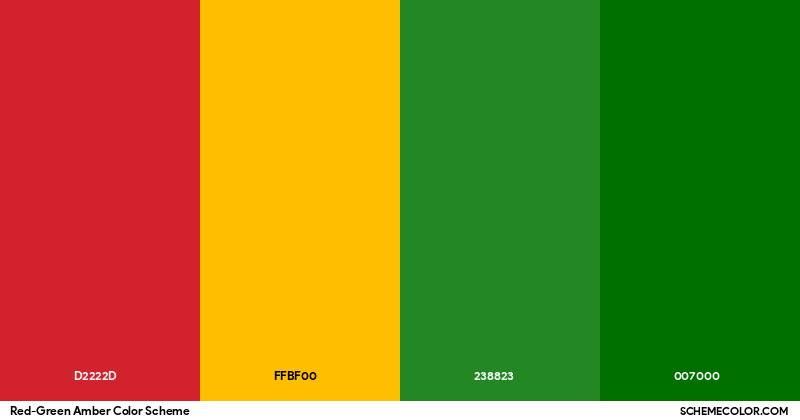
Amber category
The work you submit must be your work.
You must present your work
as you understand it.
Academic Integrity and Use of Generative AI
- Gen AI can be used to help you, not to author your work
- Generative AI guidance for taught students | Generative AI
- section 10 of the handbook (Referencing, plagiarism and use of generative AI)
- Skills@library page advice on plagiarism
- Skill@library advice on referencing
use GenAI in an assistive role
examples
- Finding/summarising existing literature on a specific topic-warning!
- Help you understand a specific topic – warning!
- Coming up with ideas for further exploration
- Testing and debugging code
- Creating LaTeX code, e.g. using Mathpix or other AI tools
- Polishing pieces of writing, correcting spelling and grammar
- Translating individual words or phrases
- Warning: GenAI hallucinates, i.e. it makes things up.
AI tools are NOT allowed to be used to
- Translating your work into English, i.e. you must compose your work in English.
- Produce/compose sections of writing that you will submit as your work.
If you use GenAI in your project you must declare it in your report
Add a ‘Declaration’ section in the provided LaTeX template.
This must include:
- Name and version of the generative AI system used e.g. ChatGPT-4.0/ Copilot
- Publisher (company that made the AI system) e.g. OpenAI /Microsoft
- URL of the AI system
- Brief description (one sentence) of context in which the tool was used
Example declaration: I acknowledge the use of Copilot (Microsoft, OpenAI, https://copilot.cloud.microsoft) to test out some of my coding ideas and to help me find grammatical errors in my writing.
Good Practice
- Share a short report with your supervisor(s) ~2 days ahead of every meeting
- Practice on using latex with the provided template on Minerva. A very good online tool is overleaf
- Create a project on GitHub to share with your supervisor(s). (ABC for a Data Scientist!)
- Learn how to use GitHub. Very good tutorials here: Atalassian and Software Carpentries
- Improve your skills with the available University sponsored tools (LinkedIn Learning, Coursera, FutureLearn)
Projects Allocation Process
-
Projects have been shared with you on Minerva
-
Majority led by School of Mathematics Supervisors
-
Minority externally led and competition based
-
All students submit their ranked preference list of 6 projects
-
Deadline pref. list: Tue 24th February, 4 PM, via a MS Forms
-
We match you with a project within your ranked choice
-
Dissertation allocation communicated to the students in March
Projects Allocation Process
- Deadline Competition Based (EoI): Tue 10th February, 4 pm
-
email CV and a cover letter (up to 500 words) to mscstats_dsa@leeds.ac.uk. You can only apply for one. subject line: [Competition Based - project number]
-
Promptly notify mscstats_dsa@leeds.ac.uk of any GeoDS/Competition Based outcome
IMPORTANT NOTE: If you applied for a GeoDS Scheme (UCL – external option) or Competition Based, please submit your ranked projects choices anyway via the provided MS form.
Career Seminars
The following Mondays, 2-3 pm, in Chemistry West Block LT F
- 09/02/2026 Supervisors Meet The Students
- 16/02/2026 Dr Michael Croucher, The MathWorks
-
23/02/2026 Joint Session:
First half: Dr Duncan Wilson, Leeds Institute of Clinical Trials Research
Second half: Pharmacy2U representative ( speaker online) - Leeds Institute of Clinical Trials Research
- 02/03/2026 Akintya Nigam, Data Scientist at Aviva Insurance
Thanks!
Time for questions!
Reminders
New Pharmacy2U Dissertation Projects Now Available
We are pleased to announce three new competition‑based dissertation projects offered by Pharmacy2U. The full project descriptions are uploaded to Minerva.
How to apply
Please send Cover letter and CV to the MSc programme team at: 📧 mscstatsdsa@leeds.ac.uk
(We will then forward applications to Pharmacy2U)
Pharmacy2U Project Presentation – Monday 23 February
As part of the seminar on 23 February, a Pharmacy2U representative will join online for the second half of the session to present the projects and answer questions.
Note
Competitition Based projet:
#63 DSA and #54 Stats
is NOT RUNNING this year!
"Using spatial data to understand fair transition to low carbon futures"
Supervisors: Anne Owen (Faculty of Earth and Environment), Beverley Searle (Faculty of Earth and Environment) and Jochen Voss (School of Mathematics) Contact supervisor: Jochen Voss, J.Voss@leeds.ac.uk
Career Seminars
The following Mondays, 2-3 pm, in Chemistry West Block LT F
- 09/02/2026 Supervisors Meet The Students
- 16/02/2026 Dr Michael Croucher, The MathWorks
-
23/02/2026 Joint Session:
First half: Dr Duncan Wilson, Leeds Institute of Clinical Trials Research
Second half: Pharmacy2U representative ( speaker online) - Leeds Institute of Clinical Trials Research
- 02/03/2026 Akintya Nigam, Data Scientist at Aviva Insurance
Dedlines Reminder
Application deadline for your 6 ranked project list and for the Pharmacy2U competition based projects:
📅 4 pm Tuesday 24 February
Application deadlines for the other competition based projects (excluding Pharmacy2U) :
📅 4 pm Tuesday 10 February
Supervisors Meet The Students
Agenda - 09/02/2026
Ranked List Form
- Elham Mirfarah, School of Mathematics. Project (#24 DSA,#22 Stats)
- Jim McQuaid (Earth & Environment) Project (#25 DSA, #23 Stats)
- Lorenzo Tomassini, School of Mathematics and Met Office, (#32 DSA)
- Sofya Titarenko, School of Mathematics (#29,30,31 DSA, #27, 28 Stats)
Competition Based
- Marlous Hall, LICAMM and LIDA (#51 DSA, #42 Stats)
- Thomal Sloan, Earth and Environment (#64 DSA, #55 Stats)
- Emma Harris and Catherine Bradshaw, Met Office ( #62 DSA, #53 Stats)
- Lauren Burton and Catherin Bradshaw, Met Office (#59 DSA, #50 Stats)
- Carlo Campagnoli, School of Psycology (#65 DSA)
Dissertation Meeting January 2026
By Luisa Cutillo